C - SCSC Magical Garden Editorial
by  Lulusphere

Every \(3\times3\) subgrid must contain more S than C. Since a \(3\times3\) subgrid has \(9\) cells, this means that every \(3\times3\) subgrid must contain at least \(5\) cells marked S.
On the other hand, in the whole grid, C must be the majority. Therefore, if the number of S cells is denoted by \(\#S\), we need
\[ \#S < \frac{N^2}{2}. \]
We first derive lower bounds on \(\#S\).
If \(N=3q\), the whole grid can be tiled by \(q^2\) disjoint \(3\times3\) blocks. Each block needs at least \(5\) cells marked S, so
\[ \#S \ge 5q^2=\frac{5}{9}N^2. \]
This is larger than \(\frac{N^2}{2}\), so C cannot be the majority. Hence, if \(3\mid N\), the answer is NO.
Next, consider the case \(N=3q+2\).
Take the upper-left \(3q\times3q\) square. It can be tiled by \(3\times3\) blocks, so it needs at least \(5q^2\) cells marked S.
Now consider the right \(3q\times2\) strip. Divide it into \(q\) pieces of size \(3\times2\). If one such piece contained at most one S, then by adding the adjacent column on its left, we would get a \(3\times3\) subgrid with at most \(4\) cells marked S, which is impossible.
Therefore, the right strip needs at least \(2q\) cells marked S. By the same argument, the bottom \(2\times3q\) strip also needs at least \(2q\) cells marked S.
Thus, when \(N=3q+2\),
\[ \#S \ge 5q^2+4q. \]
For C to be the majority, we need
\[ 5q^2+4q < \frac{(3q+2)^2}{2}. \]
After rearranging, this becomes
\[ q^2-4q-4<0. \]
For integers \(q\ge1\), this holds only when \(q\le4\). Hence, for \(N=3q+2\), all cases with \(N\ge17\) are impossible.
Now consider the case \(N=3q+1\).
Again, the upper-left \(3q\times3q\) square needs at least \(5q^2\) cells marked S.
Look at the side consisting of the last row and the last column. This side cannot be entirely C. Indeed, if it were entirely C, then in the bottom-right \(3\times3\) subgrid, the cells belonging to the last row or the last column would be all C. These are \(5\) cells, so that \(3\times3\) subgrid would contain at most \(4\) cells marked S, contradiction.
Therefore, the side needs at least one cell marked S, and we have
\[ \#S \ge 5q^2+1. \]
For C to be the majority, we need
\[ 5q^2+1 < \frac{(3q+1)^2}{2}. \]
After rearranging, this becomes
\[ q^2-6q+1<0. \]
For integers \(q\ge1\), this holds only when \(q\le5\). Hence, for \(N=3q+1\), all cases with \(N\ge19\) are impossible.
It remains to rule out the special case \(N=16\).
Use the decomposition shown in the figure below.
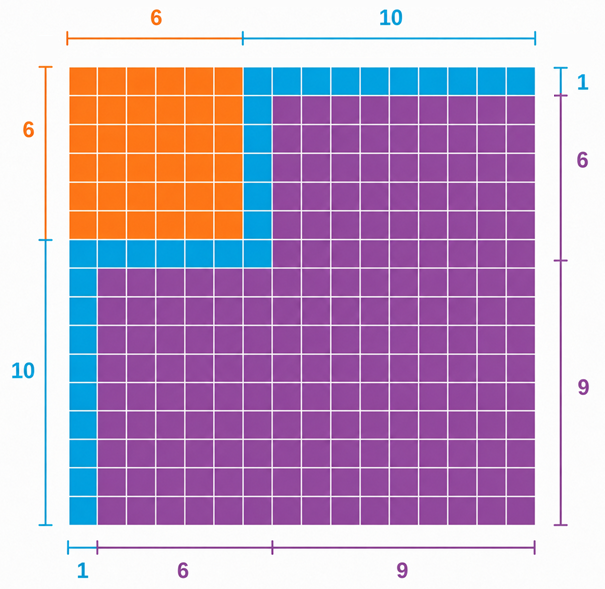
The four rectangular regions can be tiled by \(3\times3\) blocks, and their total area is \(15\times15\). Therefore, these regions alone require at least
\[ 25\cdot5=125 \]
cells marked S.
Now look at the three marked corners of the remaining side region. Each corner consists of \(5\) cells inside some \(3\times3\) subgrid. If all five cells of such a corner were C, then even if the other four cells of that \(3\times3\) subgrid were all S, the condition would still be violated.
Thus, each marked corner must contain at least one S. Since the three marked corners are disjoint, the side region requires at least \(3\) additional cells marked S.
Hence, for \(N=16\),
\[ \#S \ge 125+3=128. \]
However, the whole grid has \(256\) cells, so for C to be the majority, we would need \(\#S\le127\). This is a contradiction. Therefore, \(N=16\) is also impossible.
From the discussion above, the only possible cases are
\[ N<16,\qquad 3\nmid N. \]
We now show that all such cases are actually possible.
First, suppose \(N\equiv2\pmod3\). Use the following periodic \(3\times3\) pattern:
\[ \begin{matrix} C&C&S\\ C&C&S\\ S&S&S \end{matrix} \]
That is, using \(1\)-indexed rows and columns, place S if the row number or the column number is divisible by \(3\), and place C otherwise.
Every consecutive three rows contain exactly one row of S, and every consecutive three columns contain exactly one column of S. Therefore, every \(3\times3\) subgrid contains exactly \(5\) cells marked S.
If \(N=3q+2\), the number of S cells in this construction is
\[ 5q^2+4q. \]
In the possible range, we have \(q\le4\), and as shown above,
\[ 5q^2+4q < \frac{(3q+2)^2}{2}. \]
Thus, C is the majority.
Next, suppose \(N\equiv1\pmod3\). Use the following periodic \(3\times3\) pattern:
\[ \begin{matrix} C&C&S\\ C&S&S\\ C&S&S \end{matrix} \]
Again, every \(3\times3\) subgrid contains exactly \(5\) cells marked S.
If \(N=3q+1\), the number of S cells in this construction is
\[ 5q^2+q. \]
In the possible range, we have \(q\le4\), and
\[ 5q^2+q < \frac{(3q+1)^2}{2}. \]
Thus, C is the majority.
Therefore, the final criterion is as follows.
If
\[ N\ge16 \]
or
\[ 3\mid N, \]
print NO.
Otherwise, print YES and output the periodic pattern corresponding to \(N\bmod3\).
posted:
last update: