 /
/ 
実行時間制限: 2 sec / メモリ制限: 1024 MiB
配点 : 1000 点
問題文
4\times 500 のグリッドグラフの各頂点に 0 または 1 を書き込むことを考えます.N=0,1,\ldots,999899,999900 に対して以下の条件を満たすことができるように上手に書き込んでください.
- グリッドグラフのハミルトンパスであって,そのパスの頂点に書かれた数を並べて得られる列の転倒数が N であるようなものが存在する.
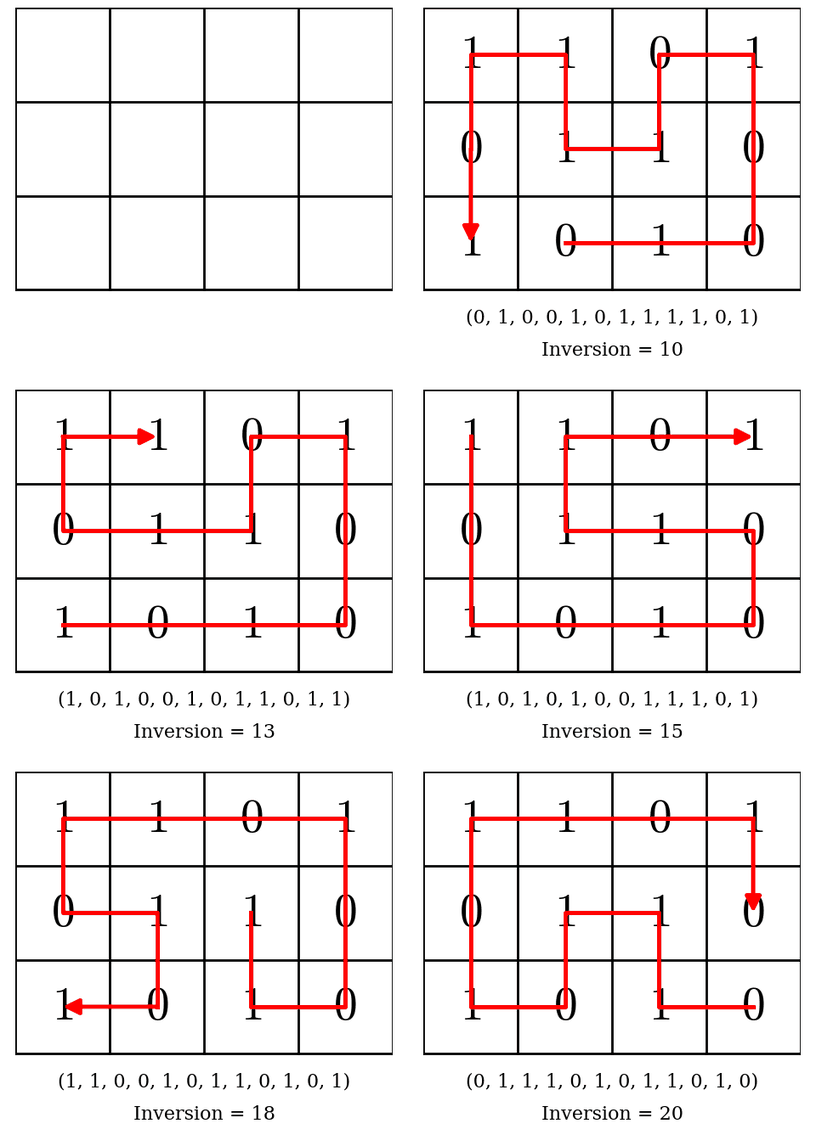
3\times 4 の例.この書き込み方では N = 10, 11, \ldots, 20 が達成可能である.
この問題は インタラクティブ な問題です.問題文中のパラメータは H=4,W=500,Q=200 で固定されています.
あなたとジャッジは下記の手順を行います.手順はフェイズ 1 とフェイズ 2 からなり,まずフェイズ 1 を行った直後,続けてフェイズ 2 を行います.
(フェイズ 1)
各要素が 0 または 1 である H\times W 行列 A=(A_{i,j})\ (1\leq i\leq H,1\leq j\leq W) を出力してください.
(フェイズ 2)
以下の問題を Q 回解いてください.
ジャッジから整数 N が与えられる.
H 行 W 列のグリッドを考える.上から i 行目,左から j 列目のマス (i,j) には整数 A_{i,j} が書かれている.
好きなマスから開始し,上下左右に隣接するマスへの移動を繰り返して HW 個すべてのマスをちょうど一度ずつ通り,好きなマスで終わる長さ HW の経路 P であって,以下を満たすものを一つ求めよ.
- P で通るマスに書かれた整数を順に並べて得られる長さ HW の数列の転倒数は N である.
制約
- H=4,W=500,Q=200
- 0\leq N\leq 999900
- 入力される数値は全て整数
入出力
この問題はインタラクティブな問題である.
最初に H,W,Q が標準入力から与えられる.
H W Q
(フェイズ 1)
各要素が 0 または 1 である H\times W 行列 A=(A_{i,j})\ (1\leq i\leq H,1\leq j\leq W) を H 行に渡って出力せよ.
i 行目には,A_{i,1}A_{i,2}\ldots A_{i,W} を長さ W の 0 と 1 からなる文字列として出力せよ.
A_{1,1}A_{1,2}\ldots A_{1,W}
A_{2,1}A_{2,2}\ldots A_{2,W}
\vdots
A_{H,1}A_{H,2}\ldots A_{H,W}
(フェイズ 2)
Q 回問題を解く.各問題では,まず整数 N が標準入力から与えられる.
N
(なお,直前の問題が不正解だったり,A や経路の出力形式が誤っていたりした場合,ここでは N の代わりに -1 が標準入力から与えられる.この場合はただちにプログラムを正常終了すること.ただし,Q 個目の問題で初めて誤った出力を行った場合,その後の入力は何も与えられない.)
その後,条件を満たす経路 P を,i 番目に訪れるマスを (x_i, y_i) として以下の形式で出力せよ.
x_1 y_1
x_2 y_2
\vdots
x_{HW} y_{HW}
x_i,y_i は以下を満たす必要がある.
- 1\leq x_i\leq H, 1\leq y_i\leq W
- i\neq j ならば (x_i,y_i)\neq (x_j,y_j)
- i=1,2,\ldots,HW-1 に対し |x_i-x_{i+1}|+|y_i-y_{i+1}|=1
- 数列 (A_{x_1,y_1}, A_{x_2,y_2},\ldots,A_{x_{HW},y_{HW}}) の転倒数は N
注意点
- ジャッジから
-1という入力を受け取った場合はただちにプログラムを正常終了してください.終了した場合のジャッジ結果は WA となりますが,終了しなかった場合のジャッジ結果は不定です. - 出力を行うたびに,末尾に改行を入れて標準出力を flush してください.そうしない場合,ジャッジ結果が TLE となる可能性があります.
- 余分な改行は不正な形式の出力とみなされるため,行わないでください.
- フェイズ 2 を終了したらただちにプログラムを終了してください.そうしない場合,ジャッジ結果は不定です.
入出力例
以下は,H=3,W=4,Q=2 の場合の入出力例です.
この例は制約を満たさないので,ジャッジには含まれません.
| 入力 | 出力 | 説明 |
|---|---|---|
3 4 2 | H,W,Q が与えられます. | |
1101 0110 1010 | A=\begin{pmatrix} 1&1&0&1 \\ 0&1&1&0 \\ 1&0&1&0 \end{pmatrix} を出力します. | |
10 | 1 つ目の問題の N が与えられます. | |
3 2 3 3 3 4 2 4 1 4 1 3 2 3 2 2 1 2 1 1 2 1 3 1 | (3,2)\to(3,3)\to(3,4)\to(2,4)\to(1,4)\to(1,3)\to(2,3)\to(2,2)\to(1,2)\to(1,1)\to(2,1)\to(3,1) という経路を出力します.この経路で通るマスに書かれた整数を順に並べて得られる数列は (0,1,0,0,1,0,1,1,1,1,0,1) であり,この数列の転倒数は 10 であるため条件を満たします. | |
15 | 2 つ目の問題の N が与えられます. | |
1 1 2 1 3 1 3 2 3 3 3 4 2 4 2 3 2 2 1 2 1 3 1 4 | (1,1)\to(2,1)\to(3,1)\to(3,2)\to(3,3)\to(3,4)\to(2,4)\to(2,3)\to(2,2)\to(1,2)\to(1,3)\to(1,4) という経路を出力します.この経路で通るマスに書かれた整数を順に並べて得られる数列は (1, 0, 1, 0, 1, 0, 0, 1, 1, 1, 0, 1) であり,この数列の転倒数は 15 であるため条件を満たします. |
Score : 1000 points
Problem Statement
Consider writing 0 or 1 on each vertex of a 4\times 500 grid graph. Write the values cleverly so that for each N=0,1,\ldots,999899,999900, the following condition is satisfied.
- There exists a Hamiltonian path on the grid graph such that the sequence of numbers written on the vertices along the path has an inversion count of N.
An example with 3\times 4. With this assignment, N = 10, 11, \ldots, 20 are achievable.
This is an interactive problem. The parameters in the problem statement are fixed at H=4,W=500,Q=200.
You and the judge perform the following steps. The steps consist of Phase 1 and Phase 2; Phase 1 is performed first, immediately followed by Phase 2.
(Phase 1)
Output an H\times W matrix A=(A_{i,j})\ (1\leq i\leq H,1\leq j\leq W) where each element is 0 or 1.
(Phase 2)
Solve the following problem Q times.
The judge gives you an integer N.
Consider an H-row W-column grid. The cell (i,j), located at the i-th row from the top and the j-th column from the left, has the integer A_{i,j} written on it.
Find a path P of length HW that starts at any cell, moves to an adjacent cell (up, down, left, or right) repeatedly, visits all HW cells exactly once, and ends at any cell, such that the following is satisfied.
- The inversion count of the sequence of length HW obtained by listing the integers written on the cells visited by P in order is N.
Constraints
- H=4,W=500,Q=200
- 0\leq N\leq 999900
- All input values are integers.
Interaction
This is an interactive problem.
First, H,W,Q are given from Standard Input.
H W Q
(Phase 1)
Output an H\times W matrix A=(A_{i,j})\ (1\leq i\leq H,1\leq j\leq W) where each element is 0 or 1, over H lines.
The i-th line should contain A_{i,1}A_{i,2}\ldots A_{i,W} as a string of length W consisting of 0 and 1.
A_{1,1}A_{1,2}\ldots A_{1,W}
A_{2,1}A_{2,2}\ldots A_{2,W}
\vdots
A_{H,1}A_{H,2}\ldots A_{H,W}
(Phase 2)
Solve the problem Q times. For each problem, first an integer N is given from Standard Input.
N
(Note: if your answer to the previous problem was incorrect, or if A or the path was output in an incorrect format, then instead of N, -1 is given from Standard Input here. In that case, immediately terminate the program normally. However, if an incorrect output is given for the first time in the Q-th problem, no further input will be given.)
Then, output a path P satisfying the condition, where the i-th visited cell is (x_i, y_i), in the following format:
x_1 y_1
x_2 y_2
\vdots
x_{HW} y_{HW}
x_i and y_i must satisfy the following.
- 1\leq x_i\leq H, 1\leq y_i\leq W.
- (x_i,y_i)\neq (x_j,y_j) if i\neq j.
- |x_i-x_{i+1}|+|y_i-y_{i+1}|=1 for i=1,2,\ldots,HW-1.
- The inversion count of the sequence (A_{x_1,y_1}, A_{x_2,y_2},\ldots,A_{x_{HW},y_{HW}}) is N.
Notes
- If you receive
-1as input from the judge, immediately terminate the program normally. If you terminate, the verdict will be WA; otherwise, the verdict is indeterminate. - In each output, include a newline at the end and flush Standard Output. Otherwise, the verdict may be TLE.
- Extra newlines in output are considered as malformed; do not include them.
- Terminate your program immediately after finishing Phase 2. Otherwise, the verdict is indeterminate.
Sample Interaction
Below is a sample interaction for the case H=3,W=4,Q=2.
This example does not satisfy the constraints and is not included in the judge.
| Input | Output | Explanation |
|---|---|---|
3 4 2 | H,W,Q are given. | |
1101 0110 1010 | Output A=\begin{pmatrix} 1&1&0&1 \\ 0&1&1&0 \\ 1&0&1&0 \end{pmatrix}. | |
10 | N for the first problem is given. | |
3 2 3 3 3 4 2 4 1 4 1 3 2 3 2 2 1 2 1 1 2 1 3 1 | Output the path (3,2)\to(3,3)\to(3,4)\to(2,4)\to(1,4)\to(1,3)\to(2,3)\to(2,2)\to(1,2)\to(1,1)\to(2,1)\to(3,1). The sequence of integers written on the cells visited along this path is (0,1,0,0,1,0,1,1,1,1,0,1), and the inversion count of this sequence is 10, so the condition is satisfied. | |
15 | N for the second problem is given. | |
1 1 2 1 3 1 3 2 3 3 3 4 2 4 2 3 2 2 1 2 1 3 1 4 | Output the path (1,1)\to(2,1)\to(3,1)\to(3,2)\to(3,3)\to(3,4)\to(2,4)\to(2,3)\to(2,2)\to(1,2)\to(1,3)\to(1,4). The sequence of integers written on the cells visited along this path is (1, 0, 1, 0, 1, 0, 0, 1, 1, 1, 0, 1), and the inversion count of this sequence is 15, so the condition is satisfied. |