 /
/ 
Time Limit: 2 sec / Memory Limit: 1024 MiB
配点 : 500 点
問題文
頂点に 1 から N の番号がついた N 頂点の木 T が与えられます。i 番目の辺は頂点 A_i と頂点 B_i を結んでいます。
正整数 k について「長さ k のムカデグラフ」を以下の手順で得られる頂点数 3k のグラフと定義します。
- 頂点数 k のパスグラフを用意する。
- そのパスグラフの各頂点 v に対して、v のみに隣接する 2 つの頂点を新たに追加する。
例えば、長さ 4 のムカデグラフは下図のようになります。
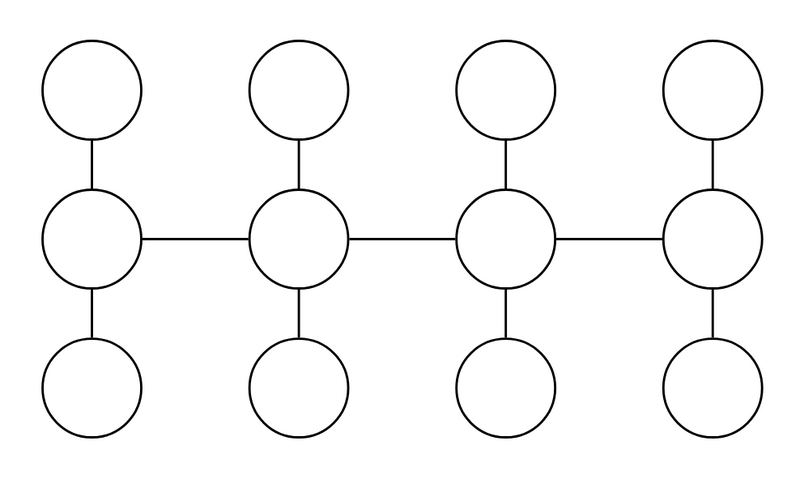
木 T の部分グラフとして含まれる「長さ x のムカデグラフ」のうち、最大の x を求めて下さい。
Q 個のテストケースが与えられるので、それぞれについて答えを求めてください。
制約
- 1 \le Q
- 3 \le N \le 2 \times 10^5
- 1 \le A_i, B_i \le N
- 与えられるグラフは木
- 全てのテストケースにおける N の総和は 2 \times 10^5 以下
- 入力される値は全て整数
入力
入力は以下の形式で標準入力から与えられる。
Q
\text{case}_1
\text{case}_2
\vdots
\text{case}_Q
各テストケースは以下の形式で与えられる。
N
A_1 B_1
A_2 B_2
\vdots
A_{N-1} B_{N-1}
出力
Q 行出力せよ。
i 行目には i 番目のテストケースについて、答えを出力せよ。
入力例 1
3
8
1 3
2 4
2 5
2 6
3 5
4 7
5 8
5
1 5
1 2
1 3
3 4
15
13 3
4 13
11 1
14 9
9 13
13 6
1 10
7 9
13 2
10 5
3 12
15 13
9 10
12 8
出力例 1
2
1
3
1 番目のテストケースについて、頂点 2,3,4,5,6,8 の 6 頂点からなるグラフは「長さ 2 のムカデグラフ」となっています。
長さ 3 以上のムカデグラフは部分グラフに含まれないため、答えは 2 です。よって 2 と出力してください。
Score : 500 points
Problem Statement
You are given a tree T with N vertices numbered 1 to N. The i-th edge connects vertices A_i and B_i.
For a positive integer k, define a "centipede graph of length k" as a graph with 3k vertices obtained by the following procedure:
- Prepare a path graph with k vertices.
- For each vertex v of the path graph, add two new vertices adjacent only to v.
For example, a centipede graph of length 4 is as shown in the figure below.
Find the maximum x such that a "centipede graph of length x" is contained as a subgraph of tree T.
Q test cases are given; solve each of them.
Constraints
- 1 \le Q
- 3 \le N \le 2 \times 10^5
- 1 \le A_i, B_i \le N
- The given graph is a tree.
- The sum of N over all test cases is at most 2 \times 10^5.
- All input values are integers.
Input
The input is given from Standard Input in the following format:
Q
\text{case}_1
\text{case}_2
\vdots
\text{case}_Q
Each test case is given in the following format:
N
A_1 B_1
A_2 B_2
\vdots
A_{N-1} B_{N-1}
Output
Output Q lines.
The i-th line should contain the answer for the i-th test case.
Sample Input 1
3
8
1 3
2 4
2 5
2 6
3 5
4 7
5 8
5
1 5
1 2
1 3
3 4
15
13 3
4 13
11 1
14 9
9 13
13 6
1 10
7 9
13 2
10 5
3 12
15 13
9 10
12 8
Sample Output 1
2
1
3
For the first test case, the graph consisting of the six vertices 2,3,4,5,6,8 forms a "centipede graph of length 2".
No centipede graph of length 3 or more is contained as a subgraph, so the answer is 2. Thus, output 2.