Time Limit: 2 sec / Memory Limit: 1024 MiB
配点 : 200 点
問題文
長さ M の整数列 A=(A_1,A_2,\dots,A_M) が与えられます。
A の各要素は 1 以上 N 以下で、全ての要素は相異なります。
A の要素として含まれない 1 以上 N 以下の整数を、昇順に全て列挙してください。
制約
- 入力は全て整数
- 1 \le M \le N \le 1000
- 1 \le A_i \le N
- A の要素は相異なる
入力
入力は以下の形式で標準入力から与えられる。
N M
A_1 A_2 \dots A_M
出力
A の要素として含まれない 1 以上 N 以下の整数を昇順に全て挙げた列が (X_1,X_2,\dots,X_C) であるとき、以下の形式で出力せよ。
C
X_1 X_2 \dots X_C
入力例 1
10 3
3 9 2
出力例 1
7
1 4 5 6 7 8 10
A=(3,9,2) です。
A の要素として含まれない 1 以上 10 以下の整数を昇順に全て挙げると、 1,4,5,6,7,8,10 となります。
入力例 2
6 6
1 3 5 2 4 6
出力例 2
0
A の要素として含まれない 1 以上 6 以下の整数がひとつもありません。
この場合、 1 行目に 0 と出力し、 2 行目は空行としてください。
入力例 3
9 1
9
出力例 3
8
1 2 3 4 5 6 7 8
Score : 200 points
Problem Statement
You are given a sequence of M integers A = (A_1, A_2, \dots, A_M).
Each element of A is an integer between 1 and N, inclusive, and all elements are distinct.
List all integers between 1 and N that do not appear in A in ascending order.
Constraints
- All input values are integers.
- 1 \le M \le N \le 1000
- 1 \le A_i \le N
- The elements of A are distinct.
Input
The input is given from Standard Input in the following format:
N M
A_1 A_2 \dots A_M
Output
Let (X_1, X_2, \dots, X_C) be the sequence of all integers between 1 and N, inclusive, that do not appear in A, listed in ascending order. The output should be in the following format:
C
X_1 X_2 \dots X_C
Sample Input 1
10 3
3 9 2
Sample Output 1
7
1 4 5 6 7 8 10
Here, A=(3,9,2).
The integers between 1 and 10 that do not appear in A, listed in ascending order, are 1,4,5,6,7,8,10.
Sample Input 2
6 6
1 3 5 2 4 6
Sample Output 2
0
No integer between 1 and 6 is missing from A.
In this case, print 0 on the first line and leave the second line empty.
Sample Input 3
9 1
9
Sample Output 3
8
1 2 3 4 5 6 7 8
Time Limit: 2 sec / Memory Limit: 1024 MiB
配点 : 200 点
問題文
-10^{18} 以上 10^{18} 以下の整数 X が与えられるので、\left\lfloor \dfrac{X}{10} \right\rfloor を出力してください。
注記
実数 x に対して、「x 以下の整数の中で最大の整数」を \left\lfloor x \right\rfloor と表します。たとえば \left\lfloor 4.7 \right\rfloor = 4, \left\lfloor -2.4 \right\rfloor = -3, \left\lfloor 5 \right\rfloor = 5 のようになります。(詳しくは入出力例にある説明を参考にしてください。)
制約
- -10^{18} \leq X \leq 10^{18}
- 入力はすべて整数である。
入力
入力は以下の形式で標準入力から与えられる。
X
出力
\left\lfloor \frac{X}{10} \right\rfloor を出力せよ。整数として出力する必要があることに注意せよ。
入力例 1
47
出力例 1
4
\frac{47}{10} = 4.7 以下の整数は、すべての負の整数および 0, 1, 2, 3, 4 です。この中で一番大きい整数は 4 なので、\left\lfloor \frac{47}{10} \right\rfloor = 4 となります。
入力例 2
-24
出力例 2
-3
\frac{-24}{10} = -2.4 以下の整数の中で一番大きい整数は -3 なので、 \left\lfloor \frac{-24}{10} \right\rfloor = -3 となります。
-2 は -2.4 よりも大きいので、条件を満たさないことに注意してください。
入力例 3
50
出力例 3
5
\frac{50}{10} = 5 以下の整数の中で一番大きい整数は 5 自身です。よって \left\lfloor \frac{50}{10} \right\rfloor = 5 となります。
入力例 4
-30
出力例 4
-3
上の例と同様に \left\lfloor \frac{-30}{10} \right\rfloor = -3 となります。
入力例 5
987654321987654321
出力例 5
98765432198765432
答えは 98765432198765432 となります。すべての桁が正しく合っているか確認しましょう。
なお、もしも自分で書いたプログラムが想定通りの挙動をしない場合は、使用しているプログラミング言語の仕様を調べてみることを推奨します。
また、自分の書いたコードがどのように動作するかを確認したい場合は問題文上部の「コードテスト」をご利用ください。
Score : 200 points
Problem Statement
Given an integer X between -10^{18} and 10^{18} (inclusive), print \left\lfloor \dfrac{X}{10} \right\rfloor.
Notes
For a real number x, \left\lfloor x \right\rfloor denotes "the maximum integer not exceeding x". For example, we have \left\lfloor 4.7 \right\rfloor = 4, \left\lfloor -2.4 \right\rfloor = -3, and \left\lfloor 5 \right\rfloor = 5. (For more details, please refer to the description in the Sample Input and Output.)
Constraints
- -10^{18} \leq X \leq 10^{18}
- All values in input are integers.
Input
Input is given from Standard Input in the following format:
X
Output
Print \left\lfloor \frac{X}{10} \right\rfloor. Note that it should be output as an integer.
Sample Input 1
47
Sample Output 1
4
The integers that do not exceed \frac{47}{10} = 4.7 are all the negative integers, 0, 1, 2, 3, and 4. The maximum integer among them is 4, so we have \left\lfloor \frac{47}{10} \right\rfloor = 4.
Sample Input 2
-24
Sample Output 2
-3
Since the maximum integer not exceeding \frac{-24}{10} = -2.4 is -3, we have \left\lfloor \frac{-24}{10} \right\rfloor = -3.
Note that -2 does not satisfy the condition, as -2 exceeds -2.4.
Sample Input 3
50
Sample Output 3
5
The maximum integer that does not exceed \frac{50}{10} = 5 is 5 itself. Thus, we have \left\lfloor \frac{50}{10} \right\rfloor = 5.
Sample Input 4
-30
Sample Output 4
-3
Just like the previous example, \left\lfloor \frac{-30}{10} \right\rfloor = -3.
Sample Input 5
987654321987654321
Sample Output 5
98765432198765432
The answer is 98765432198765432. Make sure that all the digits match.
If your program does not behave as intended, we recommend you checking the specification of the programming language you use.
If you want to check how your code works, you may use "Custom Test" above the Problem Statement.
Time Limit: 2 sec / Memory Limit: 1024 MiB
配点 : 300 点
問題文
二次元平面上に高橋君がいます。高橋君は原点から移動を N 回行いました。
N 回の移動は長さ N の文字列で表され、意味は次の通りです。
- i 回目の高橋君の移動後の座標は、移動前の座標を (x,y) として、
- S の i 文字目が
Rであるとき (x+1,y) - S の i 文字目が
Lであるとき (x-1,y) - S の i 文字目が
Uであるとき (x,y+1) - S の i 文字目が
Dであるとき (x,y-1)
- S の i 文字目が
N 回の移動 (始点と終点を含む) で、高橋君が同じ座標にいたことがあるかどうかを判定してください。
制約
- 1 \leq N \leq 2\times 10^5
- N は整数
- S は
R,L,U,Dのみからなる長さ N の文字列
入力
入力は以下の形式で標準入力から与えられる。
N
S
出力
N 回の移動 (始点と終点を含む) で、高橋君が同じ座標にいたことがあれば Yes、なければ No と出力せよ。
入力例 1
5
RLURU
出力例 1
Yes
高橋君のいる座標は (0,0)\to (1,0)\to (0,0)\to (0,1)\to (1,1)\to (1,2) と変化します。
入力例 2
20
URDDLLUUURRRDDDDLLLL
出力例 2
No
Score : 300 points
Problem Statement
Takahashi is on a two-dimensional plane. Starting from the origin, he made N moves.
The N moves are represented by a string of length N as described below:
-
Takahashi's coordinates after the i-th move are:
- (x+1,y) if the i-th character of S is
R; - (x-1,y) if the i-th character of S is
L; - (x,y+1) if the i-th character of S is
U; and - (x,y-1) if the i-th character of S is
D,
where (x,y) is his coordinates before the move.
- (x+1,y) if the i-th character of S is
Determine if Takahashi visited the same coordinates multiple times in the course of the N moves (including the starting and ending points).
Constraints
- 1 \leq N \leq 2\times 10^5
- N is an integer.
- S is a string of length N consisting of
R,L,U, andD.
Input
The input is given from Standard Input in the following format:
N
S
Output
Print Yes if Takahashi visited the same coordinates multiple times in the course of the N moves; print No otherwise.
Sample Input 1
5
RLURU
Sample Output 1
Yes
Takahashi's coordinates change as follows: (0,0)\to (1,0)\to (0,0)\to (0,1)\to (1,1)\to (1,2).
Sample Input 2
20
URDDLLUUURRRDDDDLLLL
Sample Output 2
No
Time Limit: 2 sec / Memory Limit: 1024 MiB
配点 : 300 点
問題文
上下左右に広がる N\times N のマス目があり、最初全てのマスは白く塗られています。このマス目の上から i 行目、左から j 列目のマスを (i,j) で表します。
高橋君は 1 以上 N 以下の整数 A, B を持っており、次のような操作を行います。
- \max(1-A,1-B)\leq k\leq \min(N-A,N-B) をみたす全ての整数 k について、(A+k,B+k) を黒く塗る。
- \max(1-A,B-N)\leq k\leq \min(N-A,B-1) をみたす全ての整数 k について、(A+k,B-k) を黒く塗る。
この操作を行った後のマス目について、P\leq i\leq Q かつ R\leq j\leq S をみたす各マス (i,j) がそれぞれ何色で塗られているか求めてください。
制約
- 1 \leq N \leq 10^{18}
- 1 \leq A \leq N
- 1 \leq B \leq N
- 1 \leq P \leq Q \leq N
- 1 \leq R \leq S \leq N
- (Q-P+1)\times(S-R+1)\leq 3\times 10^5
- 入力は全て整数である。
入力
入力は以下の形式で標準入力から与えられる。
N A B
P Q R S
出力
Q-P+1 行出力せよ。
各行は # と . のみからなる長さ S-R+1 の文字列であり、
i 行目の文字列の j 番目の文字が
# であることは (P+i-1,R+j-1) が黒く塗られていることを、
. であることは (P+i-1,R+j-1) が白く塗られていることをさす。
入力例 1
5 3 2
1 5 1 5
出力例 1
...#.
#.#..
.#...
#.#..
...#.
1 つめの操作で (2,1), (3,2), (4,3), (5,4) の 4 マスが、
2 つめの操作で (4,1), (3,2), (2,3), (1,4) の 4 マスが黒く塗られます。
よって、P=1, Q=5, R=1, S=5 より、上のように出力します。
入力例 2
5 3 3
4 5 2 5
出力例 2
#.#.
...#
操作によって、
(1,1), (1,5), (2,2), (2,4), (3,3), (4,2), (4,4), (5,1), (5,5) の 9 マスが
黒く塗られます。
P=4, Q=5, R=2, S=5 より、上のように出力します。
入力例 3
1000000000000000000 999999999999999999 999999999999999999
999999999999999998 1000000000000000000 999999999999999998 1000000000000000000
出力例 3
#.#
.#.
#.#
入力が 32 bit 整数型に収まらないことがあることに注意してください。
Score : 300 points
Problem Statement
There is an N\times N grid with horizontal rows and vertical columns, where all squares are initially painted white. Let (i,j) denote the square at the i-th row and j-th column.
Takahashi has integers A and B, which are between 1 and N (inclusive). He will do the following operations.
- For every integer k such that \max(1-A,1-B)\leq k\leq \min(N-A,N-B), paint (A+k,B+k) black.
- For every integer k such that \max(1-A,B-N)\leq k\leq \min(N-A,B-1), paint (A+k,B-k) black.
In the grid after these operations, find the color of each square (i,j) such that P\leq i\leq Q and R\leq j\leq S.
Constraints
- 1 \leq N \leq 10^{18}
- 1 \leq A \leq N
- 1 \leq B \leq N
- 1 \leq P \leq Q \leq N
- 1 \leq R \leq S \leq N
- (Q-P+1)\times(S-R+1)\leq 3\times 10^5
- All values in input are integers.
Input
Input is given from Standard Input in the following format:
N A B
P Q R S
Output
Print Q-P+1 lines.
Each line should contain a string of length S-R+1 consisting of # and ..
The j-th character of the string in the i-th line should be # to represent that (P+i-1, R+j-1) is painted black, and . to represent that (P+i-1, R+j-1) is white.
Sample Input 1
5 3 2
1 5 1 5
Sample Output 1
...#.
#.#..
.#...
#.#..
...#.
The first operation paints the four squares (2,1), (3,2), (4,3), (5,4) black, and the second paints the four squares (4,1), (3,2), (2,3), (1,4) black.
Thus, the above output should be printed, since P=1, Q=5, R=1, S=5.
Sample Input 2
5 3 3
4 5 2 5
Sample Output 2
#.#.
...#
The operations paint the nine squares (1,1), (1,5), (2,2), (2,4), (3,3), (4,2), (4,4), (5,1), (5,5).
Thus, the above output should be printed, since P=4, Q=5, R=2, S=5.
Sample Input 3
1000000000000000000 999999999999999999 999999999999999999
999999999999999998 1000000000000000000 999999999999999998 1000000000000000000
Sample Output 3
#.#
.#.
#.#
Note that the input may not fit into a 32-bit integer type.
Time Limit: 2 sec / Memory Limit: 1024 MiB
配点 : 425 点
問題文
無限に広い 2 次元グリッドがあり、このグリッドの座標 (0,0) に焚き火があります。
時刻 t=0 では、マス (0,0) にのみ煙が存在します。
N, W, S, E からなる長さ N の文字列 S が与えられ、時刻 t=1,2,\dots,N では次の現象が順番に発生します。
- 風が吹き、現時点で存在する全ての煙が以下の通りに移動する。
- S の t 文字目が
Nであるとき、マス (r,c) にある煙がマス (r-1,c) に移動する。 - S の t 文字目が
Wであるとき、マス (r,c) にある煙がマス (r,c-1) に移動する。 - S の t 文字目が
Sであるとき、マス (r,c) にある煙がマス (r+1,c) に移動する。 - S の t 文字目が
Eであるとき、マス (r,c) にある煙がマス (r,c+1) に移動する。
- S の t 文字目が
- マス (0,0) に煙が存在しない場合、新たな煙がマス (0,0) に生成される。
高橋君はマス (R,C) に立っています。
整数 1 \le t \le N について、時刻 t+0.5 においてマス (R,C) に煙が存在するか判定し、出力欄の形式に従って出力してください。
制約
- N は 1 以上 200000 以下の整数
- S は
N,W,S,Eからなる長さ N の文字列 - R,C は -N 以上 N 以下の整数
- (R,C) \neq (0,0)
入力
入力は以下の形式で標準入力から与えられる。
N R C
S
出力
答えを N 文字の 0, 1 からなる文字列として出力せよ。
出力する文字列のうち t 文字目 (1 \le t \le N) は次の通りにせよ。
- 時刻 t+0.5 においてマス (R,C) に煙が存在するなら
1 - 時刻 t+0.5 においてマス (R,C) に煙が存在しないなら
0
入力例 1
6 -2 1
NNEEWS
出力例 1
001010
時刻 1.5,2.5,4.5,6.5 ではマス (-2,1) には煙が存在せず、時刻 3.5,5.5 ではマス (-2,1) に煙が存在します。
よって、 001010 と出力します。
図では焚き火のあるマス (0,0) を基準として、マス (r,c) を
- r < 0 なら -r マス上に
- r \ge 0 なら r マス下に
- c < 0 なら -c マス左に
- c \ge 0 なら c マス右に
描画します。
時刻 0.5 でのグリッドの状態は次の通りです。
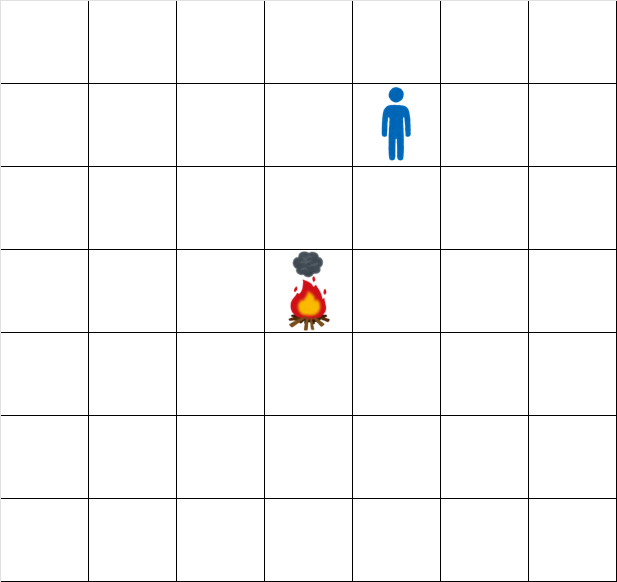
時刻 1.5 でのグリッドの状態は次の通りです。
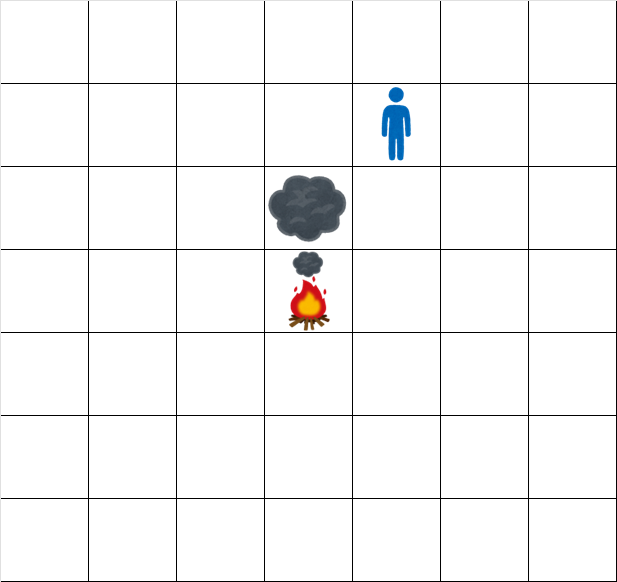
時刻 2.5 でのグリッドの状態は次の通りです。
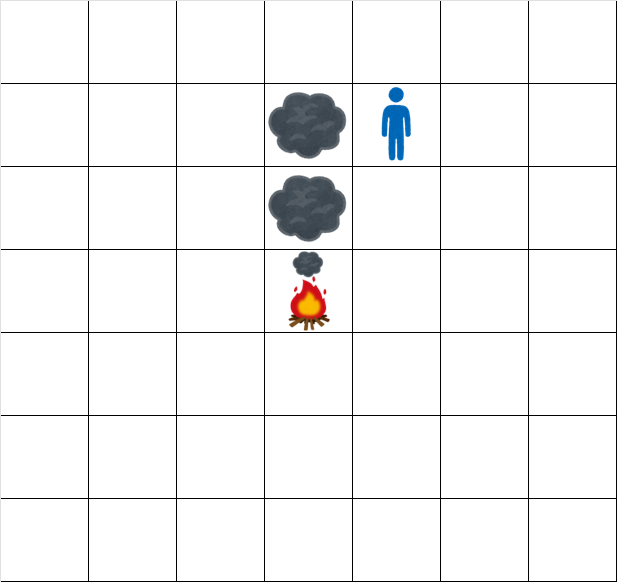
時刻 3.5 でのグリッドの状態は次の通りです。
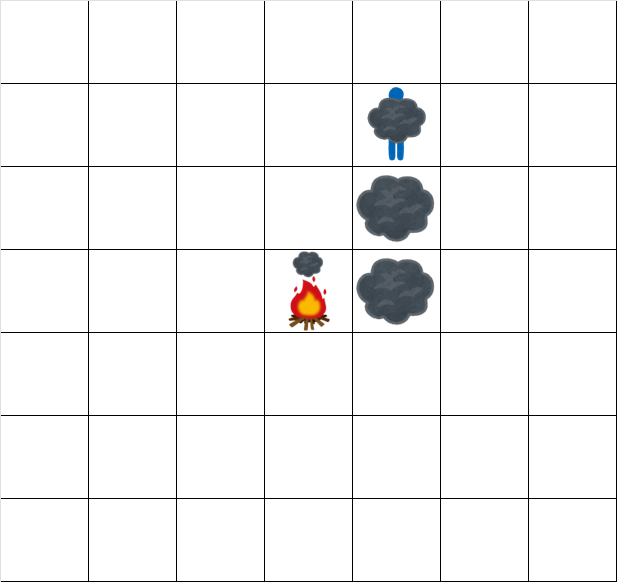
時刻 4.5 でのグリッドの状態は次の通りです。
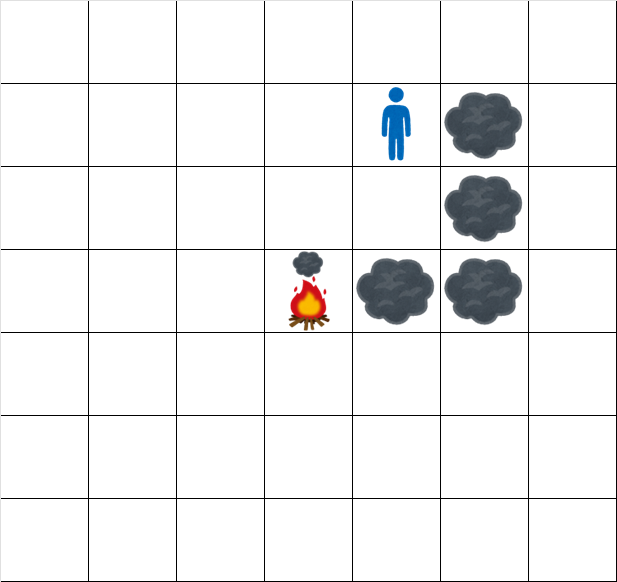
時刻 5.5 でのグリッドの状態は次の通りです。
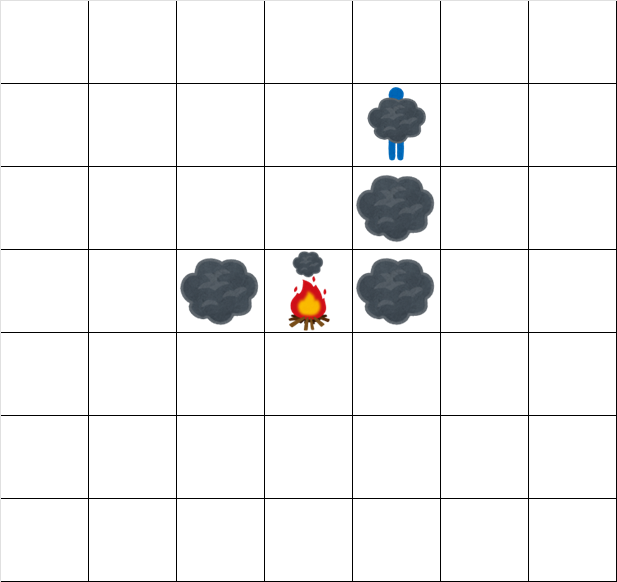
時刻 6.5 でのグリッドの状態は次の通りです。
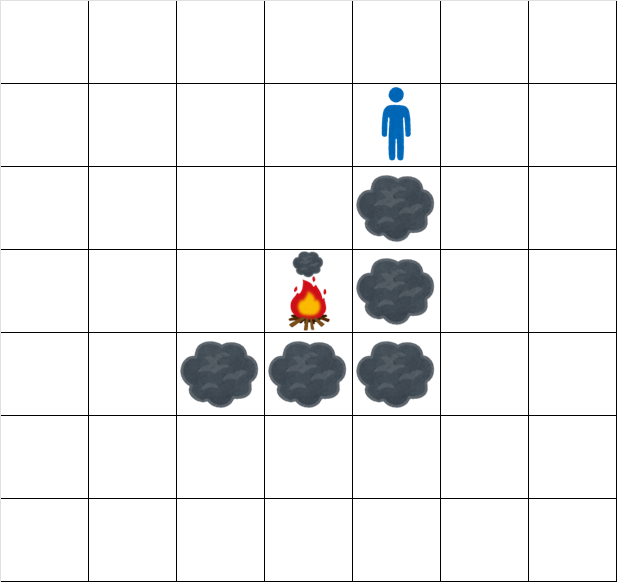
入力例 2
10 1 2
NEESESWEES
出力例 2
0001101011
入力例 3
20 -1 -2
WWNNWSWEWNSWWENSNWWN
出力例 3
00100111111000101111
Score : 425 points
Problem Statement
There is an infinitely large two-dimensional grid, with a campfire at coordinate (0,0).
At time t=0, smoke exists only at cell (0,0).
You are given a length-N string S consisting of N, W, S, E. At times t=1,2,\dots,N, the following happen in order:
- Wind blows, and all the smoke present at that time moves as follows:
- If the t-th character of S is
N, smoke in cell (r,c) moves to cell (r-1,c). - If it is
W, smoke in cell (r,c) moves to cell (r,c-1). - If it is
S, smoke in cell (r,c) moves to cell (r+1,c). - If it is
E, smoke in cell (r,c) moves to cell (r,c+1).
- If the t-th character of S is
- If there is no smoke in cell (0,0), new smoke is generated at cell (0,0).
Takahashi is standing at cell (R,C).
For each integer 1 \le t \le N, determine if smoke exists at cell (R,C) at time t+0.5, and print the response according to the required format.
Constraints
- N is an integer between 1 and 200000, inclusive.
- S is a length N string consisting of
N,W,S,E. - R and C are integers between -N and N, inclusive.
- (R,C) \neq (0,0)
Input
The input is given from Standard Input in the following format:
N R C
S
Output
Print an N-character string consisting of 0 and 1.
The t-th character (1 \le t \le N) should be:
1if smoke exists at cell (R,C) at time t+0.5, and0otherwise.
Sample Input 1
6 -2 1
NNEEWS
Sample Output 1
001010
At times 1.5,2.5,4.5,6.5, there is no smoke at cell (-2,1). At times 3.5,5.5, there is smoke at cell (-2,1).
Hence, output 001010.
In the figures below, taking cell (0,0) with the campfire as a reference, cell (r,c) is drawn:
- -r cells up if r < 0,
- r cells down if r \ge 0,
- -c cells left if c < 0,
- c cells right if c \ge 0.
The grid at time 0.5 looks like:
The grid at time 1.5 looks like:
The grid at time 2.5 looks like:
The grid at time 3.5 looks like:
The grid at time 4.5 looks like:
The grid at time 5.5 looks like:
The grid at time 6.5 looks like:
Sample Input 2
10 1 2
NEESESWEES
Sample Output 2
0001101011
Sample Input 3
20 -1 -2
WWNNWSWEWNSWWENSNWWN
Sample Output 3
00100111111000101111