Time Limit: 2 sec / Memory Limit: 1024 MiB
配点 : 200 点
問題文
1 から N の番号がついた N 人の人がいます。
人 i はキーエンス本社ビルの建築面積を S_i 平方メートルであると予想しました。
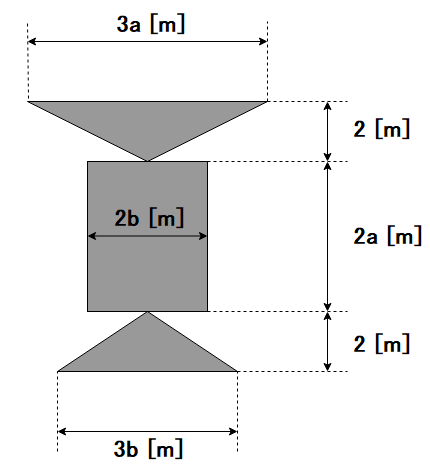
キーエンス本社ビルは下図のような形をしています。ただし、a,b はある 正の整数 です。
つまり、キーエンス本社ビルの建築面積は 4ab+3a+3b 平方メートルと表されます。
N 人のうち、この情報のみによって、予想した面積が確実に誤りであるとわかる人数を求めてください。
制約
- 1 \leq N \leq 20
- 1 \leq S_i \leq 1000
- 入力に含まれる値は全て整数である
入力
入力は以下の形式で標準入力から与えられる。
N
S_1 \ldots S_N
出力
答えを出力せよ。
入力例 1
3
10 20 39
出力例 1
1
a=1,b=1 のとき面積は 10 平方メートル、a=2,b=3 のとき面積は 39 平方メートルとなります。
しかし a,b がどのような正の整数であったとしても面積が 20 平方メートルになることはありません。
よって、人 2 の予想だけは確実に誤りであることがわかります。
入力例 2
5
666 777 888 777 666
出力例 2
3
Score : 200 points
Problem Statement
There are N people numbered 1 to N.
Person i guessed the building area of KEYENCE headquarters building to be S_i square meters.
The shape of KEYENCE headquarters building is shown below, where a and b are some positive integers.
That is, the building area of the building can be represented as 4ab+3a+3b.
Based on just this information, how many of the N people are guaranteed to be wrong in their guesses?
Constraints
- 1 \leq N \leq 20
- 1 \leq S_i \leq 1000
- All values in input are integers.
Input
Input is given from Standard Input in the following format:
N
S_1 \ldots S_N
Output
Print the answer.
Sample Input 1
3
10 20 39
Sample Output 1
1
The area would be 10 square meters if a=1,b=1, and 39 square meters if a=2,b=3.
However, no pair of positive integers a and b would make the area 20 square meters.
Thus, we can only be sure that Person 2 guessed wrong.
Sample Input 2
5
666 777 888 777 666
Sample Output 2
3
Time Limit: 2 sec / Memory Limit: 1024 MiB
配点 : 200 点
問題文
拡張 A 文字列、拡張 B 文字列、拡張 C 文字列および拡張 ABC 文字列を以下のように定義します。
- 文字列 S が拡張 A 文字列であるとは、S のすべての文字が
Aであることをいいます。 - 文字列 S が拡張 B 文字列であるとは、S のすべての文字が
Bであることをいいます。 - 文字列 S が拡張 C 文字列であるとは、S のすべての文字が
Cであることをいいます。 - 文字列 S が拡張 ABC 文字列であるとは、ある拡張 A 文字列 S _ A 、拡張 B 文字列 S _ B 、拡張 C 文字列 S _ C が存在して、S _ A,S _ B,S _ C をこの順に連結した文字列が S と等しいことをいいます。
例えば、ABC や A 、AAABBBCCCCCCC などは拡張 ABC 文字列ですが、ABBAAAC 、BBBCCCCCCCAAA などは拡張 ABC 文字列ではありません。
空文字列は拡張 A 文字列でも拡張 B 文字列でも拡張 C 文字列でもあることに注意してください。
A, B, C からなる文字列 S が与えられます。
S が拡張 ABC 文字列ならば Yes を、そうでなければ No を出力してください。
制約
- S は
A,B,Cからなる文字列 - 1\leq|S|\leq 100\ (|S| は文字列 S の長さ)
入力
入力は以下の形式で標準入力から与えられる。
S
出力
S が拡張 ABC 文字列ならば Yes を、そうでなければ No を出力せよ。
入力例 1
AAABBBCCCCCCC
出力例 1
Yes
AAABBBCCCCCCC は長さ 3 の拡張 A 文字列 AAA 、長さ 3 の拡張 B 文字列 BBB 、長さ 7 の拡張 C 文字列 CCCCCCC をこの順に連結した文字列なので、拡張 ABC 文字列です。
よって、Yes を出力してください。
入力例 2
ACABABCBC
出力例 2
No
どのような拡張 A 文字列 S _ A, 拡張 B 文字列 S _ B, 拡張 C 文字列 S _ C についても、S _ A,S _ B,S _ C をこの順に連結した文字列が ACABABCBC と等しくなることはありません。
よって、No を出力してください。
入力例 3
A
出力例 3
Yes
入力例 4
ABBBBBBBBBBBBBCCCCCC
出力例 4
Yes
Score: 200 points
Problem Statement
We define Extended A strings, Extended B strings, Extended C strings, and Extended ABC strings as follows:
- A string S is an Extended A string if all characters in S are
A. - A string S is an Extended B string if all characters in S are
B. - A string S is an Extended C string if all characters in S are
C. - A string S is an Extended ABC string if there is an Extended A string S_A, an Extended B string S_B, and an Extended C string S_C such that the string obtained by concatenating S_A, S_B, S_C in this order equals S.
For example, ABC, A, and AAABBBCCCCCCC are Extended ABC strings, but ABBAAAC and BBBCCCCCCCAAA are not.
Note that the empty string is an Extended A string, an Extended B string, and an Extended C string.
You are given a string S consisting of A, B, and C.
If S is an Extended ABC string, print Yes; otherwise, print No.
Constraints
- S is a string consisting of
A,B, andC. - 1\leq|S|\leq 100 (|S| is the length of the string S.)
Input
The input is given from Standard Input in the following format:
S
Output
If S is an Extended ABC string, print Yes; otherwise, print No.
Sample Input 1
AAABBBCCCCCCC
Sample Output 1
Yes
AAABBBCCCCCCC is an Extended ABC string because it is a concatenation of an Extended A string of length 3, AAA, an Extended B string of length 3, BBB, and an Extended C string of length 7, CCCCCCC, in this order.
Thus, print Yes.
Sample Input 2
ACABABCBC
Sample Output 2
No
There is no triple of Extended A string S_A, Extended B string S_B, and Extended C string S_C such that the string obtained by concatenating S_A, S_B, and S_C in this order equals ACABABCBC.
Therefore, print No.
Sample Input 3
A
Sample Output 3
Yes
Sample Input 4
ABBBBBBBBBBBBBCCCCCC
Sample Output 4
Yes
Time Limit: 2 sec / Memory Limit: 1024 MiB
配点 : 350 点
問題文
AtCoder 王国の 1 週間は A+B 日からなり、1 日目から A 日目が休日で、A+1 日目から A+B 日目が平日です。
高橋くんは N 個の予定があり、i 番目の予定は今日から D_i 日後です。
高橋くんは今日が 1 週間の何日目かを忘れてしまいました。高橋くんの N 個の予定が全て休日である可能性があるかを判定してください。
制約
- 1\leq N\leq 2\times 10^5
- 1\leq A,B\leq 10^9
- 1\leq D_1<D_2<\ldots<D_N\leq 10^9
入力
入力は以下の形式で標準入力から与えられる。
N A B
D_1 D_2 \ldots D_N
出力
高橋くんの N 個の予定が全て休日である可能性がある場合は Yes を、そうでない場合は No を一行に出力せよ。
入力例 1
3 2 5
1 2 9
出力例 1
Yes
入力では 1 週間は 7 日からなり、1 日目から 2 日目が休日、3 日目から 7 日目が平日です。
今日が 1 週間の 7 日目だとします。このとき、1 日後は 1 週間の 1 日目、2 日後は 1 週間の 2 日目、9 日後は 1 週間の 2 日目となり、全ての予定が休日となります。そのため、高橋くんの N 個の予定が全て休日である可能性があります。
入力例 2
2 5 10
10 15
出力例 2
No
入力例 3
4 347 347
347 700 705 710
出力例 3
Yes
Score: 350 points
Problem Statement
In the Kingdom of AtCoder, a week consists of A+B days, with the first through A-th days being holidays and the (A+1)-th through (A+B)-th being weekdays.
Takahashi has N plans, and the i-th plan is scheduled D_i days later.
He has forgotten what day of the week it is today. Determine if it is possible for all of his N plans to be scheduled on holidays.
Constraints
- 1\leq N\leq 2\times 10^5
- 1\leq A,B\leq 10^9
- 1\leq D_1<D_2<\ldots<D_N\leq 10^9
Input
The input is given from Standard Input in the following format:
N A B
D_1 D_2 \ldots D_N
Output
Print Yes in a single line if it is possible for all of Takahashi's N plans to be scheduled on holidays, and No otherwise.
Sample Input 1
3 2 5
1 2 9
Sample Output 1
Yes
In this input, a week consists of seven days, with the first through second days being holidays and the third through seventh days being weekdays.
Let us assume today is the seventh day of the week. In this case, one day later would be the first day of the week, two days later would be the second day of the week, and nine days later would also be the second day of the week, making all plans scheduled on holidays. Therefore, it is possible for all of Takahashi's N plans to be scheduled on holidays.
Sample Input 2
2 5 10
10 15
Sample Output 2
No
Sample Input 3
4 347 347
347 700 705 710
Sample Output 3
Yes
Time Limit: 2 sec / Memory Limit: 1024 MiB
配点 : 300 点
問題文
英小文字からなる 2 つの文字列 S, T が与えられます。 次の操作を好きな回数( 0 回でも良い)行うことで、S を T と一致させることができるかを判定してください。
S において同じ文字が 2 文字連続しているところの間に、その文字と同じ文字を 1 つ挿入する。 すなわち、下記の 3 つの手順からなる操作を行う。
- 現在の S の長さを N とし、S = S_1S_2\ldots S_N とする。
- 1 以上 N-1 以下の整数 i であって、S_i = S_{i+1} を満たすものを 1 つ選択する。(ただし、そのような i が存在しない場合は、何もせずに手順 3.をスキップして操作を終了する。)
- S の i 文字目と i+1 文字目の間に文字 S_i(= S_{i+1}) を 1 つ挿入する。その結果、S は長さ N+1 の文字列 S_1S_2\ldots S_i S_i S_{i+1} \ldots S_N となる。
制約
- S と T はそれぞれ英小文字からなる長さ 2 以上 2 \times 10^5 以下の文字列
入力
入力は以下の形式で標準入力から与えられる。
S
T
出力
S を T と一致させることができる場合は Yes を、そうでない場合は No を出力せよ。
ジャッジは英小文字と英大文字を厳密に区別することに注意せよ。
入力例 1
abbaac
abbbbaaac
出力例 1
Yes
下記の 3 回の操作によって、S = abbaac を T = abbbbaaac に一致させることができます。
- まず、S の 2 文字目と 3 文字目の間に
bを挿入する。その結果、S =abbbaacとなる。 - 次に、再び S の 2 文字目と 3 文字目の間に
bを挿入する。その結果、S =abbbbaacとなる。 - 最後に、S の 6 文字目と 7 文字目の間に
aを挿入する。その結果、S =abbbbaaacとなる。
よって、Yes を出力します。
入力例 2
xyzz
xyyzz
出力例 2
No
どのように操作を行っても、 S = xyzz を T = xyyzz に一致させることはできません。
よって、No を出力します。
Score : 300 points
Problem Statement
You are given two strings S and T. Determine whether it is possible to make S equal T by performing the following operation some number of times (possibly zero).
Between two consecutive equal characters in S, insert a character equal to these characters. That is, take the following three steps.
- Let N be the current length of S, and S = S_1S_2\ldots S_N.
- Choose an integer i between 1 and N-1 (inclusive) such that S_i = S_{i+1}. (If there is no such i, do nothing and terminate the operation now, skipping step 3.)
- Insert a single copy of the character S_i(= S_{i+1}) between the i-th and (i+1)-th characters of S. Now, S is a string of length N+1: S_1S_2\ldots S_i S_i S_{i+1} \ldots S_N.
Constraints
- Each of S and T is a string of length between 2 and 2 \times 10^5 (inclusive) consisting of lowercase English letters.
Input
Input is given from Standard Input in the following format:
S
T
Output
If it is possible to make S equal T, print Yes; otherwise, print No.
Note that the judge is case-sensitive.
Sample Input 1
abbaac
abbbbaaac
Sample Output 1
Yes
You can make S = abbaac equal T = abbbbaaac by the following three operations.
- First, insert
bbetween the 2-nd and 3-rd characters of S. Now, S =abbbaac. - Next, insert
bagain between the 2-nd and 3-rd characters of S. Now, S =abbbbaac. - Lastly, insert
abetween the 6-th and 7-th characters of S. Now, S =abbbbaaac.
Thus, Yes should be printed.
Sample Input 2
xyzz
xyyzz
Sample Output 2
No
No sequence of operations makes S = xyzz equal T = xyyzz.
Thus, No should be printed.
Time Limit: 2 sec / Memory Limit: 1024 MiB
配点 : 400 点
問題文
1, 2, \ldots, 2N と番号づけられた 2N 人の人が舞踏会に参加します。 彼らは N 個の 2 人組にわかれてダンスを踊ります。
2 人組を構成する人のうち、番号の小さい方の人が人 i 、番号の大きい方の人が人 j のとき、
その 2 人組の「相性」は A_{i, j} です。
N 個の 2 人組の相性がそれぞれ B_1, B_2, \ldots, B_N であるとき、
「舞踏会全体の楽しさ」はそれらのビットごとの排他的論理和である B_1 \oplus B_2 \oplus \cdots \oplus B_N です。
「 2N 人の参加者が N 個の 2 人組に分かれる方法」を自由に選べるとき、「舞踏会全体の楽しさ」としてあり得る最大値を出力してください。
制約
- 1 \leq N \leq 8
- 0 \leq A_{i, j} < 2^{30}
- 入力はすべて整数
入力
入力は以下の形式で標準入力から与えられる。
N
A_{1, 2} A_{1, 3} A_{1, 4} \cdots A_{1, 2N}
A_{2, 3} A_{2, 4} \cdots A_{2, 2N}
A_{3, 4} \cdots A_{3, 2N}
\vdots
A_{2N-1, 2N}
出力
舞踏会全体の楽しさとしてあり得る最大値を出力せよ。
入力例 1
2
4 0 1
5 3
2
出力例 1
6
人 i と人 j からなる 2 人組を \lbrace i, j\rbrace で表します。 4 人が 2 個の 2 人組にわかれる方法は下記の 3 通りです。
- \lbrace 1, 2\rbrace, \lbrace 3, 4\rbrace という 2 組にわかれる。 このとき、舞踏会全体の楽しさは A_{1, 2} \oplus A_{3, 4} = 4 \oplus 2 = 6 です。
- \lbrace 1, 3\rbrace, \lbrace 2, 4\rbrace という 2 組にわかれる。 このとき、舞踏会全体の楽しさは A_{1, 3} \oplus A_{2, 4} = 0 \oplus 3 = 3 です。
- \lbrace 1, 4\rbrace, \lbrace 2, 3\rbrace という 2 組にわかれる。 このとき、舞踏会全体の楽しさは A_{1, 4} \oplus A_{2, 3} = 1 \oplus 5 = 4 です。
よって、舞踏会全体の楽しさとしてあり得る最大値は 6 です。
入力例 2
1
5
出力例 2
5
人 1 と人 2 からなる 2 人組のみが作られ、このときの舞踏会全体の楽しさは 5 です。
入力例 3
5
900606388 317329110 665451442 1045743214 260775845 726039763 57365372 741277060 944347467
369646735 642395945 599952146 86221147 523579390 591944369 911198494 695097136
138172503 571268336 111747377 595746631 934427285 840101927 757856472
655483844 580613112 445614713 607825444 252585196 725229185
827291247 105489451 58628521 1032791417 152042357
919691140 703307785 100772330 370415195
666350287 691977663 987658020
1039679956 218233643
70938785
出力例 3
1073289207
Score : 400 points
Problem Statement
2N people numbered 1, 2, \ldots, 2N attend a ball. They will group into N pairs and have a dance.
If Person i and Person j pair up, where i is smaller than j, the affinity of that pair is A_{i, j}.
If the N pairs have the affinity of B_1, B_2, \ldots, B_N, the total fun of the ball is the bitwise XOR of them: B_1 \oplus B_2 \oplus \cdots \oplus B_N.
Print the maximum possible total fun of the ball when the 2N people can freely group into N pairs.
Constraints
- 1 \leq N \leq 8
- 0 \leq A_{i, j} < 2^{30}
- All values in input are integers.
Input
Input is given from Standard Input in the following format:
N
A_{1, 2} A_{1, 3} A_{1, 4} \cdots A_{1, 2N}
A_{2, 3} A_{2, 4} \cdots A_{2, 2N}
A_{3, 4} \cdots A_{3, 2N}
\vdots
A_{2N-1, 2N}
Output
Print the maximum possible total fun of the ball.
Sample Input 1
2
4 0 1
5 3
2
Sample Output 1
6
Let \lbrace i, j\rbrace denote a pair of Person i and Person j. There are three ways for the four people to group into two pairs, as follows.
- Group into \lbrace 1, 2\rbrace, \lbrace 3, 4\rbrace. The total fun of the ball here is A_{1, 2} \oplus A_{3, 4} = 4 \oplus 2 = 6.
- Group into \lbrace 1, 3\rbrace, \lbrace 2, 4\rbrace. The total fun of the ball here is A_{1, 3} \oplus A_{2, 4} = 0 \oplus 3 = 3.
- Group into \lbrace 1, 4\rbrace, \lbrace 2, 3\rbrace. The total fun of the ball here is A_{1, 4} \oplus A_{2, 3} = 1 \oplus 5 = 4.
Therefore, the maximum possible total fun of the ball is 6.
Sample Input 2
1
5
Sample Output 2
5
There will be just a pair of Person 1 and Person 2, where the total fun of the ball is 5.
Sample Input 3
5
900606388 317329110 665451442 1045743214 260775845 726039763 57365372 741277060 944347467
369646735 642395945 599952146 86221147 523579390 591944369 911198494 695097136
138172503 571268336 111747377 595746631 934427285 840101927 757856472
655483844 580613112 445614713 607825444 252585196 725229185
827291247 105489451 58628521 1032791417 152042357
919691140 703307785 100772330 370415195
666350287 691977663 987658020
1039679956 218233643
70938785
Sample Output 3
1073289207