実行時間制限: 2 sec / メモリ制限: 1024 MiB
配点 : 100 点
問題文
下の画像で示す図において、a 番の点と b 番の点が線で直接結ばれているかを答えてください。
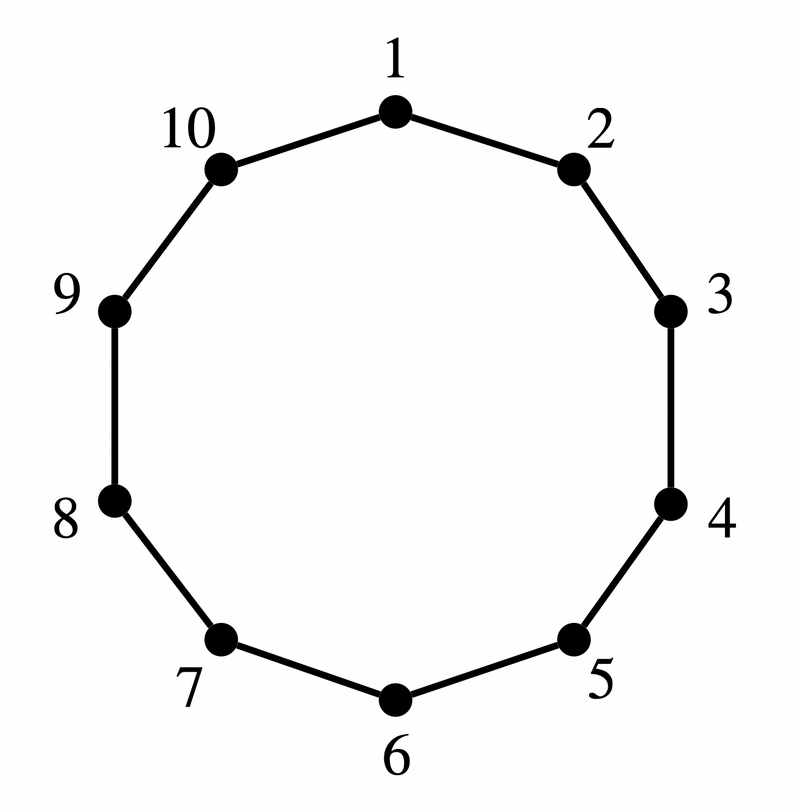
制約
- 1 \leq a \lt b \leq 10
- a, b は整数
入力
入力は以下の形式で標準入力から与えられる。
a b
出力
a 番の点と b 番の点が線で直接結ばれている場合は Yes を出力し、結ばれていない場合は No を出力せよ。
ジャッジは英大文字と英小文字を厳密に区別することに注意せよ。
入力例 1
4 5
出力例 1
Yes
問題文で示した図において、4 番の点と 5 番の点は線で直接結ばれています。
よって、Yes を出力します。
入力例 2
3 5
出力例 2
No
問題文で示した図において、3 番の点と 5 番の点は線で直接結ばれていません。
よって、No を出力します。
入力例 3
1 10
出力例 3
Yes
Score : 100 points
Problem Statement
In the figure shown in the image below, are the points numbered a and b directly connected by a line segment?
Constraints
- 1 \leq a \lt b \leq 10
- a and b are integers.
Input
Input is given from Standard Input in the following format:
a b
Output
If the points numbered a and b are directly connected by a line segment, print Yes; otherwise, print No.
The judge is case-sensitive: be sure to print uppercase and lowercase letters correctly.
Sample Input 1
4 5
Sample Output 1
Yes
In the figure shown in the Problem Statement, the points numbered 4 and 5 are directly connected by a line segment.
Thus, Yes should be printed.
Sample Input 2
3 5
Sample Output 2
No
In the figure shown in the Problem Statement, the points numbered 3 and 5 are not directly connected by a line segment.
Thus, No should be printed.
Sample Input 3
1 10
Sample Output 3
Yes
実行時間制限: 2 sec / メモリ制限: 1024 MiB
配点 : 100 点
問題文
英小文字からなる N 個の文字列 W_1,W_2,\dots,W_N が与えられます。
これらのうち一つ以上が and, not, that, the, you のいずれかと一致するなら Yes 、そうでないなら No と出力してください。
制約
- N は 1 以上 100 以下の整数
- 1 \le |W_i| \le 50 ( |W_i| は文字列 W_i の長さ )
- W_i は英小文字からなる
入力
入力は以下の形式で標準入力から与えられる。
N
W_1 W_2 \dots W_N
出力
答えを出力せよ。
入力例 1
10
in that case you should print yes and not no
出力例 1
Yes
例えば W_4= you なので、 Yes と出力します。
入力例 2
10
in diesem fall sollten sie no und nicht yes ausgeben
出力例 2
No
文字列 W_i はいずれも、 and, not, that, the, you のいずれとも一致しません。
Score : 100 points
Problem Statement
You are given N strings W_1,W_2,\dots,W_N consisting of lowercase English letters.
If one or more of these strings equal and, not, that, the, or you, then print Yes; otherwise, print No.
Constraints
- N is an integer between 1 and 100, inclusive.
- 1 \le |W_i| \le 50 (|W_i| is the length of W_i.)
- W_i consists of lowercase English letters.
Input
The input is given from Standard Input in the following format:
N
W_1 W_2 \dots W_N
Output
Print the answer.
Sample Input 1
10
in that case you should print yes and not no
Sample Output 1
Yes
We have, for instance, W_4= you, so you should print Yes.
Sample Input 2
10
in diesem fall sollten sie no und nicht yes ausgeben
Sample Output 2
No
None of the strings W_i equals any of and, not, that, the, and you.
実行時間制限: 2 sec / メモリ制限: 1024 MiB
配点 : 200 点
問題文
1 以上 26 以下の整数からなる長さ 26 の数列 P=(P_1,P_2, \ldots ,P_{26}) が与えられます。ここで、P の要素は相異なることが保証されます。
以下の条件を満たす長さ 26 の文字列 S を出力してください。
- 任意の i\, (1 \leq i \leq 26) について、S の i 文字目は辞書順で小さい方から P_i 番目の英小文字である。
制約
- 1 \leq P_i \leq 26
- P_i \neq P_j (i \neq j)
- 入力は全て整数である。
入力
入力は以下の形式で標準入力から与えられる。
P_1 P_2 \ldots P_{26}
出力
文字列 S を出力せよ。
入力例 1
1 2 3 4 5 6 7 8 9 10 11 12 13 14 15 16 17 18 19 20 21 22 23 24 25 26
出力例 1
abcdefghijklmnopqrstuvwxyz
入力例 2
2 1 3 4 5 6 7 8 9 10 11 12 13 14 15 16 17 18 19 20 21 22 23 24 25 26
出力例 2
bacdefghijklmnopqrstuvwxyz
入力例 3
5 11 12 16 25 17 18 1 7 10 4 23 20 3 2 24 26 19 14 9 6 22 8 13 15 21
出力例 3
eklpyqragjdwtcbxzsnifvhmou
Score : 200 points
Problem Statement
You are given a sequence of 26 integers P=(P_1,P_2, \ldots ,P_{26}) consisting of integers from 1 through 26. It is guaranteed that all elements in P are distinct.
Print a string S of length 26 that satisfies the following condition.
- For every i (1 \leq i \leq 26), the i-th character of S is the lowercase English letter that comes P_i-th in alphabetical order.
Constraints
- 1 \leq P_i \leq 26
- P_i \neq P_j (i \neq j)
- All values in input are integers.
Input
Input is given from Standard Input in the following format:
P_1 P_2 \ldots P_{26}
Output
Print the string S.
Sample Input 1
1 2 3 4 5 6 7 8 9 10 11 12 13 14 15 16 17 18 19 20 21 22 23 24 25 26
Sample Output 1
abcdefghijklmnopqrstuvwxyz
Sample Input 2
2 1 3 4 5 6 7 8 9 10 11 12 13 14 15 16 17 18 19 20 21 22 23 24 25 26
Sample Output 2
bacdefghijklmnopqrstuvwxyz
Sample Input 3
5 11 12 16 25 17 18 1 7 10 4 23 20 3 2 24 26 19 14 9 6 22 8 13 15 21
Sample Output 3
eklpyqragjdwtcbxzsnifvhmou
実行時間制限: 2 sec / メモリ制限: 1024 MiB
配点 : 200 点
問題文
高橋君は chess960 と呼ばれるゲームで遊んでいます。 高橋君はランダムに決めた初期配置が chess960 の条件を満たすか確認するプログラムを書くことにしました。
長さ 8 の文字列 S が与えられます。S には K, Q がちょうど 1 文字ずつ、R, B, N がちょうど 2 文字ずつ含まれます。 S が以下の条件を全て満たしているか判定してください。
-
S において左から x,y\ (x < y) 文字目が
Bであるとする。このとき x と y の偶奇が異なる。 -
Kは 2 つのRの間にある。より形式的には、S において左から x,y\ (x < y) 文字目がRであり、 z 文字目がKであるとする。このとき、 x< z < y が成り立つ。
制約
- S は 長さ 8 の文字列であり、
K,Qがちょうど 1 文字ずつ、R,B,Nがちょうど 2 文字ずつ含まれる。
入力
入力は以下の形式で標準入力から与えられる。
S
出力
S が条件を満たす場合 Yes を、そうでない場合 No を出力せよ。
入力例 1
RNBQKBNR
出力例 1
Yes
B は左から 3 番目、6 番目にあり、3 と 6 は偶奇が異なります。
また、K は 2 つの R の間にあります。よって条件を満たします。
入力例 2
KRRBBNNQ
出力例 2
No
K は 2 つの R の間にありません。
入力例 3
BRKRBQNN
出力例 3
No
Score : 200 points
Problem Statement
Takahashi is playing a game called Chess960. He has decided to write a code that determines if a random initial state satisfies the conditions of Chess960.
You are given a string S of length eight. S has exactly one K and Q, and exactly two R's, B's , and N's. Determine if S satisfies all of the following conditions.
-
Suppose that the x-th and y-th (x < y) characters from the left of S are
B; then, x and y have different parities. -
Kis between twoR's. More formally, suppose that the x-th and y-th (x < y) characters from the left of S areRand the z-th isK; then x< z < y.
Constraints
- S is a string of length 8 that contains exactly one
KandQ, and exactly twoR's,B's , andN's.
Input
The input is given from Standard Input in the following format:
S
Output
Print Yes if S satisfies the conditions; print No otherwise.
Sample Input 1
RNBQKBNR
Sample Output 1
Yes
The 3-rd and 6-th characters are B, and 3 and 6 have different parities.
Also, K is between the two R's. Thus, the conditions are fulfilled.
Sample Input 2
KRRBBNNQ
Sample Output 2
No
K is not between the two R's.
Sample Input 3
BRKRBQNN
Sample Output 3
No
実行時間制限: 2 sec / メモリ制限: 1024 MiB
配点 : 300 点
問題文
整数 N が与えられるので、以下の条件を全て満たす整数 X の個数を 998244353 で割った余りを求めてください。
- N 桁の正整数である。
- X の各桁を上の位から順に X_1,X_2,\dots,X_N とする。このとき以下の条件を全て満たす。
- 全ての整数 1 \le i \le N に対して、 1 \le X_i \le 9
- 全ての整数 1 \le i \le N-1 に対して、 |X_i-X_{i+1}| \le 1
制約
- N は整数
- 2 \le N \le 10^6
入力
入力は以下の形式で標準入力から与えられる。
N
出力
答えを整数として出力せよ。
入力例 1
4
出力例 1
203
4 桁の整数として、例えば 1111,1234,7878,6545 が問題文中の条件を満たします。
入力例 2
2
出力例 2
25
入力例 3
1000000
出力例 3
248860093
998244353 で割った余りを求めることに注意してください。
Score : 300 points
Problem Statement
Given an integer N, find the number of integers X that satisfy all of the following conditions, modulo 998244353.
- X is an N-digit positive integer.
- Let X_1,X_2,\dots,X_N be the digits of X from top to bottom. They satisfy all of the following:
- 1 \le X_i \le 9 for all integers 1 \le i \le N;
- |X_i-X_{i+1}| \le 1 for all integers 1 \le i \le N-1.
Constraints
- N is an integer.
- 2 \le N \le 10^6
Input
Input is given from Standard Input in the following format:
N
Output
Print the answer as an integer.
Sample Input 1
4
Sample Output 1
203
Some of the 4-digit integers satisfying the conditions are 1111,1234,7878,6545.
Sample Input 2
2
Sample Output 2
25
Sample Input 3
1000000
Sample Output 3
248860093
Be sure to find the count modulo 998244353.
実行時間制限: 2 sec / メモリ制限: 1024 MiB
配点 : 300 点
問題文
(1, \dots, N) の順列 P = (P_1, \dots, P_N) が与えられます。ただし、(P_1, \dots, P_N) \neq (1, \dots, N) です。
(1 \dots, N) の順列を全て辞書順で小さい順に並べたとき、P が K 番目であるとします。辞書順で小さい方から K-1 番目の順列を求めてください。
順列とは?
(1, \dots, N) の順列とは、(1, \dots, N) を並べ替えて得られる数列のことをいいます。
辞書順とは?
長さ N の数列 A = (A_1, \dots, A_N), B = (B_1, \dots, B_N) に対し、A が B より辞書順で真に小さいとは、ある整数 1 \leq i \leq N が存在して、下記の 2 つがともに成り立つことをいいます。
- (A_{1},\ldots,A_{i-1}) = (B_1,\ldots,B_{i-1})
- A_i < B_i
制約
- 2 \leq N \leq 100
- 1 \leq P_i \leq N \, (1 \leq i \leq N)
- P_i \neq P_j \, (i \neq j)
- (P_1, \dots, P_N) \neq (1, \dots, N)
- 入力される値は全て整数
入力
入力は以下の形式で標準入力から与えられる。
N
P_1 \ldots P_N
出力
求める順列を Q = (Q_1, \dots, Q_N) として、Q_1, \dots, Q_N をこの順に空白区切りで一行に出力せよ。
入力例 1
3
3 1 2
出力例 1
2 3 1
(1, 2, 3) の順列を辞書順で小さい順に並べると次のようになります。
- (1, 2, 3)
- (1, 3, 2)
- (2, 1, 3)
- (2, 3, 1)
- (3, 1, 2)
- (3, 2, 1)
よって P = (3, 1, 2) は小さい方から 5 番目であり、求める順列、すなわち小さい方から 5 - 1 = 4 番目の順列は (2, 3, 1) です。
入力例 2
10
9 8 6 5 10 3 1 2 4 7
出力例 2
9 8 6 5 10 2 7 4 3 1
Score : 300 points
Problem Statement
You are given a permutation P = (P_1, \dots, P_N) of (1, \dots, N), where (P_1, \dots, P_N) \neq (1, \dots, N).
Assume that P is the K-th lexicographically smallest among all permutations of (1 \dots, N). Find the (K-1)-th lexicographically smallest permutation.
What are permutations?
A permutation of (1, \dots, N) is an arrangement of (1, \dots, N) into a sequence.
What is lexicographical order?
For sequences of length N, A = (A_1, \dots, A_N) and B = (B_1, \dots, B_N), A is said to be strictly lexicographically smaller than B if and only if there is an integer 1 \leq i \leq N that satisfies both of the following.
- (A_{1},\ldots,A_{i-1}) = (B_1,\ldots,B_{i-1}).
- A_i < B_i.
Constraints
- 2 \leq N \leq 100
- 1 \leq P_i \leq N \, (1 \leq i \leq N)
- P_i \neq P_j \, (i \neq j)
- (P_1, \dots, P_N) \neq (1, \dots, N)
- All values in the input are integers.
Input
The input is given from Standard Input in the following format:
N
P_1 \ldots P_N
Output
Let Q = (Q_1, \dots, Q_N) be the sought permutation. Print Q_1, \dots, Q_N in a single line in this order, separated by spaces.
Sample Input 1
3
3 1 2
Sample Output 1
2 3 1
Here are the permutations of (1, 2, 3) in ascending lexicographical order.
- (1, 2, 3)
- (1, 3, 2)
- (2, 1, 3)
- (2, 3, 1)
- (3, 1, 2)
- (3, 2, 1)
Therefore, P = (3, 1, 2) is the fifth smallest, so the sought permutation, which is the fourth smallest (5 - 1 = 4), is (2, 3, 1).
Sample Input 2
10
9 8 6 5 10 3 1 2 4 7
Sample Output 2
9 8 6 5 10 2 7 4 3 1
実行時間制限: 2 sec / メモリ制限: 1024 MiB
配点 : 400 点
問題文
長さ L メートルの直線状の木材があります。
x = 1, 2, \dots, L - 1 に対して、木材の左端から x メートルの地点には目印として線 x が引かれています。
Q 個のクエリが与えられます。 i 番目のクエリは数の組 (c_i, x_i) によって表されます。
以下の説明に従ってクエリを i の昇順に処理してください。
- c_i = 1 のとき : 線 x_i がある地点で木材を 2 つに切る。
- c_i = 2 のとき : 線 x_i を含む木材を選び、その長さを出力する。
ただし c_i = 1, 2 の両方に対して、線 x_i はクエリを処理する時点で切られていないことが保証されます。
制約
- 1 \leq L \leq 10^9
- 1 \leq Q \leq 2 \times 10^5
- c_i = 1, 2 (1 \leq i \leq Q)
- 1 \leq x_i \leq L - 1 (1 \leq i \leq Q)
- 全ての i (1 \leq i \leq Q) に対して次が成り立つ: 1 \leq j \lt i かつ (c_j,x_j) = (1, x_i) を満たす j は存在しない。
- 入力は全て整数である。
入力
入力は以下の形式で標準入力から与えられる。
L Q
c_1 x_1
c_2 x_2
\vdots
c_Q x_Q
出力
c_i = 2 を満たすクエリの回数と等しい行数だけ出力せよ。 j 行目では j 番目のそのようなクエリに対する答えを出力せよ。
入力例 1
5 3
2 2
1 3
2 2
出力例 1
5
3
1 番目のクエリ時点では木材は一度も切られていないので、線 2 を含む木材の長さは 5 メートルです。よって 5 を出力します。
2 番目のクエリによって、木材は 3 メートルの木材と 2 メートルの木材に分割されます。
3 番目のクエリ時点では 線 2 を含む木材の長さは 3 メートルなので、3 を出力します。
入力例 2
5 3
1 2
1 4
2 3
出力例 2
2
入力例 3
100 10
1 31
2 41
1 59
2 26
1 53
2 58
1 97
2 93
1 23
2 84
出力例 3
69
31
6
38
38
Score : 400 points
Problem Statement
We have a long piece of timber with a length of L meters.
For each x = 1, 2, \dots, L - 1, there is a mark called Mark x at x meters from the left end of the piece.
You are given Q queries, the i-th of which is represented as a pair of numbers (c_i, x_i).
Process the queries in ascending order of i as described below.
- If c_i = 1: cut the piece at Mark x_i into two.
- If c_i = 2: choose the piece with Mark x_i on it and print its length.
Here, for both kinds of queries c_i = 1, 2, it is guaranteed that there will have been no cut at Mark x_i when the query is to be processed.
Constraints
- 1 \leq L \leq 10^9
- 1 \leq Q \leq 2 \times 10^5
- c_i = 1, 2 (1 \leq i \leq Q)
- 1 \leq x_i \leq L - 1 (1 \leq i \leq Q)
- For every i (1 \leq i \leq Q), the following holds: there is no j such that 1 \leq j \lt i and (c_j,x_j) = (1, x_i).
- All values in input are integers.
Input
Input is given from Standard Input in the following format:
L Q
c_1 x_1
c_2 x_2
\vdots
c_Q x_Q
Output
Print the number of lines equal to the number of queries c_i = 2. In the j-th line, print the response to the j-th such query.
Sample Input 1
5 3
2 2
1 3
2 2
Sample Output 1
5
3
At the time of the first query, no cut has been made, so the piece with Mark 2 has a length of 5 meters. Thus, you should print 5.
In the second query, the piece is cut into two pieces with lengths of 3 and 2 meters.
At the time of the third query, the piece with Mark 2 has a length of 3 meters, so you should print 3.
Sample Input 2
5 3
1 2
1 4
2 3
Sample Output 2
2
Sample Input 3
100 10
1 31
2 41
1 59
2 26
1 53
2 58
1 97
2 93
1 23
2 84
Sample Output 3
69
31
6
38
38
実行時間制限: 2 sec / メモリ制限: 1024 MiB
配点 : 500 点
問題文
以下の条件を満たす正の整数 n を、 等差数 と呼びます。
- (n を先頭に余計な 0 を付けずに 10 進法で表記した際、) n の上から i 桁目を d_i とする。このとき、 n が k 桁の整数であったとすると、 (d_2-d_1)=(d_3-d_2)=\dots=(d_k-d_{k-1}) が成立する。
- この条件は、「 数列 (d_1,d_2,\dots,d_k) が等差数列である」と言い換えることができる。
- 但し、 n が 1 桁の整数である時、 n は等差数であるものとする。
たとえば、 234,369,86420,17,95,8,11,777 は等差数ですが、 751,919,2022,246810,2356 は等差数ではありません。
等差数のうち、 X 以上で最小のものを求めてください。
制約
- X は 1 以上 10^{17} 以下の整数である
入力
入力は以下の形式で標準入力から与えられる。
X
出力
答えを整数として出力せよ。
入力例 1
152
出力例 1
159
152 以上で最小の等差数は 159 です。
入力例 2
88
出力例 2
88
X 自身が等差数である場合もあります。
入力例 3
8989898989
出力例 3
9876543210
Score : 500 points
Problem Statement
Let us call a positive integer n that satisfies the following condition an arithmetic number.
- Let d_i be the i-th digit of n from the top (when n is written in base 10 without unnecessary leading zeros.) Then, (d_2-d_1)=(d_3-d_2)=\dots=(d_k-d_{k-1}) holds, where k is the number of digits in n.
- This condition can be rephrased into the sequence (d_1,d_2,\dots,d_k) being arithmetic.
- If n is a 1-digit integer, it is assumed to be an arithmetic number.
For example, 234,369,86420,17,95,8,11,777 are arithmetic numbers, while 751,919,2022,246810,2356 are not.
Find the smallest arithmetic number not less than X.
Constraints
- X is an integer between 1 and 10^{17} (inclusive).
Input
Input is given from Standard Input in the following format:
X
Output
Print the answer as an integer.
Sample Input 1
152
Sample Output 1
159
The smallest arithmetic number not less than 152 is 159.
Sample Input 2
88
Sample Output 2
88
X itself may be an arithmetic number.
Sample Input 3
8989898989
Sample Output 3
9876543210
実行時間制限: 2 sec / メモリ制限: 1024 MiB
配点 : 500 点
問題文
長さ N の数列 A = (A_1, \dots, A_N), B = (B_1, \dots, B_N) が与えられます。\{1,2,\ldots,N\} の空でない部分集合 S であって、以下の条件を満たすものの個数を数えてください。
- \max_{i \in S} A_i \geq \sum_{i \in S} B_i
なお、答えは非常に大きくなることがあるため、998244353 で割ったあまりを出力してください。
制約
- 1 \leq N \leq 5000
- 1 \leq A_i,B_i \leq 5000
- 入力は全て整数
入力
入力は以下の形式で標準入力から与えられる。
N
A_1 A_2 \ldots A_N
B_1 B_2 \ldots B_N
出力
問題文中の条件を満たす S の個数を 998244353 で割ったあまりを出力せよ。
入力例 1
2
3 1
1 2
出力例 1
2
\{1,2,\ldots,N\} の空でない部分集合としてあり得るものは、\{1\}, \{2\}, \{1,2\} の 3 通りです。
- S=\{1\} のとき \max_{i \in S} A_i=3, \sum_{i \in S} B_i=1
- S=\{2\} のとき \max_{i \in S} A_i=1, \sum_{i \in S} B_i=2
- S=\{1,2\} のとき \max_{i \in S} A_i=3, \sum_{i \in S} B_i=3
であるため、問題文中の条件、即ち \max_{i \in S} A_i \geq \sum_{i \in S} B_i を満たす S は \{1\} と \{1,2\} の 2 通りです。
入力例 2
2
1 1
2 2
出力例 2
0
条件を満たす S が存在しない場合もあります。
入力例 3
20
1937 3980 2689 1208 3640 1979 581 2271 4229 3948 3708 1522 4161 4661 3797 96 3388 3395 2920 2247
4485 2580 174 1156 3770 3396 3558 3500 3494 479 269 3383 1230 1711 3545 3919 134 475 3796 1017
出力例 3
476
Score : 500 points
Problem Statement
Given are sequences of N integers each: A = (A_1, \dots, A_N) and B = (B_1, \dots, B_N). Find the number of non-empty subsets S of \{1,2,\ldots,N\} that satisfy the following condition:
- \max_{i \in S} A_i \geq \sum_{i \in S} B_i.
Since the count can be enormous, print it modulo 998244353.
Constraints
- 1 \leq N \leq 5000
- 1 \leq A_i,B_i \leq 5000
- All values in input are integers.
Input
Input is given from Standard Input in the following format:
N
A_1 A_2 \ldots A_N
B_1 B_2 \ldots B_N
Output
Print the number of subsets S that satisfy the condition in the Problem Statement, modulo 998244353.
Sample Input 1
2
3 1
1 2
Sample Output 1
2
\{1,2,\ldots,N\} has three subsets: \{1\}, \{2\}, and \{1,2\}.
- For S=\{1\}, we have \max_{i \in S} A_i=3 and \sum_{i \in S} B_i=1.
- For S=\{2\}, we have \max_{i \in S} A_i=1 and \sum_{i \in S} B_i=2.
- For S=\{1,2\}, we have \max_{i \in S} A_i=3 and \sum_{i \in S} B_i=3.
Thus, the condition \max_{i \in S} A_i \geq \sum_{i \in S} B_i is satisfied by two subsets: \{1\} and \{1,2\}.
Sample Input 2
2
1 1
2 2
Sample Output 2
0
There may be no subsets that satisfy the condition.
Sample Input 3
20
1937 3980 2689 1208 3640 1979 581 2271 4229 3948 3708 1522 4161 4661 3797 96 3388 3395 2920 2247
4485 2580 174 1156 3770 3396 3558 3500 3494 479 269 3383 1230 1711 3545 3919 134 475 3796 1017
Sample Output 3
476