Time Limit: 2 sec / Memory Limit: 1024 MiB
配点 : 200 点
問題文
整数 N が与えられます。
以下の指示に従って N の近似値を出力してください。
- N が 10^3-1 以下ならば、N をそのまま出力する。
- N が 10^3 以上 10^4-1 以下ならば、N の一の位を切り捨てて出力する。
- N が 10^4 以上 10^5-1 以下ならば、N の十の位以下を切り捨てて出力する。
- N が 10^5 以上 10^6-1 以下ならば、N の百の位以下を切り捨てて出力する。
- N が 10^6 以上 10^7-1 以下ならば、N の千の位以下を切り捨てて出力する。
- N が 10^7 以上 10^8-1 以下ならば、N の一万の位以下を切り捨てて出力する。
- N が 10^8 以上 10^9-1 以下ならば、N の十万の位以下を切り捨てて出力する。
制約
- N は 0 以上 10^9-1 以下の整数
入力
入力は以下の形式で標準入力から与えられる。
N
出力
答えを出力せよ。
入力例 1
20230603
出力例 1
20200000
20230603 は 10^7 以上 10^8-1 以下です。
したがって、一万以下の位を切り捨てて 20200000 を出力します。
入力例 2
0
出力例 2
0
入力例 3
304
出力例 3
304
入力例 4
500600
出力例 4
500000
Score : 200 points
Problem Statement
You are given an integer N.
Print an approximation of N according to the following instructions.
- If N is less than or equal to 10^3-1, print N as it is.
- If N is between 10^3 and 10^4-1, inclusive, truncate the ones digit of N and print the result.
- If N is between 10^4 and 10^5-1, inclusive, truncate the tens digit and all digits below it of N and print the result.
- If N is between 10^5 and 10^6-1, inclusive, truncate the hundreds digit and all digits below it of N and print the result.
- If N is between 10^6 and 10^7-1, inclusive, truncate the thousands digit and all digits below it of N and print the result.
- If N is between 10^7 and 10^8-1, inclusive, truncate the ten-thousands digit and all digits below it of N and print the result.
- If N is between 10^8 and 10^9-1, inclusive, truncate the hundred-thousands digit and all digits below it of N and print the result.
Constraints
- N is an integer between 0 and 10^9-1, inclusive.
Input
The input is given from Standard Input in the following format:
N
Output
Print the answer.
Sample Input 1
20230603
Sample Output 1
20200000
20230603 is between 10^7 and 10^8-1 (inclusive).
Therefore, truncate the ten-thousands digit and all digits below it, and print 20200000.
Sample Input 2
0
Sample Output 2
0
Sample Input 3
304
Sample Output 3
304
Sample Input 4
500600
Sample Output 4
500000
Time Limit: 2 sec / Memory Limit: 1024 MiB
配点 : 200 点
問題文
英小文字からなる文字列 S, T が与えられます。S の長さは N、T の長さは M です。(N \leq M が制約で保証されています)
S が T の 接頭辞 であるとは、T のはじめ N 文字からなる文字列が S と一致することを言います。
S が T の 接尾辞 であるとは、T の後ろ N 文字からなる文字列が S と一致することを言います。
S が T の接頭辞であり、かつ接尾辞でもある場合は 0 を、
S が T の接頭辞であるが、接尾辞でない場合は 1 を、
S が T の接尾辞であるが、接頭辞でない場合は 2 を、
S が T の接頭辞でも接尾辞でもない場合は 3 を出力してください。
制約
- 1 \leq N \leq M \leq 100
- S は英小文字からなる長さ N の文字列
- T は英小文字からなる長さ M の文字列
入力
入力は以下の形式で標準入力から与えられる。
N M
S
T
出力
問題文の指示に従って答えを出力せよ。
入力例 1
3 7
abc
abcdefg
出力例 1
1
S は T の接頭辞ですが接尾辞ではありません。よって 1 を出力します。
入力例 2
3 4
abc
aabc
出力例 2
2
S は T の接尾辞ですが接頭辞ではありません。
入力例 3
3 3
abc
xyz
出力例 3
3
S は T の接頭辞でも接尾辞でもありません。
入力例 4
3 3
aaa
aaa
出力例 4
0
S と T が完全に一致する場合もあります。この場合、S は T の接頭辞であり、かつ接尾辞でもあります。
Score : 200 points
Problem Statement
You are given two strings S and T consisting of lowercase English letters. The lengths of S and T are N and M, respectively. (The constraints guarantee that N \leq M.)
S is said to be a prefix of T when the first N characters of T coincide S.
S is said to be a suffix of T when the last N characters of T coincide S.
If S is both a prefix and a suffix of T, print 0;
If S is a prefix of T but not a suffix, print 1;
If S is a suffix of T but not a prefix, print 2;
If S is neither a prefix nor a suffix of T, print 3.
Constraints
- 1 \leq N \leq M \leq 100
- S is a string of length N consisting of lowercase English letters.
- T is a string of length M consisting of lowercase English letters.
Input
The input is given from Standard Input in the following format:
N M
S
T
Output
Print the answer according to the instructions in the problem statement.
Sample Input 1
3 7
abc
abcdefg
Sample Output 1
1
S is a prefix of T but not a suffix, so you should print 1.
Sample Input 2
3 4
abc
aabc
Sample Output 2
2
S is a suffix of T but not a prefix.
Sample Input 3
3 3
abc
xyz
Sample Output 3
3
S is neither a prefix nor a suffix of T.
Sample Input 4
3 3
aaa
aaa
Sample Output 4
0
S and T may coincide, in which case S is both a prefix and a suffix of T.
Time Limit: 2 sec / Memory Limit: 1024 MiB
配点 : 300 点
問題文
高橋君が運営する SNS「Twidai」にはユーザー 1 からユーザー N までの N 人のユーザーがいます。 Twidai では、ユーザーは別のユーザーをフォローすることや、フォローを解除することができます。
Twidai がサービスを開始してから、Q 回の操作が行われました。 i 回目 (1\leq i\leq Q) の操作は 3 つの整数 T _ i, A _ i, B _ i で表され、それぞれ次のような操作を表します。
- T _ i=1 のとき:ユーザー A _ i がユーザー B _ i をフォローしたことを表す。この操作の時点でユーザー A _ i がユーザー B _ i をフォローしている場合、ユーザーのフォロー状況に変化はない。
- T _ i=2 のとき:ユーザー A _ i がユーザー B _ i のフォローを解除したことを表す。この操作の時点でユーザー A _ i がユーザー B _ i をフォローしていない場合、ユーザーのフォロー状況に変化はない。
- T _ i=3 のとき:ユーザー A _ i とユーザー B _ i が互いにフォローしているかをチェックすることを表す。この操作の時点でユーザー A _ i がユーザー B _ i をフォローしており、かつユーザー B _ i がユーザー A _ i をフォローしているとき、このチェックに対して
Yesと答え、そうでないときこのチェックに対してNoと答える必要がある。
サービス開始時には、どのユーザーも他のユーザーをフォローしていません。
すべての T _ i=3 であるような操作に対して、i が小さいほうから順番に正しい答えを出力してください。
制約
- 2 \leq N \leq 10 ^ 9
- 1 \leq Q \leq 2\times10 ^ 5
- T _ i=1,2,3\ (1\leq i\leq Q)
- 1 \leq A _ i \leq N\ (1\leq i\leq Q)
- 1 \leq B _ i \leq N\ (1\leq i\leq Q)
- A _ i\neq B _ i\ (1\leq i\leq Q)
- T _ i=3 となる i\ (1\leq i\leq Q) が存在する
- 入力される値はすべて整数
入力
入力は以下の形式で標準入力から与えられる。
N Q
T _ 1 A _ 1 B _ 1
T _ 2 A _ 2 B _ 2
\vdots
T _ Q A _ Q B _ Q
出力
T _ i=3 であるような i\ (1\leq i\leq Q) の個数を X として、X 行出力せよ。 j\ (1\leq j\leq X) 行目には j 番目の T _ i=3 であるような操作に対する答えを出力せよ。
入力例 1
3 9
1 1 2
3 1 2
1 2 1
3 1 2
1 2 3
1 3 2
3 1 3
2 1 2
3 1 2
出力例 1
No
Yes
No
No
Twidai には 3 人のユーザーがいます。 9 回の操作はそれぞれ次のようになっています。
- ユーザー 1 がユーザー 2 をフォローします。そのほかにフォローしている/されているユーザーはいません。
- ユーザー 1 とユーザー 2 が互いにフォローしているかチェックします。ユーザー 1 はユーザー 2 をフォローしていますが、ユーザー 2 はユーザー 1 をフォローしていません。この操作への正しい答えは
Noです。 - ユーザー 2 がユーザー 1 をフォローします。
- ユーザー 1 とユーザー 2 が互いにフォローしているかチェックします。ユーザー 1 はユーザー 2 をフォローしており、ユーザー 2 はユーザー 1 をフォローしています。この操作への正しい答えは
Yesです。 - ユーザー 2 がユーザー 3 をフォローします。
- ユーザー 3 がユーザー 2 をフォローします。
- ユーザー 1 とユーザー 3 が互いにフォローしているかチェックします。ユーザー 1 はユーザー 3 をフォローしておらず、ユーザー 3 もユーザー 1 をフォローしていません。この操作への正しい答えは
Noです。 - ユーザー 1 がユーザー 2 のフォローを解除します。
- ユーザー 1 とユーザー 2 が互いにフォローしているかチェックします。ユーザー 2 はユーザー 1 をフォローしていますが、ユーザー 1 はユーザー 2 をフォローしていません。この操作への正しい答えは
Noです。
入力例 2
2 8
1 1 2
1 2 1
3 1 2
1 1 2
1 1 2
1 1 2
2 1 2
3 1 2
出力例 2
Yes
No
同じユーザーに対して何度もフォロー操作をする場合があります。
入力例 3
10 30
3 1 6
3 5 4
1 6 1
3 1 7
3 8 4
1 1 6
2 4 3
1 6 5
1 5 6
1 1 8
1 8 1
2 3 10
1 7 6
3 5 6
1 6 7
3 6 7
1 9 5
3 8 6
3 3 8
2 6 9
1 7 1
3 10 8
2 9 2
1 10 9
2 6 10
2 6 8
3 1 6
3 1 8
2 8 5
1 9 10
出力例 3
No
No
No
No
Yes
Yes
No
No
No
Yes
Yes
Score : 300 points
Problem Statement
Takahashi runs an SNS "Twidai," which has N users from user 1 through user N. In Twidai, users can follow or unfollow other users.
Q operations have been performed since Twidai was launched. The i-th (1\leq i\leq Q) operation is represented by three integers T_i, A_i, and B_i, whose meanings are as follows:
- If T_i = 1: it means that user A_i follows user B_i. If user A_i is already following user B_i at the time of this operation, it does not make any change.
- If T_i = 2: it means that user A_i unfollows user B_i. If user A_i is not following user B_i at the time of this operation, it does not make any change.
- If T_i = 3: it means that you are asked to determine if users A_i and B_i are following each other. You need to print
Yesif user A_i is following user B_i and user B_i is following user A_i, andNootherwise.
When the service was launched, no users were following any users.
Print the correct answers for all operations such that T_i = 3 in ascending order of i.
Constraints
- 2 \leq N \leq 10 ^ 9
- 1 \leq Q \leq 2\times10 ^ 5
- T _ i=1,2,3\ (1\leq i\leq Q)
- 1 \leq A _ i \leq N\ (1\leq i\leq Q)
- 1 \leq B _ i \leq N\ (1\leq i\leq Q)
- A _ i\neq B _ i\ (1\leq i\leq Q)
- There exists i\ (1\leq i\leq Q) such that T _ i=3.
- All values in the input are integers.
Input
The input is given from Standard Input in the following format:
N Q
T _ 1 A _ 1 B _ 1
T _ 2 A _ 2 B _ 2
\vdots
T _ Q A _ Q B _ Q
Output
Print X lines, where X is the number of i's (1\leq i\leq Q) such that T _ i=3. The j-th (1\leq j\leq X) line should contain the answer to the j-th operation such that T _ i=3.
Sample Input 1
3 9
1 1 2
3 1 2
1 2 1
3 1 2
1 2 3
1 3 2
3 1 3
2 1 2
3 1 2
Sample Output 1
No
Yes
No
No
Twidai has three users. The nine operations are as follows.
- User 1 follows user 2. No other users are following or followed by any users.
- Determine if users 1 and 2 are following each other. User 1 is following user 2, but user 2 is not following user 1, so
Nois the correct answer to this operation. - User 2 follows user 1.
- Determine if users 1 and 2 are following each other. User 1 is following user 2, and user 2 is following user 1, so
Yesis the correct answer to this operation. - User 2 follows user 3.
- User 3 follows user 2.
- Determine if users 1 and 3 are following each other. User 1 is not following user 3, and user 3 is not following user 1, so
Nois the correct answer to this operation. - User 1 unfollows user 2.
- Determine if users 1 and 2 are following each other. User 2 is following user 1, but user 1 is not following user 2, so
Nois the correct answer to this operation.
Sample Input 2
2 8
1 1 2
1 2 1
3 1 2
1 1 2
1 1 2
1 1 2
2 1 2
3 1 2
Sample Output 2
Yes
No
A user may follow the same user multiple times.
Sample Input 3
10 30
3 1 6
3 5 4
1 6 1
3 1 7
3 8 4
1 1 6
2 4 3
1 6 5
1 5 6
1 1 8
1 8 1
2 3 10
1 7 6
3 5 6
1 6 7
3 6 7
1 9 5
3 8 6
3 3 8
2 6 9
1 7 1
3 10 8
2 9 2
1 10 9
2 6 10
2 6 8
3 1 6
3 1 8
2 8 5
1 9 10
Sample Output 3
No
No
No
No
Yes
Yes
No
No
No
Yes
Yes
Time Limit: 2 sec / Memory Limit: 1024 MiB
配点 : 300 点
問題文
ある地方に、1 から N の番号がついた N 個の街と、1 から M の番号がついた M 本の道路があります。
i 番目の道路は街 A_i と街 B_i を双方向に結び、長さは C_i です。
好きな街からスタートして同じ街を二度以上通らずに別の街へ移動するときの、通る道路の長さの和としてありえる最大値を求めてください。
制約
- 2 \leq N \leq 10
- 1 \leq M \leq \frac{N(N-1)}{2}
- 1\leq A_i < B_i \leq N
- (A_i,B_i) は相異なる
- 1\leq C_i \leq 10^8
- 入力は全て整数である
入力
入力は以下の形式で標準入力から与えられる。
N M
A_1 B_1 C_1
\vdots
A_M B_M C_M
出力
答えを出力せよ。
入力例 1
4 4
1 2 1
2 3 10
1 3 100
1 4 1000
出力例 1
1110
4\to 1\to 3\to 2 と移動すると、通る道路の長さの和は 1110 となります。
入力例 2
10 1
5 9 1
出力例 2
1
道路と繋がっていない街が存在するかもしれません。
入力例 3
10 13
1 2 1
1 10 1
2 3 1
3 4 4
4 7 2
4 8 1
5 8 1
5 9 3
6 8 1
6 9 5
7 8 1
7 9 4
9 10 3
出力例 3
20
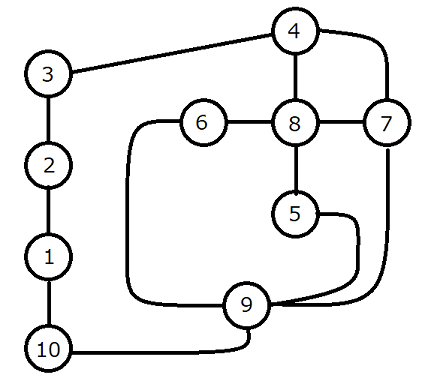
Score : 300 points
Problem Statement
A region has N towns numbered 1 to N, and M roads numbered 1 to M.
The i-th road connects town A_i and town B_i bidirectionally with length C_i.
Find the maximum possible total length of the roads you traverse when starting from a town of your choice and getting to another town without passing through the same town more than once.
Constraints
- 2 \leq N \leq 10
- 1 \leq M \leq \frac{N(N-1)}{2}
- 1 \leq A_i < B_i \leq N
- The pairs (A_i,B_i) are distinct.
- 1\leq C_i \leq 10^8
- All input values are integers.
Input
The input is given from Standard Input in the following format:
N M
A_1 B_1 C_1
\vdots
A_M B_M C_M
Output
Print the answer.
Sample Input 1
4 4
1 2 1
2 3 10
1 3 100
1 4 1000
Sample Output 1
1110
If you travel as 4\to 1\to 3\to 2, the total length of the roads you traverse is 1110.
Sample Input 2
10 1
5 9 1
Sample Output 2
1
There may be a town that is not connected to a road.
Sample Input 3
10 13
1 2 1
1 10 1
2 3 1
3 4 4
4 7 2
4 8 1
5 8 1
5 9 3
6 8 1
6 9 5
7 8 1
7 9 4
9 10 3
Sample Output 3
20
Time Limit: 2.5 sec / Memory Limit: 1024 MiB
配点 : 400 点
問題文
項数が N の正整数列 A=(a_1,\ldots,a_N) が与えられます。
A の項を 1 個以上選ぶ方法は 2^N-1 通りありますが、そのうち選んだ項の平均値が整数であるものが何通りかを 998244353 で割った余りを求めてください。
制約
- 1 \leq N \leq 100
- 1 \leq a_i \leq 10^9
- 入力はすべて整数
入力
入力は以下の形式で標準入力から与えられる。
N
a_1 \ldots a_N
出力
答えを出力せよ。
入力例 1
3
2 6 2
出力例 1
6
A の項を選ぶ方法それぞれに対する平均値は以下のようになります。
-
a_1 のみを選んだ場合、平均値は \frac{a_1}{1}=\frac{2}{1} = 2 であり、整数である。
-
a_2 のみを選んだ場合、平均値は \frac{a_2}{1}=\frac{6}{1} = 6 であり、整数である。
-
a_3 のみを選んだ場合、平均値は \frac{a_3}{1}=\frac{2}{1} = 2 であり、整数である。
-
a_1 と a_2 を選んだ場合、平均値は \frac{a_1+a_2}{2}=\frac{2+6}{2} = 4 であり、整数である。
-
a_1 と a_3 を選んだ場合、平均値は \frac{a_1+a_3}{2}=\frac{2+2}{2} = 2 であり、整数である。
-
a_2 と a_3 を選んだ場合、平均値は \frac{a_2+a_3}{2}=\frac{6+2}{2} = 4 であり、整数である。
-
a_1 と a_2 と a_3 を選んだ場合、平均値は \frac{a_1+a_2+a_3}{3}=\frac{2+6+2}{3} = \frac{10}{3} であり、整数ではない。
以上より、6 通りの選び方が条件を満たします。
入力例 2
5
5 5 5 5 5
出力例 2
31
どのように A の項を 1 個以上選んでも平均値が 5 になります。
Score : 400 points
Problem Statement
You are given a sequence of positive integers A=(a_1,\ldots,a_N) of length N.
There are (2^N-1) ways to choose one or more terms of A. How many of them have an integer-valued average? Find the count modulo 998244353.
Constraints
- 1 \leq N \leq 100
- 1 \leq a_i \leq 10^9
- All values in input are integers.
Input
Input is given from Standard Input in the following format:
N
a_1 \ldots a_N
Output
Print the answer.
Sample Input 1
3
2 6 2
Sample Output 1
6
For each way to choose terms of A, the average is obtained as follows:
-
If just a_1 is chosen, the average is \frac{a_1}{1}=\frac{2}{1} = 2, which is an integer.
-
If just a_2 is chosen, the average is \frac{a_2}{1}=\frac{6}{1} = 6, which is an integer.
-
If just a_3 is chosen, the average is \frac{a_3}{1}=\frac{2}{1} = 2, which is an integer.
-
If a_1 and a_2 are chosen, the average is \frac{a_1+a_2}{2}=\frac{2+6}{2} = 4, which is an integer.
-
If a_1 and a_3 are chosen, the average is \frac{a_1+a_3}{2}=\frac{2+2}{2} = 2, which is an integer.
-
If a_2 and a_3 are chosen, the average is \frac{a_2+a_3}{2}=\frac{6+2}{2} = 4, which is an integer.
-
If a_1, a_2, and a_3 are chosen, the average is \frac{a_1+a_2+a_3}{3}=\frac{2+6+2}{3} = \frac{10}{3}, which is not an integer.
Therefore, 6 ways satisfy the condition.
Sample Input 2
5
5 5 5 5 5
Sample Output 2
31
Regardless of the choice of one or more terms of A, the average equals 5.