実行時間制限: 2 sec / メモリ制限: 1024 MiB
配点 : 100 点
問題文
高橋君は野球ゲームを作っています。
高橋君はバッターの打率を指定された桁数の分だけ表示するプログラムを作ることにしました。
整数 A, B があります。ここで A, B は 1 \leq A \leq 10, 0 \leq B \leq A を満たします。
このとき、文字列 S を次のように定義します。
- \dfrac{B}{A} を小数点第 4 位で四捨五入した値を「整数部 1 桁」「
.」「小数部 3 桁」の順に末尾ゼロを省略せずに表記した文字列。
例えば A=7, B = 4 の場合は、\dfrac{B}{A} = \dfrac{4}{7} = 0.571428\dots で、これを小数点第 4 位で四捨五入した値は 0.571 です。よって S は 0.571 になります。
A, B が入力として与えられるので S を出力してください。
制約
- 1 \leq A \leq 10
- 0 \leq B \leq A
- A, B は整数
入力
入力は以下の形式で標準入力から与えられる。
A B
出力
S を問題文の指示に従った形式で出力せよ。問題文の指示と異なる形式で出力した場合は誤答となることに注意せよ。
入力例 1
7 4
出力例 1
0.571
問題文本文でも説明した通り、\dfrac{B}{A} = \dfrac{4}{7} = 0.571428\dots で、これを小数点第 4 位で四捨五入した値は 0.571 です。よって S は 0.571 になります。
入力例 2
7 3
出力例 2
0.429
\dfrac{B}{A} = \dfrac{3}{7} = 0.428571\dots で、これを小数点第 4 位で四捨五入した値は 0.429 です。(繰り上がりが発生するのに注意してください。)
よって S は 0.429 となります。
入力例 3
2 1
出力例 3
0.500
\dfrac{B}{A} = \dfrac{1}{2} = 0.5 で、これを小数点第 4 位で四捨五入した値も同様に 0.5 です。
よって S は 0.500 となります。小数部を 3 桁並べる必要があるのに注意してください。
入力例 4
10 10
出力例 4
1.000
入力例 5
1 0
出力例 5
0.000
Score : 100 points
Problem Statement
Takahashi is making a computer baseball game.
He will write a program that shows a batter's batting average with a specified number of digits.
There are integers A and B, which satisfy 1 \leq A \leq 10 and 0 \leq B \leq A.
Let S be the string obtained as follows.
- Round off \dfrac{B}{A} to three decimal digits, then write the integer part (1 digit),
.(the decimal point), and the decimal part (3 digits) in this order, with trailing zeros.
For example, if A=7 and B=4, then \dfrac{B}{A} = \dfrac{4}{7} = 0.571428\dots rounded off to three decimal digits is 0.571. Thus, S is 0.571.
You are given A and B as the input and asked to print S.
Constraints
- 1 \leq A \leq 10
- 0 \leq B \leq A
- A and B are integers.
Input
The input is given from Standard Input in the following format:
A B
Output
Print S in the format specified in the Problem Statement. Note that answers in different formats will be considered wrong.
Sample Input 1
7 4
Sample Output 1
0.571
As explained in the Problem Statement, \dfrac{B}{A} = \dfrac{4}{7} = 0.571428\dots rounded off to three decimal digits is 0.571. Thus, S is 0.571.
Sample Input 2
7 3
Sample Output 2
0.429
\dfrac{B}{A} = \dfrac{3}{7} = 0.428571\dots rounded off to three decimal digits is 0.429. (Note that it got rounded up.)
Thus, S is 0.429.
Sample Input 3
2 1
Sample Output 3
0.500
\dfrac{B}{A} = \dfrac{1}{2} = 0.5 rounded off to three decimal digits is again 0.5.
Thus, S is 0.500. Note that it must have three decimal places.
Sample Input 4
10 10
Sample Output 4
1.000
Sample Input 5
1 0
Sample Output 5
0.000
実行時間制限: 2 sec / メモリ制限: 1024 MiB
配点 : 100 点
問題文
高橋君は N 歳の誕生日を迎えました。この時の彼の身長は T cmです。
また、以下のことが分かっています。
- 高橋君は 0 歳の誕生日(生まれた当日)から X 歳の誕生日までの間、毎年身長が D cmずつ伸びた。より厳密に書くと、i=1,2,\ldots,X それぞれに対し、i-1 歳の誕生日から i 歳の誕生日までの間に身長が D cm伸びた。
- 高橋君は X 歳の誕生日から N 歳の誕生日までの間、身長が変化していない。
高橋君の M 歳の誕生日の時の身長が何cmだったかを求めてください。
制約
- 0 \leq M \lt N \leq 100
- 1 \leq X \leq N
- 1 \leq T \leq 200
- 1 \leq D \leq 100
- 高橋君の 0 歳の誕生日の時の身長は 1 cm以上である
- 入力はすべて整数
入力
入力は以下の形式で標準入力から与えられる。
N M X T D
出力
答えを整数として出力せよ。
入力例 1
38 20 17 168 3
出力例 1
168
この例では、高橋君の 38 歳の誕生日の時の身長が 168 cmです。また、17 歳の誕生日から 38 歳の誕生日までの間、身長が変化していません。
このことから、20 歳の誕生日の時の身長は 168 cmだったと言え、これが答えになります。
入力例 2
1 0 1 3 2
出力例 2
1
この例において、高橋君は 0(=M) 歳の誕生日の時の身長が 1 cmで、1(=N) 歳の誕生日の時の身長が 3(=T) cmです。
入力例 3
100 10 100 180 1
出力例 3
90
Score : 100 points
Problem Statement
Takahashi had his N-th birthday, when he was T centimeters tall.
Additionally, we know the following facts:
- In each year between Takahashi's birth (0-th birthday) and his X-th birthday, his height increased by D centimeters. More formally, for each i = 1, 2, \ldots, X, his height increased by D centimeters between his (i-1)-th birthday and his i-th birthday.
- Between Takahashi's X-th birthday and his N-th birthday, his height did not change.
Find Takahashi's height on his M-th birthday, in centimeters.
Constraints
- 0 \leq M \lt N \leq 100
- 1 \leq X \leq N
- 1 \leq T \leq 200
- 1 \leq D \leq 100
- Takahashi was at least 1 centimeter tall at his birth.
- All values in input are integers.
Input
Input is given from Standard Input in the following format:
N M X T D
Output
Print the answer as an integer.
Sample Input 1
38 20 17 168 3
Sample Output 1
168
In this sample, Takahashi was 168 centimeters tall on his 38-th birthday. Also, his height did not change between his 17-th birthday and 38-th birthday.
From these facts, we find that he was 168 centimeters tall on his 20-th birthday, so the answer is 168.
Sample Input 2
1 0 1 3 2
Sample Output 2
1
In this sample, Takahashi was 1 centimeter tall on his 0(=M)-th birthday and 3(=T) centimeters tall on his 1(=N)-st birthday.
Sample Input 3
100 10 100 180 1
Sample Output 3
90
実行時間制限: 2 sec / メモリ制限: 1024 MiB
配点 : 150 点
問題文
N 頂点の単純無向グラフ G があり、グラフの頂点には 1,2,\ldots, N の番号が付けられています。
G の隣接行列 (A_{i,j}) が与えられます。すなわち、G は A_{i,j} = 1 であるとき、またそのときに限り頂点 i と頂点 j を結ぶ辺を持ちます。
i = 1, 2, \ldots, N について、頂点 i と直接結ばれている頂点の番号を昇順に出力してください。
ただし、頂点 i と頂点 j が直接結ばれているとは、頂点 i と頂点 j を結ぶ辺が存在することをいいます。
制約
- 2 \leq N \leq 100
- A_{i,j} \in \lbrace 0,1 \rbrace
- A_{i,i} = 0
- A_{i,j} = A_{j,i}
- 入力される値はすべて整数
入力
入力は以下の形式で標準入力から与えられる。
N
A_{1,1} A_{1,2} \ldots A_{1,N}
A_{2,1} A_{2,2} \ldots A_{2,N}
\vdots
A_{N,1} A_{N,2} \ldots A_{N,N}
出力
N 行出力せよ。 i 行目には頂点 i と直接結ばれている頂点の番号を昇順に空白区切りで出力せよ。
入力例 1
4
0 1 1 0
1 0 0 1
1 0 0 0
0 1 0 0
出力例 1
2 3
1 4
1
2
頂点 1 と直接結ばれている頂点は頂点 2, 3 です。したがって、1 行目には 2, 3 をこの順で出力します。
同様に、2 行目には 1, 4 をこの順に、3 行目には 1 を、4 行目には 2 を出力します。
入力例 2
2
0 0
0 0
出力例 2
G に辺が存在しないこともあります。
入力例 3
5
0 1 0 1 1
1 0 0 1 0
0 0 0 0 1
1 1 0 0 1
1 0 1 1 0
出力例 3
2 4 5
1 4
5
1 2 5
1 3 4
Score: 150 points
Problem Statement
There is a simple undirected graph G with N vertices labeled with numbers 1, 2, \ldots, N.
You are given the adjacency matrix (A_{i,j}) of G. That is, G has an edge connecting vertices i and j if and only if A_{i,j} = 1.
For each i = 1, 2, \ldots, N, print the numbers of the vertices directly connected to vertex i in ascending order.
Here, vertices i and j are said to be directly connected if and only if there is an edge connecting vertices i and j.
Constraints
- 2 \leq N \leq 100
- A_{i,j} \in \lbrace 0,1 \rbrace
- A_{i,i} = 0
- A_{i,j} = A_{j,i}
- All input values are integers.
Input
The input is given from Standard Input in the following format:
N
A_{1,1} A_{1,2} \ldots A_{1,N}
A_{2,1} A_{2,2} \ldots A_{2,N}
\vdots
A_{N,1} A_{N,2} \ldots A_{N,N}
Output
Print N lines. The i-th line should contain the numbers of the vertices directly connected to vertex i in ascending order, separated by a space.
Sample Input 1
4
0 1 1 0
1 0 0 1
1 0 0 0
0 1 0 0
Sample Output 1
2 3
1 4
1
2
Vertex 1 is directly connected to vertices 2 and 3. Thus, the first line should contain 2 and 3 in this order.
Similarly, the second line should contain 1 and 4 in this order, the third line should contain 1, and the fourth line should contain 2.
Sample Input 2
2
0 0
0 0
Sample Output 2
G may have no edges.
Sample Input 3
5
0 1 0 1 1
1 0 0 1 0
0 0 0 0 1
1 1 0 0 1
1 0 1 1 0
Sample Output 3
2 4 5
1 4
5
1 2 5
1 3 4
実行時間制限: 2 sec / メモリ制限: 1024 MiB
配点 : 250 点
問題文
縦 N 行 横 N 列からなる 2 つのグリッド S,T があります。グリッドの上から i 行目、左から j 列目のマスをマス (i,j) と表します。
グリッド S,T の各マスは白または黒のいずれかに塗られています。S_{i,j} が . のとき S のマス (i,j) は白く、S_{i,j} が # のとき S のマス (i,j) は黒く塗られています。T についても同様です。
次の 2 種類の操作を好きな順序で好きな回数行うとき、グリッド S をグリッド T と一致させるために必要な操作回数の最小値を求めてください。
- グリッド S のマスを 1 つ選び、色を変更する
- グリッド S 全体を 90 度右に回転する
制約
- 1\leq N \leq 100
- N は整数
- S_{i,j},T_{i,j} は
.または#
入力
入力は以下の形式で標準入力から与えられる。
N
S_{1,1}S_{1,2}\dots S_{1,N}
\vdots
S_{N,1}S_{N,2}\dots S_{N,N}
T_{1,1}T_{1,2}\dots T_{1,N}
\vdots
T_{N,1}T_{N,2}\dots T_{N,N}
出力
答えを出力せよ。
入力例 1
4
###.
..#.
..#.
..#.
...#
...#
###.
....
出力例 1
2
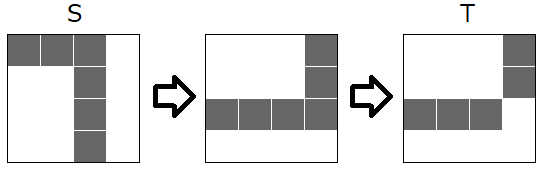
下図のようにして 2 回の操作で S を T と一致させることができます。
入力例 2
13
.#..###..##..
#.#.#..#.#.#.
#.#.###..#...
###.#..#.#.#.
#.#.###..##..
.............
..#...#....#.
.##..#.#..##.
#.#..#.#.#.#.
####.#.#.####
..#..#.#...#.
..#...#....#.
.............
.............
.#....#...#..
.#...#.#..#..
####.#.#.####
.#.#.###..#.#
.##....#..##.
.#....#...#..
.............
..##..###.#.#
.#.#.#..#.###
.#.#..###.#.#
.#.#.#..#.#.#
..##..###..#.
出力例 2
5
Score : 250 points
Problem Statement
There are two grids S and T, each with N rows and N columns. Let (i,j) denote the cell at the i-th row from the top and the j-th column from the left.
Each cell of grids S and T is colored either white or black. Cell (i,j) of S is white if S_{i,j} is ., and black if S_{i,j} is #. The same applies to T.
You may perform the following two types of operations any number of times in any order. Find the minimum number of operations required to make grid S identical to grid T.
- Choose one cell of grid S and change its color.
- Rotate the entire grid S 90 degrees clockwise.
Constraints
- 1 \le N \le 100
- N is an integer.
- Each of S_{i,j} and T_{i,j} is
.or#.
Input
The input is given from Standard Input in the following format:
N
S_{1,1}S_{1,2}\dots S_{1,N}
\vdots
S_{N,1}S_{N,2}\dots S_{N,N}
T_{1,1}T_{1,2}\dots T_{1,N}
\vdots
T_{N,1}T_{N,2}\dots T_{N,N}
Output
Output the minimum number of operations required.
Sample Input 1
4
###.
..#.
..#.
..#.
...#
...#
###.
....
Sample Output 1
2
You can match S to T in two operations as shown below.
Sample Input 2
13
.#..###..##..
#.#.#..#.#.#.
#.#.###..#...
###.#..#.#.#.
#.#.###..##..
.............
..#...#....#.
.##..#.#..##.
#.#..#.#.#.#.
####.#.#.####
..#..#.#...#.
..#...#....#.
.............
.............
.#....#...#..
.#...#.#..#..
####.#.#.####
.#.#.###..#.#
.##....#..##.
.#....#...#..
.............
..##..###.#.#
.#.#.#..#.###
.#.#..###.#.#
.#.#.#..#.#.#
..##..###..#.
Sample Output 2
5
実行時間制限: 2 sec / メモリ制限: 1024 MiB
配点 : 300 点
問題文
整数 N が与えられるので、以下の条件を全て満たす整数 X の個数を 998244353 で割った余りを求めてください。
- N 桁の正整数である。
- X の各桁を上の位から順に X_1,X_2,\dots,X_N とする。このとき以下の条件を全て満たす。
- 全ての整数 1 \le i \le N に対して、 1 \le X_i \le 9
- 全ての整数 1 \le i \le N-1 に対して、 |X_i-X_{i+1}| \le 1
制約
- N は整数
- 2 \le N \le 10^6
入力
入力は以下の形式で標準入力から与えられる。
N
出力
答えを整数として出力せよ。
入力例 1
4
出力例 1
203
4 桁の整数として、例えば 1111,1234,7878,6545 が問題文中の条件を満たします。
入力例 2
2
出力例 2
25
入力例 3
1000000
出力例 3
248860093
998244353 で割った余りを求めることに注意してください。
Score : 300 points
Problem Statement
Given an integer N, find the number of integers X that satisfy all of the following conditions, modulo 998244353.
- X is an N-digit positive integer.
- Let X_1,X_2,\dots,X_N be the digits of X from top to bottom. They satisfy all of the following:
- 1 \le X_i \le 9 for all integers 1 \le i \le N;
- |X_i-X_{i+1}| \le 1 for all integers 1 \le i \le N-1.
Constraints
- N is an integer.
- 2 \le N \le 10^6
Input
Input is given from Standard Input in the following format:
N
Output
Print the answer as an integer.
Sample Input 1
4
Sample Output 1
203
Some of the 4-digit integers satisfying the conditions are 1111,1234,7878,6545.
Sample Input 2
2
Sample Output 2
25
Sample Input 3
1000000
Sample Output 3
248860093
Be sure to find the count modulo 998244353.