Time Limit: 2 sec / Memory Limit: 1024 MiB
配点 : 100 点
問題文
0 以上 255 以下の整数 A,B が与えられます。 A \text{ xor }C=B となる 0 以上の整数 C を求めてください。
なお、そのような C はただ 1 つ存在し、0 以上 255 以下であることが証明されます。
\text{ xor } とは
整数 a, b のビットごとの排他的論理和 a \text{ xor } b は、以下のように定義されます。
- a \text{ xor } b を二進表記した際の 2^k (k \geq 0) の位の数は、a, b を二進表記した際の 2^k の位の数のうち一方のみが 1 であれば 1、そうでなければ 0 である。
制約
- 0\leq A,B \leq 255
- 入力に含まれる値は全て整数である
入力
入力は以下の形式で標準入力から与えられる。
A B
出力
答えを出力せよ。
入力例 1
3 6
出力例 1
5
3 は 二進表記で 11、5 は二進表記で 101 なので、これらの \text{xor} は二進表記で 110 であり、十進表記で 6 です。
このように、3 \text{ xor } 5 = 6 となるので、答えは 5 です。
入力例 2
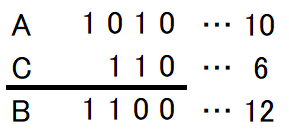
10 12
出力例 2
6
Score : 100 points
Problem Statement
You are given integers A and B between 0 and 255 (inclusive). Find a non-negative integer C such that A \text{ xor }C=B.
It can be proved that there uniquely exists such C, and it will be between 0 and 255 (inclusive).
What is bitwise \mathrm{XOR}?
The bitwise \mathrm{XOR} of integers A and B, A\ \mathrm{XOR}\ B, is defined as follows:
- When A\ \mathrm{XOR}\ B is written in base two, the digit in the 2^k's place (k \geq 0) is 1 if exactly one of A and B is 1, and 0 otherwise.
Constraints
- 0\leq A,B \leq 255
- All values in input are integers.
Input
Input is given from Standard Input in the following format:
A B
Output
Print the answer.
Sample Input 1
3 6
Sample Output 1
5
When written in binary, 3 will be 11, and 5 will be 101. Thus, their \text{xor} will be 110 in binary, or 6 in decimal.
In short, 3 \text{ xor } 5 = 6, so the answer is 5.
Sample Input 2
10 12
Sample Output 2
6
Time Limit: 2 sec / Memory Limit: 1024 MiB
配点 : 100 点
問題文
長さ 3 の英大文字からなる文字列 S が与えられます。
S の各文字を並び替えることで S を文字列 ABC と一致させることができるか判定してください。
制約
- S は英大文字からなる長さ 3 の文字列
入力
入力は以下の形式で標準入力から与えられる。
S
出力
S の各文字を並び替えることで文字列 ABC と一致させることができるなら Yes を、そうでないなら No を出力せよ。
入力例 1
BAC
出力例 1
Yes
S の 1 文字目と S の 2 文字目を入れ替えることで ABC と一致させることができます。
入力例 2
AAC
出力例 2
No
どのように並び替えても S を ABC と一致させることはできません。
入力例 3
ABC
出力例 3
Yes
入力例 4
ARC
出力例 4
No
Score : 100 points
Problem Statement
You are given a string S of length 3 consisting of uppercase English letters.
Determine whether it is possible to rearrange the characters in S to make it match the string ABC.
Constraints
- S is a string of length 3 consisting of uppercase English letters.
Input
The input is given from Standard Input in the following format:
S
Output
Print Yes if it is possible to rearrange the characters in S to make it match the string ABC, and No otherwise.
Sample Input 1
BAC
Sample Output 1
Yes
You can make S match ABC by swapping the first and second characters of S.
Sample Input 2
AAC
Sample Output 2
No
You cannot make S match ABC no matter how you rearrange the characters.
Sample Input 3
ABC
Sample Output 3
Yes
Sample Input 4
ARC
Sample Output 4
No
Time Limit: 2 sec / Memory Limit: 1024 MiB
配点 : 200 点
問題文
ナオヒロ君は N+1 個の連続する整数を 1 個ずつ持っていましたが、そのうち 1 個をなくしてしまいました。
残っている N 個の整数が順不同で A_1,\ldots,A_N として与えられるので、なくした整数を求めてください。
なお、なくした整数が一意に定まるような入力のみが与えられます。
制約
- 2 \leq N \leq 100
- 1 \leq A_i \leq 1000
- 入力は全て整数である
- なくした整数は一意に定まる
入力
入力は以下の形式で標準入力から与えられる。
N
A_1 A_2 \ldots A_N
出力
答えを出力せよ。
入力例 1
3
2 3 5
出力例 1
4
ナオヒロ君は初め 2,3,4,5 の 4 個の整数を持っており、4 をなくし、2,3,5 が残っていました。
なくした整数である 4 を出力します。
入力例 2
8
3 1 4 5 9 2 6 8
出力例 2
7
入力例 3
16
152 153 154 147 148 149 158 159 160 155 156 157 144 145 146 150
出力例 3
151
Score : 200 points
Problem Statement
Naohiro had N+1 consecutive integers, one of each, but he lost one of them.
The remaining N integers are given in arbitrary order as A_1,\ldots,A_N. Find the lost integer.
The given input guarantees that the lost integer is uniquely determined.
Constraints
- 2 \leq N \leq 100
- 1 \leq A_i \leq 1000
- All input values are integers.
- The lost integer is uniquely determined.
Input
The input is given from Standard Input in the following format:
N
A_1 A_2 \ldots A_N
Output
Print the answer.
Sample Input 1
3
2 3 5
Sample Output 1
4
Naohiro originally had four integers, 2,3,4,5, then lost 4, and now has 2,3,5.
Print the lost integer, 4.
Sample Input 2
8
3 1 4 5 9 2 6 8
Sample Output 2
7
Sample Input 3
16
152 153 154 147 148 149 158 159 160 155 156 157 144 145 146 150
Sample Output 3
151
Time Limit: 2 sec / Memory Limit: 1024 MiB
配点 : 200 点
問題文
1, \dots, N と番号付けられた N 個の都市と、都市間を結ぶ M 本の道路があります。
i \, (1 \leq i \leq M) 番目の道路は都市 A_i と都市 B_i を結んでいます。
以下の指示に従い、N 行にわたって出力してください。
- 都市 i \, (1 \leq i \leq N) と道路で直接結ばれた都市が d_i 個あるとし、それらを昇順に都市 a_{i, 1}, \dots, a_{i, d_i} とおく。
- i \, (1 \leq i \leq N) 行目には、d_i + 1 個の整数 d_i, a_{i, 1}, \dots, a_{i, d_i} を、この順番で空白区切りで出力せよ。
制約
- 2 \leq N \leq 10^5
- 1 \leq M \leq 10^5
- 1 \leq A_i \lt B_i \leq N \, (1 \leq i \leq M)
- (i \neq j) ならば (A_i, B_i) \neq (A_j, B_j)
- 入力される値は全て整数
入力
入力は以下の形式で標準入力から与えられる。
N M
A_1 B_1
\vdots
A_M B_M
出力
問題文の指示に従い、N 行にわたって出力せよ。
入力例 1
6 6
3 6
1 3
5 6
2 5
1 2
1 6
出力例 1
3 2 3 6
2 1 5
2 1 6
0
2 2 6
3 1 3 5
都市 1 と道路で直接結ばれているのは都市 2, 3, 6 です。よって、d_1 = 3, a_{1, 1} = 2, a_{1, 2} = 3, a_{1, 3} = 6 であるので、1 行目には 3, 2, 3, 6 をこの順番で空白区切りで出力します。
a_{i, 1}, \dots, a_{i, d_i} は昇順に並んでいなければならないことに注意してください。例えば、1 行目に 3, 3, 2, 6 をこの順番で出力した場合、不正解となります。
入力例 2
5 10
1 2
1 3
1 4
1 5
2 3
2 4
2 5
3 4
3 5
4 5
出力例 2
4 2 3 4 5
4 1 3 4 5
4 1 2 4 5
4 1 2 3 5
4 1 2 3 4
Score : 200 points
Problem Statement
There are N cities numbered 1, \dots, N, and M roads connecting cities.
The i-th road (1 \leq i \leq M) connects city A_i and city B_i.
Print N lines as follows.
- Let d_i be the number of cities directly connected to city i \, (1 \leq i \leq N), and those cities be city a_{i, 1}, \dots, city a_{i, d_i}, in ascending order.
- The i-th line (1 \leq i \leq N) should contain d_i + 1 integers d_i, a_{i, 1}, \dots, a_{i, d_i} in this order, separated by spaces.
Constraints
- 2 \leq N \leq 10^5
- 1 \leq M \leq 10^5
- 1 \leq A_i \lt B_i \leq N \, (1 \leq i \leq M)
- (A_i, B_i) \neq (A_j, B_j) if (i \neq j).
- All values in the input are integers.
Input
The input is given from Standard Input in the following format:
N M
A_1 B_1
\vdots
A_M B_M
Output
Print N lines as specified in the Problem Statement.
Sample Input 1
6 6
3 6
1 3
5 6
2 5
1 2
1 6
Sample Output 1
3 2 3 6
2 1 5
2 1 6
0
2 2 6
3 1 3 5
The cities directly connected to city 1 are city 2, city 3, and city 6. Thus, we have d_1 = 3, a_{1, 1} = 2, a_{1, 2} = 3, a_{1, 3} = 6, so you should print 3, 2, 3, 6 in the first line in this order, separated by spaces.
Note that a_{i, 1}, \dots, a_{i, d_i} must be in ascending order. For instance, it is unacceptable to print 3, 3, 2, 6 in the first line in this order.
Sample Input 2
5 10
1 2
1 3
1 4
1 5
2 3
2 4
2 5
3 4
3 5
4 5
Sample Output 2
4 2 3 4 5
4 1 3 4 5
4 1 2 4 5
4 1 2 3 5
4 1 2 3 4
Time Limit: 2 sec / Memory Limit: 1024 MiB
配点 : 300 点
問題文
1 から N の番号がついた N 個のボールが袋に入っています。ボール i には整数 A_i が書かれています。
Q 個のクエリを処理してください。
クエリでは長さ K の数列 B_1, B_2, \dots, B_{K} が与えられるので以下の一連の操作を行ってください。ここで、B_i は全て 1 以上 N 以下で、かつ相異なります。
- まず、ボール B_1, ボール B_2, \dots, ボール B_K を全て袋から取り出す。
- そして、現在の袋に入っているボールに書かれた整数の最小値を出力する。(この時、袋は空でないことが制約から保証されている。)
- その後、取り出した K 個のボールを全て袋に戻す。
制約
- 6 \leq N \leq 3 \times 10^5
- 1 \leq Q \leq 2 \times 10^5
- 1 \leq A_i \leq 10^9
- 1 \leq K \leq 5
- 1 \leq B_1 \lt B_2 \lt \dots \lt B_K \leq N
- 全てのクエリに対する K の総和は 4 \times 10^5 以下
- 入力される値は全て整数
入力
入力は以下の形式で標準入力から与えられる。ここで \mathrm{query}_i は i 番目のクエリを意味する。
N Q
A_1 A_2 \dots A_N
\mathrm{query}_1
\mathrm{query}_2
\vdots
\mathrm{query}_Q
クエリは以下の形式で与えられる。
K
B_1 B_2 \dots B_K
出力
Q 行出力せよ。i 行目には i 番目のクエリの答えを出力せよ。
入力例 1
6 6
3 2 5 9 1 2
2
4 5
5
1 2 3 4 6
3
2 5 6
4
1 2 5 6
1
5
3
1 2 3
出力例 1
2
1
3
5
2
1
例えば 1 番目のクエリでは、ボール 4 とボール 5 を袋から取り出します。この時、袋には以下の 4 個のボールが残っています:
- 3 が書き込まれたボール 1
- 2 が書き込まれたボール 2
- 5 が書き込まれたボール 3
- 2 が書き込まれたボール 6
よってこの時の袋に入っているボールに書かれた整数の最小値は 2 です。
Score : 300 points
Problem Statement
A bag contains N balls numbered 1 to N. Ball i has the integer A_i written on it.
Process Q queries.
For each query, a sequence B_1, B_2, \dots, B_{K} of length K is given, and you should perform the following sequence of operations. Here, all B_i are between 1 and N inclusive and are distinct.
- First, remove balls B_1, B_2, \dots, B_K from the bag.
- Then, output the minimum value among the integers written on the balls currently in the bag. (It is guaranteed by the constraints that the bag is not empty at this point.)
- Afterwards, return all K removed balls to the bag.
Constraints
- 6 \leq N \leq 3 \times 10^5
- 1 \leq Q \leq 2 \times 10^5
- 1 \leq A_i \leq 10^9
- 1 \leq K \leq 5
- 1 \leq B_1 \lt B_2 \lt \dots \lt B_K \leq N
- The sum of K over all queries is at most 4 \times 10^5.
- All input values are integers.
Input
The input is given from Standard Input in the following format, where \mathrm{query}_i denotes the i-th query.
N Q
A_1 A_2 \dots A_N
\mathrm{query}_1
\mathrm{query}_2
\vdots
\mathrm{query}_Q
Each query is given in the following format.
K
B_1 B_2 \dots B_K
Output
Output Q lines. The i-th line should contain the answer to the i-th query.
Sample Input 1
6 6
3 2 5 9 1 2
2
4 5
5
1 2 3 4 6
3
2 5 6
4
1 2 5 6
1
5
3
1 2 3
Sample Output 1
2
1
3
5
2
1
For example, in the first query, balls 4 and 5 are removed from the bag. At this point, the following four balls remain in the bag:
- Ball 1 with 3 written on it
- Ball 2 with 2 written on it
- Ball 3 with 5 written on it
- Ball 6 with 2 written on it
Thus, the minimum value among the integers written on the balls in the bag is 2.