Time Limit: 2 sec / Memory Limit: 1024 MiB
配点 : 100 点
問題文
AtCoder では、ユーザーのレートは正の整数で与えられ、その値に応じて ^ がいくつか表示されます。
特に、レートが 1 以上 399 以下のときは次のようになります。
- レートが 1 以上 99 以下のときは
^は 1 個表示される。 - レートが 100 以上 199 以下のときは
^は 2 個表示される。 - レートが 200 以上 299 以下のときは
^は 3 個表示される。 - レートが 300 以上 399 以下のときは
^は 4 個表示される。
現在の高橋君のレートは R です。ここで、R は 1 以上 299 以下の整数であることが保証されます。
表示される ^ の数を現在より増やすために、高橋君は少なくともレートをいくつ上げる必要があるか答えてください。
なお、本問題の制約下で、高橋君はレートを 400 以上に上げることなく ^ の数を増やすことができることが証明できます。
制約
- 1\leq R \leq 299
- R は整数
入力
入力は以下の形式で標準入力から与えられる。
R
出力
表示される ^ の数を現在より増やすために、高橋君は少なくともレートをいくつ上げる必要があるか整数で出力せよ。
入力例 1
123
出力例 1
77
高橋君の現在のレートは 123 であり、^ は 2 個表示されています。
ここからレートを 77 上げると高橋君のレートは 200 となり、^ は 3 個表示されるようになります。
レート が 199 以下のときは ^ の数は 2 個以下であるので、77 を出力します。
入力例 2
250
出力例 2
50
Score : 100 points
Problem Statement
In AtCoder, a user's rating is given as a positive integer, and based on this value, a certain number of ^ is displayed.
Specifically, when the rating is between 1 and 399, inclusive, the display rules are as follows:
- When the rating is between 1 and 99, inclusive,
^is displayed once. - When the rating is between 100 and 199, inclusive,
^is displayed twice. - When the rating is between 200 and 299, inclusive,
^is displayed three times. - When the rating is between 300 and 399, inclusive,
^is displayed four times.
Currently, Takahashi's rating is R. Here, it is guaranteed that R is an integer between 1 and 299, inclusive.
Find the minimum increase in rating required for him to increase the number of displayed ^.
It can be proved that under the constraints of this problem, he can increase the number of ^ without raising his rating to 400 or above.
Constraints
- 1 \leq R \leq 299
- R is an integer.
Input
The input is given from Standard Input in the following format:
R
Output
Print, as an integer, the minimum increase in rating required for Takahashi to increase the number of displayed ^.
Sample Input 1
123
Sample Output 1
77
Takahashi's current rating is 123, and ^ is displayed twice.
By increasing his rating by 77, his rating will become 200, and ^ will be displayed three times.
When the rating is 199 or below, ^ is displayed not more than twice, so print 77.
Sample Input 2
250
Sample Output 2
50
Time Limit: 2 sec / Memory Limit: 1024 MiB
配点 : 100 点
問題文
キーエンスでは、役割や年齢、立場の違いに関係なく「さん」付けして呼ぶという文化があります。 新入社員が社長を呼ぶときも「中田さん」と呼びます。
ある人の苗字と名前がそれぞれ文字列 S,T として与えられます。
苗字、スペース( )、敬称(san)をこの順に連結した文字列を出力してください。
制約
- S,T は以下の各条件を満たす文字列
- 長さ 1 以上 10 以下
- 先頭の文字は英大文字
- 先頭以外の文字は英小文字
入力
入力は以下の形式で標準入力から与えられる。
S T
出力
苗字、スペース( )、敬称(san)をこの順に連結した文字列を出力せよ。
入力例 1
Takahashi Chokudai
出力例 1
Takahashi san
苗字(Takahashi)、スペース( )、敬称(san)をこの順に連結した文字列を出力します。
入力例 2
K Eyence
出力例 2
K san
Score : 100 points
Problem Statement
Keyence has a culture of addressing everyone with the honorific "san," regardless of their role, age, or position. Even a new employee would call the president "Nakata-san." [Translator's note: this is a bit unusual in Japan.]
You are given a person's surname and first name as strings S and T, respectively.
Print the concatenation of the surname, a space ( ), and the honorific (san) in this order.
Constraints
- Each of S and T is a string that satisfies the following conditions.
- The length is between 1 and 10, inclusive.
- The first character is an uppercase English letter.
- All characters except the first one are lowercase English letters.
Input
The input is given from Standard Input in the following format:
S T
Output
Print the concatenation of the surname, a space ( ), and the honorific (san) in this order.
Sample Input 1
Takahashi Chokudai
Sample Output 1
Takahashi san
Print the concatenation of the surname (Takahashi), a space ( ), and the honorific (san) in this order.
Sample Input 2
K Eyence
Sample Output 2
K san
Time Limit: 2 sec / Memory Limit: 1024 MiB
配点 : 200 点
問題文
英小文字からなる長さ N の文字列 S が与えられます。 S の x 文字目 (1 \le x \le N) は S_x です。
i=1,2,\dots,N-1 それぞれについて、以下の条件を全て満たす最大の非負整数 l を求めてください。
- l+i \le N である。
- 全ての 1 \le k \le l を満たす整数 k について、 S_{k} \neq S_{k+i} を満たす。
なお、 l=0 は常に条件を満たすことに注意してください。
制約
- N は 2 \le N \le 5000 を満たす整数
- S は英小文字からなる長さ N の文字列
入力
入力は以下の形式で標準入力から与えられる。
N
S
出力
N-1 行にわたって出力せよ。そのうち x 行目 (1 \le x < N) には i=x とした場合の答えを整数として出力せよ。
入力例 1
6
abcbac
出力例 1
5
1
2
0
1
この入力では、 S= abcbac です。
- i=1 のとき、 S_1 \neq S_2, S_2 \neq S_3, \dots ,S_5 \neq S_6 であるため、 最大値は l=5 です。
- i=2 のとき、 S_1 \neq S_3 ですが S_2 = S_4 であるため、 最大値は l=1 です。
- i=3 のとき、 S_1 \neq S_4, S_2 \neq S_5 ですが S_3 = S_6 であるため、 最大値は l=2 です。
- i=4 のとき、 S_1 = S_5 であるため、 最大値は l=0 です。
- i=5 のとき、 S_1 \neq S_6 であるため、 最大値は l=1 です。
Score : 200 points
Problem Statement
You are given a string S of length N consisting of lowercase English letters. The x-th (1 \le x \le N) character of S is S_x.
For each i=1,2,\dots,N-1, find the maximum non-negative integer l that satisfies all of the following conditions:
- l+i \le N, and
- for all integers k such that 1 \le k \le l, it holds that S_{k} \neq S_{k+i}.
Note that l=0 always satisfies the conditions.
Constraints
- N is an integer such that 2 \le N \le 5000.
- S is a string of length N consisting of lowercase English letters.
Input
The input is given from Standard Input in the following format:
N
S
Output
Print (N-1) lines. The x-th (1 \le x < N) line should contain the answer as an integer when i=x.
Sample Input 1
6
abcbac
Sample Output 1
5
1
2
0
1
In this input, S= abcbac.
- When i=1, we have S_1 \neq S_2, S_2 \neq S_3, \dots, and S_5 \neq S_6, so the maximum value is l=5.
- When i=2, we have S_1 \neq S_3 but S_2 = S_4, so the maximum value is l=1.
- When i=3, we have S_1 \neq S_4 and S_2 \neq S_5 but S_3 = S_6, so the maximum value is l=2.
- When i=4, we have S_1 = S_5, so the maximum value is l=0.
- When i=5, we have S_1 \neq S_6, so the maximum value is l=1.
Time Limit: 2 sec / Memory Limit: 1024 MiB
配点 : 200 点
問題文
1 から N の番号がついた N 人の人がいます。
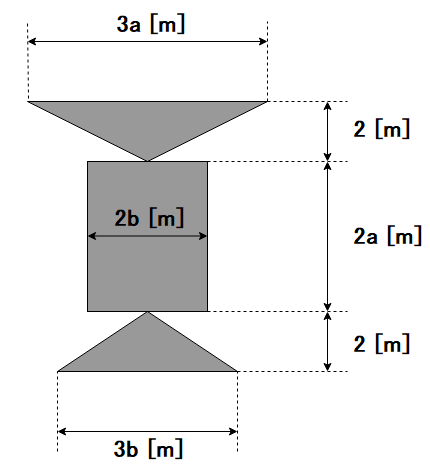
人 i はキーエンス本社ビルの建築面積を S_i 平方メートルであると予想しました。
キーエンス本社ビルは下図のような形をしています。ただし、a,b はある 正の整数 です。
つまり、キーエンス本社ビルの建築面積は 4ab+3a+3b 平方メートルと表されます。
N 人のうち、この情報のみによって、予想した面積が確実に誤りであるとわかる人数を求めてください。
制約
- 1 \leq N \leq 20
- 1 \leq S_i \leq 1000
- 入力に含まれる値は全て整数である
入力
入力は以下の形式で標準入力から与えられる。
N
S_1 \ldots S_N
出力
答えを出力せよ。
入力例 1
3
10 20 39
出力例 1
1
a=1,b=1 のとき面積は 10 平方メートル、a=2,b=3 のとき面積は 39 平方メートルとなります。
しかし a,b がどのような正の整数であったとしても面積が 20 平方メートルになることはありません。
よって、人 2 の予想だけは確実に誤りであることがわかります。
入力例 2
5
666 777 888 777 666
出力例 2
3
Score : 200 points
Problem Statement
There are N people numbered 1 to N.
Person i guessed the building area of KEYENCE headquarters building to be S_i square meters.
The shape of KEYENCE headquarters building is shown below, where a and b are some positive integers.
That is, the building area of the building can be represented as 4ab+3a+3b.
Based on just this information, how many of the N people are guaranteed to be wrong in their guesses?
Constraints
- 1 \leq N \leq 20
- 1 \leq S_i \leq 1000
- All values in input are integers.
Input
Input is given from Standard Input in the following format:
N
S_1 \ldots S_N
Output
Print the answer.
Sample Input 1
3
10 20 39
Sample Output 1
1
The area would be 10 square meters if a=1,b=1, and 39 square meters if a=2,b=3.
However, no pair of positive integers a and b would make the area 20 square meters.
Thus, we can only be sure that Person 2 guessed wrong.
Sample Input 2
5
666 777 888 777 666
Sample Output 2
3
Time Limit: 4 sec / Memory Limit: 1024 MiB
配点 : 300 点
問題文
高橋君は全 10^9 巻の漫画『すぬけ君』を読むことにしました。
初め、高橋君は『すぬけ君』の単行本を N 冊持っています。i 番目の単行本は a_i 巻です。
高橋君は『すぬけ君』を読み始める前に限り次の操作を 0 回以上何度でも繰り返せます。
- 現在持っている単行本が 1 冊以下の場合、何もしない。そうでない場合、現在持っている単行本から 2 冊を選んで売り、代わりに好きな巻を選んで 1 冊買う
その後、高橋君は『すぬけ君』を 1 巻、2 巻、3 巻、\ldots と順番に読みます。ただし、次に読むべき巻を持っていない状態になった場合、(他の巻を持っているかどうかに関わらず)その時点で『すぬけ君』を読むのをやめます。
高橋君が『すぬけ君』を最大で何巻まで読めるかを求めてください。ただし、1 巻を読めない場合の答えは 0 とします。
制約
- 1 \leq N \leq 3 \times 10^5
- 1 \leq a_i \leq 10^9
- 入力はすべて整数
入力
入力は以下の形式で標準入力から与えられる。
N
a_1 \ldots a_N
出力
答えを出力せよ。
入力例 1
6
1 2 4 6 7 271
出力例 1
4
『すぬけ君』を読み始める前に「7 巻と 271 巻を選んで売り、代わりに 3 巻を選んで 1 冊買う」という内容で操作をすると、高橋君は 1 巻、2 巻、3 巻、4 巻、6 巻を 1 冊ずつ持っている状態になります。
この状態から『すぬけ君』を読み始めると、高橋君は 1 巻、2 巻、3 巻、4 巻を読み、続いて 5 巻を読もうとしますが持っていないためこの時点で『すぬけ君』を読むのをやめます。
操作の方法を変えても 5 巻を読むことは出来ないため、4 が答えです。
入力例 2
10
1 1 1 1 1 1 1 1 1 1
出力例 2
5
高橋君は同じ巻を 2 冊以上持っているかもしれません。
この入力に対しては以下のように 4 回操作をしてから『すぬけ君』を読み始めることで 5 巻まで読むことが出来、これが最大です。
- 1 巻を 2 冊選んで売り、代わりに 2 巻を選んで 1 冊買う
- 1 巻を 2 冊選んで売り、代わりに 3 巻を選んで 1 冊買う
- 1 巻を 2 冊選んで売り、代わりに 4 巻を選んで 1 冊買う
- 1 巻を 2 冊選んで売り、代わりに 5 巻を選んで 1 冊買う
入力例 3
1
5
出力例 3
0
高橋君は 1 巻を読めません。
Score : 300 points
Problem Statement
Takahashi is going to read a manga series "Snuke-kun" in 10^9 volumes.
Initially, Takahashi has N books of this series. The i-th book is Volume a_i.
Takahashi may repeat the following operation any number of (possibly zero) times only before he begins to read:
- Do nothing if he has 1 or less books; otherwise, sell two of the books he has and buy one book of any volume instead.
Then, Takahashi reads Volume 1, Volume 2, Volume 3, \ldots, in order. However, when he does not have a book of the next volume to read, he stops reading the series (regardless of the other volumes he has).
Find the latest volume of the series that he can read up to. If he cannot read any, let the answer be 0.
Constraints
- 1 \leq N \leq 3 \times 10^5
- 1 \leq a_i \leq 10^9
- All values in the input are integers.
Input
The input is given from Standard Input in the following format:
N
a_1 \ldots a_N
Output
Print the answer.
Sample Input 1
6
1 2 4 6 7 271
Sample Output 1
4
Before he begins to read the series, he may do the following operation: "sell books of Volumes 7 and 271 and buy one book of Volume 3 instead." Then, he has one book each of Volumes 1, 2, 3, 4, and 6.
If he then begins to read the series, he reads Volumes 1, 2, 3, and 4, then tries to read Volume 5. However, he does not have one, so he stops reading at this point.
Regardless of the choices in the operation, he cannot read Volume 5, so the answer is 4.
Sample Input 2
10
1 1 1 1 1 1 1 1 1 1
Sample Output 2
5
Takahashi may have multiple books of the same volume.
For this input, if he performs the following 4 operations before he begins to read the series, he can read up to Volume 5, which is the maximum:
- Sell two books of Volume 1 and buy a book of Volume 2 instead.
- Sell two books of Volume 1 and buy a book of Volume 3 instead.
- Sell two books of Volume 1 and buy a book of Volume 4 instead.
- Sell two books of Volume 1 and buy a book of Volume 5 instead.
Sample Input 3
1
5
Sample Output 3
0
Takahashi cannot read Volume 1.