Time Limit: 2 sec / Memory Limit: 1024 MiB
配点 : 100 点
問題文
縦 H 行、横 W 列のマス目があり、このうち上から i 個目、左から j 個目のマスを (i,j) と呼びます。
このとき、マス (R,C) に辺で隣接するマスの個数を求めてください。
ただし、ある 2 つのマス (a,b),(c,d) が辺で隣接するとは、 |a-c|+|b-d|=1 (|x| を x の絶対値とする) であることを言います。
制約
- 入力は全て整数
- 1 \le R \le H \le 10
- 1 \le C \le W \le 10
入力
入力は以下の形式で標準入力から与えられる。
H W
R C
出力
答えを整数として出力せよ。
入力例 1
3 4
2 2
出力例 1
4
入出力例 1,2,3 に対する説明は、出力例 3 の下にまとめて示します。
入力例 2
3 4
1 3
出力例 2
3
入力例 3
3 4
3 4
出力例 3
2
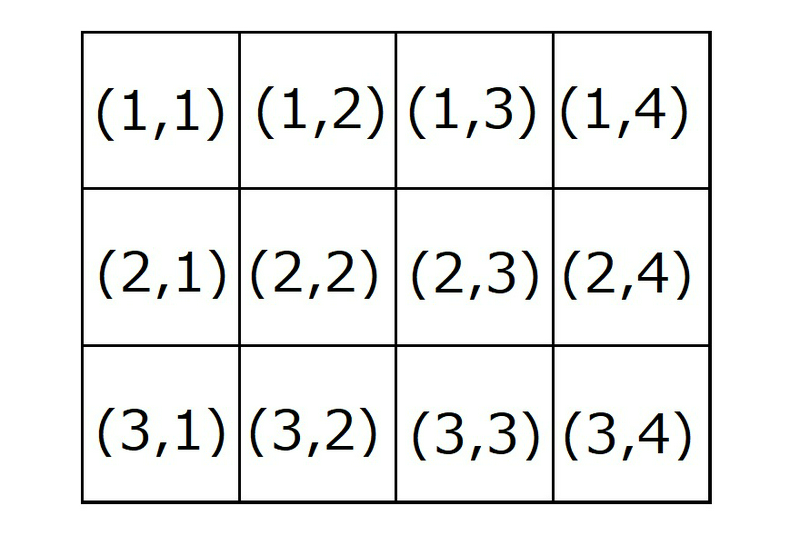
H=3,W=4 のとき、マス目は以下のようになります。
- 入力例 1 について、マス (2,2) に隣接するマスは 4 つです。
- 入力例 2 について、マス (1,3) に隣接するマスは 3 つです。
- 入力例 3 について、マス (3,4) に隣接するマスは 2 つです。
入力例 4
1 10
1 5
出力例 4
2
入力例 5
8 1
8 1
出力例 5
1
入力例 6
1 1
1 1
出力例 6
0
Score : 100 points
Problem Statement
There is a grid with H horizontal rows and W vertical columns. Let (i,j) denote the square at the i-th row from the top and the j-th column from the left.
Find the number of squares that share a side with Square (R, C).
Here, two squares (a,b) and (c,d) are said to share a side if and only if |a-c|+|b-d|=1 (where |x| denotes the absolute value of x).
Constraints
- All values in input are integers.
- 1 \le R \le H \le 10
- 1 \le C \le W \le 10
Input
Input is given from Standard Input in the following format:
H W
R C
Output
Print the answer as an integer.
Sample Input 1
3 4
2 2
Sample Output 1
4
We will describe Sample Inputs/Outputs 1,2, and 3 at once below Sample Output 3.
Sample Input 2
3 4
1 3
Sample Output 2
3
Sample Input 3
3 4
3 4
Sample Output 3
2
When H=3 and W=4, the grid looks as follows.
- For Sample Input 1, there are 4 squares adjacent to Square (2,2).
- For Sample Input 2, there are 3 squares adjacent to Square (1,3).
- For Sample Input 3, there are 2 squares adjacent to Square (3,4).
Sample Input 4
1 10
1 5
Sample Output 4
2
Sample Input 5
8 1
8 1
Sample Output 5
1
Sample Input 6
1 1
1 1
Sample Output 6
0
Time Limit: 2 sec / Memory Limit: 1024 MiB
配点 : 100 点
問題文
野球少年の高橋君は今年とても良い子にしていたので、サンタさんはバットかグローブのうち値段が高い方を高橋君にプレゼントすることにしました。
バットの値段が B 円、グローブの値段が G 円 (B\neq G) のとき、サンタさんが高橋君にプレゼントするのはどちらですか?
制約
- B,G は 1 以上 1000 以下の相異なる整数
入力
入力は以下の形式で標準入力から与えられる。
B G
出力
サンタさんが高橋君にプレゼントするのがバットであるとき Bat を、グローブであるとき Glove を出力せよ。
入力例 1
300 100
出力例 1
Bat
バットの方がグローブより値段が高いので、サンタさんは高橋君にバットをプレゼントします。
入力例 2
334 343
出力例 2
Glove
グローブの方がバットより値段が高いので、サンタさんは高橋君にグローブをプレゼントします。
Score : 100 points
Problem Statement
Takahashi, a young baseball enthusiast, has been a very good boy this year, so Santa has decided to give him a bat or a glove, whichever is more expensive.
If a bat costs B yen and a glove costs G yen (B\neq G), which one will Santa give to Takahashi?
Constraints
- B and G are different integers between 1 and 1000, inclusive.
Input
The input is given from Standard Input in the following format:
B G
Output
If Santa gives Takahashi a bat, print Bat; if Santa gives him a glove, print Glove.
Sample Input 1
300 100
Sample Output 1
Bat
The bat is more expensive than the glove, so Santa will give Takahashi the bat.
Sample Input 2
334 343
Sample Output 2
Glove
The glove is more expensive than the bat, so Santa will give Takahashi the glove.
Time Limit: 2 sec / Memory Limit: 1024 MiB
配点 : 200 点
問題文
-10^{18} 以上 10^{18} 以下の整数 X が与えられるので、\left\lfloor \dfrac{X}{10} \right\rfloor を出力してください。
注記
実数 x に対して、「x 以下の整数の中で最大の整数」を \left\lfloor x \right\rfloor と表します。たとえば \left\lfloor 4.7 \right\rfloor = 4, \left\lfloor -2.4 \right\rfloor = -3, \left\lfloor 5 \right\rfloor = 5 のようになります。(詳しくは入出力例にある説明を参考にしてください。)
制約
- -10^{18} \leq X \leq 10^{18}
- 入力はすべて整数である。
入力
入力は以下の形式で標準入力から与えられる。
X
出力
\left\lfloor \frac{X}{10} \right\rfloor を出力せよ。整数として出力する必要があることに注意せよ。
入力例 1
47
出力例 1
4
\frac{47}{10} = 4.7 以下の整数は、すべての負の整数および 0, 1, 2, 3, 4 です。この中で一番大きい整数は 4 なので、\left\lfloor \frac{47}{10} \right\rfloor = 4 となります。
入力例 2
-24
出力例 2
-3
\frac{-24}{10} = -2.4 以下の整数の中で一番大きい整数は -3 なので、 \left\lfloor \frac{-24}{10} \right\rfloor = -3 となります。
-2 は -2.4 よりも大きいので、条件を満たさないことに注意してください。
入力例 3
50
出力例 3
5
\frac{50}{10} = 5 以下の整数の中で一番大きい整数は 5 自身です。よって \left\lfloor \frac{50}{10} \right\rfloor = 5 となります。
入力例 4
-30
出力例 4
-3
上の例と同様に \left\lfloor \frac{-30}{10} \right\rfloor = -3 となります。
入力例 5
987654321987654321
出力例 5
98765432198765432
答えは 98765432198765432 となります。すべての桁が正しく合っているか確認しましょう。
なお、もしも自分で書いたプログラムが想定通りの挙動をしない場合は、使用しているプログラミング言語の仕様を調べてみることを推奨します。
また、自分の書いたコードがどのように動作するかを確認したい場合は問題文上部の「コードテスト」をご利用ください。
Score : 200 points
Problem Statement
Given an integer X between -10^{18} and 10^{18} (inclusive), print \left\lfloor \dfrac{X}{10} \right\rfloor.
Notes
For a real number x, \left\lfloor x \right\rfloor denotes "the maximum integer not exceeding x". For example, we have \left\lfloor 4.7 \right\rfloor = 4, \left\lfloor -2.4 \right\rfloor = -3, and \left\lfloor 5 \right\rfloor = 5. (For more details, please refer to the description in the Sample Input and Output.)
Constraints
- -10^{18} \leq X \leq 10^{18}
- All values in input are integers.
Input
Input is given from Standard Input in the following format:
X
Output
Print \left\lfloor \frac{X}{10} \right\rfloor. Note that it should be output as an integer.
Sample Input 1
47
Sample Output 1
4
The integers that do not exceed \frac{47}{10} = 4.7 are all the negative integers, 0, 1, 2, 3, and 4. The maximum integer among them is 4, so we have \left\lfloor \frac{47}{10} \right\rfloor = 4.
Sample Input 2
-24
Sample Output 2
-3
Since the maximum integer not exceeding \frac{-24}{10} = -2.4 is -3, we have \left\lfloor \frac{-24}{10} \right\rfloor = -3.
Note that -2 does not satisfy the condition, as -2 exceeds -2.4.
Sample Input 3
50
Sample Output 3
5
The maximum integer that does not exceed \frac{50}{10} = 5 is 5 itself. Thus, we have \left\lfloor \frac{50}{10} \right\rfloor = 5.
Sample Input 4
-30
Sample Output 4
-3
Just like the previous example, \left\lfloor \frac{-30}{10} \right\rfloor = -3.
Sample Input 5
987654321987654321
Sample Output 5
98765432198765432
The answer is 98765432198765432. Make sure that all the digits match.
If your program does not behave as intended, we recommend you checking the specification of the programming language you use.
If you want to check how your code works, you may use "Custom Test" above the Problem Statement.
Time Limit: 2 sec / Memory Limit: 1024 MiB
配点 : 200 点
問題文
H 行 W 列のブロックからなる長方形状のチョコレートがあります。
Q 個のクエリが与えられるので、順に処理したときの各クエリの答えを求めてください。各クエリは、以下のいずれかの形式です。
-
タイプ 1 : 整数 R が与えられる。下 R 行のチョコレートのブロックの個数を求め、それらを食べる。
-
タイプ 2 : 整数 C が与えられる。右 C 列のチョコレートのブロックの個数を求め、それらを食べる。
なお、クエリを順に処理したとき、各クエリを処理した後もチョコレートは長方形状であり、タイプ 1 のクエリを処理する直前の時点でチョコレートは R + 1 行以上存在し、タイプ 2 のクエリを処理する直前の時点でチョコレートは C + 1 列以上存在します。
制約
- 2 \leq H, W \leq 100
- 1 \leq Q \leq 100
- タイプ 1 のクエリについて、1 \leq R
- クエリを順に処理したとき、タイプ 1 のクエリを処理する直前にチョコレートは R + 1 行以上存在する
- タイプ 2 のクエリについて、1 \leq C
- クエリを順に処理したとき、タイプ 2 のクエリを処理する直前にチョコレートは C + 1 列以上存在する
- 入力される値はすべて整数
入力
入力は以下の形式で標準入力から与えられる。
H W Q
\text{query}_1
\text{query}_2
\vdots
\text{query}_Q
ただし、\text{query}_i は i 番目のクエリであり、以下のいずれかの形式で与えられる。
1 R
2 C
出力
Q 行出力せよ。 i (1 \leq i \leq Q) 行目には i 番目のクエリに対する答えを出力せよ。
入力例 1
7 9 5
2 4
1 3
2 1
2 1
1 3
出力例 1
28
15
4
4
9
はじめ、チョコレートは 7 行 9 列の長方形状です。
1 番目のクエリでは、右 4 列のチョコレートの個数は 28 個であるため 28 を出力します。チョコレートは 7 行 5 列となります。
2 番目のクエリでは、下 3 行のチョコレートの個数は 15 個であるため 15 を出力します。チョコレートは 4 行 5 列となります。
3 番目のクエリでは、右 1 列のチョコレートの個数は 4 個であるため 4 を出力します。チョコレートは 4 行 4 列となります。
4 番目のクエリでは、右 1 列のチョコレートの個数は 4 個であるため 4 を出力します。チョコレートは 4 行 3 列となります。
5 番目のクエリでは、下 3 行のチョコレートの個数は 9 個であるため 9 を出力します。チョコレートは 1 行 3 列となります。
Score : 200 points
Problem Statement
There is a rectangular chocolate consisting of H rows and W columns of blocks.
You are given Q queries; process them in order and find the answer to each query. Each query is in one of the following formats:
-
Type 1: An integer R is given. Find the number of chocolate blocks in the bottom R rows, then eat them.
-
Type 2: An integer C is given. Find the number of chocolate blocks in the rightmost C columns, then eat them.
When the queries are processed in order, the chocolate remains rectangular after each query is processed, and it has at least R + 1 rows immediately before processing a type 1 query and has at least C + 1 columns immediately before processing a type 2 query.
Constraints
- 2 \leq H, W \leq 100
- 1 \leq Q \leq 100
- For type 1 queries, 1 \leq R.
- When the queries are processed in order, the chocolate has at least R + 1 rows immediately before processing a type 1 query.
- For type 2 queries, 1 \leq C.
- When the queries are processed in order, the chocolate has at least C + 1 columns immediately before processing a type 2 query.
- All input values are integers.
Input
The input is given from Standard Input in the following format:
H W Q
\text{query}_1
\text{query}_2
\vdots
\text{query}_Q
Here, \text{query}_i is the i-th query, given in one of the following formats:
1 R
2 C
Output
Output Q lines. The i-th line (1 \leq i \leq Q) should contain the answer to the i-th query.
Sample Input 1
7 9 5
2 4
1 3
2 1
2 1
1 3
Sample Output 1
28
15
4
4
9
Initially, the chocolate is a rectangle with 7 rows and 9 columns.
For the first query, the number of chocolate blocks in the rightmost 4 columns is 28, so output 28. The chocolate becomes 7 rows and 5 columns.
For the second query, the number of chocolate blocks in the bottom 3 rows is 15, so output 15. The chocolate becomes 4 rows and 5 columns.
For the third query, the number of chocolate blocks in the rightmost 1 column is 4, so output 4. The chocolate becomes 4 rows and 4 columns.
For the fourth query, the number of chocolate blocks in the rightmost 1 column is 4, so output 4. The chocolate becomes 4 rows and 3 columns.
For the fifth query, the number of chocolate blocks in the bottom 3 rows is 9, so output 9. The chocolate becomes 1 row and 3 columns.
Time Limit: 2 sec / Memory Limit: 1024 MiB
配点 : 300 点
問題文
非負整数 n が次の条件を満たすとき、n を 良い整数 と呼びます。
- n を 10 進法で表したときに、偶数の数字 (0, 2, 4, 6, 8) のみが登場する。
例えば 0、68 および 2024 は良い整数です。
整数 N が与えられます。良い整数のうち小さい方から N 番目の整数を求めてください。
制約
- 1 \leq N \leq 10^{12}
- N は整数
入力
入力は以下の形式で標準入力から与えられる。
N
出力
小さい方から N 番目の良い整数を出力せよ。
入力例 1
8
出力例 1
24
良い整数を小さい方から順に並べると 0, 2, 4, 6, 8, 20, 22, 24, 26, 28, \dots となります。
小さい方から 8 番目の良い整数は 24 なので、これを出力します。
入力例 2
133
出力例 2
2024
入力例 3
31415926535
出力例 3
2006628868244228
Score: 300 points
Problem Statement
A non-negative integer n is called a good integer when it satisfies the following condition:
- All digits in the decimal notation of n are even numbers (0, 2, 4, 6, and 8).
For example, 0, 68, and 2024 are good integers.
You are given an integer N. Find the N-th smallest good integer.
Constraints
- 1 \leq N \leq 10^{12}
- N is an integer.
Input
The input is given from Standard Input in the following format:
N
Output
Print the N-th smallest good integer.
Sample Input 1
8
Sample Output 1
24
The good integers in ascending order are 0, 2, 4, 6, 8, 20, 22, 24, 26, 28, \dots.
The eighth smallest is 24, which should be printed.
Sample Input 2
133
Sample Output 2
2024
Sample Input 3
31415926535
Sample Output 3
2006628868244228