実行時間制限: 2 sec / メモリ制限: 1024 MiB
配点 : 100 点
問題文
v と w のみからなる文字列 S が与えられます。
S の中に、下に尖っている部分が何箇所あるかを出力してください(入出力例にある図もご参照ください)。
制約
- S は
vとwのみからなる文字列 - S の長さは 1 以上 100 以下
入力
入力は以下の形式で標準入力から与えられる。
S
出力
答えを整数として出力せよ。
入力例 1
vvwvw
出力例 1
7

上の画像のように、vvwvw という文字列には下に尖った部分が 7 箇所あります。
入力例 2
v
出力例 2
1
入力例 3
wwwvvvvvv
出力例 3
12
Score : 100 points
Problem Statement
You are given a string S consisting of v and w.
Print the number of "bottoms" in the string S (see the figure at Sample Input/Output).
Constraints
- S is a string consisting of
vandw. - The length of S is between 1 and 100, inclusive.
Input
The input is given from Standard Input in the following format:
S
Output
Print the answer as an integer.
Sample Input 1
vvwvw
Sample Output 1
7
The image above shows the seven "bottoms" in the string vvwvw.
Sample Input 2
v
Sample Output 2
1
Sample Input 3
wwwvvvvvv
Sample Output 3
12
実行時間制限: 2 sec / メモリ制限: 1024 MiB
配点 : 100 点
問題文
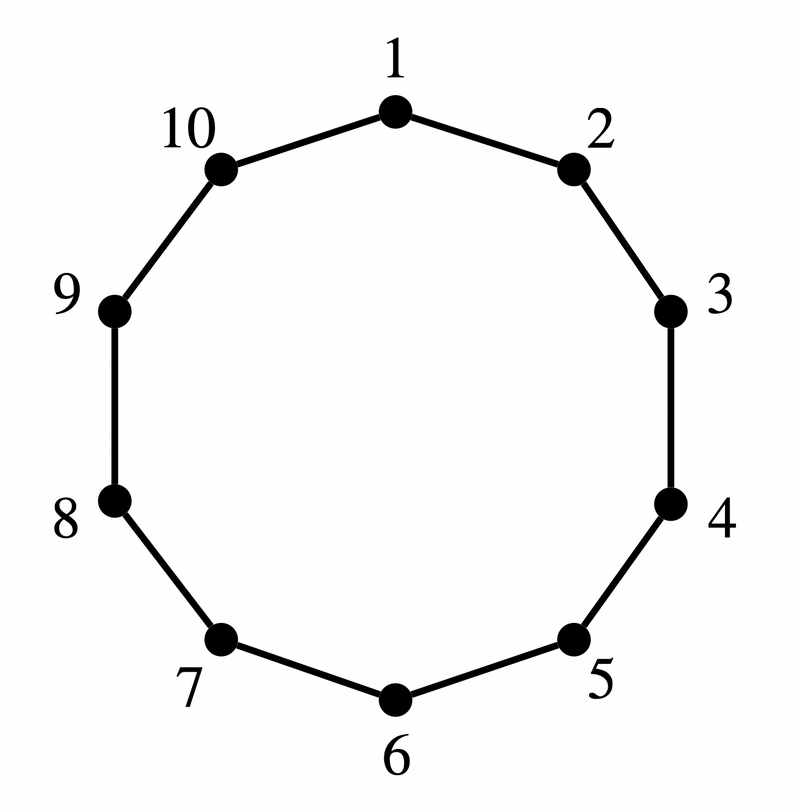
下の画像で示す図において、a 番の点と b 番の点が線で直接結ばれているかを答えてください。
制約
- 1 \leq a \lt b \leq 10
- a, b は整数
入力
入力は以下の形式で標準入力から与えられる。
a b
出力
a 番の点と b 番の点が線で直接結ばれている場合は Yes を出力し、結ばれていない場合は No を出力せよ。
ジャッジは英大文字と英小文字を厳密に区別することに注意せよ。
入力例 1
4 5
出力例 1
Yes
問題文で示した図において、4 番の点と 5 番の点は線で直接結ばれています。
よって、Yes を出力します。
入力例 2
3 5
出力例 2
No
問題文で示した図において、3 番の点と 5 番の点は線で直接結ばれていません。
よって、No を出力します。
入力例 3
1 10
出力例 3
Yes
Score : 100 points
Problem Statement
In the figure shown in the image below, are the points numbered a and b directly connected by a line segment?
Constraints
- 1 \leq a \lt b \leq 10
- a and b are integers.
Input
Input is given from Standard Input in the following format:
a b
Output
If the points numbered a and b are directly connected by a line segment, print Yes; otherwise, print No.
The judge is case-sensitive: be sure to print uppercase and lowercase letters correctly.
Sample Input 1
4 5
Sample Output 1
Yes
In the figure shown in the Problem Statement, the points numbered 4 and 5 are directly connected by a line segment.
Thus, Yes should be printed.
Sample Input 2
3 5
Sample Output 2
No
In the figure shown in the Problem Statement, the points numbered 3 and 5 are not directly connected by a line segment.
Thus, No should be printed.
Sample Input 3
1 10
Sample Output 3
Yes
実行時間制限: 2 sec / メモリ制限: 1024 MiB
配点 : 200 点
問題文
H 行 W 列の行列 A が与えられます。
A の上から i 行目、左から j 列目の要素は A_{i,j} です。
ここで、W 行 H 列の行列 B を、上から i 行目、左から j 列目の要素が A_{j,i} と一致するような行列として定めます。
すなわち、B は A の転置行列です。
B を出力してください。
制約
- 1\leq H,W \leq 10^5
- H \times W \leq 10^5
- 1 \leq A_{i,j} \leq 10^9
- 入力は全て整数である
入力
入力は以下の形式で標準入力から与えられる。
H W
A_{1,1} A_{1,2} \ldots A_{1,W}
A_{2,1} A_{2,2} \ldots A_{2,W}
\vdots
A_{H,1} A_{H,2} \ldots A_{H,W}
出力
B を以下の形式で出力せよ。
B_{1,1} B_{1,2} \ldots B_{1,H}
B_{2,1} B_{2,2} \ldots B_{2,H}
\vdots
B_{W,1} B_{W,2} \ldots B_{W,H}
入力例 1
4 3
1 2 3
4 5 6
7 8 9
10 11 12
出力例 1
1 4 7 10
2 5 8 11
3 6 9 12
たとえば A_{2,1}=4 なので、転置行列 B の上から 1 行目、左から 2 列目の要素は 4 になります。
入力例 2
2 2
1000000000 1000000000
1000000000 1000000000
出力例 2
1000000000 1000000000
1000000000 1000000000
Score : 200 points
Problem Statement
You are given an H-by-W matrix A.
The element at the i-th row from the top and j-th column from the left of A is A_{i,j}.
Let B be a W-by-H matrix whose element at the i-th row from the top and j-th column from the left equals A_{j, i}.
That is, B is the transpose of A.
Print B.
Constraints
- 1\leq H,W \leq 10^5
- H \times W \leq 10^5
- 1 \leq A_{i,j} \leq 10^9
- All values in input are integers.
Input
Input is given from Standard Input in the following format:
H W
A_{1,1} A_{1,2} \ldots A_{1,W}
A_{2,1} A_{2,2} \ldots A_{2,W}
\vdots
A_{H,1} A_{H,2} \ldots A_{H,W}
Output
Print B in the following format:
B_{1,1} B_{1,2} \ldots B_{1,H}
B_{2,1} B_{2,2} \ldots B_{2,H}
\vdots
B_{W,1} B_{W,2} \ldots B_{W,H}
Sample Input 1
4 3
1 2 3
4 5 6
7 8 9
10 11 12
Sample Output 1
1 4 7 10
2 5 8 11
3 6 9 12
For example, we have A_{2,1}=4, so the element at the 1-st row from the top and 2-nd column from the left of the transpose B is 4.
Sample Input 2
2 2
1000000000 1000000000
1000000000 1000000000
Sample Output 2
1000000000 1000000000
1000000000 1000000000
実行時間制限: 2 sec / メモリ制限: 1024 MiB
配点 : 200 点
問題文
ナオヒロ君は N+1 個の連続する整数を 1 個ずつ持っていましたが、そのうち 1 個をなくしてしまいました。
残っている N 個の整数が順不同で A_1,\ldots,A_N として与えられるので、なくした整数を求めてください。
なお、なくした整数が一意に定まるような入力のみが与えられます。
制約
- 2 \leq N \leq 100
- 1 \leq A_i \leq 1000
- 入力は全て整数である
- なくした整数は一意に定まる
入力
入力は以下の形式で標準入力から与えられる。
N
A_1 A_2 \ldots A_N
出力
答えを出力せよ。
入力例 1
3
2 3 5
出力例 1
4
ナオヒロ君は初め 2,3,4,5 の 4 個の整数を持っており、4 をなくし、2,3,5 が残っていました。
なくした整数である 4 を出力します。
入力例 2
8
3 1 4 5 9 2 6 8
出力例 2
7
入力例 3
16
152 153 154 147 148 149 158 159 160 155 156 157 144 145 146 150
出力例 3
151
Score : 200 points
Problem Statement
Naohiro had N+1 consecutive integers, one of each, but he lost one of them.
The remaining N integers are given in arbitrary order as A_1,\ldots,A_N. Find the lost integer.
The given input guarantees that the lost integer is uniquely determined.
Constraints
- 2 \leq N \leq 100
- 1 \leq A_i \leq 1000
- All input values are integers.
- The lost integer is uniquely determined.
Input
The input is given from Standard Input in the following format:
N
A_1 A_2 \ldots A_N
Output
Print the answer.
Sample Input 1
3
2 3 5
Sample Output 1
4
Naohiro originally had four integers, 2,3,4,5, then lost 4, and now has 2,3,5.
Print the lost integer, 4.
Sample Input 2
8
3 1 4 5 9 2 6 8
Sample Output 2
7
Sample Input 3
16
152 153 154 147 148 149 158 159 160 155 156 157 144 145 146 150
Sample Output 3
151
実行時間制限: 2 sec / メモリ制限: 1024 MiB
配点 : 300 点
問題文
高橋君はレベル N の赤い宝石を 1 個持っています。(他に宝石は持っていません。)
高橋君は次の操作を好きなだけ行うことができます。
- レベル n の赤い宝石 (n は 2 以上) を「レベル n-1 の赤い宝石 1 個と、レベル n の青い宝石 X 個」に変換する。
- レベル n の青い宝石 (n は 2 以上) を「レベル n-1 の赤い宝石 1 個と、レベル n-1 の青い宝石 Y 個」に変換する。
高橋君はレベル 1 の青い宝石ができるだけたくさんほしいです。操作によって高橋君はレベル 1 の青い宝石を最大何個入手できますか?
制約
- 1 \leq N \leq 10
- 1 \leq X \leq 5
- 1 \leq Y \leq 5
- 入力される値はすべて整数
入力
入力は以下の形式で標準入力から与えられる。
N X Y
出力
答えを出力せよ。
入力例 1
2 3 4
出力例 1
12
次のような変換を行うことで、高橋君はレベル 1 の青い宝石を 12 個手に入れることができます。
- まず、レベル 2 の赤い宝石 1 個を、レベル 1 の赤い宝石 1 個とレベル 2 の青い宝石 3 個に変換します。
- 操作後の高橋君は、レベル 1 の赤い宝石 1 個とレベル 2 の青い宝石 3 個を持っています。
- 次に、レベル 2 の青い宝石 1 個を、レベル 1 の赤い宝石 1 個とレベル 1 の青い宝石 4 個に変換します。この変換を 3 回繰り返します。
- 操作後の高橋君は、レベル 1 の赤い宝石 4 個とレベル 1 の青い宝石 12 個を持っています。
- これ以上変換を行うことはできません。
12 個より多くレベル 1 の青い宝石を手に入れることはできないので、答えは 12 になります。
入力例 2
1 5 5
出力例 2
0
高橋君がレベル 1 の青い宝石を 1 個も手に入れられない場合もあります。
入力例 3
10 5 5
出力例 3
3942349900
答えが 32 bit 整数に収まらない場合があることに注意してください。
Score : 300 points
Problem Statement
Takahashi has a red jewel of level N. (He has no other jewels.)
Takahashi can do the following operations any number of times.
- Convert a red jewel of level n (n is at least 2) into "a red jewel of level (n-1) and X blue jewels of level n".
- Convert a blue jewel of level n (n is at least 2) into "a red jewel of level (n-1) and Y blue jewels of level (n-1)".
Takahashi wants as many blue jewels of level 1 as possible. At most, how many blue jewels of level 1 can he obtain by the operations?
Constraints
- 1 \leq N \leq 10
- 1 \leq X \leq 5
- 1 \leq Y \leq 5
- All values in input are integers.
Input
Input is given from Standard Input in the following format:
N X Y
Output
Print the answer.
Sample Input 1
2 3 4
Sample Output 1
12
Takahashi can obtain 12 blue jewels of level 1 by the following conversions.
- First, he converts a red jewel of level 2 into a red jewel of level 1 and 3 blue jewels of level 2.
- After this operation, Takahashi has 1 red jewel of level 1 and 3 blue jewels of level 2.
- Next, he repeats the following conversion 3 times: converting a blue jewel of level 2 into a red jewel of level 1 and 4 blue jewels of level 1.
- After these operations, Takahashi has 4 red jewels of level 1 and 12 blue jewels of level 1.
- He cannot perform a conversion anymore.
He cannot obtain more than 12 blue jewels of level 1, so the answer is 12.
Sample Input 2
1 5 5
Sample Output 2
0
Takahashi may not be able to obtain a blue jewel of level 1.
Sample Input 3
10 5 5
Sample Output 3
3942349900
Note that the answer may not fit into a 32-bit integer type.