実行時間制限: 2 sec / メモリ制限: 1024 MiB
配点 : 100 点
問題文
6 桁の正整数 N が与えられます。
この整数が以下の条件を全て満たすか判定してください。
- N の各桁のうち、 1 は丁度 1 つである。
- N の各桁のうち、 2 は丁度 2 つである。
- N の各桁のうち、 3 は丁度 3 つである。
制約
- N は 100000 \le N \le 999999 を満たす整数
入力
入力は以下の形式で標準入力から与えられる。
N
出力
N が問題文中の条件を全て満たすなら Yes 、そうでないなら No と 1 行に出力せよ。
入力例 1
123233
出力例 1
Yes
123233 は問題文中の条件を満たすので、 Yes と出力します。
入力例 2
123234
出力例 2
No
123234 は問題文中の条件を満たさないので、 No と出力します。
入力例 3
323132
出力例 3
Yes
入力例 4
500000
出力例 4
No
Score : 100 points
Problem Statement
You are given a 6-digit positive integer N.
Determine whether N satisfies all of the following conditions.
- Among the digits of N, the digit 1 appears exactly once.
- Among the digits of N, the digit 2 appears exactly twice.
- Among the digits of N, the digit 3 appears exactly three times.
Constraints
- N is an integer satisfying 100000 \le N \le 999999.
Input
The input is given from Standard Input in the following format:
N
Output
Print Yes if N satisfies all the conditions described in the problem statement, and No otherwise, in one line.
Sample Input 1
123233
Sample Output 1
Yes
123233 satisfies the conditions in the problem statement, so print Yes.
Sample Input 2
123234
Sample Output 2
No
123234 does not satisfy the conditions in the problem statement, so print No.
Sample Input 3
323132
Sample Output 3
Yes
Sample Input 4
500000
Sample Output 4
No
実行時間制限: 2 sec / メモリ制限: 1024 MiB
配点 : 100 点
問題文
正整数 D が与えられます。
直径が D の円の面積を求めて下さい。
制約
- 1\le D\le 100
- 入力される値は整数
入力
入力は以下の形式で標準入力から与えられる。
D
出力
答えを出力せよ。
真の解との絶対誤差または相対誤差が 10^{-6} 以下のとき正解と判定される。
入力例 1
2
出力例 1
3.141592653589793
直径が 2 の円の面積は 3.141592653589793\ldots です。
入力例 2
7
出力例 2
38.48451000647496
入力例 3
98
出力例 3
7542.9639612690935
Score : 100 points
Problem Statement
You are given a positive integer D.
Find the area of a circle with diameter D.
Constraints
- 1\le D\le 100
- The input value is an integer.
Input
The input is given from Standard Input in the following format:
D
Output
Output the answer.
Your answer is considered correct if the absolute or relative error from the true answer is at most 10^{-6}.
Sample Input 1
2
Sample Output 1
3.141592653589793
The area of a circle with diameter 2 is 3.141592653589793\ldots.
Sample Input 2
7
Sample Output 2
38.48451000647496
Sample Input 3
98
Sample Output 3
7542.9639612690935
実行時間制限: 2 sec / メモリ制限: 1024 MiB
配点 : 150 点
問題文
1 から N までの番号がつけられた N 個の国があり、i = 1, 2, \ldots, N について、高橋君は国 i の通貨を A_i 単位持っています。
高橋君は、下記の操作を好きな回数( 0 回でも良い)繰り返します。
- まず、1 以上 N-1 以下の整数 i を選ぶ。
- その後、国 i の通貨を S_i 単位以上持っているなら、下記の行動を 1 回行う。
- 国 i の通貨を S_i 単位だけ支払い、国 (i+1) の通貨を T_i 単位だけ獲得する。
最終的に高橋君が持っている国 N の通貨の単位数としてあり得る最大値を出力してください。
制約
- 入力される値はすべて整数
- 2 \leq N \leq 2 \times 10^5
- 0 \leq A_i \leq 10^9
- 1 \leq T_i \leq S_i \leq 10^9
入力
入力は以下の形式で標準入力から与えられる。
N
A_1 A_2 \ldots A_N
S_1 T_1
S_2 T_2
\vdots
S_{N-1} T_{N-1}
出力
答えを出力せよ。
入力例 1
4
5 7 0 3
2 2
4 3
5 2
出力例 1
5
以下の説明では、高橋君が持っている各国の通貨の単位数を、数列 A = (A_1, A_2, A_3, A_4) として表します。はじめ、A = (5, 7, 0, 3) です。
下記の通りに 4 回操作を行うことを考えます。
- i = 2 を選び、国 2 の通貨 4 単位を支払って、国 3 の通貨 3 単位を獲得する。その結果、A = (5, 3, 3, 3) となる。
- i = 1 を選び、国 1 の通貨 2 単位を支払って、国 2 の通貨 2 単位を獲得する。その結果、A = (3, 5, 3, 3) となる。
- i = 2 を選び、国 2 の通貨 4 単位を支払って、国 3 の通貨 3 単位を獲得する。その結果、A = (3, 1, 6, 3) となる。
- i = 3 を選び、国 3 の通貨 5 単位を支払って、国 4 の通貨 2 単位を獲得する。その結果、A = (3, 1, 1, 5) となる。
このとき、最終的に高橋君が持っている国 4 の通貨の単位数は 5 であり、これが考えられる最大値です。
入力例 2
10
32 6 46 9 37 8 33 14 31 5
5 5
3 1
4 3
2 2
3 2
3 2
4 4
3 3
3 1
出力例 2
45
Score: 150 points
Problem Statement
There are N countries numbered 1 to N. For each i = 1, 2, \ldots, N, Takahashi has A_i units of the currency of country i.
Takahashi can repeat the following operation any number of times, possibly zero:
- First, choose an integer i between 1 and N-1, inclusive.
- Then, if Takahashi has at least S_i units of the currency of country i, he performs the following action once:
- Pay S_i units of the currency of country i and gain T_i units of the currency of country (i+1).
Print the maximum possible number of units of the currency of country N that Takahashi could have in the end.
Constraints
- All input values are integers.
- 2 \leq N \leq 2 \times 10^5
- 0 \leq A_i \leq 10^9
- 1 \leq T_i \leq S_i \leq 10^9
Input
The input is given from Standard Input in the following format:
N
A_1 A_2 \ldots A_N
S_1 T_1
S_2 T_2
\vdots
S_{N-1} T_{N-1}
Output
Print the answer.
Sample Input 1
4
5 7 0 3
2 2
4 3
5 2
Sample Output 1
5
In the following explanation, let the sequence A = (A_1, A_2, A_3, A_4) represent the numbers of units of the currencies of the countries Takahashi has. Initially, A = (5, 7, 0, 3).
Consider performing the operation four times as follows:
- Choose i = 2, pay four units of the currency of country 2, and gain three units of the currency of country 3. Now, A = (5, 3, 3, 3).
- Choose i = 1, pay two units of the currency of country 1, and gain two units of the currency of country 2. Now, A = (3, 5, 3, 3).
- Choose i = 2, pay four units of the currency of country 2, and gain three units of the currency of country 3. Now, A = (3, 1, 6, 3).
- Choose i = 3, pay five units of the currency of country 3, and gain two units of the currency of country 4. Now, A = (3, 1, 1, 5).
At this point, Takahashi has five units of the currency of country 4, which is the maximum possible number.
Sample Input 2
10
32 6 46 9 37 8 33 14 31 5
5 5
3 1
4 3
2 2
3 2
3 2
4 4
3 3
3 1
Sample Output 2
45
実行時間制限: 2 sec / メモリ制限: 1024 MiB
配点 : 200 点
問題文
高橋君は N 軒の店で買い物をしました。はじめ、高橋君は 10000 円持っていました。
i 軒目の店では A_i 円の商品を買って B_i 円支払いました。ここで A_i \leq B_i が成り立ちます。そして、S_i = keep の時、高橋君はお釣りを受け取らず、S_i = take の場合、お釣りを受け取りました。
高橋君が全ての店でお釣りを受け取っていた場合に比べて損した金額を求めてください。厳密に述べると、
- 高橋君の最終的な所持金を X 円、
- 高橋君が全ての店でお釣りを受け取っていた場合の最終的な所持金を Y 円
とした時、Y - X を求めてください。
制約
- 1 \leq N \leq 100
- 1 \leq A_i \leq B_i \leq 100
- S_i は
keepまたはtake - N, A_i, B_i は全て整数
入力
入力は以下の形式で標準入力から与えられる。
N
A_1 B_1 S_1
A_2 B_2 S_2
\vdots
A_N B_N S_N
出力
高橋君が全ての店でお釣りを受け取っていた場合に比べて損した金額を出力せよ。
入力例 1
3
1 2 keep
3 6 take
5 9 keep
出力例 1
5
高橋君の行動を説明すると次の通りです。
- 1 番目の店で 1 円の商品を買い、2 円支払い、お釣りを受け取らなかった。
- 2 番目の店で 3 円の商品を買い、6 円支払い、お釣りを受け取った。
- 3 番目の店で 5 円の商品を買い、9 円支払い、お釣りを受け取らなかった。
入力例 2
8
36 49 take
38 73 keep
27 85 take
65 71 take
52 86 keep
48 60 keep
37 98 keep
5 38 keep
出力例 2
175
Score : 200 points
Problem Statement
Takahashi made purchases at N stores. Initially, he had 10000 yen.
At the i-th store, he bought an item worth A_i yen and paid B_i yen. Here, A_i \leq B_i holds. If S_i = keep, he did not receive the change, and if S_i = take, he received the change.
Find the amount of money he lost compared to the case where he received the change at every store. To be precise,
- let X yen be Takahashi's final amount of money, and
- let Y yen be Takahashi's final amount of money in the case where he received the change at every store.
Find Y - X.
Constraints
- 1 \leq N \leq 100
- 1 \leq A_i \leq B_i \leq 100
- S_i is
keeportake. - N, A_i, B_i are all integers.
Input
The input is given from Standard Input in the following format:
N
A_1 B_1 S_1
A_2 B_2 S_2
\vdots
A_N B_N S_N
Output
Output the amount of money Takahashi lost compared to the case where he received the change at every store.
Sample Input 1
3
1 2 keep
3 6 take
5 9 keep
Sample Output 1
5
Takahashi's actions are as follows.
- At the first store, he bought an item worth 1 yen, paid 2 yen, and did not receive the change.
- At the second store, he bought an item worth 3 yen, paid 6 yen, and received the change.
- At the third store, he bought an item worth 5 yen, paid 9 yen, and did not receive the change.
Sample Input 2
8
36 49 take
38 73 keep
27 85 take
65 71 take
52 86 keep
48 60 keep
37 98 keep
5 38 keep
Sample Output 2
175
実行時間制限: 2 sec / メモリ制限: 1024 MiB
配点 : 300 点
問題文
正の整数 L に対して、 レベル L のダンゴ文字列とは、以下の条件を満たす文字列です。
oと-からなる長さ L+1 の文字列である。- 先頭の文字と末尾の文字のうちちょうど一方が
-であり、そのほかの L 文字はすべてoである。
例えば、ooo- はレベル 3 のダンゴ文字列ですが、-ooo- や oo や o-oo- などはダンゴ文字列ではありません(より正確には、どのような正の整数 L に対してもレベル L のダンゴ文字列ではありません)。
2 種類の文字 o - からなる、長さ N の文字列 S が与えられます。
次の条件を満たすような正整数 X のうち、最大のものを求めてください。
- S の連続する部分文字列であって、レベル X のダンゴ文字列であるものが存在する。
ただし、そのような整数が存在しない場合、-1 と出力してください。
制約
- 1\leq N\leq 2\times10^5
- S は
o-からなる長さ N の文字列
入力
入力は以下の形式で標準入力から与えられる。
N
S
出力
S にレベル X のダンゴ文字列が含まれるような最大の X の値を 1 行で出力せよ。
そのような値が存在しない場合、-1 を出力せよ。
入力例 1
10
o-oooo---o
出力例 1
4
たとえば、S の 3 文字目から 7 文字目までに対応する部分文字列 oooo- は、レベル 4 のダンゴ文字列です。
S の部分文字列であってレベル 5 以上のダンゴ文字列であるようなものは存在しないため、4 と出力してください。
入力例 2
1
-
出力例 2
-1
S の連続する部分文字列は空文字列と - の 2 種類だけです。
これらはダンゴ文字列ではないため、-1 と出力してください。
入力例 3
30
-o-o-oooo-oo-o-ooooooo--oooo-o
出力例 3
7
Score : 300 points
Problem Statement
For a positive integer L, a level-L dango string is a string that satisfies the following conditions.
- It is a string of length L+1 consisting of
oand-. - Exactly one of the first character and the last character is
-, and the other L characters areo.
For instance, ooo- is a level-3 dango string, but none of -ooo-, oo, and o-oo- is a dango string (more precisely, none of them is a level-L dango string for any positive integer L).
You are given a string S of length N consisting of the two characters o and -.
Find the greatest positive integer X that satisfies the following condition.
- There is a contiguous substring of S that is a level-X dango string.
If there is no such integer, print -1.
Constraints
- 1\leq N\leq 2\times10^5
- S is a string of length N consisting of
oand-.
Input
The input is given from Standard Input in the following format:
N
S
Output
Print the greatest positive integer X such that S contains a level-X dango string, or -1 if there is no such integer.
Sample Input 1
10
o-oooo---o
Sample Output 1
4
For instance, the substring oooo- corresponding to the 3-rd through 7-th characters of S is a level-4 dango string.
No substring of S is a level-5 dango string or above, so you should print 4.
Sample Input 2
1
-
Sample Output 2
-1
Only the empty string and - are the substrings of S.
They are not dango strings, so you should print -1.
Sample Input 3
30
-o-o-oooo-oo-o-ooooooo--oooo-o
Sample Output 3
7
実行時間制限: 2 sec / メモリ制限: 1024 MiB
配点 : 300 点
問題文
ある地方に、1 から N の番号がついた N 個の街と、1 から M の番号がついた M 本の道路があります。
i 番目の道路は街 A_i と街 B_i を双方向に結び、長さは C_i です。
好きな街からスタートして同じ街を二度以上通らずに別の街へ移動するときの、通る道路の長さの和としてありえる最大値を求めてください。
制約
- 2 \leq N \leq 10
- 1 \leq M \leq \frac{N(N-1)}{2}
- 1\leq A_i < B_i \leq N
- (A_i,B_i) は相異なる
- 1\leq C_i \leq 10^8
- 入力は全て整数である
入力
入力は以下の形式で標準入力から与えられる。
N M
A_1 B_1 C_1
\vdots
A_M B_M C_M
出力
答えを出力せよ。
入力例 1
4 4
1 2 1
2 3 10
1 3 100
1 4 1000
出力例 1
1110
4\to 1\to 3\to 2 と移動すると、通る道路の長さの和は 1110 となります。
入力例 2
10 1
5 9 1
出力例 2
1
道路と繋がっていない街が存在するかもしれません。
入力例 3
10 13
1 2 1
1 10 1
2 3 1
3 4 4
4 7 2
4 8 1
5 8 1
5 9 3
6 8 1
6 9 5
7 8 1
7 9 4
9 10 3
出力例 3
20
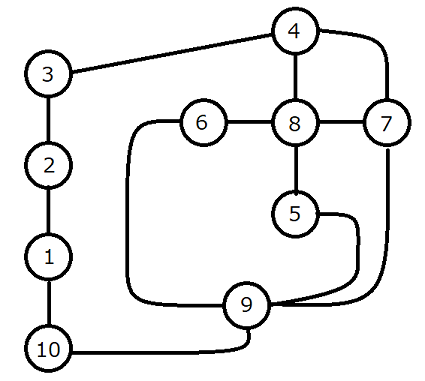
Score : 300 points
Problem Statement
A region has N towns numbered 1 to N, and M roads numbered 1 to M.
The i-th road connects town A_i and town B_i bidirectionally with length C_i.
Find the maximum possible total length of the roads you traverse when starting from a town of your choice and getting to another town without passing through the same town more than once.
Constraints
- 2 \leq N \leq 10
- 1 \leq M \leq \frac{N(N-1)}{2}
- 1 \leq A_i < B_i \leq N
- The pairs (A_i,B_i) are distinct.
- 1\leq C_i \leq 10^8
- All input values are integers.
Input
The input is given from Standard Input in the following format:
N M
A_1 B_1 C_1
\vdots
A_M B_M C_M
Output
Print the answer.
Sample Input 1
4 4
1 2 1
2 3 10
1 3 100
1 4 1000
Sample Output 1
1110
If you travel as 4\to 1\to 3\to 2, the total length of the roads you traverse is 1110.
Sample Input 2
10 1
5 9 1
Sample Output 2
1
There may be a town that is not connected to a road.
Sample Input 3
10 13
1 2 1
1 10 1
2 3 1
3 4 4
4 7 2
4 8 1
5 8 1
5 9 3
6 8 1
6 9 5
7 8 1
7 9 4
9 10 3
Sample Output 3
20
実行時間制限: 2 sec / メモリ制限: 1024 MiB
配点 : 400 点
問題文
X と . からなる文字列 S が与えられます。
S に対して、次の操作を 0 回以上 K 回以下行うことができます。
.をXに置き換える
操作後に、X を最大で何個連続させることができますか?
制約
- 1 \leq |S| \leq 2 \times 10^5
- S の各文字は
Xまたは.である - 0 \leq K \leq 2 \times 10^5
- K は整数である
入力
入力は以下の形式で標準入力から与えられる。
S
K
出力
答えを出力せよ。
入力例 1
XX...X.X.X.
2
出力例 1
5
S の 7 文字目と 9 文字目の . を X に置き換えて XX...XXXXX. とすると、6 文字目から 10 文字目で X が 5 個連続しています。
X を 6 個以上連続させることはできないので、答えは 5 です。
入力例 2
XXXX
200000
出力例 2
4
操作を行う回数は 0 回でも構いません。
Score : 400 points
Problem Statement
Given is a string S consisting of X and ..
You can do the following operation on S between 0 and K times (inclusive).
- Replace a
.with anX.
What is the maximum possible number of consecutive Xs in S after the operations?
Constraints
- 1 \leq |S| \leq 2 \times 10^5
- Each character of S is
Xor.. - 0 \leq K \leq 2 \times 10^5
- K is an integer.
Input
Input is given from Standard Input in the following format:
S
K
Output
Print the answer.
Sample Input 1
XX...X.X.X.
2
Sample Output 1
5
After replacing the Xs at the 7-th and 9-th positions with X, we have XX...XXXXX., which has five consecutive Xs at 6-th through 10-th positions.
We cannot have six or more consecutive Xs, so the answer is 5.
Sample Input 2
XXXX
200000
Sample Output 2
4
It is allowed to do zero operations.
実行時間制限: 4 sec / メモリ制限: 1024 MiB
配点 : 500 点
問題文
長さ N-1 の整数列 S = (S_1, S_2, \ldots, S_{N-1}) および、「ラッキーナンバー」として M 個の相異なる整数 X_1, X_2, \ldots, X_M が与えられます。
長さ N の整数列 A = (A_1, A_2, \ldots, A_N) であって、次の条件を満たすものを「良い数列」と呼びます。
すべての i = 1, 2, \ldots, N-1 について、A_i + A_{i+1} = S_i が成り立つ。
良い数列 A を 1 つ選ぶときの、A の要素のうちラッキーナンバーであるものの個数(すなわち、A_i \in \lbrace X_1, X_2, \ldots, X_M \rbrace となる 1 以上 N 以下の整数 i の個数)としてあり得る最大値を求めてください。
制約
- 2 \leq N \leq 10^5
- 1 \leq M \leq 10
- -10^9 \leq S_i \leq 10^9
- -10^9 \leq X_i \leq 10^9
- X_1 \lt X_2 \lt \cdots \lt X_M
- 入力はすべて整数
入力
入力は以下の形式で標準入力から与えられる。
N M
S_1 S_2 \ldots S_{N-1}
X_1 X_2 \ldots X_M
出力
良い数列 A を 1 つ選ぶときの、A の要素のうちラッキーナンバーであるものの個数としてありうる最大値を出力せよ。
入力例 1
9 2
2 3 3 4 -4 -7 -4 -1
-1 5
出力例 1
4
良い数列 A として A = (3, -1, 4, -1, 5, -9, 2, -6, 5) を選ぶと、A の要素のうちラッキーナンバーであるものは A_2, A_4, A_5, A_9 の 4 個となり、これが考えられる中で最大です。
入力例 2
20 10
-183260318 206417795 409343217 238245886 138964265 -415224774 -499400499 -313180261 283784093 498751662 668946791 965735441 382033304 177367159 31017484 27914238 757966050 878978971 73210901
-470019195 -379631053 -287722161 -231146414 -84796739 328710269 355719851 416979387 431167199 498905398
出力例 2
8
Score : 500 points
Problem Statement
You are given a sequence of N-1 integers S = (S_1, S_2, \ldots, S_{N-1}), and M distinct integers X_1, X_2, \ldots, X_M, which are called lucky numbers.
A sequence of N integers A = (A_1, A_2, \ldots, A_N) satisfying the following condition is called a good sequence.
A_i + A_{i+1} = S_i holds for every i = 1, 2, \ldots, N-1.
Find the maximum possible number of terms that are lucky numbers in a good sequence A, that is, the maximum possible number of integers i between 1 and N such that A_i \in \lbrace X_1, X_2, \ldots, X_M \rbrace.
Constraints
- 2 \leq N \leq 10^5
- 1 \leq M \leq 10
- -10^9 \leq S_i \leq 10^9
- -10^9 \leq X_i \leq 10^9
- X_1 \lt X_2 \lt \cdots \lt X_M
- All values in input are integers.
Input
Input is given from Standard Input in the following format:
N M
S_1 S_2 \ldots S_{N-1}
X_1 X_2 \ldots X_M
Output
Print the maximum possible number of terms that are lucky numbers in a good sequence A.
Sample Input 1
9 2
2 3 3 4 -4 -7 -4 -1
-1 5
Sample Output 1
4
A good sequence A = (3, -1, 4, -1, 5, -9, 2, -6, 5) contains four terms that are lucky numbers: A_2, A_4, A_5, A_9, which is the maximum possible count.
Sample Input 2
20 10
-183260318 206417795 409343217 238245886 138964265 -415224774 -499400499 -313180261 283784093 498751662 668946791 965735441 382033304 177367159 31017484 27914238 757966050 878978971 73210901
-470019195 -379631053 -287722161 -231146414 -84796739 328710269 355719851 416979387 431167199 498905398
Sample Output 2
8
実行時間制限: 2 sec / メモリ制限: 1024 MiB
配点 : 525 点
問題文
N 行 N 列のグリッドがあります。上から i 行目、左から j 列目のマスをマス (i,j) と表します。各マスには 1 から 9 までの数字が書かれており、マス (i,j) には数字 A_{i,j} が書かれています。
はじめ、コマがマス (1,1) にあります。また、 S を空文字列とし、以下の操作を 2N-1 回繰り返します:
- S の末尾に現在コマが存在するマスに書かれた数字を連結する。
- コマを現在のマスの下か右に 1 マス移動する。ただし、 2N-1 回目の操作では移動させない。
2N-1 回の操作の後、コマはマス (N,N) に存在し、 S の長さは 2N-1 となります。
最終的な文字列 S を整数としてみた値を M で割ったあまりがスコアとなります。
達成可能なスコアの最大値を求めてください。
制約
- 1\le N\le 20
- 2\le M\le 10^9
- 1\le A_{i,j}\le 9
- 入力される値は全て整数である
入力
入力は以下の形式で標準入力から与えられる。
N M
A_{1,1} A_{1,2} \ldots A_{1,N}
A_{2,1} A_{2,2} \ldots A_{2,N}
\vdots
A_{N,1} A_{N,2} \ldots A_{N,N}
出力
答えを出力せよ。
入力例 1
2 7
1 2
3 1
出力例 1
5
コマの動かし方は以下の 2 通りがあります:
- コマを (1,1),(1,2),(2,2) と順に動かしていく。S=
121となり、この場合のスコアは 121 を 7 で割った 2 である。 - コマを (1,1),(2,1),(2,2) と順に動かしていく。S=
131となり、この場合のスコアは 131 を 7 で割った 5 である。
スコアの最大値は 5 なので、 5 を出力してください。
入力例 2
3 100000
1 2 3
3 5 8
7 1 2
出力例 2
13712
入力例 3
5 402
8 1 3 8 9
8 2 4 1 8
4 1 8 5 9
6 2 1 6 7
6 6 7 7 6
出力例 3
384
Score : 525 points
Problem Statement
There is an N\times N grid. Let cell (i,j) denote the cell in the i-th row from the top and j-th column from the left. Each cell contains a digit from 1 to 9; cell (i,j) contains A_{i,j}.
Initially, a token is on cell (1,1). Let S be an empty string. Repeat the following operation 2N-1 times:
- Append to the end of S the digit in the current cell.
- Move the token one cell down or one cell to the right. However, do not move it in the (2N-1)-th operation.
After 2N-1 operations, the token is on cell (N,N) and the length of S is 2N-1.
Interpret S as an integer. The score is the remainder when this integer is divided by M.
Find the maximum achievable score.
Constraints
- 1 \leq N \leq 20
- 2 \leq M \leq 10^9
- 1 \leq A_{i,j} \leq 9
- All input values are integers.
Input
The input is given from Standard Input in the following format:
N M
A_{1,1} A_{1,2} \ldots A_{1,N}
A_{2,1} A_{2,2} \ldots A_{2,N}
\vdots
A_{N,1} A_{N,2} \ldots A_{N,N}
Output
Print the answer.
Sample Input 1
2 7
1 2
3 1
Sample Output 1
5
There are two ways to move the token:
- Move through (1,1),(1,2),(2,2). Then S=
121, and the score is the remainder when 121 is divided by 7, which is 2. - Move through (1,1),(2,1),(2,2). Then S=
131, and the score is the remainder when 131 is divided by 7, which is 5.
The maximum score is 5, so print 5.
Sample Input 2
3 100000
1 2 3
3 5 8
7 1 2
Sample Output 2
13712
Sample Input 3
5 402
8 1 3 8 9
8 2 4 1 8
4 1 8 5 9
6 2 1 6 7
6 6 7 7 6
Sample Output 3
384