実行時間制限: 2 sec / メモリ制限: 1024 MiB
配点 : 100 点
問題文
英小文字からなる文字列 S が与えられます。
S の先頭から a 文字目と b 文字目を入れ替えて得られる文字列を出力してください。
制約
- S は英小文字からなる文字列
- S の長さ |S| は、 2 \leq |S| \leq 10 を満たす
- 1 \leq a < b \leq |S|
- a, b は整数
入力
入力は以下の形式で標準入力から与えられる。
S
a b
出力
答えを出力せよ。
入力例 1
chokudai
3 5
出力例 1
chukodai
chokudai の 3 文字目 o と 5 文字目 u を入れ替えると chukodai となります。
入力例 2
aa
1 2
出力例 2
aa
この入力例では、S の 1 文字目と 2 文字目を入れ替えて得られる文字列は、元の S と同じになります。
入力例 3
aaaabbbb
1 8
出力例 3
baaabbba
Score : 100 points
Problem Statement
You are given a string S consisting of lowercase English letters.
Swap the a-th and b-th characters from the beginning of S and print the resulting string.
Constraints
- S is a string consisting of lowercase English letters.
- The length of S, |S|, satisfies 2 \leq |S| \leq 10.
- 1 \leq a < b \leq |S|
- a and b are integers.
Input
Input is given from Standard Input in the following format:
S
a b
Output
Print the answer.
Sample Input 1
chokudai
3 5
Sample Output 1
chukodai
After swapping the 3-rd character o and 5-th character u of chokudai, we have chukodai.
Sample Input 2
aa
1 2
Sample Output 2
aa
In this sample, after swapping the 1-st and 2-nd characters of S, we have the same string as S.
Sample Input 3
aaaabbbb
1 8
Sample Output 3
baaabbba
実行時間制限: 2 sec / メモリ制限: 1024 MiB
配点 : 100 点
問題文
高橋君は、毎日 S 時 0 分に部屋の電気をつけ、毎日 T 時 0 分に消します。
電気をつけている間に日付が変わることもあります。
X 時 30 分に部屋の電気がついているかどうか判定してください。
制約
- 0 \leq S, T, X \leq 23
- S \neq T
- 入力は全て整数である。
入力
入力は以下の形式で標準入力から与えられる。
S T X
出力
X 時 30 分に部屋の電気がついているならば Yes と、そうでなければ No と出力せよ。
入力例 1
7 20 12
出力例 1
Yes
部屋の電気がついているのは 7 時 0 分から 20 時 0 分までの間です。12 時 30 分には電気がついているので、Yes と出力します。
入力例 2
20 7 12
出力例 2
No
部屋の電気がついているのは 0 時 0 分から 7 時 0 分までの間と、20 時 0 分から(次の日の)0 時 0 分までの間です。
12 時 30 分には電気がついていないので、No と出力します。
入力例 3
23 0 23
出力例 3
Yes
Score : 100 points
Problem Statement
Takahashi turns on the light of his room at S o'clock (on the 24-hour clock) every day and turns it off at T o'clock every day.
The date may change while the light is on.
Determine whether the light is on at 30 minutes past X o'clock.
Constraints
- 0 \leq S, T, X \leq 23
- S \neq T
- All values in input are integers.
Input
Input is given from Standard Input in the following format:
S T X
Output
If the light is on at 30 minutes past X o'clock, print Yes; otherwise, print No.
Sample Input 1
7 20 12
Sample Output 1
Yes
The light is on between 7 o'clock and 20 o'clock. At 30 minutes past 12 o'clock, it is on, so we print Yes.
Sample Input 2
20 7 12
Sample Output 2
No
The light is on between 0 o'clock and 7 o'clock, and between 20 o'clock and 0 o'clock (on the next day). At 30 minutes past 12 o'clock, it is off, so we print No.
Sample Input 3
23 0 23
Sample Output 3
Yes
実行時間制限: 2 sec / メモリ制限: 1024 MiB
配点 : 250 点
問題文
キーエンスには世界各地に N 個の拠点があり、1 から N までの番号が付けられています。 拠点 i には W_i 人の社員が所属しており、世界標準時で 0 時のとき拠点 i は X_i 時です。
あなたはキーエンス全社で 1 時間の会議を開きたいです。 各社員は、会議の開催時間帯が所属する拠点における 9:00-18:00 の時間帯に完全に含まれる場合にのみ会議に参加できます。 なるべく多くの社員が参加できるように会議の開催時間帯を決めるとき、会議に参加できる社員の数の最大値を求めてください。
制約
- 1\leq N \leq 1000
- 1\leq W_i \leq 10^6
- 0\leq X_i < 24
- 入力は全て整数
入力
入力は以下の形式で標準入力から与えられる。
N
W_1 X_1
W_2 X_2
\vdots
W_N X_N
出力
会議に参加できる社員の数の最大値を出力せよ。
入力例 1
3
5 0
3 3
2 18
出力例 1
8
世界標準時で 14:00-15:00 の時間帯に会議を開催することを考えます。
- 拠点 1 における 14:00-15:00 の時間帯に会議が開催されるため、拠点 1 に所属する 5 人の社員は会議に参加できます。
- 拠点 2 における 17:00-18:00 の時間帯に会議が開催されるため、拠点 2 に所属する 3 人の社員は会議に参加できます。
- 拠点 3 における 8:00-9:00 の時間帯に会議が開催されるため、拠点 3 に所属する 2 人の社員は会議に参加できません。
よって、合計で 5+3=8 人の社員が会議に参加できます。 これより多くの社員が参加できるような会議の開催時間帯はありません。
入力例 2
2
1 10
1000000 20
出力例 2
1000000
入力例 3
6
31 3
20 8
11 5
4 3
47 14
1 18
出力例 3
67
Score : 250 points
Problem Statement
Keyence has N bases worldwide, numbered 1 to N. Base i has W_i employees, and at 0 o'clock in Coordinated Universal Time (UTC), it is X_i o'clock at base i.
You want to hold a one-hour meeting across the entire company. Each employee can only participate in the meeting if the meeting time is completely within the 9:00-18:00 time slot at their base. Find the maximum number of employees who can participate when deciding the meeting time to allow as many employees as possible to participate.
Constraints
- 1\leq N \leq 1000
- 1\leq W_i \leq 10^6
- 0\leq X_i < 24
- All input values are integers.
Input
The input is given from Standard Input in the following format:
N
W_1 X_1
W_2 X_2
\vdots
W_N X_N
Output
Print the maximum number of employees who can participate in the meeting.
Sample Input 1
3
5 0
3 3
2 18
Sample Output 1
8
Consider holding the meeting from 14:00 to 15:00 in UTC.
- The meeting is held from 14:00 to 15:00 at base 1, so the 5 employees at base 1 can participate in the meeting.
- The meeting is held from 17:00 to 18:00 at base 2, so the 3 employees at base 2 can participate in the meeting.
- The meeting is held from 8:00 to 9:00 at base 3, so the 2 employees at base 3 cannot participate in the meeting.
Thus, a total of 5+3=8 employees can participate in the meeting. No meeting time allows more employees to participate.
Sample Input 2
2
1 10
1000000 20
Sample Output 2
1000000
Sample Input 3
6
31 3
20 8
11 5
4 3
47 14
1 18
Sample Output 3
67
実行時間制限: 2 sec / メモリ制限: 1024 MiB
配点 : 200 点
問題文
無限に長いピアノの鍵盤があります。 この鍵盤内の連続する区間であって、白鍵 W 個と黒鍵 B 個からなるものは存在しますか?
文字列 wbwbwwbwbwbw を無限に繰り返してできる文字列を S とおきます。
S の部分文字列であって、W 個の w と B 個の b からなるものは存在しますか?
S の部分文字列とは
S の部分文字列とは、ある 2 つの正整数 l,r\ (l\leq r) に対して、S の l 文字目、l+1 文字目、\dots、r 文字目をこの順に繋げてできる文字列のことをいいます。制約
- W,B は整数
- 0\leq W,B \leq 100
- W+B \geq 1
入力
入力は以下の形式で標準入力から与えられる。
W B
出力
S の部分文字列であって、W 個の w と B 個の b からなるものが存在するならば Yes を、存在しないならば No を出力せよ。
入力例 1
3 2
出力例 1
Yes
S の最初の 15 文字は wbwbwwbwbwbwwbw であり、S の 11 文字目から 15 文字目までを取り出してできる文字列 bwwbw は 3 個の w と 2 個の b からなる部分文字列の一例です。
入力例 2
3 0
出力例 2
No
3 個の w と 0 個の b からなる文字列は www のみですが、これは S の部分文字列ではありません。
入力例 3
92 66
出力例 3
Yes
Score: 200 points
Problem Statement
There is an infinitely long piano keyboard. Is there a continuous segment within this keyboard that consists of W white keys and B black keys?
Let S be the string formed by infinitely repeating the string wbwbwwbwbwbw.
Is there a substring of S that consists of W occurrences of w and B occurrences of b?
What is a substring of S?
A substring of S is a string that can be formed by concatenating the l-th, (l+1)-th, \dots, r-th characters of S in this order for some two positive integers l and r (l\leq r).Constraints
- W and B are integers.
- 0\leq W,B \leq 100
- W+B \geq 1
Input
The input is given from Standard Input in the following format:
W B
Output
If there is a substring of S that consists of W occurrences of w and B occurrences of b, print Yes; otherwise, print No.
Sample Input 1
3 2
Sample Output 1
Yes
The first 15 characters of S are wbwbwwbwbwbwwbw. You can take the 11-th through 15-th characters to form the string bwwbw, which is a substring consisting of three occurrences of w and two occurrences of b.
Sample Input 2
3 0
Sample Output 2
No
The only string consisting of three occurrences of w and zero occurrences of b is www, which is not a substring of S.
Sample Input 3
92 66
Sample Output 3
Yes
実行時間制限: 2 sec / メモリ制限: 1024 MiB
配点 : 250 点
問題文
英小文字からなる長さ M の文字列 N 個 S_1,S_2,\dots,S_N が与えられます。ここで、S_i は互いに異なります。
これらを並び替えた文字列の列 T_1,T_2,\dots,T_N であって、以下の条件を満たすものが存在するか判定してください。
- 1 \le i \le N-1 を満たす全ての整数 i に対して、T_i を 1 文字だけ別の英小文字に変えて T_{i+1} にすることが出来る。
制約
- 2 \le N \le 8
- 1 \le M \le 5
- S_i は英小文字からなる長さ M の文字列である。(1 \le i \le N)
- S_i は互いに異なる。
入力
入力は以下の形式で標準入力から与えられる。
N M
S_1
S_2
\vdots
S_N
出力
問題文の条件を満たす列が存在するならば Yes を、そうでないならば No を出力せよ。
入力例 1
4 4
bbed
abcd
abed
fbed
出力例 1
Yes
abcd , abed , bbed , fbed の順に並び替えると条件を満たします。
入力例 2
2 5
abcde
abced
出力例 2
No
どのように並び替えても条件を満たすことは出来ません。
入力例 3
8 4
fast
face
cast
race
fact
rice
nice
case
出力例 3
Yes
Score : 250 points
Problem Statement
You are given N strings S_1,S_2,\dots,S_N, each of length M, consisting of lowercase English letter. Here, S_i are pairwise distinct.
Determine if one can rearrange these strings to obtain a new sequence of strings T_1,T_2,\dots,T_N such that:
- for all integers i such that 1 \le i \le N-1, one can alter exactly one character of T_i to another lowercase English letter to make it equal to T_{i+1}.
Constraints
- 2 \le N \le 8
- 1 \le M \le 5
- S_i is a string of length M consisting of lowercase English letters. (1 \le i \le N)
- S_i are pairwise distinct.
Input
The input is given from Standard Input in the following format:
N M
S_1
S_2
\vdots
S_N
Output
Print Yes if one can obtain a conforming sequence; print No otherwise.
Sample Input 1
4 4
bbed
abcd
abed
fbed
Sample Output 1
Yes
One can rearrange them in this order: abcd, abed, bbed, fbed. This sequence satisfies the condition.
Sample Input 2
2 5
abcde
abced
Sample Output 2
No
No matter how the strings are rearranged, the condition is never satisfied.
Sample Input 3
8 4
fast
face
cast
race
fact
rice
nice
case
Sample Output 3
Yes
実行時間制限: 2 sec / メモリ制限: 1024 MiB
配点 : 300 点
問題文
冷蔵庫に N 種類の材料があります。これらを材料 1、\dots、材料 N と呼びます。材料 i は Q_i グラムあります。
あなたは 2 種類の料理を作れます。料理 A は、1 人分を作るのに各材料 i (1 \leq i \leq N) が A_i グラム必要です。料理 B は、1 人分を作るのに各材料 i が B_i グラム必要です。どちらも整数人分しか作れません。
冷蔵庫にある材料のみを使って、最大で合計何人分の料理を作れますか。
制約
- 1 \leq N \leq 10
- 1 \leq Q_i \leq 10^6
- 0 \leq A_i \leq 10^6
- A_i \geq 1 であるような i が存在する。
- 0 \leq B_i \leq 10^6
- B_i \geq 1 であるような i が存在する。
- 入力値はすべて整数である。
入力
入力は以下の形式で標準入力から与えられる。
N
Q_1 Q_2 \dots Q_N
A_1 A_2 \dots A_N
B_1 B_2 \dots B_N
出力
最大で合計 S 人分の料理を作れるとして、整数 S を出力せよ。
入力例 1
2
800 300
100 100
200 10
出力例 1
5
この冷蔵庫には、800 グラムの材料 1 と 300 グラムの材料 2 があります。
100 グラムの材料 1 と 100 グラムの材料 2 で料理 A を 1 人分作れ、200 グラムの材料 1 と 10 グラムの材料 2 で料理 B を 1 人分作れます。
料理 A を 2 人分、料理 B を 3 人分作るのに必要な材料 1 の量は 100 \times 2 + 200 \times 3 = 800 グラム、材料 2 の量は 100 \times 2 + 10 \times 3 = 230 グラムで、いずれも冷蔵庫にある量を超えません。このようにして合計 5 人分の料理を作ることができますが、6 人分を作る方法はなく、答えは 5 です。
入力例 2
2
800 300
100 0
0 10
出力例 2
38
800 グラムの材料 1 で料理 A を 8 人分、300 グラムの材料 2 で料理 B を 30 人分、合計 38 人分作れます。
入力例 3
2
800 300
801 300
800 301
出力例 3
0
何も作れません。
入力例 4
10
1000000 1000000 1000000 1000000 1000000 1000000 1000000 1000000 1000000 1000000
0 1 2 3 4 5 6 7 8 9
9 8 7 6 5 4 3 2 1 0
出力例 4
222222
Score: 300 points
Problem Statement
Your refrigerator has N kinds of ingredients. Let us call them ingredient 1, \dots, ingredient N. You have Q_i grams of ingredient i.
You can make two types of dishes. To make one serving of dish A, you need A_i grams of each ingredient i (1 \leq i \leq N). To make one serving of dish B, you need B_i grams of each ingredient i. You can only make an integer number of servings of each type of dish.
Using only the ingredients in the refrigerator, what is the maximum total number of servings of dishes you can make?
Constraints
- 1 \leq N \leq 10
- 1 \leq Q_i \leq 10^6
- 0 \leq A_i \leq 10^6
- There is an i such that A_i \geq 1.
- 0 \leq B_i \leq 10^6
- There is an i such that B_i \geq 1.
- All input values are integers.
Input
The input is given from Standard Input in the following format:
N
Q_1 Q_2 \dots Q_N
A_1 A_2 \dots A_N
B_1 B_2 \dots B_N
Output
Assuming that you can make a maximum total of S servings of dishes, print the integer S.
Sample Input 1
2
800 300
100 100
200 10
Sample Output 1
5
This refrigerator has 800 grams of ingredient 1 and 300 grams of ingredient 2.
You can make one serving of dish A with 100 grams of ingredient 1 and 100 grams of ingredient 2, and one serving of dish B with 200 grams of ingredient 1 and 10 grams of ingredient 2.
To make two servings of dish A and three servings of dish B, you need 100 \times 2 + 200 \times 3 = 800 grams of ingredient 1, and 100 \times 2 + 10 \times 3 = 230 grams of ingredient 2, neither of which exceeds the amount available in the refrigerator. In this way, you can make a total of five servings of dishes, but there is no way to make six, so the answer is 5.
Sample Input 2
2
800 300
100 0
0 10
Sample Output 2
38
You can make 8 servings of dish A with 800 grams of ingredient 1, and 30 servings of dish B with 300 grams of ingredient 2, for a total of 38 servings.
Sample Input 3
2
800 300
801 300
800 301
Sample Output 3
0
You cannot make any dishes.
Sample Input 4
10
1000000 1000000 1000000 1000000 1000000 1000000 1000000 1000000 1000000 1000000
0 1 2 3 4 5 6 7 8 9
9 8 7 6 5 4 3 2 1 0
Sample Output 4
222222
実行時間制限: 2 sec / メモリ制限: 1024 MiB
配点 : 425 点
問題文
(, x, ) からなる文字列 A が与えられます。
あなたは A に対して次の 2 種類の操作を自由な順番で自由な回数行うことが出来ます。
- A の部分文字列
(xx)を 1 カ所選び、xxに置換する。 - A の部分文字列
xxを 1 カ所選び、(xx)に置換する。
(, x, ) からなる文字列 B が与えられます。A を B と一致させることが出来るか判定してください。
T 個のテストケースが与えられるので、それぞれに対して答えを求めてください。
部分文字列とは
S の 部分文字列 とは、S の先頭から 0 文字以上、末尾から 0 文字以上削除して得られる文字列のことをいいます。例えば、
ab は abc の部分文字列ですが、ac は abc の部分文字列ではありません。
制約
- 1 \leq T \leq 3 \times 10^5
- A, B は
(,x,)からなる長さ 1 以上 2\times 10^6 以下の文字列 - 全てのテストケースに対する |A| + |B| の総和は 2 \times 10^6 以下 (ここで |A| は A の長さを意味する)
入力
入力は以下の形式で標準入力から与えられる。
T
\mathrm{case}_1
\mathrm{case}_2
\vdots
\mathrm{case}_T
各テストケースは以下の形式で与えられる。
A
B
出力
T 行出力せよ。i 行目には i 番目のテストケースの答えを出力せよ。
各テストケースでは、A を B と一致させることが出来る場合は Yes を、そうでない場合は No を出力せよ。
入力例 1
6
(xx)x
x(xx)
(x)x
(xx)
)x()x(
)x()x(
x
(x)
(((((xx)))))x
x((((((((((xx))))))))))
((xx)xx)xx
(x((xx))x)(xx)
出力例 1
Yes
No
Yes
No
Yes
Yes
例えば 1 番目のテストケースでは、次の手順によって A を B と一致させることが出来ます。
- A の 1 文字目から 4 文字目の
(xx)をxxに置換する。操作後の A はxxxとなる。 - A の 2 文字目から 3 文字目の
xxを(xx)に置換する。操作後の A はx(xx)となる。
Score : 425 points
Problem Statement
You are given a string A consisting of (, x, ).
You can perform the following two types of operations on A any number of times in any order.
- Choose one occurrence of the substring
(xx)in A and replace it withxx. - Choose one occurrence of the substring
xxin A and replace it with(xx).
You are given a string B consisting of (, x, ). Determine whether you can make A equal to B.
You are given T test cases; solve each of them.
What is a substring
A substring of S is a string obtained by deleting zero or more characters from the beginning and zero or more characters from the end of S.For example,
ab is a substring of abc, but ac is not a substring of abc.
Constraints
- 1 \leq T \leq 3 \times 10^5
- A and B are strings of length between 1 and 2\times 10^6, inclusive, consisting of
(,x,). - The sum of |A| + |B| over all test cases is at most 2 \times 10^6 (where |A| denotes the length of A).
Input
The input is given from Standard Input in the following format:
T
\mathrm{case}_1
\mathrm{case}_2
\vdots
\mathrm{case}_T
Each test case is given in the following format:
A
B
Output
Output T lines. The i-th line should contain the answer to the i-th test case.
For each test case, output Yes if you can make A equal to B, and No otherwise.
Sample Input 1
6
(xx)x
x(xx)
(x)x
(xx)
)x()x(
)x()x(
x
(x)
(((((xx)))))x
x((((((((((xx))))))))))
((xx)xx)xx
(x((xx))x)(xx)
Sample Output 1
Yes
No
Yes
No
Yes
Yes
For example, in the first test case, you can make A equal to B by the following procedure:
- Replace the
(xx)from the 1st through 4th characters of A withxx. After this operation, A isxxx. - Replace the
xxfrom the 2nd through 3rd characters of A with(xx). After this operation, A isx(xx).
実行時間制限: 2 sec / メモリ制限: 1024 MiB
配点 : 475 点
問題文
N 頂点 M 辺の単純連結無向グラフ G が与えられます。
G の頂点は頂点 1, 頂点 2, \ldots, 頂点 N と番号付けられており、
i (1\leq i\leq M) 本目の辺は頂点 U_i と頂点 V_i を結んでいます。
G における頂点 X から頂点 Y への単純パスのうち辞書順最小のものを求めてください。
すなわち、以下の条件をみたす整数列 P=(P_1,P_2,\ldots,P_{\lvert P\rvert}) の中で辞書順最小のものを求めてください。
- 1\leq P_i\leq N
- i\neq j ならば P_i\neq P_j
- P_1=X かつ P_{\lvert P\rvert}=Y
- 1\leq i\leq \lvert P\rvert-1 について、頂点 P_i と頂点 P_{i+1} を結ぶ辺が存在する。
なお、本問題の制約下で条件をみたすようなものが必ず存在することが証明できます。
T 個のテストケースが与えられるので、それぞれについて答えを求めてください。
整数列の辞書順 とは
整数列 S=(S_1,S_2,\ldots,S_{\lvert S\rvert}) が整数列 T=(T_1,T_2,\ldots,T_{\lvert T\rvert}) より辞書順で小さいとは、下記の 1. と 2. のどちらかが成り立つことを言います。 ここで、\lvert S\rvert, \lvert T\rvert はそれぞれ S,T の長さを表します。- \lvert S\rvert<\lvert T\rvert かつ (S_1,S_2,\ldots,S_{\lvert S\rvert})=(T_1,T_2,\ldots,T_{\lvert S\rvert})。
- ある 1\leq i\leq \min(\lvert S\rvert,\lvert T\rvert) が存在して (S_1,S_2,\ldots,S_{i-1})=(T_1,T_2,\ldots,T_{i-1}) かつ S_i< T_i。
制約
- 1\leq T\leq 500
- 2\leq N\leq 1000
- N-1\leq M\leq \min\left( \frac{N(N-1)}{2},5\times 10^4\right)
- 1\leq X,Y \leq N
- X\neq Y
- 1\leq U_i<V_i \leq N
- i\neq j ならば (U_i,V_i)\neq (U_j,V_j)
- 与えられるグラフは連結である。
- 1 つの入力における N の総和は 1000 以下である。
- 1 つの入力における M の総和は 5\times 10^4 以下である。
- 入力はすべて整数
入力
入力は以下の形式で標準入力から与えられる。
T
\mathrm{case}_1
\mathrm{case}_2
\vdots
\mathrm{case}_T
\mathrm{case}_i は i 番目のテストケースを表す。 各テストケースは以下の形式で与えられる。
N M X Y
U_1 V_1
U_2 V_2
\vdots
U_M V_M
出力
T 行出力せよ。
i 行目 (1\leq i\leq T) には、i 個目のテストケースの答えとなる単純パス上の頂点番号を、順に空白区切りで出力せよ。
すなわち i 個目のテストケースに対する答えが P=(P_1,P_2,\ldots,P_{\lvert P\rvert}) であるとき、
P_1, P_2, \ldots, P_{\lvert P\rvert} を i 行目にこの順に空白区切りで出力せよ。
入力例 1
2
6 10 3 5
1 2
1 3
1 5
1 6
2 4
2 5
2 6
3 4
3 5
5 6
3 2 3 2
1 3
2 3
出力例 1
3 1 2 5
3 2
1 つめのテストケースについて、グラフ G は次のようになっています。
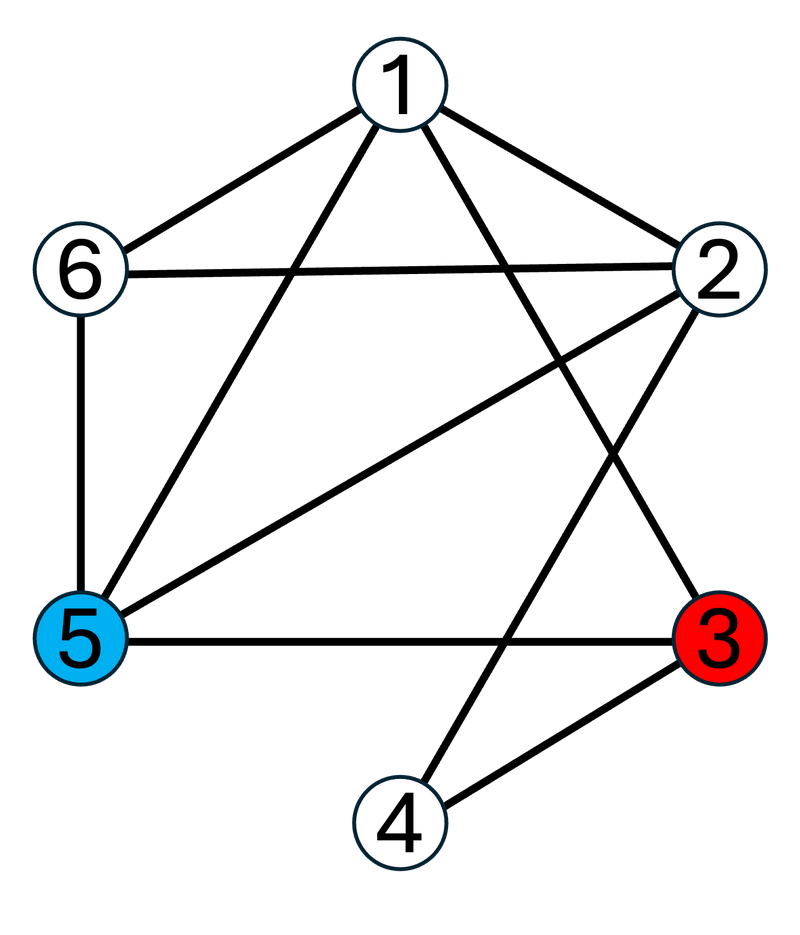
G 上の頂点 3 から頂点 5 への単純パスを辞書順に列挙すると、次のとおりになります。
- (3,1,2,5)
- (3,1,2,6,5)
- (3,1,5)
- (3,1,6,2,5)
- (3,1,6,5)
- (3,4,2,1,5)
- (3,4,2,1,6,5)
- (3,4,2,5)
- (3,4,2,6,1,5)
- (3,4,2,6,5)
- (3,5)
このうち、辞書順最小のものは (3,1,2,5) であるため、1 行目には 3,1,2,5 を空白区切りで出力します。
2 つめのテストケースにおいては、(3,2) が頂点 3 から頂点 2 への唯一の単純パスです。
Score : 475 points
Problem Statement
You are given a simple connected undirected graph G with N vertices and M edges.
The vertices of G are numbered vertex 1, vertex 2, \ldots, vertex N, and
the i-th (1\leq i\leq M) edge connects vertices U_i and V_i.
Find the lexicographically smallest simple path from vertex X to vertex Y in G.
That is, find the lexicographically smallest among the integer sequences P=(P_1,P_2,\ldots,P_{\lvert P\rvert}) that satisfy the following conditions:
- 1\leq P_i\leq N
- If i\neq j, then P_i\neq P_j.
- P_1=X and P_{\lvert P\rvert}=Y.
- For 1\leq i\leq \lvert P\rvert-1, there exists an edge connecting vertices P_i and P_{i+1}.
One can prove that such a path always exists under the constraints of this problem.
You are given T test cases, so find the answer for each.
Lexicographic order on integer sequences
An integer sequence S=(S_1,S_2,\ldots,S_{\lvert S\rvert}) is lexicographically smaller than an integer sequence T=(T_1,T_2,\ldots,T_{\lvert T\rvert}) if either of the following 1. or 2. holds. Here, \lvert S\rvert and \lvert T\rvert represent the lengths of S and T, respectively.- \lvert S\rvert<\lvert T\rvert and (S_1,S_2,\ldots,S_{\lvert S\rvert})=(T_1,T_2,\ldots,T_{\lvert S\rvert}).
- There exists some 1\leq i\leq \min(\lvert S\rvert,\lvert T\rvert) such that (S_1,S_2,\ldots,S_{i-1})=(T_1,T_2,\ldots,T_{i-1}) and S_i< T_i.
Constraints
- 1\leq T\leq 500
- 2\leq N\leq 1000
- N-1\leq M\leq \min\left( \frac{N(N-1)}{2},5\times 10^4\right)
- 1\leq X,Y \leq N
- X\neq Y
- 1\leq U_i<V_i \leq N
- If i\neq j, then (U_i,V_i)\neq (U_j,V_j).
- The given graph is connected.
- The sum of N over all test cases in each input is at most 1000.
- The sum of M over all test cases in each input is at most 5\times 10^4.
- All input values are integers.
Input
The input is given from Standard Input in the following format:
T
\mathrm{case}_1
\mathrm{case}_2
\vdots
\mathrm{case}_T
\mathrm{case}_i represents the i-th test case. Each test case is given in the following format:
N M X Y
U_1 V_1
U_2 V_2
\vdots
U_M V_M
Output
Output T lines.
The i-th line (1\leq i\leq T) should contain the vertex numbers on the simple path that is the answer to the i-th test case, in order, separated by spaces.
That is, when the answer to the i-th test case is P=(P_1,P_2,\ldots,P_{\lvert P\rvert}),
output P_1, P_2, \ldots, P_{\lvert P\rvert} on the i-th line in this order, separated by spaces.
Sample Input 1
2
6 10 3 5
1 2
1 3
1 5
1 6
2 4
2 5
2 6
3 4
3 5
5 6
3 2 3 2
1 3
2 3
Sample Output 1
3 1 2 5
3 2
For the first test case, graph G is as follows:
The simple paths from vertex 3 to vertex 5 on G, listed in lexicographic order, are as follows:
- (3,1,2,5)
- (3,1,2,6,5)
- (3,1,5)
- (3,1,6,2,5)
- (3,1,6,5)
- (3,4,2,1,5)
- (3,4,2,1,6,5)
- (3,4,2,5)
- (3,4,2,6,1,5)
- (3,4,2,6,5)
- (3,5)
Among these, the lexicographically smallest is (3,1,2,5), so output 3,1,2,5 separated by spaces on the first line.
For the second test case, (3,2) is the only simple path from vertex 3 to vertex 2.
実行時間制限: 2 sec / メモリ制限: 1024 MiB
配点 : 500 点
問題文
N 頂点 M 辺からなる単純な有向グラフ G があり、頂点には頂点 1, 頂点 2, \ldots, 頂点 N と番号がついています。 また、i (1\leq i\leq M) 本目の辺は頂点 U_i から頂点 V_i へ張られています。
高橋君がある頂点から始めて、G の上を有向辺に沿って頂点から頂点へ移動することを繰り返します。 G の頂点のうち、高橋君がうまく経路を選ぶことで、その頂点から始めていくらでも移動を繰り返すことができるようなものの個数を求めてください。
制約
- 1 \leq N \leq 2\times 10^5
- 0 \leq M \leq \min(N(N-1), 2\times 10^5)
- 1 \leq U_i,V_i\leq N
- U_i\neq V_i
- i\neq j ならば (U_i,V_i)\neq (U_j,V_j)
- 入力はすべて整数である。
入力
入力は以下の形式で標準入力から与えられる。
N M
U_1 V_1
U_2 V_2
\vdots
U_M V_M
出力
答えを出力せよ。
入力例 1
5 5
1 2
2 3
3 4
4 2
4 5
出力例 1
4
頂点 2 を始点とした場合、頂点 2 \to 頂点 3 \to 頂点 4 \to 頂点 2 \to 頂点 3 \to \cdots
と高橋君はいくらでも移動を繰り返す事ができます。
頂点 3, 頂点 4 を始点とした場合も同様です。
頂点 1 からは最初に頂点 2 に移動して、以下同様にいくらでも行動を繰り返すことができます。
一方、頂点 5 からは一度も移動することができません。
よって、条件を満たすのは頂点 1, 2, 3, 4 の 4 つであるので、 4 を出力します。
入力例 2
3 2
1 2
2 1
出力例 2
2
単純な有向グラフにおいて、2 つの頂点の間を互いに逆向きに結ぶ辺が、ともに存在する事はあり得ることに注意してください。 また、G は連結であるとは限りません。
Score : 500 points
Problem Statement
We have a simple directed graph G with N vertices and M edges. The vertices are labeled as Vertex 1, Vertex 2, \ldots, Vertex N. The i-th edge (1\leq i\leq M) goes from Vertex U_i to Vertex V_i.
Takahashi will start at a vertex and repeatedly travel on G from one vertex to another along a directed edge. How many vertices of G have the following condition: Takahashi can start at that vertex and continue traveling indefinitely by carefully choosing the path?
Constraints
- 1 \leq N \leq 2\times 10^5
- 0 \leq M \leq \min(N(N-1), 2\times 10^5)
- 1 \leq U_i,V_i\leq N
- U_i\neq V_i
- (U_i,V_i)\neq (U_j,V_j) if i\neq j.
- All values in input are integers.
Input
Input is given from Standard Input in the following format:
N M
U_1 V_1
U_2 V_2
\vdots
U_M V_M
Output
Print the answer.
Sample Input 1
5 5
1 2
2 3
3 4
4 2
4 5
Sample Output 1
4
When starting at Vertex 2, Takahashi can continue traveling indefinitely: 2 \to 3 \to 4 \to 2 \to 3 \to \cdots
The same goes when starting at Vertex 3 or Vertex 4.
From Vertex 1, he can first go to Vertex 2 and then continue traveling indefinitely again.
On the other hand, from Vertex 5, he cannot move at all.
Thus, four vertices ―Vertex 1, 2, 3, and 4― satisfy the conditions, so 4 should be printed.
Sample Input 2
3 2
1 2
2 1
Sample Output 2
2
Note that, in a simple directed graph, there may be two edges in opposite directions between the same pair of vertices. Additionally, G may not be connected.