実行時間制限: 2 sec / メモリ制限: 1024 MiB
配点 : 100 点
問題文
高橋君は野球ゲームを作っています。
高橋君はバッターの打率を指定された桁数の分だけ表示するプログラムを作ることにしました。
整数 A, B があります。ここで A, B は 1 \leq A \leq 10, 0 \leq B \leq A を満たします。
このとき、文字列 S を次のように定義します。
- \dfrac{B}{A} を小数点第 4 位で四捨五入した値を「整数部 1 桁」「
.」「小数部 3 桁」の順に末尾ゼロを省略せずに表記した文字列。
例えば A=7, B = 4 の場合は、\dfrac{B}{A} = \dfrac{4}{7} = 0.571428\dots で、これを小数点第 4 位で四捨五入した値は 0.571 です。よって S は 0.571 になります。
A, B が入力として与えられるので S を出力してください。
制約
- 1 \leq A \leq 10
- 0 \leq B \leq A
- A, B は整数
入力
入力は以下の形式で標準入力から与えられる。
A B
出力
S を問題文の指示に従った形式で出力せよ。問題文の指示と異なる形式で出力した場合は誤答となることに注意せよ。
入力例 1
7 4
出力例 1
0.571
問題文本文でも説明した通り、\dfrac{B}{A} = \dfrac{4}{7} = 0.571428\dots で、これを小数点第 4 位で四捨五入した値は 0.571 です。よって S は 0.571 になります。
入力例 2
7 3
出力例 2
0.429
\dfrac{B}{A} = \dfrac{3}{7} = 0.428571\dots で、これを小数点第 4 位で四捨五入した値は 0.429 です。(繰り上がりが発生するのに注意してください。)
よって S は 0.429 となります。
入力例 3
2 1
出力例 3
0.500
\dfrac{B}{A} = \dfrac{1}{2} = 0.5 で、これを小数点第 4 位で四捨五入した値も同様に 0.5 です。
よって S は 0.500 となります。小数部を 3 桁並べる必要があるのに注意してください。
入力例 4
10 10
出力例 4
1.000
入力例 5
1 0
出力例 5
0.000
Score : 100 points
Problem Statement
Takahashi is making a computer baseball game.
He will write a program that shows a batter's batting average with a specified number of digits.
There are integers A and B, which satisfy 1 \leq A \leq 10 and 0 \leq B \leq A.
Let S be the string obtained as follows.
- Round off \dfrac{B}{A} to three decimal digits, then write the integer part (1 digit),
.(the decimal point), and the decimal part (3 digits) in this order, with trailing zeros.
For example, if A=7 and B=4, then \dfrac{B}{A} = \dfrac{4}{7} = 0.571428\dots rounded off to three decimal digits is 0.571. Thus, S is 0.571.
You are given A and B as the input and asked to print S.
Constraints
- 1 \leq A \leq 10
- 0 \leq B \leq A
- A and B are integers.
Input
The input is given from Standard Input in the following format:
A B
Output
Print S in the format specified in the Problem Statement. Note that answers in different formats will be considered wrong.
Sample Input 1
7 4
Sample Output 1
0.571
As explained in the Problem Statement, \dfrac{B}{A} = \dfrac{4}{7} = 0.571428\dots rounded off to three decimal digits is 0.571. Thus, S is 0.571.
Sample Input 2
7 3
Sample Output 2
0.429
\dfrac{B}{A} = \dfrac{3}{7} = 0.428571\dots rounded off to three decimal digits is 0.429. (Note that it got rounded up.)
Thus, S is 0.429.
Sample Input 3
2 1
Sample Output 3
0.500
\dfrac{B}{A} = \dfrac{1}{2} = 0.5 rounded off to three decimal digits is again 0.5.
Thus, S is 0.500. Note that it must have three decimal places.
Sample Input 4
10 10
Sample Output 4
1.000
Sample Input 5
1 0
Sample Output 5
0.000
実行時間制限: 2 sec / メモリ制限: 1024 MiB
配点 : 100 点
問題文
高橋君は N 歳の誕生日を迎えました。この時の彼の身長は T cmです。
また、以下のことが分かっています。
- 高橋君は 0 歳の誕生日(生まれた当日)から X 歳の誕生日までの間、毎年身長が D cmずつ伸びた。より厳密に書くと、i=1,2,\ldots,X それぞれに対し、i-1 歳の誕生日から i 歳の誕生日までの間に身長が D cm伸びた。
- 高橋君は X 歳の誕生日から N 歳の誕生日までの間、身長が変化していない。
高橋君の M 歳の誕生日の時の身長が何cmだったかを求めてください。
制約
- 0 \leq M \lt N \leq 100
- 1 \leq X \leq N
- 1 \leq T \leq 200
- 1 \leq D \leq 100
- 高橋君の 0 歳の誕生日の時の身長は 1 cm以上である
- 入力はすべて整数
入力
入力は以下の形式で標準入力から与えられる。
N M X T D
出力
答えを整数として出力せよ。
入力例 1
38 20 17 168 3
出力例 1
168
この例では、高橋君の 38 歳の誕生日の時の身長が 168 cmです。また、17 歳の誕生日から 38 歳の誕生日までの間、身長が変化していません。
このことから、20 歳の誕生日の時の身長は 168 cmだったと言え、これが答えになります。
入力例 2
1 0 1 3 2
出力例 2
1
この例において、高橋君は 0(=M) 歳の誕生日の時の身長が 1 cmで、1(=N) 歳の誕生日の時の身長が 3(=T) cmです。
入力例 3
100 10 100 180 1
出力例 3
90
Score : 100 points
Problem Statement
Takahashi had his N-th birthday, when he was T centimeters tall.
Additionally, we know the following facts:
- In each year between Takahashi's birth (0-th birthday) and his X-th birthday, his height increased by D centimeters. More formally, for each i = 1, 2, \ldots, X, his height increased by D centimeters between his (i-1)-th birthday and his i-th birthday.
- Between Takahashi's X-th birthday and his N-th birthday, his height did not change.
Find Takahashi's height on his M-th birthday, in centimeters.
Constraints
- 0 \leq M \lt N \leq 100
- 1 \leq X \leq N
- 1 \leq T \leq 200
- 1 \leq D \leq 100
- Takahashi was at least 1 centimeter tall at his birth.
- All values in input are integers.
Input
Input is given from Standard Input in the following format:
N M X T D
Output
Print the answer as an integer.
Sample Input 1
38 20 17 168 3
Sample Output 1
168
In this sample, Takahashi was 168 centimeters tall on his 38-th birthday. Also, his height did not change between his 17-th birthday and 38-th birthday.
From these facts, we find that he was 168 centimeters tall on his 20-th birthday, so the answer is 168.
Sample Input 2
1 0 1 3 2
Sample Output 2
1
In this sample, Takahashi was 1 centimeter tall on his 0(=M)-th birthday and 3(=T) centimeters tall on his 1(=N)-st birthday.
Sample Input 3
100 10 100 180 1
Sample Output 3
90
実行時間制限: 2 sec / メモリ制限: 1024 MiB
配点 : 150 点
問題文
N 頂点の単純無向グラフ G があり、グラフの頂点には 1,2,\ldots, N の番号が付けられています。
G の隣接行列 (A_{i,j}) が与えられます。すなわち、G は A_{i,j} = 1 であるとき、またそのときに限り頂点 i と頂点 j を結ぶ辺を持ちます。
i = 1, 2, \ldots, N について、頂点 i と直接結ばれている頂点の番号を昇順に出力してください。
ただし、頂点 i と頂点 j が直接結ばれているとは、頂点 i と頂点 j を結ぶ辺が存在することをいいます。
制約
- 2 \leq N \leq 100
- A_{i,j} \in \lbrace 0,1 \rbrace
- A_{i,i} = 0
- A_{i,j} = A_{j,i}
- 入力される値はすべて整数
入力
入力は以下の形式で標準入力から与えられる。
N
A_{1,1} A_{1,2} \ldots A_{1,N}
A_{2,1} A_{2,2} \ldots A_{2,N}
\vdots
A_{N,1} A_{N,2} \ldots A_{N,N}
出力
N 行出力せよ。 i 行目には頂点 i と直接結ばれている頂点の番号を昇順に空白区切りで出力せよ。
入力例 1
4
0 1 1 0
1 0 0 1
1 0 0 0
0 1 0 0
出力例 1
2 3
1 4
1
2
頂点 1 と直接結ばれている頂点は頂点 2, 3 です。したがって、1 行目には 2, 3 をこの順で出力します。
同様に、2 行目には 1, 4 をこの順に、3 行目には 1 を、4 行目には 2 を出力します。
入力例 2
2
0 0
0 0
出力例 2
G に辺が存在しないこともあります。
入力例 3
5
0 1 0 1 1
1 0 0 1 0
0 0 0 0 1
1 1 0 0 1
1 0 1 1 0
出力例 3
2 4 5
1 4
5
1 2 5
1 3 4
Score: 150 points
Problem Statement
There is a simple undirected graph G with N vertices labeled with numbers 1, 2, \ldots, N.
You are given the adjacency matrix (A_{i,j}) of G. That is, G has an edge connecting vertices i and j if and only if A_{i,j} = 1.
For each i = 1, 2, \ldots, N, print the numbers of the vertices directly connected to vertex i in ascending order.
Here, vertices i and j are said to be directly connected if and only if there is an edge connecting vertices i and j.
Constraints
- 2 \leq N \leq 100
- A_{i,j} \in \lbrace 0,1 \rbrace
- A_{i,i} = 0
- A_{i,j} = A_{j,i}
- All input values are integers.
Input
The input is given from Standard Input in the following format:
N
A_{1,1} A_{1,2} \ldots A_{1,N}
A_{2,1} A_{2,2} \ldots A_{2,N}
\vdots
A_{N,1} A_{N,2} \ldots A_{N,N}
Output
Print N lines. The i-th line should contain the numbers of the vertices directly connected to vertex i in ascending order, separated by a space.
Sample Input 1
4
0 1 1 0
1 0 0 1
1 0 0 0
0 1 0 0
Sample Output 1
2 3
1 4
1
2
Vertex 1 is directly connected to vertices 2 and 3. Thus, the first line should contain 2 and 3 in this order.
Similarly, the second line should contain 1 and 4 in this order, the third line should contain 1, and the fourth line should contain 2.
Sample Input 2
2
0 0
0 0
Sample Output 2
G may have no edges.
Sample Input 3
5
0 1 0 1 1
1 0 0 1 0
0 0 0 0 1
1 1 0 0 1
1 0 1 1 0
Sample Output 3
2 4 5
1 4
5
1 2 5
1 3 4
実行時間制限: 2 sec / メモリ制限: 1024 MiB
配点 : 250 点
問題文
縦 N 行 横 N 列からなる 2 つのグリッド S,T があります。グリッドの上から i 行目、左から j 列目のマスをマス (i,j) と表します。
グリッド S,T の各マスは白または黒のいずれかに塗られています。S_{i,j} が . のとき S のマス (i,j) は白く、S_{i,j} が # のとき S のマス (i,j) は黒く塗られています。T についても同様です。
次の 2 種類の操作を好きな順序で好きな回数行うとき、グリッド S をグリッド T と一致させるために必要な操作回数の最小値を求めてください。
- グリッド S のマスを 1 つ選び、色を変更する
- グリッド S 全体を 90 度右に回転する
制約
- 1\leq N \leq 100
- N は整数
- S_{i,j},T_{i,j} は
.または#
入力
入力は以下の形式で標準入力から与えられる。
N
S_{1,1}S_{1,2}\dots S_{1,N}
\vdots
S_{N,1}S_{N,2}\dots S_{N,N}
T_{1,1}T_{1,2}\dots T_{1,N}
\vdots
T_{N,1}T_{N,2}\dots T_{N,N}
出力
答えを出力せよ。
入力例 1
4
###.
..#.
..#.
..#.
...#
...#
###.
....
出力例 1
2
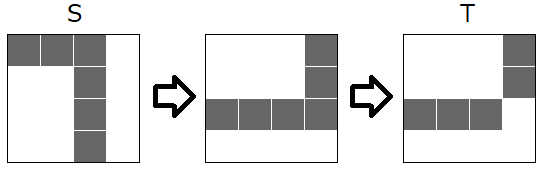
下図のようにして 2 回の操作で S を T と一致させることができます。
入力例 2
13
.#..###..##..
#.#.#..#.#.#.
#.#.###..#...
###.#..#.#.#.
#.#.###..##..
.............
..#...#....#.
.##..#.#..##.
#.#..#.#.#.#.
####.#.#.####
..#..#.#...#.
..#...#....#.
.............
.............
.#....#...#..
.#...#.#..#..
####.#.#.####
.#.#.###..#.#
.##....#..##.
.#....#...#..
.............
..##..###.#.#
.#.#.#..#.###
.#.#..###.#.#
.#.#.#..#.#.#
..##..###..#.
出力例 2
5
Score : 250 points
Problem Statement
There are two grids S and T, each with N rows and N columns. Let (i,j) denote the cell at the i-th row from the top and the j-th column from the left.
Each cell of grids S and T is colored either white or black. Cell (i,j) of S is white if S_{i,j} is ., and black if S_{i,j} is #. The same applies to T.
You may perform the following two types of operations any number of times in any order. Find the minimum number of operations required to make grid S identical to grid T.
- Choose one cell of grid S and change its color.
- Rotate the entire grid S 90 degrees clockwise.
Constraints
- 1 \le N \le 100
- N is an integer.
- Each of S_{i,j} and T_{i,j} is
.or#.
Input
The input is given from Standard Input in the following format:
N
S_{1,1}S_{1,2}\dots S_{1,N}
\vdots
S_{N,1}S_{N,2}\dots S_{N,N}
T_{1,1}T_{1,2}\dots T_{1,N}
\vdots
T_{N,1}T_{N,2}\dots T_{N,N}
Output
Output the minimum number of operations required.
Sample Input 1
4
###.
..#.
..#.
..#.
...#
...#
###.
....
Sample Output 1
2
You can match S to T in two operations as shown below.
Sample Input 2
13
.#..###..##..
#.#.#..#.#.#.
#.#.###..#...
###.#..#.#.#.
#.#.###..##..
.............
..#...#....#.
.##..#.#..##.
#.#..#.#.#.#.
####.#.#.####
..#..#.#...#.
..#...#....#.
.............
.............
.#....#...#..
.#...#.#..#..
####.#.#.####
.#.#.###..#.#
.##....#..##.
.#....#...#..
.............
..##..###.#.#
.#.#.#..#.###
.#.#..###.#.#
.#.#.#..#.#.#
..##..###..#.
Sample Output 2
5
実行時間制限: 2 sec / メモリ制限: 1024 MiB
配点 : 300 点
問題文
整数 N が与えられるので、以下の条件を全て満たす整数 X の個数を 998244353 で割った余りを求めてください。
- N 桁の正整数である。
- X の各桁を上の位から順に X_1,X_2,\dots,X_N とする。このとき以下の条件を全て満たす。
- 全ての整数 1 \le i \le N に対して、 1 \le X_i \le 9
- 全ての整数 1 \le i \le N-1 に対して、 |X_i-X_{i+1}| \le 1
制約
- N は整数
- 2 \le N \le 10^6
入力
入力は以下の形式で標準入力から与えられる。
N
出力
答えを整数として出力せよ。
入力例 1
4
出力例 1
203
4 桁の整数として、例えば 1111,1234,7878,6545 が問題文中の条件を満たします。
入力例 2
2
出力例 2
25
入力例 3
1000000
出力例 3
248860093
998244353 で割った余りを求めることに注意してください。
Score : 300 points
Problem Statement
Given an integer N, find the number of integers X that satisfy all of the following conditions, modulo 998244353.
- X is an N-digit positive integer.
- Let X_1,X_2,\dots,X_N be the digits of X from top to bottom. They satisfy all of the following:
- 1 \le X_i \le 9 for all integers 1 \le i \le N;
- |X_i-X_{i+1}| \le 1 for all integers 1 \le i \le N-1.
Constraints
- N is an integer.
- 2 \le N \le 10^6
Input
Input is given from Standard Input in the following format:
N
Output
Print the answer as an integer.
Sample Input 1
4
Sample Output 1
203
Some of the 4-digit integers satisfying the conditions are 1111,1234,7878,6545.
Sample Input 2
2
Sample Output 2
25
Sample Input 3
1000000
Sample Output 3
248860093
Be sure to find the count modulo 998244353.
実行時間制限: 2 sec / メモリ制限: 1024 MiB
配点 : 250 点
問題文
N 種類のビーンズが 1 粒ずつあります。 i 種類目のビーンズはおいしさが A_i で色が C_i です。ビーンズは混ぜられており、色でしか区別することができません。
あなたはビーンズの色を 1 つ選び、その色のビーンズをどれか 1 粒食べます。ビーンズの色をうまく選ぶことで、食べる可能性のあるビーンズのおいしさの最小値を最大化してください。
制約
- 1 \leq N \leq 2 \times 10^{5}
- 1 \leq A_i \leq 10^{9}
- 1 \leq C_i \leq 10^{9}
- 入力は全て整数である。
入力
入力は以下の形式で標準入力から与えられる。
N
A_1 C_1
A_2 C_2
\vdots
A_N C_N
出力
食べる可能性のあるビーンズのおいしさの最小値の最大値を整数として出力せよ。
入力例 1
4
100 1
20 5
30 5
40 1
出力例 1
40
同じ色のビーンズは互いに区別がつかないことに注意してください。
選ぶことができる色は 色 1 と 色 5 です。
- 色 1 のビーンズは 2 種類あり、美味しさはそれぞれ 100, 40 です。よって、色 1 を選んだときのおいしさの最小値は 40 です。
- 色 5 のビーンズは 2 種類あり、美味しさはそれぞれ 20, 30 です。よって、色 5 を選んだときのおいしさの最小値は 20 です。
おいしさの最小値を最大化するには 色 1 を選べばよいため、そのときの最小値である 40 を出力します。
入力例 2
10
68 3
17 2
99 2
92 4
82 4
10 3
100 2
78 1
3 1
35 4
出力例 2
35
Score: 250 points
Problem Statement
There are N types of beans, one bean of each type. The i-th type of bean has a deliciousness of A_i and a color of C_i. The beans are mixed and can only be distinguished by color.
You will choose one color of beans and eat one bean of that color. By selecting the optimal color, maximize the minimum possible deliciousness of the bean you eat.
Constraints
- 1 \leq N \leq 2 \times 10^{5}
- 1 \leq A_i \leq 10^{9}
- 1 \leq C_i \leq 10^{9}
- All input values are integers.
Input
The input is given from Standard Input in the following format:
N
A_1 C_1
A_2 C_2
\vdots
A_N C_N
Output
Print as an integer the maximum value of the minimum possible deliciousness of the bean you eat.
Sample Input 1
4
100 1
20 5
30 5
40 1
Sample Output 1
40
Note that beans of the same color cannot be distinguished from each other.
You can choose color 1 or color 5.
- There are two types of beans of color 1, with deliciousness of 100 and 40. Thus, the minimum deliciousness when choosing color 1 is 40.
- There are two types of beans of color 5, with deliciousness of 20 and 30. Thus, the minimum deliciousness when choosing color 5 is 20.
To maximize the minimum deliciousness, you should choose color 1, so print the minimum deliciousness in that case: 40.
Sample Input 2
10
68 3
17 2
99 2
92 4
82 4
10 3
100 2
78 1
3 1
35 4
Sample Output 2
35
実行時間制限: 2 sec / メモリ制限: 1024 MiB
配点 : 425 点
問題文
1 周の長さが M である池があり、その周上に 1 つの小屋と N 人の人が立っています。
実数 x (0\leq x <M) について、小屋から時計回りに x だけ進んだところを地点 x と定義します。
i 番目の人は、 地点 A_i にいます。
複数の人が同じ場所に立っていることもあります。
また、N 以下の整数 C が与えられます。 i=0,1,\ldots,M-1 について、X_i を次のように定義します。
- 高橋君は地点 (i+0.5) からスタートして、時計回りに動き始める。
- 高橋君は出会った人数の合計が C 未満である限り(時計回りに)動き続け、C 以上になったら止まる。ここで、「地点 y にいる人と出会う」とは、高橋君が地点 y に到達することを指す。
- 高橋君が止まるまでに出会った人数を X_i とする。ここで、高橋君が止まった地点に複数の人がいる場合、そこにいた人はすべて出会った人として数えられ、特に X_i は C より大きくなる可能性がある。
i=0,1,\ldots,M-1 にわたる X_i の総和、すなわち \displaystyle\sum_{i=0}^{M-1} X_i を求めてください。
制約
- 1\leq N\leq 5\times 10^5
- 1\leq M\leq 10^{12}
- 0\leq A_i\leq M-1
- 1\leq C\leq N
- 入力はすべて整数
入力
入力は以下の形式で標準入力から与えられる。
N M C
A_1 A_2 \ldots A_N
出力
i=0,1,\ldots,M-1 にわたる X_i の総和を一行に出力せよ。
入力例 1
5 3 2
1 2 1 0 1
出力例 1
9
i=0 のとき、高橋君は地点 0.5 からスタートして時計回りに動きます。その後、次のようになります。
- 地点 1 で 1,3,5 番目の 3 人と出会い、今まで出会った人数の合計は 3 となる。これは C=2 以上であるため、高橋くんはそこで止まる。よって、X_0=3 である。
i=1 のとき、高橋君は地点 1.5 からスタートして時計回りに動きます。その後、次のようになります。
- 地点 2 で 2 番目の人と出会う。今まで出会った人数の合計は 1 であるため、動き続ける。
- 地点 0 で 4 番目の人と出会い、今まで出会った人数の合計は 2 となる。これは C=2 以上であるため、高橋くんはそこで止まる。よって、X_1=2 である。
i=2 のとき、高橋君は地点 2.5 からスタートして時計回りに動きます。その後、次のようになります。
- 地点 0 で 4 番目の人と会う。今まで出会った人数の合計は 1 であるため、動き続ける。
- 地点 1 で 1,3,5 番目の 3 人と会い、今まで出会った人数の合計は 4 となる。これは C=2 以上であるため、高橋くんはそこで止まる。よって、X_2=4 である。
よって、答えは X_0+X_1+X_2=3+2+4=9 となります。
入力例 2
1 1000000000000 1
1
出力例 2
1000000000000
高橋君はスタートする位置によらず、池の周りに立っている唯一の人である、地点 1 にいる人に出会った時に止まります。
よって、i によらず X_i=1 であり、答えは 10^{12} となります。
Score : 425 points
Problem Statement
There is a pond with a circumference of M, and on its shore stand one hut and N people.
For a real number x (0\leq x <M), define point x as the location that is x distance clockwise from the hut.
The i-th person is at point A_i.
Multiple people may be standing at the same location.
Additionally, an integer C not greater than N is given. For i=0,1,\ldots,M-1, define X_i as follows:
- Takahashi starts at point (i+0.5) and begins moving clockwise.
- Takahashi continues moving (clockwise) as long as the total number of people he has met is less than C, and stops when it becomes C or more. Here, "meeting a person at point y" means that Takahashi reaches point y.
- Let X_i be the number of people Takahashi met before stopping. Here, if there are multiple people at the point where Takahashi stopped, all the people there are counted as people he met, and particularly, X_i may be greater than C.
Find the sum of X_i over i=0,1,\ldots,M-1, that is, \displaystyle\sum_{i=0}^{M-1} X_i.
Constraints
- 1\leq N\leq 5\times 10^5
- 1\leq M\leq 10^{12}
- 0\leq A_i\leq M-1
- 1\leq C\leq N
- All input values are integers.
Input
The input is given from Standard Input in the following format:
N M C
A_1 A_2 \ldots A_N
Output
Print the sum of X_i over i=0,1,\ldots,M-1 on a single line.
Sample Input 1
5 3 2
1 2 1 0 1
Sample Output 1
9
When i=0, Takahashi starts at point 0.5 and moves clockwise. Then, the following happens:
- At point 1, he meets the 1st, 3rd, and 5th people, a total of three people, and the total number of people met so far is 3. This is not less than C=2, so Takahashi stops there. Therefore, X_0=3.
When i=1, Takahashi starts at point 1.5 and moves clockwise. Then, the following happens:
- At point 2, he meets the 2nd person. The total number of people met so far is 1, so he continues moving.
- At point 0, he meets the 4th person, and the total number of people met so far is 2. This is not less than C=2, so Takahashi stops there. Therefore, X_1=2.
When i=2, Takahashi starts at point 2.5 and moves clockwise. Then, the following happens:
- At point 0, he meets the 4th person. The total number of people met so far is 1, so he continues moving.
- At point 1, he meets the 1st, 3rd, and 5th people, a total of three people, and the total number of people met so far is 4. This is not less than C=2, so Takahashi stops there. Therefore, X_2=4.
Therefore, the answer is X_0+X_1+X_2=3+2+4=9.
Sample Input 2
1 1000000000000 1
1
Sample Output 2
1000000000000
Regardless of the starting position, Takahashi stops when he meets the only person standing around the pond, who is at point 1.
Therefore, X_i=1 regardless of i, and the answer is 10^{12}.
実行時間制限: 4 sec / メモリ制限: 1024 MiB
配点 : 500 点
問題文
N 頂点 M 辺の重み付き無向連結グラフ G が与えられます。G には自己ループや多重辺が含まれている可能性があります。
頂点には頂点 1, 頂点 2, \dots, 頂点 N と番号がついています。
辺には辺 1, 辺 2, \dots, 辺 M と番号がついています。辺 i は頂点 a_i と頂点 b_i を結ぶ重み c_i の辺です。ここで、1 \leq i \lt j \leq M を満たすすべての整数の組 (i, j) について c_i \neq c_j が成り立ちます。
以下で説明される Q 個のクエリに答えてください。
i 番目のクエリでは整数の組 (u_i, v_i, w_i) が与えられます。ここで、1 \leq j \leq M を満たすすべての整数 j について w_i \neq c_j が成り立ちます。
頂点 u_i と頂点 v_i を結ぶ重み w_i の無向辺を e_i として、G に e_i を追加してできるグラフ G_i を考えます。
このとき G_i の最小全域木 T_i は一意に定まることが証明できますが、T_i に e_i は含まれるでしょうか?答えを Yes あるいは No で出力してください。
ここで、クエリの前後で G は変化しないことに注意してください。言い換えると、クエリ i で G に e_i を追加したグラフを考えたとしても、他のクエリで出てくる G に e_i が追加されていることはありません。
最小全域木とは?
G の 全域木 とは、G に含まれるすべての頂点と G に含まれる辺の一部からなる木のことを言います。G の 最小全域木 とは、G の全域木の中で辺の重みの和が最小である木のことを言います。
制約
- 2 \leq N \leq 2 \times 10^5
- N - 1 \leq M \leq 2 \times 10^5
- 1 \leq a_i \leq N (1 \leq i \leq M)
- 1 \leq b_i \leq N (1 \leq i \leq M)
- 1 \leq c_i \leq 10^9 (1 \leq i \leq M)
- c_i \neq c_j (1 \leq i \lt j \leq M)
- グラフ G は連結である。
- 1 \leq Q \leq 2 \times 10^5
- 1 \leq u_i \leq N (1 \leq i \leq Q)
- 1 \leq v_i \leq N (1 \leq i \leq Q)
- 1 \leq w_i \leq 10^9 (1 \leq i \leq Q)
- w_i \neq c_j (1 \leq i \leq Q, 1 \leq j \leq M)
- 入力はすべて整数である。
入力
入力は以下の形式で標準入力から与えられる。
N M Q
a_1 b_1 c_1
a_2 b_2 c_2
\vdots
a_M b_M c_M
u_1 v_1 w_1
u_2 v_2 w_2
\vdots
u_Q v_Q w_Q
出力
Q 行出力せよ。i 行目ではクエリ i への答えを Yes または No で出力せよ。
入力例 1
5 6 3
1 2 2
2 3 3
1 3 6
2 4 5
4 5 9
3 5 8
1 3 1
3 4 7
3 5 7
出力例 1
Yes
No
Yes
以下では頂点 u と頂点 v を結ぶ重み w の無向辺を (u,v,w) と表します。 G を図に表したものを以下に挙げます。

たとえばクエリ 1 では G に e_1 = (1,3,1) を追加したグラフ G_1 を考えます。G_1 の最小全域木 T_1 の辺集合は \lbrace (1,2,2),(1,3,1),(2,4,5),(3,5,8) \rbrace であり e_1 を含みます。よって Yes を出力します。
入力例 2
2 3 2
1 2 100
1 2 1000000000
1 1 1
1 2 2
1 1 5
出力例 2
Yes
No
Score : 500 points
Problem Statement
Given is a weighted undirected connected graph G with N vertices and M edges, which may contain self-loops and multi-edges.
The vertices are labeled as Vertex 1, Vertex 2, \dots, Vertex N.
The edges are labeled as Edge 1, Edge 2, \ldots, Edge M. Edge i connects Vertex a_i and Vertex b_i and has a weight of c_i. Here, for every pair of integers (i, j) such that 1 \leq i \lt j \leq M, c_i \neq c_j holds.
Process the Q queries explained below.
The i-th query gives a triple of integers (u_i, v_i, w_i). Here, for every integer j such that 1 \leq j \leq M, w_i \neq c_j holds.
Let e_i be an undirected edge that connects Vertex u_i and Vertex v_i and has a weight of w_i. Consider the graph G_i obtained by adding e_i to G.
It can be proved that the minimum spanning tree T_i of G_i is uniquely determined. Does T_i contain e_i? Print the answer as Yes or No.
Note that the queries do not change T. In other words, even though Query i considers the graph obtained by adding e_i to G, the G in other queries does not have e_i.
What is minimum spanning tree?
The spanning tree of G is a tree with all of the vertices in G and some of the edges in G.The minimum spanning tree of G is the tree with the minimum total weight of edges among the spanning trees of G.
Constraints
- 2 \leq N \leq 2 \times 10^5
- N - 1 \leq M \leq 2 \times 10^5
- 1 \leq a_i \leq N (1 \leq i \leq M)
- 1 \leq b_i \leq N (1 \leq i \leq M)
- 1 \leq c_i \leq 10^9 (1 \leq i \leq M)
- c_i \neq c_j (1 \leq i \lt j \leq M)
- The graph G is connected.
- 1 \leq Q \leq 2 \times 10^5
- 1 \leq u_i \leq N (1 \leq i \leq Q)
- 1 \leq v_i \leq N (1 \leq i \leq Q)
- 1 \leq w_i \leq 10^9 (1 \leq i \leq Q)
- w_i \neq c_j (1 \leq i \leq Q, 1 \leq j \leq M)
- All values in input are integers.
Input
Input is given from Standard Input in the following format:
N M Q
a_1 b_1 c_1
a_2 b_2 c_2
\vdots
a_M b_M c_M
u_1 v_1 w_1
u_2 v_2 w_2
\vdots
u_Q v_Q w_Q
Output
Print Q lines. The i-th line should contain the answer to Query i: Yes or No.
Sample Input 1
5 6 3
1 2 2
2 3 3
1 3 6
2 4 5
4 5 9
3 5 8
1 3 1
3 4 7
3 5 7
Sample Output 1
Yes
No
Yes
Below, let (u,v,w) denote an undirected edge that connects Vertex u and Vertex v and has the weight of w. Here is an illustration of G:
For example, Query 1 considers the graph G_1 obtained by adding e_1 = (1,3,1) to G. The minimum spanning tree T_1 of G_1 has the edge set \lbrace (1,2,2),(1,3,1),(2,4,5),(3,5,8) \rbrace, which contains e_1, so Yes should be printed.
Sample Input 2
2 3 2
1 2 100
1 2 1000000000
1 1 1
1 2 2
1 1 5
Sample Output 2
Yes
No
実行時間制限: 4 sec / メモリ制限: 1024 MiB
配点 : 500 点
問題文
N 個の頂点と M 本の辺からなる単純(自己ループおよび多重辺を持たない)かつ連結な無向グラフが与えられます。
i = 1, 2, \ldots, M について、i 番目の辺は頂点 u_i と頂点 v_i を結びます。
下記の 2 つの条件をともに満たす整数列 (A_1, A_2, \ldots, A_k) を長さ k のパスと呼びます。
- すべての i = 1, 2, \dots, k について、1 \leq A_i \leq N 。
- すべての i = 1, 2, \ldots, k-1 について、頂点 A_i と頂点 A_{i+1} は辺で直接結ばれている。
空列も長さ 0 のパスとみなします。
S = s_1s_2\ldots s_N を 0 と 1 のみからなる長さ N の文字列とします。 パス A = (A_1, A_2, \ldots, A_k) が下記を満たすとき、パス A を S に関する良いパスと呼びます。
- すべての i = 1, 2, \ldots, N について、次を満たす。
- s_i = 0 ならば、A に含まれる i の個数は偶数である。
- s_i = 1 ならば、A に含まれる i の個数は奇数である。
S として考えられる文字列(すなわち、0 と 1 のみからなる長さ N の文字列)は 2^N 個ありますが、そのすべてにわたる「 S に関する良いパスのうち最短のものの長さ」の総和を出力してください。
この問題の制約下において、0 と 1 からなる長さ N のどのような文字列を S として選んでも、S に関する良いパスが少なくとも 1 つ存在することが示せます。
制約
- 2 \leq N \leq 17
- N-1 \leq M \leq \frac{N(N-1)}{2}
- 1 \leq u_i, v_i \leq N
- 与えられるグラフは単純かつ連結
- 入力はすべて整数
入力
入力は以下の形式で標準入力から与えられる。
N M
u_1 v_1
u_2 v_2
\vdots
u_M v_M
出力
答えを出力せよ。
入力例 1
3 2
1 2
2 3
出力例 1
14
- S = 000 のとき、空列 () は S に関する最短の良いパスであり、その長さは 0 です。
- S = 100 のとき、(1) は S に関する最短の良いパスであり、その長さは 1 です。
- S = 010 のとき、(2) は S に関する最短の良いパスであり、その長さは 1 です。
- S = 110 のとき、(1, 2) は S に関する最短の良いパスであり、その長さは 2 です。
- S = 001 のとき、(3) は S に関する最短の良いパスであり、その長さは 1 です。
- S = 101 のとき、(1, 2, 3, 2) は S に関する最短の良いパスであり、その長さは 4 です。
- S = 011 のとき、(2, 3) は S に関する最短の良いパスであり、その長さは 2 です。
- S = 111 のとき、(1, 2, 3) は S に関する最短の良いパスであり、その長さは 3 です。
よって、求める答えは 0 + 1 + 1 + 2 + 1 + 4 + 2 + 3 = 14 です。
入力例 2
5 5
4 2
2 3
1 3
2 1
1 5
出力例 2
108
Score : 500 points
Problem Statement
You are given a simple connected undirected graph with N vertices and M edges. (A graph is said to be simple if it has no multi-edges and no self-loops.)
For i = 1, 2, \ldots, M, the i-th edge connects Vertex u_i and Vertex v_i.
A sequence (A_1, A_2, \ldots, A_k) is said to be a path of length k if both of the following two conditions are satisfied:
- For all i = 1, 2, \dots, k, it holds that 1 \leq A_i \leq N.
- For all i = 1, 2, \ldots, k-1, Vertex A_i and Vertex A_{i+1} are directly connected by an edge.
An empty sequence is regarded as a path of length 0.
Let S = s_1s_2\ldots s_N be a string of length N consisting of 0 and 1. A path A = (A_1, A_2, \ldots, A_k) is said to be a good path with respect to S if the following conditions are satisfied:
- For all i = 1, 2, \ldots, N, it holds that:
- if s_i = 0, then A has even number of i's.
- if s_i = 1, then A has odd number of i's.
There are 2^N possible S (in other words, there are 2^N strings of length N consisting of 0 and 1). Find the sum of "the length of the shortest good path with respect to S" over all those S.
Under the Constraints of this problem, it can be proved that, for any string S of length N consisting of 0 and 1, there is at least one good path with respect to S.
Constraints
- 2 \leq N \leq 17
- N-1 \leq M \leq \frac{N(N-1)}{2}
- 1 \leq u_i, v_i \leq N
- The given graph is simple and connected.
- All values in input are integers.
Input
Input is given from Standard Input in the following format:
N M
u_1 v_1
u_2 v_2
\vdots
u_M v_M
Output
Print the answer.
Sample Input 1
3 2
1 2
2 3
Sample Output 1
14
- For S = 000, the empty sequence () is the shortest good path with respect to S, whose length is 0.
- For S = 100, (1) is the shortest good path with respect to S, whose length is 1.
- For S = 010, (2) is the shortest good path with respect to S, whose length is 1.
- For S = 110, (1, 2) is the shortest good path with respect to S, whose length is 2.
- For S = 001, (3) is the shortest good path with respect to S, whose length is 1.
- For S = 101, (1, 2, 3, 2) is the shortest good path with respect to S, whose length is 4.
- For S = 011, (2, 3) is the shortest good path with respect to S, whose length is 2.
- For S = 111, (1, 2, 3) is the shortest good path with respect to S, whose length is 3.
Therefore, the sought answer is 0 + 1 + 1 + 2 + 1 + 4 + 2 + 3 = 14.
Sample Input 2
5 5
4 2
2 3
1 3
2 1
1 5
Sample Output 2
108