Time Limit: 2 sec / Memory Limit: 1024 MiB
配点 : 100 点
問題文
縦 H 行、横 W 列のマス目があり、このうち上から i 個目、左から j 個目のマスを (i,j) と呼びます。
このとき、マス (R,C) に辺で隣接するマスの個数を求めてください。
ただし、ある 2 つのマス (a,b),(c,d) が辺で隣接するとは、 |a-c|+|b-d|=1 (|x| を x の絶対値とする) であることを言います。
制約
- 入力は全て整数
- 1 \le R \le H \le 10
- 1 \le C \le W \le 10
入力
入力は以下の形式で標準入力から与えられる。
H W
R C
出力
答えを整数として出力せよ。
入力例 1
3 4
2 2
出力例 1
4
入出力例 1,2,3 に対する説明は、出力例 3 の下にまとめて示します。
入力例 2
3 4
1 3
出力例 2
3
入力例 3
3 4
3 4
出力例 3
2
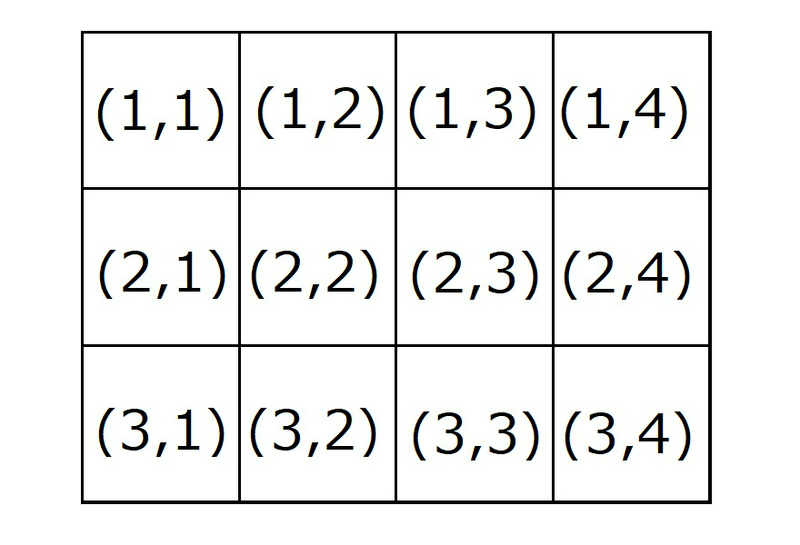
H=3,W=4 のとき、マス目は以下のようになります。
- 入力例 1 について、マス (2,2) に隣接するマスは 4 つです。
- 入力例 2 について、マス (1,3) に隣接するマスは 3 つです。
- 入力例 3 について、マス (3,4) に隣接するマスは 2 つです。
入力例 4
1 10
1 5
出力例 4
2
入力例 5
8 1
8 1
出力例 5
1
入力例 6
1 1
1 1
出力例 6
0
Score : 100 points
Problem Statement
There is a grid with H horizontal rows and W vertical columns. Let (i,j) denote the square at the i-th row from the top and the j-th column from the left.
Find the number of squares that share a side with Square (R, C).
Here, two squares (a,b) and (c,d) are said to share a side if and only if |a-c|+|b-d|=1 (where |x| denotes the absolute value of x).
Constraints
- All values in input are integers.
- 1 \le R \le H \le 10
- 1 \le C \le W \le 10
Input
Input is given from Standard Input in the following format:
H W
R C
Output
Print the answer as an integer.
Sample Input 1
3 4
2 2
Sample Output 1
4
We will describe Sample Inputs/Outputs 1,2, and 3 at once below Sample Output 3.
Sample Input 2
3 4
1 3
Sample Output 2
3
Sample Input 3
3 4
3 4
Sample Output 3
2
When H=3 and W=4, the grid looks as follows.
- For Sample Input 1, there are 4 squares adjacent to Square (2,2).
- For Sample Input 2, there are 3 squares adjacent to Square (1,3).
- For Sample Input 3, there are 2 squares adjacent to Square (3,4).
Sample Input 4
1 10
1 5
Sample Output 4
2
Sample Input 5
8 1
8 1
Sample Output 5
1
Sample Input 6
1 1
1 1
Sample Output 6
0
Time Limit: 2 sec / Memory Limit: 1024 MiB
配点 : 100 点
問題文
以下の条件を全て満たす長さ N の文字列を求めてください。
- 各文字は
-または=である - 回文である
- 文字列中に
=は 1 個または 2 個含まれる。 2 個含まれる場合、それらの=は隣接している
なお、そのような文字列はちょうど 1 つ存在します。
制約
- 1 \leq N \leq 100
- N は整数である
入力
入力は以下の形式で標準入力から与えられる。
N
出力
答えを出力せよ。
入力例 1
4
出力例 1
-==-
入力例 2
7
出力例 2
---=---
Score : 100 points
Problem Statement
Find a length-N string that satisfies all of the following conditions:
- Each character is
-or=. - It is a palindrome.
- It contains exactly one or exactly two
=s. If it contains two=s, they are adjacent.
Such a string is unique.
Constraints
- 1 \leq N \leq 100
- N is an integer.
Input
The input is given from Standard Input in the following format:
N
Output
Print the answer.
Sample Input 1
4
Sample Output 1
-==-
Sample Input 2
7
Sample Output 2
---=---
Time Limit: 2 sec / Memory Limit: 1024 MiB
配点 : 250 点
問題文
縦 H マス \times 横 W マスのマス目があり、各マスに 1 つずつ英小文字が書き込まれています。 上から i 行目かつ左から j 列目のマスを (i,j) で表します。
マス目に書き込まれている英小文字は H 個の長さ W の文字列 S_1,S_2,\ldots, S_H によって与えられ、 S_i の j 文字目が、(i, j) に書き込まれた英小文字を表します。
マス目の中に、s, n, u, k, e が
この順に(縦・横・ななめのいずれかの方向に) 連続して並んでいる
場所がただ 1 つ存在します。
そのような場所を見つけ、そのマスの位置を出力の形式に従って出力してください。
ただし、s, n, u, k, e が
この順に(縦・横・ななめのいずれかの方向に) 連続して並んでいる場所とは、
5 つのマスの組 (A_1,A_2,A_3,A_4,A_5) であって、次をすべてみたすものをさします。
- A_1,A_2,A_3,A_4,A_5 に書き込まれた英小文字はそれぞれ
s,n,u,k,eである。 - 1\leq i\leq 4 について、A_i と A_{i+1} は頂点または辺を共有している。
- A_1,A_2,A_3,A_4,A_5 の中心はこの順に一直線上に等間隔で並んでいる。
制約
- 5\leq H\leq 100
- 5\leq W\leq 100
- H,W は整数
- S_i は英小文字のみからなる長さ W の文字列
- 与えられるマス目の中に条件をみたす場所がただ 1 つ存在する
入力
入力は以下の形式で標準入力から与えられる。
H W
S_1
S_2
\vdots
S_H
出力
次の形式にしたがって、5 行出力せよ。
条件をみたす場所のうち s, n, u, k, e が書かれたマスがそれぞれ (R_1,C_1), (R_2,C_2)\ldots,(R_5,C_5) であるとき、
i 行目には R_i と C_i をこの順に空白区切りで出力せよ。
すなわち、以下のように出力せよ。
R_1 C_1
R_2 C_2
\vdots
R_5 C_5
以下の入力例も参考にせよ。
入力例 1
6 6
vgxgpu
amkxks
zhkbpp
hykink
esnuke
zplvfj
出力例 1
5 2
5 3
5 4
5 5
5 6
この時、(A_1,A_2,A_3,A_4,A_5)=((5,2),(5,3),(5,4),(5,5),(5,6)) とすると、
それぞれのマスに書き込まれた英小文字は s, n, u, k, e であり、
1\leq i\leq 4 について、A_i と A_{i+1} は辺を共有しており、
各マスの中心は一直線上に存在するため、条件をみたしています。

入力例 2
5 5
ezzzz
zkzzz
ezuzs
zzznz
zzzzs
出力例 2
5 5
4 4
3 3
2 2
1 1
(A_1,A_2,A_3,A_4,A_5)=((5,5),(4,4),(3,3),(2,2),(1,1)) が条件をみたしています。
例えば、(A_1,A_2,A_3,A_4,A_5)=((3,5),(4,4),(3,3),(2,2),(3,1)) は、1,2 つめの条件をみたしていますが、
マスの中心が一直線上に存在しないため、3 つめの条件をみたしていません。
入力例 3
10 10
kseeusenuk
usesenesnn
kskekeeses
nesnusnkkn
snenuuenke
kukknkeuss
neunnennue
sknuessuku
nksneekknk
neeeuknenk
出力例 3
9 3
8 3
7 3
6 3
5 3
Score : 250 points
Problem Statement
There is a grid with H horizontal rows and W vertical columns. Each cell has a lowercase English letter written on it. We denote by (i, j) the cell at the i-th row from the top and j-th column from the left.
The letters written on the grid are represented by H strings S_1,S_2,\ldots, S_H, each of length W. The j-th letter of S_i represents the letter written on (i, j).
There is a unique set of
contiguous cells (going vertically, horizontally, or diagonally) in the grid
with s, n, u, k, and e written on them in this order.
Find the positions of such cells and print them in the format specified in the Output section.
A tuple of five cells (A_1,A_2,A_3,A_4,A_5) is said to form
a set of contiguous cells (going vertically, horizontally, or diagonally) with s, n, u, k, and e written on them in this order
if and only if all of the following conditions are satisfied.
- A_1,A_2,A_3,A_4 and A_5 have letters
s,n,u,k, andewritten on them, respectively. - For all 1\leq i\leq 4, cells A_i and A_{i+1} share a corner or a side.
- The centers of A_1,A_2,A_3,A_4, and A_5 are on a common line at regular intervals.
Constraints
- 5\leq H\leq 100
- 5\leq W\leq 100
- H and W are integers.
- S_i is a string of length W consisting of lowercase English letters.
- The given grid has a unique conforming set of cells.
Input
The input is given from Standard Input in the following format:
H W
S_1
S_2
\vdots
S_H
Output
Print five lines in the following format.
Let (R_1,C_1), (R_2,C_2)\ldots,(R_5,C_5) be the cells in the sought set with s, n, u, k, and e written on them, respectively.
The i-th line should contain R_i and C_i in this order, separated by a space.
In other words, print them in the following format:
R_1 C_1
R_2 C_2
\vdots
R_5 C_5
See also Sample Inputs and Outputs below.
Sample Input 1
6 6
vgxgpu
amkxks
zhkbpp
hykink
esnuke
zplvfj
Sample Output 1
5 2
5 3
5 4
5 5
5 6
Tuple (A_1,A_2,A_3,A_4,A_5)=((5,2),(5,3),(5,4),(5,5),(5,6)) satisfies the conditions.
Indeed, the letters written on them are s, n, u, k, and e;
for all 1\leq i\leq 4, cells A_i and A_{i+1} share a side;
and the centers of the cells are on a common line.
Sample Input 2
5 5
ezzzz
zkzzz
ezuzs
zzznz
zzzzs
Sample Output 2
5 5
4 4
3 3
2 2
1 1
Tuple (A_1,A_2,A_3,A_4,A_5)=((5,5),(4,4),(3,3),(2,2),(1,1)) satisfies the conditions.
However, for example, (A_1,A_2,A_3,A_4,A_5)=((3,5),(4,4),(3,3),(2,2),(3,1)) violates the third condition because the centers of the cells are not on a common line, although it satisfies the first and second conditions.
Sample Input 3
10 10
kseeusenuk
usesenesnn
kskekeeses
nesnusnkkn
snenuuenke
kukknkeuss
neunnennue
sknuessuku
nksneekknk
neeeuknenk
Sample Output 3
9 3
8 3
7 3
6 3
5 3
Time Limit: 2 sec / Memory Limit: 1024 MiB
配点 : 200 点
問題文
英小文字からなる N 個の文字列 S_1, S_2, \ldots, S_N が与えられます。ここで、文字列の長さはそれぞれ相異なります。
これらの文字列を長さの昇順に並べ替え、この順に結合して得られる文字列を求めてください。
制約
- 2 \leq N \leq 50
- N は整数
- S_i は長さ 1 以上 50 以下の英小文字からなる文字列
- i \neq j のとき S_i と S_j の長さは異なる
入力
入力は以下の形式で標準入力から与えられる。
N
S_1
S_2
\vdots
S_N
出力
答えを出力せよ。
入力例 1
3
tc
oder
a
出力例 1
atcoder
( tc, oder, a ) を文字列の長さの昇順に並べ替えると ( a, tc, oder ) となります。これらの文字列を順に結合すると文字列 atcoder が得られます。
入力例 2
4
cat
enate
on
c
出力例 2
concatenate
Score : 200 points
Problem Statement
You are given N strings S_1, S_2, \ldots, S_N, each consisting of lowercase English letters. The lengths of these strings are all distinct.
Sort these strings in ascending order of length, and then concatenate them in that order to form a single string.
Constraints
- 2 \leq N \leq 50
- N is an integer.
- Each S_i is a string consisting of lowercase English letters with length between 1 and 50, inclusive.
- If i \neq j, the length of S_i is different from the length of S_j.
Input
The input is given from Standard Input in the following format:
N
S_1
S_2
\vdots
S_N
Output
Print the answer.
Sample Input 1
3
tc
oder
a
Sample Output 1
atcoder
When we sort (tc, oder, a) in ascending order of length, we get (a, tc, oder). Concatenating them in this order yields the string atcoder.
Sample Input 2
4
cat
enate
on
c
Sample Output 2
concatenate
Time Limit: 2 sec / Memory Limit: 1024 MiB
配点 : 300 点
問題文
長さ N の正整数のみからなる数列 A=(A_1,\dots,A_N) があります。
A を 10^{100} 回連結した数列を数列 B とします。
B の項を前から順に足したとき、和が初めて X を超えるのは何項目まで足したときですか?
すなわち、以下の式を満たす最小の整数 k を求めてください。
\displaystyle{\sum_{i=1}^{k} B_i \gt X}
制約
- 1 \leq N \leq 10^5
- 1 \leq A_i \leq 10^9
- 1 \leq X \leq 10^{18}
- 入力は全て整数
入力
入力は以下の形式で標準入力から与えられる。
N
A_1 \ldots A_N
X
出力
答えを出力せよ。
入力例 1
3
3 5 2
26
出力例 1
8
B=(3,5,2,3,5,2,3,5,2,\dots) です。
\displaystyle{\sum_{i=1}^{8} B_i = 28 \gt 26} であり、k が 7 以下のとき条件を満たさないので、8 が答えです。
入力例 2
4
12 34 56 78
1000
出力例 2
23
Score : 300 points
Problem Statement
We have a sequence of N positive integers: A=(A_1,\dots,A_N).
Let B be the concatenation of 10^{100} copies of A.
Consider summing up the terms of B from left to right. When does the sum exceed X for the first time?
In other words, find the minimum integer k such that:
\displaystyle{\sum_{i=1}^{k} B_i \gt X}.
Constraints
- 1 \leq N \leq 10^5
- 1 \leq A_i \leq 10^9
- 1 \leq X \leq 10^{18}
- All values in input are integers.
Input
Input is given from Standard Input in the following format:
N
A_1 \ldots A_N
X
Output
Print the answer.
Sample Input 1
3
3 5 2
26
Sample Output 1
8
We have B=(3,5,2,3,5,2,3,5,2,\dots).
\displaystyle{\sum_{i=1}^{8} B_i = 28 \gt 26} holds, but the condition is not satisfied when k is 7 or less, so the answer is 8.
Sample Input 2
4
12 34 56 78
1000
Sample Output 2
23
Time Limit: 2 sec / Memory Limit: 1024 MiB
配点 : 300 点
問題文
空の袋があります。 クエリが Q 個与えられるので、順番に処理してください。
クエリは次の 3 種類です。
1 x: 整数 x が書かれたボールを 1 つ袋に入れる。2 x: 整数 x が書かれたボールを 1 つ袋の中から取り出して外に捨てる。このクエリが与えられるとき、袋の中に整数 x が書かれたボールが存在することが保証される。3: 袋の中にあるボールに書かれている整数の種類数を出力する。
制約
- 1 \leq Q \leq 2 \times 10^{5}
- 1 \leq x \leq 10^{6}
- 2 種類目のクエリが与えられるとき、袋の中に整数 x が書かれたボールが存在する。
- 3 種類目のクエリが 1 つ以上存在する。
- 入力はすべて整数
入力
入力は以下の形式で標準入力から与えられる。
Q
\text{query}_1
\text{query}_2
\vdots
\text{query}_Q
i 番目のクエリ \text{query}_i は以下の 3 つの形式のいずれかで与えられる。
1 x
2 x
3
出力
3 種類目のクエリが K 個あるとき、K 行出力せよ。 i 行目(1 \leq i \leq K) では、i 番目の 3 種類目のクエリに対する答えを出力せよ。
入力例 1
8
1 3
1 1
1 4
3
2 1
3
1 5
3
出力例 1
3
2
3
はじめ、袋の中は空です。
1 番目のクエリ 1 3 で袋の中に 3 が書かれたボールが 1 つ入ります。
2 番目のクエリ 1 1 で袋の中に 1 が書かれたボールが 1 つ入ります。
3 番目のクエリ 1 4 で袋の中に 4 が書かれたボールが 1 つ入ります。
4 番目のクエリ 3 で袋の中に 1, 3, 4 の 3 種類のボールが入っているため、3 を出力します。
5 番目のクエリ 2 1 で袋の中から 1 が書かれたボールを 1 つ取り出します。
6 番目のクエリ 3 で袋の中に 3, 4 の 2 種類のボールが入っているため、2 を出力します。
7 番目のクエリ 1 5 で袋の中に 5 が書かれたボールが 1 つ入ります。
8 番目のクエリ 3 で袋の中に 3, 4, 5 の 3 種類のボールが入っているため、3 を出力します。
入力例 2
8
1 2
1 2
3
2 2
1 4
1 4
2 2
3
出力例 2
1
1
Score : 300 points
Problem Statement
You have an empty bag. You are given Q queries, which must be processed in order.
There are three types of queries.
1 x: Put one ball with the integer x written on it into the bag.2 x: Remove one ball with the integer x written on it from the bag and discard it. It is guaranteed that the bag has a ball with the integer x written on it when this query is given.3: Print the number of different integers written on the balls in the bag.
Constraints
- 1 \leq Q \leq 2 \times 10^{5}
- 1 \leq x \leq 10^{6}
- When a query of the second type is given, the bag has a ball with the integer x written on it.
- There is at least one query of the third type.
- All input values are integers.
Input
The input is given from Standard Input in the following format:
Q
\text{query}_1
\text{query}_2
\vdots
\text{query}_Q
The i-th query \text{query}_i is given in one of the following three formats:
1 x
2 x
3
Output
If there are K queries of the third type, print K lines. The i-th line (1 \leq i \leq K) should contain the answer to the i-th query of the third type.
Sample Input 1
8
1 3
1 1
1 4
3
2 1
3
1 5
3
Sample Output 1
3
2
3
Initially, the bag is empty.
For the first query 1 3, a ball with the integer 3 written on it enters the bag.
For the second query 1 1, a ball with the integer 1 written on it enters the bag.
For the third query 1 4, a ball with the integer 4 written on it enters the bag.
For the fourth query 3, the bag has balls with the integers 1, 3, 4, so print 3.
For the fifth query 2 1, a ball with the integer 1 written on it is removed from the bag.
For the sixth query 3, the bag has balls with the integers 3, 4, so print 2.
For the seventh query 1 5, a ball with the integer 5 written on it enters the bag.
For the eighth query 3, the bag has balls with the integers 3, 4, 5, so print 3.
Sample Input 2
8
1 2
1 2
3
2 2
1 4
1 4
2 2
3
Sample Output 2
1
1
Time Limit: 2 sec / Memory Limit: 1024 MiB
配点 : 400 点
問題文
長さ N の正整数列 L=(L_1,L_2,\ldots,L_N), R=(R_1,R_2,\ldots,R_N) と整数 M が与えられます。
以下の条件を共に満たす整数の組 (l,r) の個数を求めてください。
- 1\le l \le r \le M
- 全ての 1\le i\le N に対し区間 [l,r] は区間 [L_i,R_i] を完全には含まない。
制約
- 1\le N,M\le 2\times 10^5
- 1\le L_i\le R_i\le M
- 入力は全て整数
入力
入力は以下の形式で標準入力から与えられる。
N M
L_1 R_1
L_2 R_2
\vdots
L_N R_N
出力
答えを出力せよ。
入力例 1
2 4
1 2
3 4
出力例 1
5
(l,r)=(1,1),(2,2),(2,3),(3,3),(4,4) の 5 つが条件を満たします。
例えば (l,r)=(1,3) は条件を満たしません。これは、区間 [1,3] が区間 [1,2] を完全に含んでいるためです。
入力例 2
6 5
1 1
2 2
3 3
4 4
5 5
1 5
出力例 2
0
条件を満たす整数の組が存在しない場合もあります。
入力例 3
6 20
8 12
14 20
11 13
5 19
4 11
1 6
出力例 3
102
Score : 400 points
Problem Statement
You are given two sequences of positive integers of length N, L=(L_1,L_2,\ldots,L_N) and R=(R_1,R_2,\ldots,R_N), and an integer M.
Find the number of pairs of integers (l,r) that satisfy both of the following conditions:
- 1\le l \le r \le M
- For every 1\le i\le N, the interval [l,r] does not completely contain the interval [L_i,R_i].
Constraints
- 1\le N,M\le 2\times 10^5
- 1\le L_i\le R_i\le M
- All input values are integers.
Input
The input is given from Standard Input in the following format:
N M
L_1 R_1
L_2 R_2
\vdots
L_N R_N
Output
Print the answer.
Sample Input 1
2 4
1 2
3 4
Sample Output 1
5
The five pairs (l,r)=(1,1),(2,2),(2,3),(3,3),(4,4) satisfy the conditions.
For example, (l,r)=(1,3) does not satisfy the conditions because the interval [1,3] completely contains the interval [1,2].
Sample Input 2
6 5
1 1
2 2
3 3
4 4
5 5
1 5
Sample Output 2
0
There may be cases where no pairs of integers satisfy the conditions.
Sample Input 3
6 20
8 12
14 20
11 13
5 19
4 11
1 6
Sample Output 3
102
Time Limit: 2 sec / Memory Limit: 1024 MiB
配点 : 450 点
問題文
N 頂点の根付き木 T があり、各頂点は頂点 1, 頂点 2, \ldots, 頂点 N と番号づけられています。
頂点 1 は T の根であり、頂点 i (2\leq i\leq N) の(直接の)親は P_i です。
また、頂点 i (1\leq i\leq N) には C_i 個のアメがあります。 ここで、(C_1+C_2+\cdots+C_N) 個のアメはすべて区別されます。
高橋君は N 匹のリスに命令を出しました。 具体的には、i 匹目 (1\leq i\leq N) のリスに次の命令を出しました。
- 頂点 i を根とした部分木から D_i 個のアメを選んで取ってくる。
異なるリスが同じアメを取ることはできません。
アメの選ばれ方としてあり得るものの個数を 998244353 で割った余りを出力してください。
ここで、最終的に選ばれたアメの集合が同じであっても、選んだリスが異なっていれば、異なる選ばれ方として数えるものとします。
また、すべてのリスが命令通りにアメを持ってくることが不可能な場合は 0 を出力してください。
制約
- 2\leq N\leq 2\times 10^5
- 1\leq P_i\leq N
- 1\leq C_i\leq 10^9
- 1\leq D_i
- D_1+D_2+\cdots+D_N\leq 10^6
- 入力はすべて整数
- T は頂点 1 を根とした根付き木
入力
入力は以下の形式で標準入力から与えられる。
N
P_2 P_3 \ldots P_N
C_1 C_2 \ldots C_N
D_1 D_2 \ldots D_N
出力
アメの選ばれ方としてあり得るものの個数を 998244353 で割った余りを出力せよ。
入力例 1
5
1 1 3 3
1 2 1 2 3
1 1 3 1 1
出力例 1
144
頂点 1,2,3,4,5 にあるアメをそれぞれアメ 1, アメ 2\cdot 3, アメ 4, アメ 5\cdot 6, アメ 7\cdot 8\cdot 9 とします。
アメの選ばれ方としては例えば次のようなものが考えられます。
- リス 1 が頂点 1 を根とした(頂点 1,2,3,4,5 からなる)木からアメ 3 を持ってくる。
- リス 2 が頂点 2 を根とした(頂点 2 からなる)木からアメ 2 を持ってくる。
- リス 3 が頂点 3 を根とした(頂点 3,4,5 からなる)木からアメ 4,7,9 を持ってくる。
- リス 4 が頂点 4 を根とした(頂点 4 のみからなる)木からアメ 6 を持ってくる。
- リス 5 が頂点 5 を根とした(頂点 5 のみからなる)木からアメ 8 を持ってくる。
なお、これは以下のような選ばれ方とは区別されます。
- リス 1 が頂点 1 を根とした(頂点 1,2,3,4,5 からなる)木からアメ \mathbf{2} を持ってくる。
- リス 2 が頂点 2 を根とした(頂点 2 からなる)木からアメ \mathbf{3} を持ってくる。
- リス 3 が頂点 3 を根とした(頂点 3,4,5 からなる)木からアメ 4,7,9 を持ってくる。
- リス 4 が頂点 4 を根とした(頂点 4 のみからなる)木からアメ 6 を持ってくる。
- リス 5 が頂点 5 を根とした(頂点 5 のみからなる)木からアメ 8 を持ってくる。
条件をみたす選び方は全部で 144 通りあるため、144 を 998244353 で割った余りである 144 を出力します。
入力例 2
2
1
1 1
2 1
出力例 2
0
木には頂点 1 と頂点 2 あわせて 2 個しかアメがないため、両方のリスが命令通りにアメを選ぶことはできません。
よって、0 を出力します。
入力例 3
3
3 1
1000000000 1 1
1 1 1
出力例 3
1755647
998244353 で割った余りを出力することに注意してください。
Score : 450 points
Problem Statement
There is a rooted tree T with N vertices, where the vertices are numbered as vertex 1, vertex 2, \ldots, vertex N.
Vertex 1 is the root of T, and the (direct) parent of vertex i (2 \leq i \leq N) is P_i.
Additionally, vertex i (1 \leq i \leq N) has C_i candies. All (C_1 + C_2 + \cdots + C_N) candies are distinguishable from each other.
Takahashi gave instructions to N squirrels. Specifically, he gave the following instruction to the i-th squirrel (1 \leq i \leq N):
- Choose and collect D_i candies from the subtree rooted at vertex i.
Different squirrels cannot take the same candy.
Output the number, modulo 998244353, of possible ways to choose the candies.
Here, even if the set of candies ultimately chosen is the same, if the squirrels that chose them are different, they are counted as different ways.
If it is impossible for all squirrels to bring back candies as instructed, output 0.
Constraints
- 2 \leq N \leq 2 \times 10^5
- 1 \leq P_i \leq N
- 1 \leq C_i \leq 10^9
- 1 \leq D_i
- D_1 + D_2 + \cdots + D_N \leq 10^6
- All input values are integers.
- T is a rooted tree with vertex 1 as the root.
Input
The input is given from Standard Input in the following format:
N
P_2 P_3 \ldots P_N
C_1 C_2 \ldots C_N
D_1 D_2 \ldots D_N
Output
Output the number, modulo 998244353, of possible ways to choose the candies.
Sample Input 1
5
1 1 3 3
1 2 1 2 3
1 1 3 1 1
Sample Output 1
144
We call the candies so that we have candy 1 at vertex 1, candies 2, 3 at vertex 2, candy 4 at vertex 3, candies 5, 6 at vertex 4, and candies 7, 8, 9 at vertex 5.
One possible way to choose the candies is as follows:
- Squirrel 1 collects candy 3 from the tree rooted at vertex 1 (consisting of vertices 1, 2, 3, 4, 5).
- Squirrel 2 collects candy 2 from the tree rooted at vertex 2 (consisting of vertex 2).
- Squirrel 3 collects candies 4, 7, 9 from the tree rooted at vertex 3 (consisting of vertices 3, 4, 5).
- Squirrel 4 collects candy 6 from the tree rooted at vertex 4 (consisting of vertex 4 only).
- Squirrel 5 collects candy 8 from the tree rooted at vertex 5 (consisting of vertex 5 only).
Note that this is counted as a different way from the following:
- Squirrel 1 collects candy \mathbf{2} from the tree rooted at vertex 1 (consisting of vertices 1, 2, 3, 4, 5).
- Squirrel 2 collects candy \mathbf{3} from the tree rooted at vertex 2 (consisting of vertex 2).
- Squirrel 3 collects candies 4, 7, 9 from the tree rooted at vertex 3 (consisting of vertices 3, 4, 5).
- Squirrel 4 collects candy 6 from the tree rooted at vertex 4 (consisting of vertex 4 only).
- Squirrel 5 collects candy 8 from the tree rooted at vertex 5 (consisting of vertex 5 only).
There are 144 valid ways in total, so output 144 modulo 998244353, that is, 144.
Sample Input 2
2
1
1 1
2 1
Sample Output 2
0
The tree has only two candies across vertices 1 and 2, so it is impossible for both squirrels to collect candies as instructed.
Thus, output 0.
Sample Input 3
3
3 1
1000000000 1 1
1 1 1
Sample Output 3
1755647
Remember to output the count modulo 998244353.
Time Limit: 2 sec / Memory Limit: 1024 MiB
配点 : 550 点
問題文
整数列 A=(A_1,\ldots,A_N) が与えられます。 N 頂点の木 T に対して、 f(T) を以下で定めます。
- T の頂点 i の次数を d_i とする。このとき、f(T)=\sum_{i=1}^N {d_i}^2 A_i とする。
f(T) として考えられる最小値を求めてください。
なお、制約下において答えが 2^{63} 未満となることは保証されています。
制約
- 2\leq N\leq 2\times 10^5
- 1\leq A_i \leq 10^9
- 入力される数値は全て整数
入力
入力は以下の形式で標準入力から与えられる。
N
A_1 A_2 \ldots A_N
出力
答えを出力せよ。
入力例 1
4
3 2 5 2
出力例 1
24
頂点 1 と頂点 2 を結ぶ辺、頂点 2 と頂点 4 を結ぶ辺、頂点 4 と頂点 3 を結ぶ辺からなるような木 T を考えます。
このとき f(T) = 1^2\times 3 + 2^2\times 2+1^2\times 5 +2^2\times 2 = 24 です。これが f(T) の最小値であることが証明できます。
入力例 2
3
4 3 2
出力例 2
15
入力例 3
7
10 5 10 2 10 13 15
出力例 3
128
Score : 550 points
Problem Statement
You are given a sequence of integers A=(A_1,\ldots,A_N). For a tree T with N vertices, define f(T) as follows:
- Let d_i be the degree of vertex i in T. Then, f(T)=\sum_{i=1}^N {d_i}^2 A_i.
Find the minimum possible value of f(T).
The constraints guarantee the answer to be less than 2^{63}.
Constraints
- 2\leq N\leq 2\times 10^5
- 1\leq A_i \leq 10^9
- All input values are integers.
Input
The input is given from Standard Input in the following format:
N
A_1 A_2 \ldots A_N
Output
Print the answer.
Sample Input 1
4
3 2 5 2
Sample Output 1
24
Consider a tree T with an edge connecting vertices 1 and 2, an edge connecting vertices 2 and 4, and an edge connecting vertices 4 and 3.
Then, f(T) = 1^2\times 3 + 2^2\times 2 + 1^2\times 5 + 2^2\times 2 = 24. It can be proven that this is the minimum value of f(T).
Sample Input 2
3
4 3 2
Sample Output 2
15
Sample Input 3
7
10 5 10 2 10 13 15
Sample Output 3
128