実行時間制限: 2 sec / メモリ制限: 1024 MiB
配点 : 100 点
問題文
野球少年の高橋君は今年とても良い子にしていたので、サンタさんはバットかグローブのうち値段が高い方を高橋君にプレゼントすることにしました。
バットの値段が B 円、グローブの値段が G 円 (B\neq G) のとき、サンタさんが高橋君にプレゼントするのはどちらですか?
制約
- B,G は 1 以上 1000 以下の相異なる整数
入力
入力は以下の形式で標準入力から与えられる。
B G
出力
サンタさんが高橋君にプレゼントするのがバットであるとき Bat を、グローブであるとき Glove を出力せよ。
入力例 1
300 100
出力例 1
Bat
バットの方がグローブより値段が高いので、サンタさんは高橋君にバットをプレゼントします。
入力例 2
334 343
出力例 2
Glove
グローブの方がバットより値段が高いので、サンタさんは高橋君にグローブをプレゼントします。
Score : 100 points
Problem Statement
Takahashi, a young baseball enthusiast, has been a very good boy this year, so Santa has decided to give him a bat or a glove, whichever is more expensive.
If a bat costs B yen and a glove costs G yen (B\neq G), which one will Santa give to Takahashi?
Constraints
- B and G are different integers between 1 and 1000, inclusive.
Input
The input is given from Standard Input in the following format:
B G
Output
If Santa gives Takahashi a bat, print Bat; if Santa gives him a glove, print Glove.
Sample Input 1
300 100
Sample Output 1
Bat
The bat is more expensive than the glove, so Santa will give Takahashi the bat.
Sample Input 2
334 343
Sample Output 2
Glove
The glove is more expensive than the bat, so Santa will give Takahashi the glove.
実行時間制限: 2 sec / メモリ制限: 1024 MiB
配点 : 100 点
問題文
1 から N の番号が付けられた N 人の人がおり、この中で一対一の勝敗のつくゲームを何度か行いました。N 人は最初にそれぞれ持ち点として 0 を持っており、各ゲームでは勝者の持ち点が 1 増え、敗者の持ち点が 1 減ります(持ち点が負になることもあります)。最終的に人 i\ (1\leq i\leq N-1) の持ち点が A_i になったとき、人 N の持ち点を求めてください。なお、ゲームの進行によらず最終的な人 N の持ち点は一意に定まることが示せます。
制約
- 2\leq N\leq 100
- -100\leq A_i\leq 100
- 入力は全て整数
入力
入力は以下の形式で標準入力から与えられる。
N
A_1 A_2 \ldots A_{N-1}
出力
答えを出力せよ。
入力例 1
4
1 -2 -1
出力例 1
2
最終的に人 1,2,3 の持ち点が 1,-2,-1 となるような進行として、例えば次のようなものが考えられます。
- 最初、人 1,2,3,4 の持ち点はそれぞれ 0,0,0,0 である。
- 人 1 と 2 が対戦して、人 1 が勝利する。4 人の持ち点はそれぞれ 1,-1,0,0 である。
- 人 1 と 4 が対戦して、人 4 が勝利する。4 人の持ち点はそれぞれ 0,-1,0,1 である。
- 人 1 と 2 が対戦して、人 1 が勝利する。4 人の持ち点はそれぞれ 1,-2,0,1 である。
- 人 2 と 3 が対戦して、人 2 が勝利する。4 人の持ち点はそれぞれ 1,-1,-1,1 である。
- 人 2 と 4 が対戦して、人 4 が勝利する。4 人の持ち点はそれぞれ 1,-2,-1,2 である。
この場合、人 4 の持ち点は 2 になります。ほかにも別の進行が考えられますが、どのような進行であっても人 4 の持ち点は 2 になります。
入力例 2
3
0 0
出力例 2
0
入力例 3
6
10 20 30 40 50
出力例 3
-150
Score: 100 points
Problem Statement
There are N people labeled 1 to N, who have played several one-on-one games without draws. Initially, each person started with 0 points. In each game, the winner's score increased by 1 and the loser's score decreased by 1 (scores can become negative). Determine the final score of person N if the final score of person i\ (1\leq i\leq N-1) is A_i. It can be shown that the final score of person N is uniquely determined regardless of the sequence of games.
Constraints
- 2 \leq N \leq 100
- -100 \leq A_i \leq 100
- All input values are integers.
Input
The input is given from Standard Input in the following format:
N
A_1 A_2 \ldots A_{N-1}
Output
Print the answer.
Sample Input 1
4
1 -2 -1
Sample Output 1
2
Here is one possible sequence of games where the final scores of persons 1, 2, 3 are 1, -2, -1, respectively.
- Initially, persons 1, 2, 3, 4 have 0, 0, 0, 0 points, respectively.
- Persons 1 and 2 play, and person 1 wins. The players now have 1, -1, 0, 0 point(s).
- Persons 1 and 4 play, and person 4 wins. The players now have 0, -1, 0, 1 point(s).
- Persons 1 and 2 play, and person 1 wins. The players now have 1, -2, 0, 1 point(s).
- Persons 2 and 3 play, and person 2 wins. The players now have 1, -1, -1, 1 point(s).
- Persons 2 and 4 play, and person 4 wins. The players now have 1, -2, -1, 2 point(s).
In this case, the final score of person 4 is 2. Other possible sequences of games exist, but the score of person 4 will always be 2 regardless of the progression.
Sample Input 2
3
0 0
Sample Output 2
0
Sample Input 3
6
10 20 30 40 50
Sample Output 3
-150
実行時間制限: 2 sec / メモリ制限: 1024 MiB
配点 : 200 点
問題文
1 から N までの番号がついた N 人の選手がサッカーの試合をします。
選手が反則を犯したとき、その選手には イエローカード と レッドカード のどちらかが提示されます。
以下の条件のうち一方を満たした選手は 退場処分 と呼ばれるペナルティを受けます。
- イエローカードを累計 2 回提示される。
- レッドカードを提示される。
なお、退場処分を受けた選手にそれ以降カードが提示されることはありません。
あなたはこの試合を観戦します。はじめ、すべての選手はカードを 1 回も提示されていません。
Q 個のイベントが発生するので、イベントで聞かれる質問に正しく答えてください。
イベントは 3 種類あり、c x (c は 1, 2, 3 のいずれか) という形式で入力から与えられます。イベントの説明は次の通りです。
1 x: 選手 x にイエローカードが提示される。2 x: 選手 x にレッドカードが提示される。3 x: あなたは選手 x が退場処分を受けたかを質問される。選手 x が退場処分を受けていればYesと、そうでなければNoと答える。
制約
- 1 \leq N \leq 100
- 1 \leq Q \leq 100
- 全てのイベントにおいて 1 \leq x \leq N
- 3 種類目のイベントは少なくとも 1 個以上存在する
- すでに退場処分を受けた選手にカードが提示されることはない
- 入力される値はすべて整数
入力
入力は以下の形式で標準入力から与えられる。ただし、\text{event}_i は i 番目に発生するイベントを意味する。
N Q
\text{event}_1
\text{event}_2
\vdots
\text{event}_Q
イベントは次の 3 つのいずれかの形式で入力される。
1 x
2 x
3 x
出力
入力で与えられる 3 種類目のイベントの個数を X として、X 行出力せよ。
i 行目には、3 種類目のイベントのうち i 番目のもので聞かれる質問について、選手 x が退場処分を受けていれば Yes を、そうでなければ No を出力せよ。
入力例 1
3 9
3 1
3 2
1 2
2 1
3 1
3 2
1 2
3 2
3 3
出力例 1
No
No
Yes
No
Yes
No
イベントを時系列順にすべて説明すると次の通りです。
1 番目のイベントでは、あなたは選手 1 が退場処分を受けたかを質問されます。選手 1 は退場処分を受けていないので No を出力します。
2 番目のイベントでは、あなたは選手 2 が退場処分を受けたかを質問されます。選手 2 は退場処分を受けていないので No を出力します。
3 番目のイベントでは、選手 2 にイエローカードが提示されます。
4 番目のイベントでは、選手 1 にレッドカードが提示されます。選手 1 は退場処分を受けます。
5 番目のイベントでは、あなたは選手 1 が退場処分を受けたかを質問されます。選手 1 は退場処分を受けたので Yes を出力します。
6 番目のイベントでは、あなたは選手 2 が退場処分を受けたかを質問されます。選手 2 は退場処分を受けていないので No を出力します。
7 番目のイベントでは、選手 2 にイエローカードが提示されます。選手 2 は退場処分を受けます。
8 番目のイベントでは、あなたは選手 2 が退場処分を受けたかを質問されます。選手 2 は退場処分を受けたので Yes を出力します。
9 番目のイベントでは、あなたは選手 3 が退場処分を受けたかを質問されます。選手 3 は退場処分を受けていないので No を出力します。
Score : 200 points
Problem Statement
N players numbered 1 to N will play a soccer game.
When a player commits an offense, that player will receive a yellow card or a red card.
A player who satisfies one of the following conditions will be removed from the game.
- Accumulates two yellow cards.
- Receives a red card.
Once a player is removed, that player will no longer receive any cards.
You will watch this game. Initially, the players have not received any cards.
There will be Q events. Correctly answer the questions asked in the events.
There are three kinds of events, which are given in the format c x from the input, where c is 1, 2, or 3. The events are as follows.
1 x: Player x receives a yellow card.2 x: Player x receives a red card.3 x: You are asked whether player x has been removed from the game. AnswerYesorNo.
Constraints
- 1 \leq N \leq 100
- 1 \leq Q \leq 100
- 1 \leq x \leq N in all events.
- There is at least one event of the third kind.
- A player who has been removed will no longer receive any cards.
- All values in the input are integers.
Input
The input is given from Standard Input in the following format, where \text{event}_i denotes the i-th event.
N Q
\text{event}_1
\text{event}_2
\vdots
\text{event}_Q
Each event is in one of the following formats:
1 x
2 x
3 x
Output
Print X lines, where X is the number of events of the third kind in the input.
The i-th line should contain Yes if, for the i-th event of the third kind, player x has been removed from the game, and No otherwise.
Sample Input 1
3 9
3 1
3 2
1 2
2 1
3 1
3 2
1 2
3 2
3 3
Sample Output 1
No
No
Yes
No
Yes
No
Here are all the events in chronological order.
In the 1-st event, you are asked whether player 1 has been removed from the game. Player 1 has not been removed, so you should print No.
In the 2-nd event, you are asked whether player 2 has been removed from the game. Player 2 has not been removed, so you should print No.
In the 3-rd event, player 2 receives a yellow card.
In the 4-th event, player 1 receives a red card and is removed from the game.
In the 5-th event, you are asked whether player 1 has been removed from the game. Player 1 has been removed, so you should print Yes.
In the 6-th event, you are asked whether player 2 has been removed from the game. Player 2 has not been removed, so you should print No.
In the 7-th event, player 2 receives a yellow card and is removed from the game.
In the 8-th event, you are asked whether player 2 has been removed from the game. Player 2 has been removed, so you should print Yes.
In the 9-th event, you are asked whether player 3 has been removed from the game. Player 3 has not been removed, so you should print No.
実行時間制限: 2 sec / メモリ制限: 1024 MiB
配点 : 200 点
問題文
長さ N の正整数列 A = (A_1, A_2, \dots ,A_N) が与えられます。高橋くんは、以下の操作を A に含まれる正の要素の個数が 1 つ以下になるまで繰り返します。
- A を要素の降順に並び替える。それから、 A_1, A_2 を 1 減らす。
高橋くんが操作をする回数を求めてください。
制約
- 2 \leq N \leq 100
- 1 \leq A_i \leq 100
- 入力はすべて整数
入力
入力は以下の形式で標準入力から与えられる。
N
A_1 A_2 \cdots A_N
出力
答えを出力せよ。
入力例 1
4
1 2 3 3
出力例 1
4
操作は以下のように進みます。
- 1 回目の操作で A = (2, 2, 2, 1) となる。
- 2 回目の操作で A = (1, 1, 2, 1) となる。
- 3 回目の操作で A = (1, 0, 1, 1) となる。
- 4 回目の操作で A = (0, 0, 1, 0) となる。A に含まれる正の要素の個数が 1 つ以下になったので、ここで操作を終了する。
入力例 2
3
1 1 100
出力例 2
2
Score : 200 points
Problem Statement
You are given a sequence of N positive integers A = (A_1, A_2, \dots ,A_N). Takahashi repeats the following operation until A contains one or fewer positive elements:
- Sort A in descending order. Then, decrease both A_1 and A_2 by 1.
Find the number of times he performs this operation.
Constraints
- 2 \leq N \leq 100
- 1 \leq A_i \leq 100
- All input values are integers.
Input
The input is given from Standard Input in the following format:
N
A_1 A_2 \cdots A_N
Output
Print the answer.
Sample Input 1
4
1 2 3 3
Sample Output 1
4
The process goes as follows:
- After the 1st operation, A is (2, 2, 2, 1).
- After the 2nd operation, A is (1, 1, 2, 1).
- After the 3rd operation, A is (1, 0, 1, 1).
- After the 4th operation, A is (0, 0, 1, 0). A no longer contains more than one positive elements, so the process ends here.
Sample Input 2
3
1 1 100
Sample Output 2
2
実行時間制限: 2 sec / メモリ制限: 1024 MiB
配点 : 250 点
問題文
AtCoder 王国では、これから N 日間のお祭りが開催されます。そのうち、A_1 日目、A_2 日目、\dots、A_M 日目の M 日では花火が上がります。ここで、お祭りの最終日には花火が上がることが保証されます。(つまり、A_M=N が保証されます。)
i=1,2,\dots,N に対して、以下の問題を解いてください。
- i 日目以降で初めて花火が上がるのは、i 日目から数えて何日後か?ただし、i 日目に花火が上がる場合 0 日後とする。
制約
- 1 \le M \le N \le 2 \times 10^5
- 1 \le A_1 < A_2 < \dots < A_M = N
- 入力は全て整数
入力
入力は以下の形式で標準入力から与えられる。
N M
A_1 A_2 \dots A_M
出力
N 行出力せよ。
i(1 \le i \le N) 行目には、i 日目以降で初めて花火が上がるのは、i 日目から数えて何日後かを整数として出力せよ。
入力例 1
3 2
2 3
出力例 1
1
0
0
AtCoder 王国ではお祭りを 3 日間開催し、2,3 日目に花火が上がります。
- 1 日目以降で初めて花火が上がるのは 2 日目なので、1 日目から数えて 1 日後です。
- 2 日目以降で初めて花火が上がるのは 2 日目なので、2 日目から数えて 0 日後です。
- 3 日目以降で初めて花火が上がるのは 3 日目なので、3 日目から数えて 0 日後です。
入力例 2
8 5
1 3 4 7 8
出力例 2
0
1
0
0
2
1
0
0
Score : 250 points
Problem Statement
The AtCoder Kingdom holds a festival for N days. On M of these days, namely on the A_1-th, A_2-th, \dots, A_M-th days, fireworks will be launched. It is guaranteed that fireworks will be launched on the last day of the festival. (In other words, A_M=N is guaranteed.)
For each i=1,2,\dots,N, solve the following problem.
- How many days later from the i-th day will fireworks be launched for the first time on or after the i-th day? If fireworks are launched on the i-th day, it is considered to be 0 days later.
Constraints
- 1 \le M \le N \le 2 \times 10^5
- 1 \le A_1 < A_2 < \dots < A_M = N
- All input values are integers.
Input
The input is given from Standard Input in the following format:
N M
A_1 A_2 \dots A_M
Output
Print N lines.
The i-th line (1 \le i \le N) should contain an integer representing the number of days from the i-th day until fireworks are launched for the first time on or after the i-th day.
Sample Input 1
3 2
2 3
Sample Output 1
1
0
0
The kingdom holds a festival for 3 days, and fireworks are launched on the 2-nd and 3-rd days.
- From the 1-st day, the first time fireworks are launched is the 2-nd day of the festival, which is 1 day later.
- From the 2-nd day, the first time fireworks are launched is the 2-nd day of the festival, which is 0 days later.
- From the 3-rd day, the first time fireworks are launched is the 3-rd day of the festival, which is 0 days later.
Sample Input 2
8 5
1 3 4 7 8
Sample Output 2
0
1
0
0
2
1
0
0
実行時間制限: 2 sec / メモリ制限: 1024 MiB
配点 : 300 点
問題文
xy 座標平面上の 2 つの格子点 (x_1, y_1), (x_2, y_2) からの距離がともに \sqrt{5} である格子点は存在しますか?
注記
xy 座標平面上にある点のうち、x 座標と y 座標がともに整数である点を格子点と呼びます。
また、xy 平面上の 2 点 (a, b), (c, d) の距離をユークリッド距離 \sqrt{(a - c)^2 + (b-d)^2} として定義します。
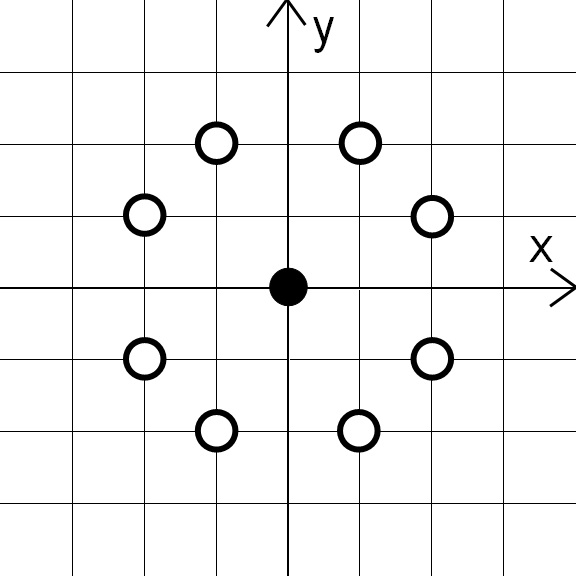
参考として、xy 平面の (0, 0) の上に黒丸を、(0, 0) からの距離が \sqrt{5} となる格子点の上に白丸を書いた図は以下のようになります。(x,y いずれかが整数となる部分に目盛り線を引いています。)
制約
- -10^9 \leq x_1 \leq 10^9
- -10^9 \leq y_1 \leq 10^9
- -10^9 \leq x_2 \leq 10^9
- -10^9 \leq y_2 \leq 10^9
- (x_1, y_1) \neq (x_2, y_2)
- 入力はすべて整数である。
入力
入力は以下の形式で標準入力から与えられる。
x_1 y_1 x_2 y_2
出力
条件を満たす格子点が存在する場合は Yes を、存在しない場合は No を出力せよ。
入力例 1
0 0 3 3
出力例 1
Yes
- 点 (2,1) と (x_1, y_1) の距離は \sqrt{(0-2)^2 + (0-1)^2} = \sqrt{5}
- 点 (2,1) と (x_2, y_2) の距離は \sqrt{(3-2)^2 + (3-1)^2} = \sqrt{5}
- 点 (2, 1) は格子点
なので点 (2, 1) は条件を満たします。よって Yes を出力します。
なお、点 (1, 2) も条件を満たすことが同様にして確認できます。
入力例 2
0 1 2 3
出力例 2
No
条件を満たす格子点は存在しません。よって No を出力します。
入力例 3
1000000000 1000000000 999999999 999999999
出力例 3
Yes
点 (10^9 + 1, 10^9 - 2) および点 (10^9 - 2, 10^9 + 1)が条件を満たします。
Score : 300 points
Problem Statement
On an xy-coordinate plane, is there a lattice point whose distances from two lattice points (x_1, y_1) and (x_2, y_2) are both \sqrt{5}?
Notes
A point on an xy-coordinate plane whose x and y coordinates are both integers is called a lattice point.
The distance between two points (a, b) and (c, d) is defined to be the Euclidean distance between them, \sqrt{(a - c)^2 + (b-d)^2}.
The following figure illustrates an xy-plane with a black circle at (0, 0) and white circles at the lattice points whose distances from (0, 0) are \sqrt{5}. (The grid shows where either x or y is an integer.)
Constraints
- -10^9 \leq x_1 \leq 10^9
- -10^9 \leq y_1 \leq 10^9
- -10^9 \leq x_2 \leq 10^9
- -10^9 \leq y_2 \leq 10^9
- (x_1, y_1) \neq (x_2, y_2)
- All values in input are integers.
Input
Input is given from Standard Input in the following format:
x_1 y_1 x_2 y_2
Output
If there is a lattice point satisfying the condition, print Yes; otherwise, print No.
Sample Input 1
0 0 3 3
Sample Output 1
Yes
- The distance between points (2,1) and (x_1, y_1) is \sqrt{(0-2)^2 + (0-1)^2} = \sqrt{5};
- the distance between points (2,1) and (x_2, y_2) is \sqrt{(3-2)^2 + (3-1)^2} = \sqrt{5};
- point (2, 1) is a lattice point,
so point (2, 1) satisfies the condition. Thus, Yes should be printed.
One can also assert in the same way that (1, 2) also satisfies the condition.
Sample Input 2
0 1 2 3
Sample Output 2
No
No lattice point satisfies the condition, so No should be printed.
Sample Input 3
1000000000 1000000000 999999999 999999999
Sample Output 3
Yes
Point (10^9 + 1, 10^9 - 2) and point (10^9 - 2, 10^9 + 1) satisfy the condition.
実行時間制限: 2 sec / メモリ制限: 1024 MiB
配点 : 400 点
問題文
正整数 N,M が与えられます。
次の条件をともにみたす最小の正整数 X を求めてください。
ただし、そのようなものが存在しない場合は -1 を出力してください。
- X は 1 以上 N 以下の整数 a,b の積として表される。ここで、a と b は同じ整数でも良い。
- X は M 以上である。
制約
- 1\leq N\leq 10^{12}
- 1\leq M\leq 10^{12}
- N,M は整数
入力
入力は以下の形式で標準入力から与えられる。
N M
出力
問題文の条件をともにみたす最小の正整数 X を出力せよ。そのようなものが存在しない場合は -1 を出力せよ。
入力例 1
5 7
出力例 1
8
まず、7 を 1 以上 5 以下の整数 2 つの積として表すことはできません。
次に、8 は 8=2\times 4 などとして、1 以上 5 以下の整数 2 つの積として表すことができます。
よって、8 を出力します。
入力例 2
2 5
出力例 2
-1
1\times 1=1、1\times 2=2、2\times 1=2、2\times 2=4 より、
1 以上 2 以下の整数 2 つの積として表す事ができるのは 1,2,4 のみであるため、
5 以上の数はそのような整数 2 つの積として表すことができません。
よって、-1 を出力します。
入力例 3
100000 10000000000
出力例 3
10000000000
a=b=100000 (=10^5)とした時、a,b の積は 10000000000 (=10^{10}) となり、これが答えとなります。
答えが 32 bit 整数型に収まらない場合があることに注意してください。
Score : 400 points
Problem Statement
You are given positive integers N and M.
Find the smallest positive integer X that satisfies both of the conditions below, or print -1 if there is no such integer.
- X can be represented as the product of two integers a and b between 1 and N, inclusive. Here, a and b may be the same.
- X is at least M.
Constraints
- 1\leq N\leq 10^{12}
- 1\leq M\leq 10^{12}
- N and M are integers.
Input
The input is given from Standard Input in the following format:
N M
Output
Print the smallest positive integer X that satisfies both of the conditions, or -1 if there is no such integer.
Sample Input 1
5 7
Sample Output 1
8
First, 7 cannot be represented as the product of two integers between 1 and 5.
Second, 8 can be represented as the product of two integers between 1 and 5, such as 8=2\times 4.
Thus, you should print 8.
Sample Input 2
2 5
Sample Output 2
-1
Since 1\times 1=1, 1\times 2=2, 2\times 1=2, and 2\times 2=4, only 1, 2, and 4 can be represented as the product of two integers between 1 and 2,
so no number greater than or equal to 5 can be represented as the product of two such integers.
Thus, you should print -1.
Sample Input 3
100000 10000000000
Sample Output 3
10000000000
For a=b=100000 (=10^5), the product of a and b is 10000000000 (=10^{10}), which is the answer.
Note that the answer may not fit into a 32-bit integer type.
実行時間制限: 2 sec / メモリ制限: 1024 MiB
配点 : 500 点
問題文
N 個の整数 a_1,\ldots,a_N が白板に書かれています。
ここで、a_i は m_i 個の素数 p_{i,1} \lt \ldots \lt p_{i,m_i} と正整数 e_{i,1},\ldots,e_{i,m_i} を用いて a_i = p_{i,1}^{e_{i,1}} \times \ldots \times p_{i,m_i}^{e_{i,m_i}} と表せる整数です。
あなたは N 個の整数から 1 つ選んで 1 に書き換えます。
書き換えた後の N 個の整数の最小公倍数としてあり得る値の個数を求めてください。
制約
- 1 \leq N \leq 2 \times 10^5
- 1 \leq m_i
- \sum{m_i} \leq 2 \times 10^5
- 2 \leq p_{i,1} \lt \ldots \lt p_{i,m_i} \leq 10^9
- p_{i,j} は素数
- 1 \leq e_{i,j} \leq 10^9
- 入力はすべて整数
入力
入力は以下の形式で標準入力から与えられる。
N
m_1
p_{1,1} e_{1,1}
\vdots
p_{1,m_1} e_{1,m_1}
m_2
p_{2,1} e_{2,1}
\vdots
p_{2,m_2} e_{2,m_2}
\vdots
m_N
p_{N,1} e_{N,1}
\vdots
p_{N,m_N} e_{N,m_N}
出力
答えを出力せよ。
入力例 1
4
1
7 2
2
2 2
5 1
1
5 1
2
2 1
7 1
出力例 1
3
白板に書かれている整数は a_1 =7^2=49, a_2=2^2 \times 5^1 = 20, a_3 = 5^1 = 5, a_4=2^1 \times 7^1 = 14 です。
a_1 を 1 に書き換えると白板に書かれている整数は 1,20,5,14 となり、これらの最小公倍数は 140 です。
a_2 を 1 に書き換えると白板に書かれている整数は 49,1,5,14 となり、これらの最小公倍数は 490 です。
a_3 を 1 に書き換えると白板に書かれている整数は 49,20,1,14 となり、これらの最小公倍数は 980 です。
a_4 を 1 に書き換えると白板に書かれている整数は 49,20,5,1 となり、これらの最小公倍数は 980 です。
以上より、書き換えた後の N 個の整数の最小公倍数としてあり得る値は 140,490,980 であり、この入力における答えが 3 と分かります。
入力例 2
1
1
998244353 1000000000
出力例 2
1
白板に書かれている整数はとても大きい場合があります。
Score : 500 points
Problem Statement
There are N integers a_1,\ldots,a_N written on a whiteboard.
Here, a_i can be represented as a_i = p_{i,1}^{e_{i,1}} \times \ldots \times p_{i,m_i}^{e_{i,m_i}} using m_i prime numbers p_{i,1} \lt \ldots \lt p_{i,m_i} and positive integers e_{i,1},\ldots,e_{i,m_i}.
You will choose one of the N integers to replace it with 1.
Find the number of values that can be the least common multiple of the N integers after the replacement.
Constraints
- 1 \leq N \leq 2 \times 10^5
- 1 \leq m_i
- \sum{m_i} \leq 2 \times 10^5
- 2 \leq p_{i,1} \lt \ldots \lt p_{i,m_i} \leq 10^9
- p_{i,j} is prime.
- 1 \leq e_{i,j} \leq 10^9
- All values in input are integers.
Input
Input is given from Standard Input in the following format:
N
m_1
p_{1,1} e_{1,1}
\vdots
p_{1,m_1} e_{1,m_1}
m_2
p_{2,1} e_{2,1}
\vdots
p_{2,m_2} e_{2,m_2}
\vdots
m_N
p_{N,1} e_{N,1}
\vdots
p_{N,m_N} e_{N,m_N}
Output
Print the answer.
Sample Input 1
4
1
7 2
2
2 2
5 1
1
5 1
2
2 1
7 1
Sample Output 1
3
The integers on the whiteboard are a_1 =7^2=49, a_2=2^2 \times 5^1 = 20, a_3 = 5^1 = 5, a_4=2^1 \times 7^1 = 14.
If you replace a_1 with 1, the integers on the whiteboard become 1,20,5,14, whose least common multiple is 140.
If you replace a_2 with 1, the integers on the whiteboard become 49,1,5,14, whose least common multiple is 490.
If you replace a_3 with 1, the integers on the whiteboard become 49,20,1,14, whose least common multiple is 980.
If you replace a_4 with 1, the integers on the whiteboard become 49,20,5,1, whose least common multiple is 980.
Therefore, the least common multiple of the N integers after the replacement can be 140, 490, or 980, so the answer is 3.
Sample Input 2
1
1
998244353 1000000000
Sample Output 2
1
There may be enormous integers on the whiteboard.
実行時間制限: 3 sec / メモリ制限: 1024 MiB
配点 : 500 点
問題文
2 以上の整数 N が与えられます。下記の条件を満たす 2 以上の整数 b の個数を出力してください。
- N を b 進法で表記したとき、すべての桁について「その桁が 0 または 1 である」が成り立つ。
T 個の独立なテストケースについて答えを求めてください。
なお、本問題の制約下において、上記の「条件を満たす 2 以上の整数 b の個数」は有限であることが証明できます。
制約
- 1 \leq T \leq 1000
- 2 \leq N \leq 10^{18}
- 入力はすべて整数
入力
入力は以下の形式で標準入力から与えられる。ここで、\mathrm{test}_i は i 番目のテストケースを表す。
T
\mathrm{test}_1
\mathrm{test}_2
\vdots
\mathrm{test}_T
各テストケースは以下の形式で与えられる。
N
出力
T 行出力せよ。 i = 1, 2, \ldots, T について、i 行目には i 番目のテストケースに対する答えを出力せよ。
入力例 1
3
12
2
36
出力例 1
4
1
5
1 番目のテストケースについて、問題文中の条件を満たす b は、b = 2, 3, 11, 12 の 4 つです。 実際、N = 12 を 2, 3, 11, 12 進法で表すと、それぞれ 1100, 110, 11, 10 となります。
Score : 500 points
Problem Statement
Given an integer N not less than 2, find the number of integers b not less than 2 such that:
- when N is written in base b, every digit is 0 or 1.
Find the answer for T independent test cases.
It can be proved that there is a finite number of desired integers b not less than 2 under the constraints of this problem.
Constraints
- 1 \leq T \leq 1000
- 2 \leq N \leq 10^{18}
- All values in the input are integers.
Input
The input is given from Standard Input in the following format, where \mathrm{test}_i denotes the i-th test case:
T
\mathrm{test}_1
\mathrm{test}_2
\vdots
\mathrm{test}_T
Each test case is given in the following format:
N
Output
Print T lines. For i = 1, 2, \ldots, T, the i-th line should contain the answer to the i-th test case.
Sample Input 1
3
12
2
36
Sample Output 1
4
1
5
For the first test case, four b's satisfy the condition in the problem statement: b = 2, 3, 11, 12. Indeed, when N=12 is written in base 2, 3, 11, and 12, it becomes 1100, 110, 11 and 10, respectively.