実行時間制限: 2 sec / メモリ制限: 1024 MiB
配点 : 100 点
問題文
4 枚のカードがあり、それぞれのカードには整数 A,B,C,D が書かれています。
ここに 1 枚カードを加え、フルハウスとできるか判定してください。
ただし、 5 枚組のカードは以下の条件を満たすとき、またそのときに限って、フルハウスであると呼ばれます。
- 異なる整数 x,y について、 x が書かれたカード 3 枚と y が書かれたカード 2 枚からなる。
制約
- 入力は全て整数
- 1 \le A,B,C,D \le 13
入力
入力は以下の形式で標準入力から与えられる。
A B C D
出力
1 枚カードを加えてフルハウスとできる場合は Yes 、そうでないときは No と出力せよ。
入力例 1
7 7 7 1
出力例 1
Yes
7,7,7,1 に 1 を加えた時、フルハウスとなります。
入力例 2
13 12 11 10
出力例 2
No
13,12,11,10 に何を加えてもフルハウスにはなりません。
入力例 3
3 3 5 5
出力例 3
Yes
3,3,5,5 に 3 を加えた時、フルハウスとなります。
また、 5 を加えてもフルハウスとなります。
入力例 4
8 8 8 8
出力例 4
No
8,8,8,8 に何を加えてもフルハウスにはなりません。
同じ 5 枚のカードはフルハウスではないことに注意してください。
入力例 5
1 3 4 1
出力例 5
No
Score : 100 points
Problem Statement
There are four cards with integers A,B,C,D written on them.
Determine whether a Full House can be formed by adding one card.
A set of five cards is called a Full House if and only if the following condition is satisfied:
- For two distinct integers x and y, there are three cards with x written on them and two cards with y written on them.
Constraints
- All input values are integers.
- 1 \le A,B,C,D \le 13
Input
The input is given from Standard Input in the following format:
A B C D
Output
If adding one card can form a Full House, print Yes; otherwise, print No.
Sample Input 1
7 7 7 1
Sample Output 1
Yes
Adding 1 to 7,7,7,1 forms a Full House.
Sample Input 2
13 12 11 10
Sample Output 2
No
Adding anything to 13,12,11,10 does not form a Full House.
Sample Input 3
3 3 5 5
Sample Output 3
Yes
Adding 3,3,5,5 to 3 forms a Full House.
Also, adding 5 forms a Full House.
Sample Input 4
8 8 8 8
Sample Output 4
No
Adding anything to 8,8,8,8 does not form a Full House.
Note that five identical cards do not form a Full House.
Sample Input 5
1 3 4 1
Sample Output 5
No
実行時間制限: 2 sec / メモリ制限: 1024 MiB
配点 : 100 点
問題文
N 以下の非負整数を大きい方から順にすべて出力してください。
制約
- 1 \leq N \leq 100
- N は整数
入力
入力は以下の形式で標準入力から与えられる。
N
出力
N 以下の非負整数が X 個存在するとき、X 行出力せよ。
i=1,2,\ldots,X に対し、i 行目には N 以下の非負整数のうち大きい方から i 番目のものを出力せよ。
入力例 1
3
出力例 1
3
2
1
0
3 以下の非負整数は 0,1,2,3 の 4 個です。
1 行目に 3 を、2 行目に 2 を、3 行目に 1 を、4 行目に 0 を出力することでこれらを大きい方から順に出力したことになります。
入力例 2
22
出力例 2
22
21
20
19
18
17
16
15
14
13
12
11
10
9
8
7
6
5
4
3
2
1
0
Score : 100 points
Problem Statement
Print all non-negative integers less than or equal to N in descending order.
Constraints
- 1 \leq N \leq 100
- N is an integer.
Input
The input is given from Standard Input in the following format:
N
Output
Print X lines, where X is the number of non-negative integers less than or equal to N.
For each i=1, 2, \ldots, X, the i-th line should contain the i-th greatest non-negative integer less than or equal to N.
Sample Input 1
3
Sample Output 1
3
2
1
0
We have four non-negative integers less than or equal to 3, which are 0, 1, 2, and 3.
To print them in descending order, print 3 in the first line, 2 in the second, 1 in the third, and 0 in the fourth.
Sample Input 2
22
Sample Output 2
22
21
20
19
18
17
16
15
14
13
12
11
10
9
8
7
6
5
4
3
2
1
0
実行時間制限: 2 sec / メモリ制限: 1024 MiB
配点 : 200 点
問題文
文字列 S が文字列 T の部分文字列であるとは、次の条件を満たすような整数 i, j (1 \leq i \leq j \leq |T|) が存在することを言います。
- T の i 文字目から j 文字目までを順番を変えずに抜き出してできる文字列が S と一致する。
文字列 T を oxx を 10^5 個結合した文字列として定めます。
文字列 S が与えられるので、 S が T の部分文字列である場合は Yes を、そうでない場合は No を出力してください。
制約
- S は
oとxのみからなる文字列である。 - S の長さは 1 以上 10 以下である。
入力
入力は以下の形式で標準入力から与えられる。
S
出力
S が条件を満たす場合は Yes を、そうでない場合は No を出力せよ。
入力例 1
xoxxoxxo
出力例 1
Yes
T のはじめの方を抜き出すと oxxoxxoxxoxx... となっています。
T の 3 文字目から 10 文字目までを抜き出した文字列は S と一致するので、 S は T の部分文字列です。よって Yes を出力します。
入力例 2
xxoxxoxo
出力例 2
No
T から文字列をどのように抜き出しても S と一致しないので、S は T の部分文字列でありません。よって No を出力します。
入力例 3
ox
出力例 3
Yes
Score : 200 points
Problem Statement
A string S is said to be a substring of a string T when there is a pair of integers i and j (1 \leq i \leq j \leq |T|) that satisfy the following condition.
- The extraction of the i-th through j-th characters of T without changing the order equals S.
Let T be the concatenation of 10^5 copies of oxx.
Given a string S, print Yes if S is a substring of T, and No otherwise.
Constraints
- S is a string consisting of
oandx. - The length of S is between 1 and 10 (inclusive).
Input
Input is given from Standard Input in the following format:
S
Output
If S satisfies the condition, print Yes; otherwise, print No.
Sample Input 1
xoxxoxxo
Sample Output 1
Yes
T begins like this: oxxoxxoxxoxx...
Since the extraction of 3-rd through 10-th characters of T equals S, S is a substring of T, so Yes should be printed.
Sample Input 2
xxoxxoxo
Sample Output 2
No
Since there is no way to extract from T a string that equals S, S is not a substring of T, so No should be printed.
Sample Input 3
ox
Sample Output 3
Yes
実行時間制限: 2 sec / メモリ制限: 1024 MiB
配点 : 200 点
問題文
長さ N の正整数列 a = (a_1, a_2, \dots, a_N) には何種類の整数が現れますか?
制約
- 1 \leq N \leq 1000
- 1 \leq a_i \leq 10^9 \, (1 \leq i \leq N)
- 入力は全て整数
入力
入力は以下の形式で標準入力から与えられる。
N
a_1 \ldots a_N
出力
答えを出力せよ。
入力例 1
6
1 4 1 2 2 1
出力例 1
3
1, 2, 4 の 3 種類の整数が現れます。
入力例 2
1
1
出力例 2
1
入力例 3
11
3 1 4 1 5 9 2 6 5 3 5
出力例 3
7
Score : 200 points
Problem Statement
In a sequence of N positive integers a = (a_1, a_2, \dots, a_N), how many different integers are there?
Constraints
- 1 \leq N \leq 1000
- 1 \leq a_i \leq 10^9 \, (1 \leq i \leq N)
- All values in input are integers.
Input
Input is given from Standard Input in the following format:
N
a_1 \ldots a_N
Output
Print the answer.
Sample Input 1
6
1 4 1 2 2 1
Sample Output 1
3
There are three different integers: 1, 2, 4.
Sample Input 2
1
1
Sample Output 2
1
Sample Input 3
11
3 1 4 1 5 9 2 6 5 3 5
Sample Output 3
7
実行時間制限: 2 sec / メモリ制限: 1024 MiB
配点 : 300 点
問題文
アーティストの高砂君は、魚の骨をかたどったオブジェを作りました。
オブジェは N 本の肋骨と 1 本の脊椎からなります。 肋骨には 1 から N までの番号が付けられています。
高砂君は、以下の条件をすべて満たすように N+1 本の骨に 1 つずつ文字列を書こうと考えています。
- 脊椎に書く文字列の長さは N である。
- 肋骨 i = 1, \dots, N に対して、以下が成り立つ。
- 肋骨 i に書く文字列の長さは A_i である。
- 肋骨 i に書く文字列の B_i 文字目は、脊椎に書く文字列の i 文字目に一致する。
- N+1 本の骨に書く文字列はいずれも、S_1, \cdots, S_M のいずれかである(重複してもよい)。
S_1, \cdots, S_M は英小文字からなる文字列であり、互いに異なります。
j = 1, \cdots, M に対して、以下の質問に答えてください。
- 条件を満たす書き方のうち、脊椎に書く文字列が S_j であるものは存在しますか?
制約
- N は整数
- 1 \leq N \leq 10
- A_i, B_i は整数 (1 \leq i \leq N)
- 1 \leq B_i \leq A_i \leq 10 (1 \leq i \leq N)
- M は整数
- 1 \leq M \leq 200\,000
- S_j は英小文字からなる文字列 (1 \leq j \leq M)
- 1 \leq |S_j| \leq 10 (1 \leq j \leq M)
- S_1, \cdots, S_M は相異なる
入力
入力は以下の形式で標準入力から与えられる。
N
A_1 B_1
\vdots
A_N B_N
M
S_1
\vdots
S_M
出力
M 行出力せよ。
j 行目 (1 \leq j \leq M) には、条件を満たす書き方のうち脊椎に書く文字列が S_j のものが存在するならば Yes を、存在しないならば No を出力せよ。
入力例 1
5
5 3
5 2
4 1
5 1
3 2
8
retro
chris
itchy
tuna
crab
rock
cod
ash
出力例 1
Yes
Yes
No
No
No
No
No
No
肋骨 1,2,3,4,5 にそれぞれ chris, retro, tuna, retro, cod と書くことで、脊椎に retro を書いたときに条件を満たします。
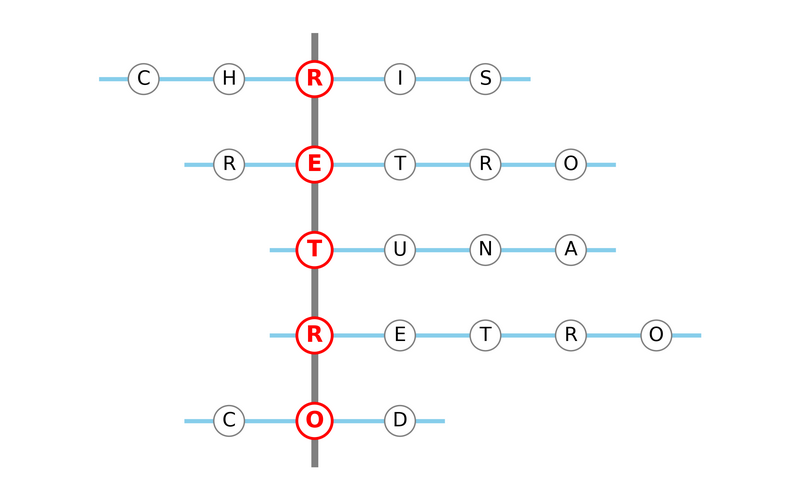
retroの長さは 5 文字。- 各肋骨について、以下が成り立つ。
- 肋骨 1 に書かれる文字列
chrisの長さは 5 文字である。その 3 文字目はrであり、retroの 1 文字目に一致する。 - 肋骨 2 に書かれる文字列
retroの長さは 5 文字である。その 2 文字目はeであり、retroの 2 文字目に一致する。 - 肋骨 3 に書かれる文字列
tunaの長さは 4 文字である。その 1 文字目はtであり、retroの 3 文字目に一致する。 - 肋骨 4 に書かれる文字列
retroの長さは 5 文字である。その 1 文字目はrであり、retroの 4 文字目に一致する。 - 肋骨 5 に書かれる文字列
codの長さは 3 文字である。その 2 文字目はoであり、retroの 5 文字目に一致する。
- 肋骨 1 に書かれる文字列
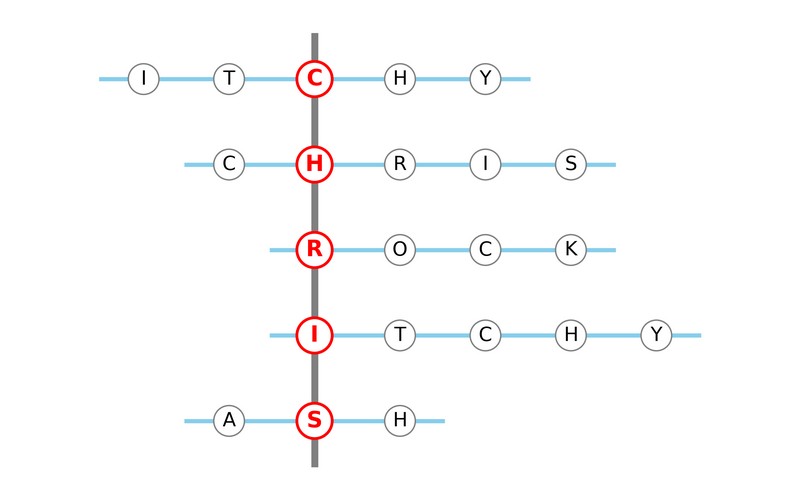
肋骨 1,2,3,4,5 にそれぞれ itchy, chris, rock, itchy, ash と書くことで、脊椎に chris を書いたときに条件を満たします。
入力例 2
5
5 1
5 2
5 3
5 4
5 5
8
retro
chris
itchy
tuna
crab
rock
cod
ash
出力例 2
Yes
Yes
Yes
No
No
No
No
No
Score : 300 points
Problem Statement
Artist Takasago has created an object in the shape of a fish skeleton.
The object consists of N ribs and one spine. The ribs are numbered 1 through N.
He wants to write one string on each of the N+1 bones, satisfying all of the following conditions.
- The length of the string written on the spine is N.
- For each rib i = 1, \dots, N, the following hold.
- The length of the string written on rib i is A_i.
- The B_i-th character of the string written on rib i equals the i-th character of the string written on the spine.
- Each of the strings written on the N+1 bones is one of S_1, \cdots, S_M (duplicates allowed).
S_1, \cdots, S_M are strings consisting of lowercase English letters, and they are all distinct.
For each j = 1, \cdots, M, answer the following question.
- Among the ways to write strings satisfying the conditions, is there one where the string written on the spine is S_j?
Constraints
- N is an integer.
- 1 \leq N \leq 10
- A_i and B_i are integers. (1 \leq i \leq N)
- 1 \leq B_i \leq A_i \leq 10 (1 \leq i \leq N)
- M is an integer.
- 1 \leq M \leq 200\,000
- S_j is a string consisting of lowercase English letters. (1 \leq j \leq M)
- 1 \leq |S_j| \leq 10 (1 \leq j \leq M)
- S_1, \cdots, S_M are pairwise distinct.
Input
The input is given from Standard Input in the following format:
N
A_1 B_1
\vdots
A_N B_N
M
S_1
\vdots
S_M
Output
Output M lines.
The j-th line (1 \leq j \leq M) should contain Yes if there exists a way to write strings satisfying the conditions with S_j written on the spine, and No otherwise.
Sample Input 1
5
5 3
5 2
4 1
5 1
3 2
8
retro
chris
itchy
tuna
crab
rock
cod
ash
Sample Output 1
Yes
Yes
No
No
No
No
No
No
By writing chris, retro, tuna, retro, cod on ribs 1,2,3,4,5 respectively, the conditions are satisfied with retro written on the spine.
- The length of
retrois 5. - For each rib, the following hold.
- The string written on rib 1 is
chris, which has length 5. Its third character isr, which equals the first character ofretro. - The string written on rib 2 is
retro, which has length 5. Its second character ise, which equals the second character ofretro. - The string written on rib 3 is
tuna, which has length 4. Its first character ist, which equals the third character ofretro. - The string written on rib 4 is
retro, which has length 5. Its first character isr, which equals the fourth character ofretro. - The string written on rib 5 is
cod, which has length 3. Its second character iso, which equals the fifth character ofretro.
- The string written on rib 1 is
By writing itchy, chris, rock, itchy, ash on ribs 1,2,3,4,5 respectively, the conditions are satisfied with chris written on the spine.
Sample Input 2
5
5 1
5 2
5 3
5 4
5 5
8
retro
chris
itchy
tuna
crab
rock
cod
ash
Sample Output 2
Yes
Yes
Yes
No
No
No
No
No
実行時間制限: 2 sec / メモリ制限: 1024 MiB
配点 : 350 点
問題文
高橋君は医者のすぬけ君から N 種類の薬を処方されました。i 種類目の薬は(処方された日を含めて) a_i 日間、毎日 b_i 錠ずつ飲む必要があります。また、高橋君はこれ以外の薬を飲む必要がありません。
薬を処方された日を 1 日目とします。1 日目以降で、初めて高橋君がその日に飲む必要がある薬が K 錠以下になるのは何日目かを求めてください。
制約
- 1 \leq N \leq 3 \times 10^5
- 0 \leq K \leq 10^9
- 1 \leq a_i,b_i \leq 10^9
- 入力はすべて整数
入力
入力は以下の形式で標準入力から与えられる。
N K
a_1 b_1
\vdots
a_N b_N
出力
1 日目以降で、初めて高橋君がその日に飲む必要がある薬が K 錠以下になるのが X 日目の時、 X を出力せよ。
入力例 1
4 8
6 3
2 5
1 9
4 2
出力例 1
3
1 日目には、高橋君は 1,2,3,4 種類目の薬をそれぞれ 3,5,9,2 錠飲む必要があります。よってこの日は 19 錠飲む必要があり、K(=8) 錠以下ではありません。
2 日目には、高橋君は 1,2,4 種類目の薬をそれぞれ 3,5,2 錠飲む必要があります。よってこの日は 10 錠飲む必要があり、K(=8) 錠以下ではありません。
3 日目には、高橋君は 1,4 種類目の薬をそれぞれ 3,2 錠飲む必要があります。よってこの日は 5 錠飲む必要があり、初めて K(=8) 錠以下になります。
以上より、3 が答えです。
入力例 2
4 100
6 3
2 5
1 9
4 2
出力例 2
1
入力例 3
15 158260522
877914575 2436426
24979445 61648772
623690081 33933447
476190629 62703497
211047202 71407775
628894325 31963982
822804784 50968417
430302156 82631932
161735902 80895728
923078537 7723857
189330739 10286918
802329211 4539679
303238506 17063340
492686568 73361868
125660016 50287940
出力例 3
492686569
Score : 350 points
Problem Statement
Snuke the doctor prescribed N kinds of medicine for Takahashi. For the next a_i days (including the day of the prescription), he has to take b_i pills of the i-th medicine. He does not have to take any other medicine.
Let the day of the prescription be day 1. On or after day 1, when is the first day on which he has to take K pills or less?
Constraints
- 1 \leq N \leq 3 \times 10^5
- 0 \leq K \leq 10^9
- 1 \leq a_i,b_i \leq 10^9
- All input values are integers.
Input
The input is given from Standard Input in the following format:
N K
a_1 b_1
\vdots
a_N b_N
Output
If Takahashi has to take K pills or less on day X for the first time on or after day 1, print X.
Sample Input 1
4 8
6 3
2 5
1 9
4 2
Sample Output 1
3
On day 1, he has to take 3,5,9, and 2 pills of the 1-st, 2-nd, 3-rd, and 4-th medicine, respectively. In total, he has to take 19 pills on this day, which is not K(=8) pills or less.
On day 2, he has to take 3,5, and 2 pills of the 1-st, 2-nd, and 4-th medicine, respectively. In total, he has to take 10 pills on this day, which is not K(=8) pills or less.
On day 3, he has to take 3 and 2 pills of the 1-st and 4-th medicine, respectively. In total, he has to take 5 pills on this day, which is K(=8) pills or less for the first time.
Thus, the answer is 3.
Sample Input 2
4 100
6 3
2 5
1 9
4 2
Sample Output 2
1
Sample Input 3
15 158260522
877914575 2436426
24979445 61648772
623690081 33933447
476190629 62703497
211047202 71407775
628894325 31963982
822804784 50968417
430302156 82631932
161735902 80895728
923078537 7723857
189330739 10286918
802329211 4539679
303238506 17063340
492686568 73361868
125660016 50287940
Sample Output 3
492686569
実行時間制限: 2 sec / メモリ制限: 1024 MiB
配点 : 400 点
問題文
N 組のカップルが一列に座っています。
2 組のカップルであって、もともと両方のカップルは隣り合わせで座っておらず、かつ 4 人の間で席を交換することで両方のカップルが隣り合わせで座れるようになる組の個数を数えてください。
長さ 2N の数列 A=(A_1,A_2,\dots,A_{2N}) があります。A には 1, 2, \dots, N がそれぞれ 2 回ずつ登場します。
1 \leq a \lt b \leq N を満たす整数対 (a, b) であって以下の条件を全て満たすものの個数を求めてください。
- A 内において a 同士は隣接していない。
- A 内において b 同士は隣接していない。
- 次の操作を 1 回以上自由な回数行うことで、A 内において a 同士が隣接していて、かつ b 同士が隣接している状態にすることができる。
- A_i = a, A_j = b を満たす整数対 (i, j) (1 \leq i \leq 2N, 1 \leq j \leq 2N) を選び、A_i と A_j を入れ替える。
T 個のテストケースが与えられるので、それぞれに対して答えを求めてください。
制約
- 1 \leq T \leq 2 \times 10^5
- 1 \leq N \leq 2 \times 10^5
- 1 \leq A_i \leq N
- A には 1, 2, \dots, N がそれぞれ 2 回ずつ登場する
- 全てのテストケースに対する N の総和は 2 \times 10^5 以下
- 入力される値は全て整数
入力
入力は以下の形式で標準入力から与えられる。ここで、\mathrm{case}_i は i 番目のテストケースを意味する。
T
\mathrm{case}_1
\mathrm{case}_2
\vdots
\mathrm{case}_T
各テストケースは以下の形式で与えられる。
N
A_1 A_2 \dots A_{2N}
出力
T 行出力せよ。i 行目には i 番目のテストケースの答えを出力せよ。
入力例 1
3
3
1 2 3 3 1 2
4
1 1 2 2 3 3 4 4
5
1 2 3 4 5 1 2 3 4 5
出力例 1
1
0
4
1 番目のテストケースについて考えます。
(a, b)=(1, 2) は問題文の条件を満たします。理由は次の通りです。
- A 内において 1 同士は隣接していない。
- A 内において 2 同士は隣接していない。
- (i,j)=(1, 6) として A_1 と A_6 を入れ替える操作を行うことで、1 同士が隣接していて、かつ 2 同士が隣接している状態にすることができる。
問題文の条件を満たす (a, b) は (1, 2) のみです。
Score : 400 points
Problem Statement
N couples are seated in a line.
Count the number of pairs of couples such that neither couple was originally sitting next to each other, and both couples can end up sitting next to each other by swapping seats among those four people.
There is a sequence A = (A_1, A_2, \dots, A_{2N}) of length 2N. Each of the integers 1, 2, \dots, N appears exactly twice in A.
Find the number of integer pairs (a, b) satisfying 1 \leq a < b \leq N and all of the following conditions:
- The two occurrences of a in A are not adjacent.
- The two occurrences of b in A are not adjacent.
- By performing the following operation one or more times in any order, it is possible to reach a state where the two occurrences of a in A are adjacent and the two occurrences of b in A are also adjacent.
- Choose an integer pair (i, j) (1 \leq i \leq 2N, 1 \leq j \leq 2N) such that A_i = a and A_j = b, and swap A_i with A_j.
You are given T test cases; solve each of them.
Constraints
- 1 \leq T \leq 2 \times 10^5
- 1 \leq N \leq 2 \times 10^5
- 1 \leq A_i \leq N
- Each of 1, 2, \dots, N appears exactly twice in A.
- The sum of N over all test cases is at most 2 \times 10^5.
- All input values are integers.
Input
The input is given from Standard Input in the following format, where \mathrm{case}_i denotes the i-th test case:
T
\mathrm{case}_1
\mathrm{case}_2
\vdots
\mathrm{case}_T
Each test case is given in the following format:
N
A_1 A_2 \dots A_{2N}
Output
Print T lines. The i-th line should contain the answer for the i-th test case.
Sample Input 1
3
3
1 2 3 3 1 2
4
1 1 2 2 3 3 4 4
5
1 2 3 4 5 1 2 3 4 5
Sample Output 1
1
0
4
Consider the first test case.
(a, b) = (1, 2) satisfies the conditions in the problem statement, for the following reasons:
- The two occurrences of 1 in A are not adjacent.
- The two occurrences of 2 in A are not adjacent.
- By performing the operation where (i, j) = (1, 6) and swapping A_1 with A_6, you can reach a state where the two occurrences of 1 are adjacent and the two occurrences of 2 are also adjacent.
(1, 2) is the only pair (a, b) that satisfies the conditions.
実行時間制限: 2 sec / メモリ制限: 1024 MiB
配点 : 450 点
問題文
H 行 W 列のグリッドがあり、はじめすべてのマスは色 0 で塗られています。
これから i = 1, 2, \ldots, M の順で以下の操作を行います。
-
T_i = 1 のとき、A_i 行目のマスをすべて色 X_i に塗り替える
-
T_i = 2 のとき、A_i 列目のマスをすべて色 X_i に塗り替える
すべての操作を終えたとき、最終的に色 i で塗られたマスが存在するような各色 i についてその色で塗られたマスの個数を求めてください。
制約
- 1 \leq H, W, M \leq 2 \times 10^5
- T_i \in \lbrace 1, 2 \rbrace
- T_i = 1 なる i に対して 1 \leq A_i \leq H
- T_i = 2 なる i に対して 1 \leq A_i \leq W
- 0 \leq X_i \leq 2 \times 10^5
- 入力される値はすべて整数
入力
入力は以下の形式で標準入力から与えられる。
H W M
T_1 A_1 X_1
T_2 A_2 X_2
\vdots
T_M A_M X_M
出力
色 i で塗られたマスが存在するような整数 i の個数を K として、K + 1 行出力せよ。
1 行目には K の値を出力せよ。
2 行目以降には色 i で塗られたマスが存在するような各色 i について、色の番号およびその色で塗られたマスの個数を出力せよ。
具体的には、i + 1 (1 \leq i \leq K) 行目には色の番号 c_i と色 c_i で塗られたマスの個数 x_i をこの順に空白区切りで出力せよ。
ただし、色の番号は昇順で出力せよ。すなわち、c_1 < c_2 < \ldots < c_K を満たすように出力せよ。また、x_i > 0 が必要であることに注意せよ。
入力例 1
3 4 4
1 2 5
2 4 0
1 3 3
1 3 2
出力例 1
3
0 5
2 4
5 3
操作によってグリッドの各マスの色は以下のように変化します。
0000   0000   0000   0000   0000
0000 → 5555 → 5550 → 5550 → 5550
0000   0000   0000   3333   2222
最終的に色 0 で塗られたマスは 5 つ、色 2 で塗られたマスは 4 つ、色 5 で塗られたマスは 3 つです。
入力例 2
1 1 5
1 1 1
1 1 10
2 1 100
1 1 1000
2 1 10000
出力例 2
1
10000 1
入力例 3
5 5 10
1 1 1
1 2 2
1 3 3
1 4 4
1 5 5
2 1 6
2 2 7
2 3 8
2 4 9
2 5 10
出力例 3
5
6 5
7 5
8 5
9 5
10 5
Score: 450 points
Problem Statement
There is a grid with H rows and W columns. Initially, all cells are painted with color 0.
You will perform the following operations in the order i = 1, 2, \ldots, M.
-
If T_i = 1, repaint all cells in the A_i-th row with color X_i.
-
If T_i = 2, repaint all cells in the A_i-th column with color X_i.
After all operations are completed, for each color i that exists on the grid, find the number of cells that are painted with color i.
Constraints
- 1 \leq H, W, M \leq 2 \times 10^5
- T_i \in \lbrace 1, 2 \rbrace
- 1 \leq A_i \leq H for each i such that T_i = 1,
- 1 \leq A_i \leq W for each i such that T_i = 2.
- 0 \leq X_i \leq 2 \times 10^5
- All input values are integers.
Input
The input is given from Standard Input in the following format:
H W M
T_1 A_1 X_1
T_2 A_2 X_2
\vdots
T_M A_M X_M
Output
Let K be the number of distinct integers i such that there are cells painted with color i. Print K + 1 lines.
The first line should contain the value of K.
The second and subsequent lines should contain, for each color i that exists on the grid, the color number i and the number of cells painted with that color.
Specifically, the (i + 1)-th line (1 \leq i \leq K) should contain the color number c_i and the number of cells x_i painted with color c_i, in this order, separated by a space.
Here, print the color numbers in ascending order. That is, ensure that c_1 < c_2 < \ldots < c_K. Note also that x_i > 0 is required.
Sample Input 1
3 4 4
1 2 5
2 4 0
1 3 3
1 3 2
Sample Output 1
3
0 5
2 4
5 3
The operations will change the colors of the cells in the grid as follows:
0000   0000   0000   0000   0000
0000 → 5555 → 5550 → 5550 → 5550
0000   0000   0000   3333   2222
Eventually, there are five cells painted with color 0, four with color 2, and three with color 5.
Sample Input 2
1 1 5
1 1 1
1 1 10
2 1 100
1 1 1000
2 1 10000
Sample Output 2
1
10000 1
Sample Input 3
5 5 10
1 1 1
1 2 2
1 3 3
1 4 4
1 5 5
2 1 6
2 2 7
2 3 8
2 4 9
2 5 10
Sample Output 3
5
6 5
7 5
8 5
9 5
10 5
実行時間制限: 3 sec / メモリ制限: 1024 MiB
配点 : 525 点
問題文
頂点に 1 から N の番号がつけられた N 頂点の木および整数 K が与えられます。i 番目の辺は頂点 u_i と頂点 v_i を双方向に結んでいます。
あなたはいま頂点 1 にいます。以下の操作を 0 回以上繰り返すことができます。
- あなたが今いる頂点からの距離が K であるような頂点を一つ選び、その頂点に移動する。ただし、2 頂点間の距離は 2 頂点を結ぶ単純パスに含まれる辺の個数とする。
各 k=2,\ldots,N に対して、操作を繰り返して頂点 k に移動することができるかどうか判定し、移動できるならば操作回数の最小値を求めてください。
T 個のテストケースが与えられるので、それぞれについて解いてください。
制約
- 1\leq T\leq 10^5
- 2\leq N\leq 2\times 10^5
- 1\leq K\leq 20
- 1\leq u_i\lt v_i\leq N
- 与えられるグラフは木
- 全てのテストケースに対する N の総和は 2\times 10^5 以下
- 入力は全て整数
入力
入力は以下の形式で標準入力から与えられる。ここで、\mathrm{case}_i は i 番目のテストケースを意味する。
T
\mathrm{case}_1
\mathrm{case}_2
\vdots
\mathrm{case}_T
各テストケースは以下の形式で与えられる。
N K
u_1 v_1
u_2 v_2
\vdots
u_{N-1} v_{N-1}
出力
T 行出力せよ。i 行目には i 番目のテストケースの答えを以下の形式で出力せよ。
\mathrm{ans}_2 \mathrm{ans}_3 \ldots \mathrm{ans}_N
\mathrm{ans}_i は k=i に対する答えである。操作を繰り返して頂点 i に移動することができるならば操作回数の最小値を、移動することができないならば -1 とせよ。
入力例 1
1
6 2
1 2
2 3
2 4
4 5
5 6
出力例 1
-1 1 1 -1 2
この入出力例は 1 つのテストケースからなります。
頂点 1 との距離が 2 である頂点は 3,4 であるため、この 2 つの頂点には 1 回の操作で移動することができます。
また、頂点 1 から頂点 4 に移動したのち、頂点 4 からの距離が 2 である頂点 6 に移動することで、頂点 6 には 2 回の操作で移動することができます。
頂点 2,5 にはどのように操作しても移動することができません。
入力例 2
3
2 20
1 2
10 2
1 9
1 8
1 5
6 8
4 5
2 8
5 10
7 9
3 5
10 1
2 6
2 9
8 9
9 10
3 9
4 9
7 9
1 6
3 5
出力例 2
-1
1 1 1 -1 1 1 -1 -1 1
2 4 4 5 1 4 4 3 4
Score : 525 points
Problem Statement
You are given a tree with N vertices numbered from 1 to N and an integer K. The i-th edge bidirectionally connects vertices u_i and v_i.
You are currently at vertex 1. You can repeat the following operation zero or more times:
- Choose a vertex whose distance from the vertex you are currently at is K, and move to that vertex. Here, the distance between two vertices is the number of edges in the simple path connecting the two vertices.
For each k=2,\ldots,N, determine whether you can move to vertex k by repeating the operation, and if you can move, find the minimum number of operations.
You have T test cases, so solve each of them.
Constraints
- 1\leq T\leq 10^5
- 2\leq N\leq 2\times 10^5
- 1\leq K\leq 20
- 1\leq u_i\lt v_i\leq N
- The given graph is a tree.
- The sum of N over all test cases is at most 2\times 10^5.
- All input values are integers.
Input
The input is given from Standard Input in the following format, where \mathrm{case}_i means the i-th test case.
T
\mathrm{case}_1
\mathrm{case}_2
\vdots
\mathrm{case}_T
Each test case is given in the following format:
N K
u_1 v_1
u_2 v_2
\vdots
u_{N-1} v_{N-1}
Output
Output T lines. The i-th line should contain the answer for the i-th test case in the following format:
\mathrm{ans}_2 \mathrm{ans}_3 \ldots \mathrm{ans}_N
\mathrm{ans}_i is the answer for k=i. If you can move to vertex i by repeating the operation, \mathrm{ans}_i is the minimum number of operations; otherwise, \mathrm{ans}_i is -1.
Sample Input 1
1
6 2
1 2
2 3
2 4
4 5
5 6
Sample Output 1
-1 1 1 -1 2
This sample input/output consists of one test case.
The vertices whose distance from vertex 1 is 2 are vertices 3 and 4, so you can move to these two vertices with one operation.
Also, by moving from vertex 1 to vertex 4, then moving to vertex 6 whose distance from vertex 4 is 2, you can move to vertex 6 with two operations.
You cannot move to vertices 2 and 5 no matter how you perform the operations.
Sample Input 2
3
2 20
1 2
10 2
1 9
1 8
1 5
6 8
4 5
2 8
5 10
7 9
3 5
10 1
2 6
2 9
8 9
9 10
3 9
4 9
7 9
1 6
3 5
Sample Output 2
-1
1 1 1 -1 1 1 -1 -1 1
2 4 4 5 1 4 4 3 4