Time Limit: 2 sec / Memory Limit: 1024 MiB
配点 : 100 点
問題文
AtCoder では、ユーザーのレートは正の整数で与えられ、その値に応じて ^ がいくつか表示されます。
特に、レートが 1 以上 399 以下のときは次のようになります。
- レートが 1 以上 99 以下のときは
^は 1 個表示される。 - レートが 100 以上 199 以下のときは
^は 2 個表示される。 - レートが 200 以上 299 以下のときは
^は 3 個表示される。 - レートが 300 以上 399 以下のときは
^は 4 個表示される。
現在の高橋君のレートは R です。ここで、R は 1 以上 299 以下の整数であることが保証されます。
表示される ^ の数を現在より増やすために、高橋君は少なくともレートをいくつ上げる必要があるか答えてください。
なお、本問題の制約下で、高橋君はレートを 400 以上に上げることなく ^ の数を増やすことができることが証明できます。
制約
- 1\leq R \leq 299
- R は整数
入力
入力は以下の形式で標準入力から与えられる。
R
出力
表示される ^ の数を現在より増やすために、高橋君は少なくともレートをいくつ上げる必要があるか整数で出力せよ。
入力例 1
123
出力例 1
77
高橋君の現在のレートは 123 であり、^ は 2 個表示されています。
ここからレートを 77 上げると高橋君のレートは 200 となり、^ は 3 個表示されるようになります。
レート が 199 以下のときは ^ の数は 2 個以下であるので、77 を出力します。
入力例 2
250
出力例 2
50
Score : 100 points
Problem Statement
In AtCoder, a user's rating is given as a positive integer, and based on this value, a certain number of ^ is displayed.
Specifically, when the rating is between 1 and 399, inclusive, the display rules are as follows:
- When the rating is between 1 and 99, inclusive,
^is displayed once. - When the rating is between 100 and 199, inclusive,
^is displayed twice. - When the rating is between 200 and 299, inclusive,
^is displayed three times. - When the rating is between 300 and 399, inclusive,
^is displayed four times.
Currently, Takahashi's rating is R. Here, it is guaranteed that R is an integer between 1 and 299, inclusive.
Find the minimum increase in rating required for him to increase the number of displayed ^.
It can be proved that under the constraints of this problem, he can increase the number of ^ without raising his rating to 400 or above.
Constraints
- 1 \leq R \leq 299
- R is an integer.
Input
The input is given from Standard Input in the following format:
R
Output
Print, as an integer, the minimum increase in rating required for Takahashi to increase the number of displayed ^.
Sample Input 1
123
Sample Output 1
77
Takahashi's current rating is 123, and ^ is displayed twice.
By increasing his rating by 77, his rating will become 200, and ^ will be displayed three times.
When the rating is 199 or below, ^ is displayed not more than twice, so print 77.
Sample Input 2
250
Sample Output 2
50
Time Limit: 2 sec / Memory Limit: 1024 MiB
配点 : 100 点
問題文
キーエンスでは、役割や年齢、立場の違いに関係なく「さん」付けして呼ぶという文化があります。 新入社員が社長を呼ぶときも「中田さん」と呼びます。
ある人の苗字と名前がそれぞれ文字列 S,T として与えられます。
苗字、スペース( )、敬称(san)をこの順に連結した文字列を出力してください。
制約
- S,T は以下の各条件を満たす文字列
- 長さ 1 以上 10 以下
- 先頭の文字は英大文字
- 先頭以外の文字は英小文字
入力
入力は以下の形式で標準入力から与えられる。
S T
出力
苗字、スペース( )、敬称(san)をこの順に連結した文字列を出力せよ。
入力例 1
Takahashi Chokudai
出力例 1
Takahashi san
苗字(Takahashi)、スペース( )、敬称(san)をこの順に連結した文字列を出力します。
入力例 2
K Eyence
出力例 2
K san
Score : 100 points
Problem Statement
Keyence has a culture of addressing everyone with the honorific "san," regardless of their role, age, or position. Even a new employee would call the president "Nakata-san." [Translator's note: this is a bit unusual in Japan.]
You are given a person's surname and first name as strings S and T, respectively.
Print the concatenation of the surname, a space ( ), and the honorific (san) in this order.
Constraints
- Each of S and T is a string that satisfies the following conditions.
- The length is between 1 and 10, inclusive.
- The first character is an uppercase English letter.
- All characters except the first one are lowercase English letters.
Input
The input is given from Standard Input in the following format:
S T
Output
Print the concatenation of the surname, a space ( ), and the honorific (san) in this order.
Sample Input 1
Takahashi Chokudai
Sample Output 1
Takahashi san
Print the concatenation of the surname (Takahashi), a space ( ), and the honorific (san) in this order.
Sample Input 2
K Eyence
Sample Output 2
K san
Time Limit: 2 sec / Memory Limit: 1024 MiB
配点 : 200 点
問題文
英小文字からなる長さ N の文字列 S が与えられます。 S の x 文字目 (1 \le x \le N) は S_x です。
i=1,2,\dots,N-1 それぞれについて、以下の条件を全て満たす最大の非負整数 l を求めてください。
- l+i \le N である。
- 全ての 1 \le k \le l を満たす整数 k について、 S_{k} \neq S_{k+i} を満たす。
なお、 l=0 は常に条件を満たすことに注意してください。
制約
- N は 2 \le N \le 5000 を満たす整数
- S は英小文字からなる長さ N の文字列
入力
入力は以下の形式で標準入力から与えられる。
N
S
出力
N-1 行にわたって出力せよ。そのうち x 行目 (1 \le x < N) には i=x とした場合の答えを整数として出力せよ。
入力例 1
6
abcbac
出力例 1
5
1
2
0
1
この入力では、 S= abcbac です。
- i=1 のとき、 S_1 \neq S_2, S_2 \neq S_3, \dots ,S_5 \neq S_6 であるため、 最大値は l=5 です。
- i=2 のとき、 S_1 \neq S_3 ですが S_2 = S_4 であるため、 最大値は l=1 です。
- i=3 のとき、 S_1 \neq S_4, S_2 \neq S_5 ですが S_3 = S_6 であるため、 最大値は l=2 です。
- i=4 のとき、 S_1 = S_5 であるため、 最大値は l=0 です。
- i=5 のとき、 S_1 \neq S_6 であるため、 最大値は l=1 です。
Score : 200 points
Problem Statement
You are given a string S of length N consisting of lowercase English letters. The x-th (1 \le x \le N) character of S is S_x.
For each i=1,2,\dots,N-1, find the maximum non-negative integer l that satisfies all of the following conditions:
- l+i \le N, and
- for all integers k such that 1 \le k \le l, it holds that S_{k} \neq S_{k+i}.
Note that l=0 always satisfies the conditions.
Constraints
- N is an integer such that 2 \le N \le 5000.
- S is a string of length N consisting of lowercase English letters.
Input
The input is given from Standard Input in the following format:
N
S
Output
Print (N-1) lines. The x-th (1 \le x < N) line should contain the answer as an integer when i=x.
Sample Input 1
6
abcbac
Sample Output 1
5
1
2
0
1
In this input, S= abcbac.
- When i=1, we have S_1 \neq S_2, S_2 \neq S_3, \dots, and S_5 \neq S_6, so the maximum value is l=5.
- When i=2, we have S_1 \neq S_3 but S_2 = S_4, so the maximum value is l=1.
- When i=3, we have S_1 \neq S_4 and S_2 \neq S_5 but S_3 = S_6, so the maximum value is l=2.
- When i=4, we have S_1 = S_5, so the maximum value is l=0.
- When i=5, we have S_1 \neq S_6, so the maximum value is l=1.
Time Limit: 2 sec / Memory Limit: 1024 MiB
配点 : 200 点
問題文
1 から N の番号がついた N 人の人がいます。
人 i はキーエンス本社ビルの建築面積を S_i 平方メートルであると予想しました。
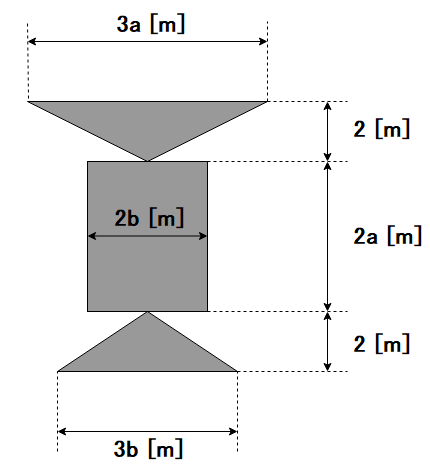
キーエンス本社ビルは下図のような形をしています。ただし、a,b はある 正の整数 です。
つまり、キーエンス本社ビルの建築面積は 4ab+3a+3b 平方メートルと表されます。
N 人のうち、この情報のみによって、予想した面積が確実に誤りであるとわかる人数を求めてください。
制約
- 1 \leq N \leq 20
- 1 \leq S_i \leq 1000
- 入力に含まれる値は全て整数である
入力
入力は以下の形式で標準入力から与えられる。
N
S_1 \ldots S_N
出力
答えを出力せよ。
入力例 1
3
10 20 39
出力例 1
1
a=1,b=1 のとき面積は 10 平方メートル、a=2,b=3 のとき面積は 39 平方メートルとなります。
しかし a,b がどのような正の整数であったとしても面積が 20 平方メートルになることはありません。
よって、人 2 の予想だけは確実に誤りであることがわかります。
入力例 2
5
666 777 888 777 666
出力例 2
3
Score : 200 points
Problem Statement
There are N people numbered 1 to N.
Person i guessed the building area of KEYENCE headquarters building to be S_i square meters.
The shape of KEYENCE headquarters building is shown below, where a and b are some positive integers.
That is, the building area of the building can be represented as 4ab+3a+3b.
Based on just this information, how many of the N people are guaranteed to be wrong in their guesses?
Constraints
- 1 \leq N \leq 20
- 1 \leq S_i \leq 1000
- All values in input are integers.
Input
Input is given from Standard Input in the following format:
N
S_1 \ldots S_N
Output
Print the answer.
Sample Input 1
3
10 20 39
Sample Output 1
1
The area would be 10 square meters if a=1,b=1, and 39 square meters if a=2,b=3.
However, no pair of positive integers a and b would make the area 20 square meters.
Thus, we can only be sure that Person 2 guessed wrong.
Sample Input 2
5
666 777 888 777 666
Sample Output 2
3
Time Limit: 4 sec / Memory Limit: 1024 MiB
配点 : 300 点
問題文
高橋君は全 10^9 巻の漫画『すぬけ君』を読むことにしました。
初め、高橋君は『すぬけ君』の単行本を N 冊持っています。i 番目の単行本は a_i 巻です。
高橋君は『すぬけ君』を読み始める前に限り次の操作を 0 回以上何度でも繰り返せます。
- 現在持っている単行本が 1 冊以下の場合、何もしない。そうでない場合、現在持っている単行本から 2 冊を選んで売り、代わりに好きな巻を選んで 1 冊買う
その後、高橋君は『すぬけ君』を 1 巻、2 巻、3 巻、\ldots と順番に読みます。ただし、次に読むべき巻を持っていない状態になった場合、(他の巻を持っているかどうかに関わらず)その時点で『すぬけ君』を読むのをやめます。
高橋君が『すぬけ君』を最大で何巻まで読めるかを求めてください。ただし、1 巻を読めない場合の答えは 0 とします。
制約
- 1 \leq N \leq 3 \times 10^5
- 1 \leq a_i \leq 10^9
- 入力はすべて整数
入力
入力は以下の形式で標準入力から与えられる。
N
a_1 \ldots a_N
出力
答えを出力せよ。
入力例 1
6
1 2 4 6 7 271
出力例 1
4
『すぬけ君』を読み始める前に「7 巻と 271 巻を選んで売り、代わりに 3 巻を選んで 1 冊買う」という内容で操作をすると、高橋君は 1 巻、2 巻、3 巻、4 巻、6 巻を 1 冊ずつ持っている状態になります。
この状態から『すぬけ君』を読み始めると、高橋君は 1 巻、2 巻、3 巻、4 巻を読み、続いて 5 巻を読もうとしますが持っていないためこの時点で『すぬけ君』を読むのをやめます。
操作の方法を変えても 5 巻を読むことは出来ないため、4 が答えです。
入力例 2
10
1 1 1 1 1 1 1 1 1 1
出力例 2
5
高橋君は同じ巻を 2 冊以上持っているかもしれません。
この入力に対しては以下のように 4 回操作をしてから『すぬけ君』を読み始めることで 5 巻まで読むことが出来、これが最大です。
- 1 巻を 2 冊選んで売り、代わりに 2 巻を選んで 1 冊買う
- 1 巻を 2 冊選んで売り、代わりに 3 巻を選んで 1 冊買う
- 1 巻を 2 冊選んで売り、代わりに 4 巻を選んで 1 冊買う
- 1 巻を 2 冊選んで売り、代わりに 5 巻を選んで 1 冊買う
入力例 3
1
5
出力例 3
0
高橋君は 1 巻を読めません。
Score : 300 points
Problem Statement
Takahashi is going to read a manga series "Snuke-kun" in 10^9 volumes.
Initially, Takahashi has N books of this series. The i-th book is Volume a_i.
Takahashi may repeat the following operation any number of (possibly zero) times only before he begins to read:
- Do nothing if he has 1 or less books; otherwise, sell two of the books he has and buy one book of any volume instead.
Then, Takahashi reads Volume 1, Volume 2, Volume 3, \ldots, in order. However, when he does not have a book of the next volume to read, he stops reading the series (regardless of the other volumes he has).
Find the latest volume of the series that he can read up to. If he cannot read any, let the answer be 0.
Constraints
- 1 \leq N \leq 3 \times 10^5
- 1 \leq a_i \leq 10^9
- All values in the input are integers.
Input
The input is given from Standard Input in the following format:
N
a_1 \ldots a_N
Output
Print the answer.
Sample Input 1
6
1 2 4 6 7 271
Sample Output 1
4
Before he begins to read the series, he may do the following operation: "sell books of Volumes 7 and 271 and buy one book of Volume 3 instead." Then, he has one book each of Volumes 1, 2, 3, 4, and 6.
If he then begins to read the series, he reads Volumes 1, 2, 3, and 4, then tries to read Volume 5. However, he does not have one, so he stops reading at this point.
Regardless of the choices in the operation, he cannot read Volume 5, so the answer is 4.
Sample Input 2
10
1 1 1 1 1 1 1 1 1 1
Sample Output 2
5
Takahashi may have multiple books of the same volume.
For this input, if he performs the following 4 operations before he begins to read the series, he can read up to Volume 5, which is the maximum:
- Sell two books of Volume 1 and buy a book of Volume 2 instead.
- Sell two books of Volume 1 and buy a book of Volume 3 instead.
- Sell two books of Volume 1 and buy a book of Volume 4 instead.
- Sell two books of Volume 1 and buy a book of Volume 5 instead.
Sample Input 3
1
5
Sample Output 3
0
Takahashi cannot read Volume 1.
Time Limit: 2 sec / Memory Limit: 1024 MiB
配点 : 300 点
問題文
二次元平面上に高橋君がいます。高橋君は原点から移動を N 回行いました。
N 回の移動は長さ N の文字列で表され、意味は次の通りです。
- i 回目の高橋君の移動後の座標は、移動前の座標を (x,y) として、
- S の i 文字目が
Rであるとき (x+1,y) - S の i 文字目が
Lであるとき (x-1,y) - S の i 文字目が
Uであるとき (x,y+1) - S の i 文字目が
Dであるとき (x,y-1)
- S の i 文字目が
N 回の移動 (始点と終点を含む) で、高橋君が同じ座標にいたことがあるかどうかを判定してください。
制約
- 1 \leq N \leq 2\times 10^5
- N は整数
- S は
R,L,U,Dのみからなる長さ N の文字列
入力
入力は以下の形式で標準入力から与えられる。
N
S
出力
N 回の移動 (始点と終点を含む) で、高橋君が同じ座標にいたことがあれば Yes、なければ No と出力せよ。
入力例 1
5
RLURU
出力例 1
Yes
高橋君のいる座標は (0,0)\to (1,0)\to (0,0)\to (0,1)\to (1,1)\to (1,2) と変化します。
入力例 2
20
URDDLLUUURRRDDDDLLLL
出力例 2
No
Score : 300 points
Problem Statement
Takahashi is on a two-dimensional plane. Starting from the origin, he made N moves.
The N moves are represented by a string of length N as described below:
-
Takahashi's coordinates after the i-th move are:
- (x+1,y) if the i-th character of S is
R; - (x-1,y) if the i-th character of S is
L; - (x,y+1) if the i-th character of S is
U; and - (x,y-1) if the i-th character of S is
D,
where (x,y) is his coordinates before the move.
- (x+1,y) if the i-th character of S is
Determine if Takahashi visited the same coordinates multiple times in the course of the N moves (including the starting and ending points).
Constraints
- 1 \leq N \leq 2\times 10^5
- N is an integer.
- S is a string of length N consisting of
R,L,U, andD.
Input
The input is given from Standard Input in the following format:
N
S
Output
Print Yes if Takahashi visited the same coordinates multiple times in the course of the N moves; print No otherwise.
Sample Input 1
5
RLURU
Sample Output 1
Yes
Takahashi's coordinates change as follows: (0,0)\to (1,0)\to (0,0)\to (0,1)\to (1,1)\to (1,2).
Sample Input 2
20
URDDLLUUURRRDDDDLLLL
Sample Output 2
No
Time Limit: 2 sec / Memory Limit: 1024 MiB
配点 : 400 点
問題文
ある日、映画館を訪れた高橋君は、館内の全ての床に、最寄りの非常口の方向を示す矢印を描くことにしました。
縦 H マス、横 W マスのグリッドが与えられます。グリッドの上から i 行目、左から j 列目のマスを (i, j) と呼びます。
各マスの状態は、次のいずれかの文字 S_{i,j} で表されます。
.: 通路マス#: 壁マスE: 非常口
任意の通路マス (i, j) に対して、(i, j) と最寄りの非常口との距離 d(i, j) を次のように定義します。
- (i, j) からスタートして、上下左右に隣接する 壁マスでないマス へ移動することを繰り返して非常口に到達する際の、必要な最小の移動回数。
ここで、入力として与えられるグリッドにおいて、全ての通路マスに対し d(i, j) が定義可能であることが保証されます。すなわち、すべての通路マス (i, j) において、通路マスのみを経由することで到達可能な非常口が少なくとも 1 つ存在します。
このとき、以下の条件を満たすように、すべての通路マスに対して「上下左右いずれかの方向の矢印」を書き込んでください。
- 各通路マス (i, j) について、(i,j) にいる状態から開始して、以下の操作を d(i, j) 回行うことで非常口に到達することができる。
- 現在いるマスに書かれた矢印の方向に従って 1 マス移動する。(ただし、壁マスやグリッドの外へは移動できない。)
制約
- 2 \leq H \leq 1000
- 2 \leq W \leq 1000
- S_{i,j} は
.,#またはE - 全ての通路マス (i, j) について、そこからいずれかの非常口に到達することが可能である
- H, W は整数である
入力
入力は以下の形式で標準入力から与えられる。
H W
S_{1,1}S_{1,2}\dots S_{1,W}
S_{2,1}S_{2,2}\dots S_{2,W}
\vdots
S_{H,1}S_{H,2}\dots S_{H,W}
出力
矢印を書き込んだ後のマス (i, j) の状態を T_{i,j} とする。T_{i,j} は次のいずれかである。
^: 上矢印が書かれた通路マスv: 下矢印が書かれた通路マス<: 左矢印が書かれた通路マス>: 右矢印が書かれた通路マス#: 壁マスE: 非常口
これらを以下の形式で出力せよ。
T_{1,1}T_{1,2}\dots T_{1,W}
T_{2,1}T_{2,2}\dots T_{2,W}
\vdots
T_{H,1}T_{H,2}\dots T_{H,W}
答えが複数ある場合は、どれを出力しても正答とみなされる。
入力例 1
3 4
...E
.#..
....
出力例 1
>>>E
^#>^
>>>^
出力例の (2, 3) について問題文の条件が成立することを確認します。(2, 3) と最寄りの非常口の距離は 2 です。そして、出力例のように書き込まれた矢印に従って移動することで 2 回の移動で非常口に到達することができます。
他の通路マスについても問題文の条件が成立することが確認できます。
入力例 2
3 2
##
##
##
出力例 2
##
##
##
通路マスおよび非常口が存在しない場合もあります。
入力例 3
7 20
....................
..#..#..####..#E##..
..#..#..#..#..#.....
..E###..#..#..####..
.....#..#..E.....#..
.....#..####..####..
....................
出力例 3
>v<<<<<>>>>>>>>v<<<<
>v#^<#^^####v^#E##vv
>v#^<#v^#>v#vv#^<<<<
>>E###vv#>v#vv####^<
>>^<<#vv#>>E<<<<<#^<
>>^<<#vv####^<####^<
>>^<<<<<>>>>^<<<<<^<
Score : 400 points
Problem Statement
One day, Takahashi visited a cinema and decided to draw arrows on every floor tile, each pointing toward the nearest emergency exit.
You are given a grid with H rows and W columns. Let (i, j) denote the cell at the i-th row from the top and the j-th column from the left.
Each cell is represented by one of the following characters S_{i,j}:
.: corridor cell#: wall cellE: emergency exit
For any corridor cell (i, j), define d(i, j), the distance to the nearest emergency exit, as follows:
- Starting from (i, j), repeatedly move to an adjacent non-wall cell in one of the four cardinal directions (up, down, left, right) until you reach an emergency exit. d(i, j) is the minimum number of moves required.
It is guaranteed that d(i, j) is definable for every corridor cell in the given grid; that is, every corridor cell (i, j) has at least one emergency exit reachable by passing through only corridor cells.
Write exactly one arrow (up, down, left, or right) in every corridor cell so that the following condition holds:
- For every corridor cell (i, j), if you start at (i, j) and perform the following action d(i, j) times, you reach an emergency exit:
- Move one cell in the direction of the arrow written in your current cell. (You cannot move into a wall cell or outside the grid.)
Constraints
- 2 \le H \le 1000
- 2 \le W \le 1000
- Each S_{i,j} is
.,#, orE. - Every corridor cell (i, j) has at least one reachable emergency exit.
- H and W are integers.
Input
The input is given from Standard Input in the following format:
H W
S_{1,1}S_{1,2}\dots S_{1,W}
S_{2,1}S_{2,2}\dots S_{2,W}
\vdots
S_{H,1}S_{H,2}\dots S_{H,W}
Output
Let T_{i,j} be the state of cell (i, j) after writing the arrows. T_{i,j} is one of the following:
^: corridor cell with an upward arrowv: corridor cell with a downward arrow<: corridor cell with a leftward arrow>: corridor cell with a rightward arrow#: wall cellE: emergency exit
Output the grid in the following format:
T_{1,1}T_{1,2}\dots T_{1,W}
T_{2,1}T_{2,2}\dots T_{2,W}
\vdots
T_{H,1}T_{H,2}\dots T_{H,W}
If multiple solutions exist, any of them will be accepted.
Sample Input 1
3 4
...E
.#..
....
Sample Output 1
>>>E
^#>^
>>>^
Let us verify the condition for (2, 3) in the sample output. The distance from (2, 3) to the nearest emergency exit is 2, and following the arrows written in the sample output leads to an emergency exit in two moves.
The condition can be verified for every other corridor cell as well.
Sample Input 2
3 2
##
##
##
Sample Output 2
##
##
##
There may be cases with no corridor cells or emergency exits.
Sample Input 3
7 20
....................
..#..#..####..#E##..
..#..#..#..#..#.....
..E###..#..#..####..
.....#..#..E.....#..
.....#..####..####..
....................
Sample Output 3
>v<<<<<>>>>>>>>v<<<<
>v#^<#^^####v^#E##vv
>v#^<#v^#>v#vv#^<<<<
>>E###vv#>v#vv####^<
>>^<<#vv#>>E<<<<<#^<
>>^<<#vv####^<####^<
>>^<<<<<>>>>^<<<<<^<
Time Limit: 2 sec / Memory Limit: 1024 MiB
配点 : 500 点
問題文
数列 X に対し、 f(X) = ( X を回文にするために変更する必要のある要素の個数の最小値 ) とします。
与えられた長さ N の数列 A の全ての 連続 部分列 X に対する f(X) の総和を求めてください。
但し、長さ m の数列 X が回文であるとは、全ての 1 \le i \le m を満たす整数 i について、 X の i 項目と m+1-i 項目が等しいことを指します。
制約
- 入力は全て整数
- 1 \le N \le 2 \times 10^5
- 1 \le A_i \le N
入力
入力は以下の形式で標準入力から与えられる。
N
A_1 A_2 \dots A_N
出力
答えを整数として出力せよ。
入力例 1
5
5 2 1 2 2
出力例 1
9
- f(5) = 0
- f(2) = 0
- f(1) = 0
- f(2) = 0
- f(2) = 0
- f(5,2) = 1
- f(2,1) = 1
- f(1,2) = 1
- f(2,2) = 0
- f(5,2,1) = 1
- f(2,1,2) = 0
- f(1,2,2) = 1
- f(5,2,1,2) = 2
- f(2,1,2,2) = 1
- f(5,2,1,2,2) = 1
以上より、求める答えは 9 です。
Score : 500 points
Problem Statement
For a sequence X, let f(X) = (the minimum number of elements one must modify to make X a palindrome).
Given a sequence A of length N, find the sum of f(X) over all contiguous subarrays of A.
Here, a sequence X of length m is said to be a palindrome if and only if the i-th and the (m+1-i)-th elements of X are equal for all 1 \le i \le m.
Constraints
- All values in the input are integers.
- 1 \le N \le 2 \times 10^5
- 1 \le A_i \le N
Input
The input is given from Standard Input in the following format:
N
A_1 A_2 \dots A_N
Output
Print the answer as an integer.
Sample Input 1
5
5 2 1 2 2
Sample Output 1
9
- f(5) = 0
- f(2) = 0
- f(1) = 0
- f(2) = 0
- f(2) = 0
- f(5,2) = 1
- f(2,1) = 1
- f(1,2) = 1
- f(2,2) = 0
- f(5,2,1) = 1
- f(2,1,2) = 0
- f(1,2,2) = 1
- f(5,2,1,2) = 2
- f(2,1,2,2) = 1
- f(5,2,1,2,2) = 1
Therefore, the sought answer is 9.
Time Limit: 3 sec / Memory Limit: 1024 MiB
配点 : 500 点
問題文
二次元平面上に N 個のクリスマスツリーがあります。i 番目 (1\le i\le N) のクリスマスツリーは座標 (X_i,Y_i) に存在します。
Q 個のクエリが与えられるので、順にクエリを処理してください。各クエリは、以下のいずれかです。
- タイプ 1 :
1 i x yの形式で与えられる。i 番目のクリスマスツリーの座標を (x,y) に変更する。 - タイプ 2 :
2 L R x yの形式で与えられる。L,L+1,\ldots,R 番目のクリスマスツリーのうち、座標 (x,y) からマンハッタン距離で最も遠いクリスマスツリーまでの距離を出力する。
ただし、座標 (x_1,y_1) と座標 (x_2,y_2) のマンハッタン距離は |x_1-x_2|+|y_1-y_2| で定義されます。
制約
- 1\le N,Q\le 2\times 10^5
- -10^9\le X_i,Y_i\le 10^9
- 1\le i\le N
- 1\le L\le R\le N
- -10^9\le x,y\le 10^9
- 入力される値は全て整数
入力
入力は以下の形式で標準入力から与えられる。
N Q
X_1 Y_1
X_2 Y_2
\vdots
X_N Y_N
\text{query}_1
\text{query}_2
\vdots
\text{query}_Q
ここで、 i 番目のクエリ \text{query}_i は以下のいずれかの形式で与えられる。
1 i x y
2 L R x y
出力
問題文の指示に従ってクエリへの答えを改行区切りで出力せよ。
入力例 1
3 4
-1 -1
1 2
-2 1
2 1 2 0 0
2 1 3 -1 2
1 1 0 1
2 1 3 -1 2
出力例 1
3
3
2
はじめ、1,2,3 番目のクリスマスツリーはそれぞれ座標 (-1,-1),(1,2),(-2,1) に存在します。
各クエリは以下のように処理されます。
- 1,2 番目のクリスマスツリーと座標 (0,0) のマンハッタン距離はそれぞれ 2,3 です。したがって、 2,3 の最大値である 3 を出力します。
- 1,2,3 番目のクリスマスツリーと座標 (-1,2) のマンハッタン距離はそれぞれ 3,2,2 です。したがって、 3,2,2 の最大値である 3 を出力します。
- 1 番目のクリスマスツリーの座標を (0,1) に変更します。1,2,3 番目のクリスマスツリーの座標はそれぞれ (0,1),(1,2),(-2,1) になります。
- 1,2,3 番目のクリスマスツリーと座標 (-1,2) のマンハッタン距離はそれぞれ 2,2,2 です。したがって、 2,2,2 の最大値である 2 を出力します。
入力例 2
5 7
-9 5
-2 -9
10 -6
9 8
2 9
1 3 -9 -6
2 3 4 2 7
1 4 -2 -10
2 1 2 0 -10
2 3 4 10 -9
2 3 4 8 7
2 5 5 0 2
出力例 2
24
24
22
30
9
Score : 500 points
Problem Statement
There are N Christmas trees on a two-dimensional plane. The i-th (1\le i\le N) Christmas tree is located at coordinates (X_i,Y_i).
You are given Q queries. Process the queries in order. Each query is one of the following:
- Type 1 : Given in the form
1 i x y. Change the coordinates of the i-th Christmas tree to (x,y). - Type 2 : Given in the form
2 L R x y. Output the Manhattan distance from the coordinates (x,y) to the farthest Christmas tree among the L,L+1,\ldots,R-th Christmas trees.
Here, the Manhattan distance between coordinates (x_1,y_1) and coordinates (x_2,y_2) is defined as |x_1-x_2|+|y_1-y_2|.
Constraints
- 1\le N,Q\le 2\times 10^5
- -10^9\le X_i,Y_i\le 10^9
- 1\le i\le N
- 1\le L\le R\le N
- -10^9\le x,y\le 10^9
- All input values are integers.
Input
The input is given from Standard Input in the following format:
N Q
X_1 Y_1
X_2 Y_2
\vdots
X_N Y_N
\text{query}_1
\text{query}_2
\vdots
\text{query}_Q
Here, the i-th query \text{query}_i is given in one of the following formats:
1 i x y
2 L R x y
Output
Output the answers to the queries, separated by newlines, according to the instructions in the problem statement.
Sample Input 1
3 4
-1 -1
1 2
-2 1
2 1 2 0 0
2 1 3 -1 2
1 1 0 1
2 1 3 -1 2
Sample Output 1
3
3
2
Initially, the 1st, 2nd, 3rd Christmas trees are located at coordinates (-1,-1), (1,2), (-2,1), respectively.
Each query is processed as follows:
- The Manhattan distances from the 1st and 2nd Christmas trees to coordinates (0,0) are 2 and 3, respectively. Thus, output 3, which is the maximum value among 2,3.
- The Manhattan distances from the 1st, 2nd, 3rd Christmas trees to coordinates (-1,2) are 3, 2, 2, respectively. Thus, output 3, which is the maximum value among 3,2,2.
- Change the coordinates of the 1st Christmas tree to (0,1). The coordinates of the 1st, 2nd, 3rd Christmas trees become (0,1),(1,2),(-2,1), respectively.
- The Manhattan distances from the 1st, 2nd, 3rd Christmas trees to coordinates (-1,2) are 2, 2, 2, respectively. Thus, output 2, which is the maximum value among 2,2,2.
Sample Input 2
5 7
-9 5
-2 -9
10 -6
9 8
2 9
1 3 -9 -6
2 3 4 2 7
1 4 -2 -10
2 1 2 0 -10
2 3 4 10 -9
2 3 4 8 7
2 5 5 0 2
Sample Output 2
24
24
22
30
9