実行時間制限: 2 sec / メモリ制限: 1024 MiB
配点 : 100 点
問題文
整数 A, B が与えられます。 A^B の値を出力してください。
制約
- 1 \leq A, B \leq 9
- 入力はすべて整数
入力
入力は以下の形式で標準入力から与えられる。
A B
出力
答えを出力せよ。
入力例 1
4 3
出力例 1
64
4^3 = 64 であるので、64 を出力します。
入力例 2
5 5
出力例 2
3125
入力例 3
8 1
出力例 3
8
Score : 100 points
Problem Statement
Given integers A and B, print the value A^B.
Constraints
- 1 \leq A, B \leq 9
- All values in the input are integers.
Input
The input is given from Standard Input in the following format:
A B
Output
Print the answer.
Sample Input 1
4 3
Sample Output 1
64
4^3 = 64, so 64 should be printed.
Sample Input 2
5 5
Sample Output 2
3125
Sample Input 3
8 1
Sample Output 3
8
実行時間制限: 2 sec / メモリ制限: 1024 MiB
配点 : 100 点
問題文
AtCoder で定期的に開催されている、国際的な権威があるコンテストである AtCoder Grand Contest (以下、AGC) は今までに 54 回開催されてきました。
みなさんがちょうど参加している 230 回目の ABC である ABC230 と同様に、 当初は N 回目の AGC のコンテスト名には N を 3 桁になるようにゼロ埋めした数が割り振られていました。( 1 回目の AGC は AGC001, 2 回目の AGC は AGC002, ...)
ところが、最新の 54 回目の AGC のコンテスト名は AGC055 で、回数より 1 大きい数が割り振られています。これは、AGC042 が社会情勢の影響で中止されて欠番となったため、42 回目以降に開催されたコンテストでは開催された回数より 1 大きい数が割り振られているからです。(入出力例にある説明も参考にしてください。)
さて、ここで問題です。整数 N が与えられるので、N 回目に開催された AGC のコンテスト名を AGCXXX の形式で出力してください。ここで、XXX にはゼロ埋めがなされた 3 桁の数が入ります。
制約
- 1 \leq N \leq 54
- N は整数である。
入力
入力は以下の形式で標準入力から与えられる。
N
出力
N 回目に開催された AGC のコンテスト名を所定の形式で出力せよ。
入力例 1
42
出力例 1
AGC043
問題文にある通り、 42 回目以降の AGC には回数より 1 大きい数が割り振られています。
よって 42 回目の AGC のコンテスト名は AGC043 になります。
入力例 2
19
出力例 2
AGC019
41 回目以前の AGC は回数と同じ数が割り振られています。
よって AGC019 が答えとなります。
入力例 3
1
出力例 3
AGC001
問題文にある通り、 1 回目の AGC のコンテスト名は AGC001 です。
数が 3 桁になるようにゼロ埋めを行う必要があるのに注意してください。
入力例 4
50
出力例 4
AGC051
Score : 100 points
Problem Statement
AtCoder Grand Contest (AGC), a regularly held contest with a world authority, has been held 54 times.
Just like the 230-th ABC ― the one you are in now ― is called ABC230, the N-th AGC is initially named with a zero-padded 3-digit number N. (The 1-st AGC is AGC001, the 2-nd AGC is AGC002, ...)
However, the latest 54-th AGC is called AGC055, where the number is one greater than 54. Because AGC042 is canceled and missing due to the social situation, the 42-th and subsequent contests are assigned numbers that are one greater than the numbers of contests held. (See also the explanations at Sample Inputs and Outputs.)
Here is the problem: given an integer N, print the name of the N-th AGC in the format AGCXXX, where XXX is the zero-padded 3-digit number.
Constraints
- 1 \leq N \leq 54
- N is an integer.
Input
Input is given from Standard Input in the following format:
N
Output
Print the name of the N-th AGC in the specified format.
Sample Input 1
42
Sample Output 1
AGC043
As explained in Problem Statement, the 42-th and subsequent AGCs are assigned numbers that are one greater than the numbers of contests.
Thus, the 42-th AGC is named AGC043.
Sample Input 2
19
Sample Output 2
AGC019
The 41-th and preceding AGCs are assigned numbers that are equal to the numbers of contests.
Thus, the answer is AGC019.
Sample Input 3
1
Sample Output 3
AGC001
As mentioned in Problem Statement, the 1-st AGC is named AGC001.
Be sure to pad the number with zeros into a 3-digit number.
Sample Input 4
50
Sample Output 4
AGC051
実行時間制限: 2 sec / メモリ制限: 1024 MiB
配点 : 200 点
問題文
AtCoder では現在、 ABC , ARC , AGC , AHC の 4 つのコンテストが定期的に開催されています。
AtCoder で現在定期的に開催されているコンテストは S_1 , S_2 , S_3 とあと 1 つは何ですか?
制約
- S_1 , S_2 , S_3 はそれぞれ、
ABC,ARC,AGC,AHCのいずれかである。 - S_1 , S_2 , S_3 は相異なる。
入力
入力は以下の形式で標準入力から与えられる。
S_1
S_2
S_3
出力
答えを出力せよ。
入力例 1
ARC
AGC
AHC
出力例 1
ABC
ARC , AGC , AHC の 3つが入力として与えられているので、
残りの 1 つはABC です。
入力例 2
AGC
ABC
ARC
出力例 2
AHC
Score : 200 points
Problem Statement
AtCoder currently holds four series of regular contests: ABC, ARC, AGC, and AHC.
What is the series of regular contests currently held by AtCoder in addition to S_1, S_2, and S_3?
Constraints
- Each of S_1, S_2, and S_3 is
ABC,ARC,AGC, orAHC. - S_1, S_2, and S_3 are pairwise different.
Input
Input is given from Standard Input in the following format:
S_1
S_2
S_3
Output
Print the answer.
Sample Input 1
ARC
AGC
AHC
Sample Output 1
ABC
Given in input are ARC, AGC, and AHC. The rest is ABC.
Sample Input 2
AGC
ABC
ARC
Sample Output 2
AHC
実行時間制限: 2 sec / メモリ制限: 1024 MiB
配点 : 200 点
問題文
-10^{18} 以上 10^{18} 以下の整数 X が与えられるので、\left\lfloor \dfrac{X}{10} \right\rfloor を出力してください。
注記
実数 x に対して、「x 以下の整数の中で最大の整数」を \left\lfloor x \right\rfloor と表します。たとえば \left\lfloor 4.7 \right\rfloor = 4, \left\lfloor -2.4 \right\rfloor = -3, \left\lfloor 5 \right\rfloor = 5 のようになります。(詳しくは入出力例にある説明を参考にしてください。)
制約
- -10^{18} \leq X \leq 10^{18}
- 入力はすべて整数である。
入力
入力は以下の形式で標準入力から与えられる。
X
出力
\left\lfloor \frac{X}{10} \right\rfloor を出力せよ。整数として出力する必要があることに注意せよ。
入力例 1
47
出力例 1
4
\frac{47}{10} = 4.7 以下の整数は、すべての負の整数および 0, 1, 2, 3, 4 です。この中で一番大きい整数は 4 なので、\left\lfloor \frac{47}{10} \right\rfloor = 4 となります。
入力例 2
-24
出力例 2
-3
\frac{-24}{10} = -2.4 以下の整数の中で一番大きい整数は -3 なので、 \left\lfloor \frac{-24}{10} \right\rfloor = -3 となります。
-2 は -2.4 よりも大きいので、条件を満たさないことに注意してください。
入力例 3
50
出力例 3
5
\frac{50}{10} = 5 以下の整数の中で一番大きい整数は 5 自身です。よって \left\lfloor \frac{50}{10} \right\rfloor = 5 となります。
入力例 4
-30
出力例 4
-3
上の例と同様に \left\lfloor \frac{-30}{10} \right\rfloor = -3 となります。
入力例 5
987654321987654321
出力例 5
98765432198765432
答えは 98765432198765432 となります。すべての桁が正しく合っているか確認しましょう。
なお、もしも自分で書いたプログラムが想定通りの挙動をしない場合は、使用しているプログラミング言語の仕様を調べてみることを推奨します。
また、自分の書いたコードがどのように動作するかを確認したい場合は問題文上部の「コードテスト」をご利用ください。
Score : 200 points
Problem Statement
Given an integer X between -10^{18} and 10^{18} (inclusive), print \left\lfloor \dfrac{X}{10} \right\rfloor.
Notes
For a real number x, \left\lfloor x \right\rfloor denotes "the maximum integer not exceeding x". For example, we have \left\lfloor 4.7 \right\rfloor = 4, \left\lfloor -2.4 \right\rfloor = -3, and \left\lfloor 5 \right\rfloor = 5. (For more details, please refer to the description in the Sample Input and Output.)
Constraints
- -10^{18} \leq X \leq 10^{18}
- All values in input are integers.
Input
Input is given from Standard Input in the following format:
X
Output
Print \left\lfloor \frac{X}{10} \right\rfloor. Note that it should be output as an integer.
Sample Input 1
47
Sample Output 1
4
The integers that do not exceed \frac{47}{10} = 4.7 are all the negative integers, 0, 1, 2, 3, and 4. The maximum integer among them is 4, so we have \left\lfloor \frac{47}{10} \right\rfloor = 4.
Sample Input 2
-24
Sample Output 2
-3
Since the maximum integer not exceeding \frac{-24}{10} = -2.4 is -3, we have \left\lfloor \frac{-24}{10} \right\rfloor = -3.
Note that -2 does not satisfy the condition, as -2 exceeds -2.4.
Sample Input 3
50
Sample Output 3
5
The maximum integer that does not exceed \frac{50}{10} = 5 is 5 itself. Thus, we have \left\lfloor \frac{50}{10} \right\rfloor = 5.
Sample Input 4
-30
Sample Output 4
-3
Just like the previous example, \left\lfloor \frac{-30}{10} \right\rfloor = -3.
Sample Input 5
987654321987654321
Sample Output 5
98765432198765432
The answer is 98765432198765432. Make sure that all the digits match.
If your program does not behave as intended, we recommend you checking the specification of the programming language you use.
If you want to check how your code works, you may use "Custom Test" above the Problem Statement.
実行時間制限: 2 sec / メモリ制限: 1024 MiB
配点 : 300 点
問題文
10 進法で表記したときに 0,2 のみからなる正整数のうち、 K 番目に小さいものを求めてください。
制約
- K は 1 以上 10^{18} 以下の整数
入力
入力は以下の形式で標準入力から与えられる。
K
出力
答えを整数として出力せよ。
ただし、たとえ答えが大きな整数であっても、求める答えを正確に整数として出力する必要がある。たとえば、 2.34e+22 のような指数表記や、 0523 のような先頭に不要な 0 を付けたような表記は許されない。
入力例 1
3
出力例 1
22
10 進法で表記した時に 0,2 のみからなる正整数を小さい方から並べると、 2,20,22,\dots となります。
このうち K=3 番目である 22 を出力してください。
入力例 2
11
出力例 2
2022
入力例 3
923423423420220108
出力例 3
220022020000202020002022022000002020002222002200002022002200
たとえ答えが大きな整数であっても、求める答えを正確に整数として出力する必要があることに注意してください。
Score : 300 points
Problem Statement
Among the positive integers that consist of 0's and 2's when written in base 10, find the K-th smallest integer.
Constraints
- K is an integer between 1 and 10^{18} (inclusive).
Input
Input is given from Standard Input in the following format:
K
Output
Print the answer as an integer.
Here, the exact value must be printed as an integer, even if it is big. Exponential notations such as 2.34e+22, for example, or unnecessary leading zeros such as 0523 are not allowed.
Sample Input 1
3
Sample Output 1
22
The positive integers that consist of 0's and 2's when written in base 10 are 2,20,22,\dots in ascending order.
The (K=) 3-rd of them, which is 22, should be printed.
Sample Input 2
11
Sample Output 2
2022
Sample Input 3
923423423420220108
Sample Output 3
220022020000202020002022022000002020002222002200002022002200
Note that the exact value of the answer must be printed as an integer, even if it is big.
実行時間制限: 2 sec / メモリ制限: 1024 MiB
配点 : 300 点
問題文
正の整数 L に対して、 レベル L のダンゴ文字列とは、以下の条件を満たす文字列です。
oと-からなる長さ L+1 の文字列である。- 先頭の文字と末尾の文字のうちちょうど一方が
-であり、そのほかの L 文字はすべてoである。
例えば、ooo- はレベル 3 のダンゴ文字列ですが、-ooo- や oo や o-oo- などはダンゴ文字列ではありません(より正確には、どのような正の整数 L に対してもレベル L のダンゴ文字列ではありません)。
2 種類の文字 o - からなる、長さ N の文字列 S が与えられます。
次の条件を満たすような正整数 X のうち、最大のものを求めてください。
- S の連続する部分文字列であって、レベル X のダンゴ文字列であるものが存在する。
ただし、そのような整数が存在しない場合、-1 と出力してください。
制約
- 1\leq N\leq 2\times10^5
- S は
o-からなる長さ N の文字列
入力
入力は以下の形式で標準入力から与えられる。
N
S
出力
S にレベル X のダンゴ文字列が含まれるような最大の X の値を 1 行で出力せよ。
そのような値が存在しない場合、-1 を出力せよ。
入力例 1
10
o-oooo---o
出力例 1
4
たとえば、S の 3 文字目から 7 文字目までに対応する部分文字列 oooo- は、レベル 4 のダンゴ文字列です。
S の部分文字列であってレベル 5 以上のダンゴ文字列であるようなものは存在しないため、4 と出力してください。
入力例 2
1
-
出力例 2
-1
S の連続する部分文字列は空文字列と - の 2 種類だけです。
これらはダンゴ文字列ではないため、-1 と出力してください。
入力例 3
30
-o-o-oooo-oo-o-ooooooo--oooo-o
出力例 3
7
Score : 300 points
Problem Statement
For a positive integer L, a level-L dango string is a string that satisfies the following conditions.
- It is a string of length L+1 consisting of
oand-. - Exactly one of the first character and the last character is
-, and the other L characters areo.
For instance, ooo- is a level-3 dango string, but none of -ooo-, oo, and o-oo- is a dango string (more precisely, none of them is a level-L dango string for any positive integer L).
You are given a string S of length N consisting of the two characters o and -.
Find the greatest positive integer X that satisfies the following condition.
- There is a contiguous substring of S that is a level-X dango string.
If there is no such integer, print -1.
Constraints
- 1\leq N\leq 2\times10^5
- S is a string of length N consisting of
oand-.
Input
The input is given from Standard Input in the following format:
N
S
Output
Print the greatest positive integer X such that S contains a level-X dango string, or -1 if there is no such integer.
Sample Input 1
10
o-oooo---o
Sample Output 1
4
For instance, the substring oooo- corresponding to the 3-rd through 7-th characters of S is a level-4 dango string.
No substring of S is a level-5 dango string or above, so you should print 4.
Sample Input 2
1
-
Sample Output 2
-1
Only the empty string and - are the substrings of S.
They are not dango strings, so you should print -1.
Sample Input 3
30
-o-o-oooo-oo-o-ooooooo--oooo-o
Sample Output 3
7
実行時間制限: 2 sec / メモリ制限: 1024 MiB
配点 : 400 点
問題文
H 行 W 列のグリッドがあります。 上から i 行目、左から j 列目のマスを (i,j) と表記します。
各マスはスタートマス・ゴールマス・空きマス・障害物マスのいずれかであり、その情報は H 個の長さ W の文字列 S_1,S_2,\dots,S_H によって表されます。
具体的には、マス (i,j) は S_i の j 文字目が S であるときスタートマス、G であるときゴールマス、. であるとき空きマス、# であるとき障害物マスです。
ここで、スタートマスとゴールマスはちょうど 1 つずつ存在することが保証されます。
あなたは今スタートマスにいます。 あなたの目標は、今いるマスと辺で隣接するマスに移動することを繰り返してゴールマスへ行くことです。 ただし、障害物マスやグリッドの外に移動することはできず、また縦移動と横移動を 1 回ずつ交互に行わなければなりません。(最初の移動の向きは任意です。)
ゴールマスへ行くことが可能であるか判定し、可能ならば移動回数の最小値を求めてください。
より形式的には、以下の条件をすべて満たすマスの列 (i_1,j_1),(i_2,j_2),\dots,(i_k,j_k) が存在するか判定し、存在するならば k-1 の最小値を求めてください。
- すべての 1\leq l\leq k について、1\leq i_l\leq H かつ 1\leq j_l\leq W であり、(i_l,j_l) は障害物マスでない
- (i_1,j_1) はスタートマス
- (i_k,j_k) はゴールマス
- すべての 1\leq l\leq k-1 について、|i_l-i_{l+1}|+|j_l-j_{l+1}|=1
- すべての 1\leq l\leq k-2 について、i_l\neq i_{l+1} ならば i_{l+1}=i_{l+2}
- すべての 1\leq l\leq k-2 について、j_l\neq j_{l+1} ならば j_{l+1}=j_{l+2}
制約
- 1\leq H,W \leq 1000
- H,W は整数
- S_i は
S,G,.,#からなる長さ W の文字列 - スタートマスとゴールマスはちょうど 1 つずつ存在する
入力
入力は以下の形式で標準入力から与えられる。
H W
S_1
S_2
\vdots
S_H
出力
ゴールマスへ行くことが可能ならば移動回数の最小値を、不可能ならば -1 を出力せよ。
入力例 1
3 5
.S#.G
.....
.#...
出力例 1
7
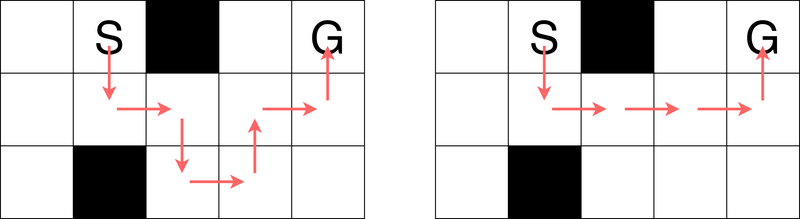
左図のように (1,2)\rightarrow(2,2)\rightarrow(2,3)\rightarrow(3,3)\rightarrow(3,4)\rightarrow(2,4)\rightarrow(2,5)\rightarrow(1,5) と移動することで、7 回の移動でゴールマスへ行くことができます。 6 回以下の移動でゴールマスへ行くことはできないので、答えは 7 です。
右図のように横移動を連続で行う経路(あるいは縦移動を連続で行う経路)はとれないことに注意してください。
入力例 2
3 5
..#.G
.....
S#...
出力例 2
-1
ゴールマスへ行くことはできません。
入力例 3
8 63
...............................................................
..S...#............................#####..#####..#####..####G..
..#...#................................#..#...#......#..#......
..#####..####...####..####..#..#...#####..#...#..#####..#####..
..#...#..#..#...#..#..#..#..#..#...#......#...#..#..........#..
..#...#..#####..####..####..####...#####..#####..#####..#####..
................#.....#........#...............................
................#.....#........#...............................
出力例 3
148
Score : 400 points
Problem Statement
You are given a grid with H rows and W columns. Let (i,j) denote the cell at the i-th row from the top and the j-th column from the left.
Each cell is one of the following: a start cell, a goal cell, an empty cell, or an obstacle cell. This information is described by H strings S_1,S_2,\dots,S_H, each of length W. Specifically, the cell (i,j) is a start cell if the j-th character of S_i is S, a goal cell if it is G, an empty cell if it is ., and an obstacle cell if it is #. It is guaranteed that there is exactly one start cell and exactly one goal cell.
You are currently on the start cell. Your objective is to reach the goal cell by repeatedly moving to a cell adjacent by an edge to the one you are in. However, you cannot move onto an obstacle cell or move outside the grid, and you must alternate between moving vertically and moving horizontally each time. (The direction of the first move can be chosen arbitrarily.)
Determine if it is possible to reach the goal cell. If it is, find the minimum number of moves required.
More formally, check if there exists a sequence of cells (i_1,j_1),(i_2,j_2),\dots,(i_k,j_k) satisfying all of the following conditions. If such a sequence exists, find the minimum value of k-1.
- For every 1 \leq l \leq k, it holds that 1 \leq i_l \leq H and 1 \leq j_l \leq W, and (i_l,j_l) is not an obstacle cell.
- (i_1,j_1) is the start cell.
- (i_k,j_k) is the goal cell.
- For every 1 \leq l \leq k-1, |i_l - i_{l+1}| + |j_l - j_{l+1}| = 1.
- For every 1 \leq l \leq k-2, if i_l \neq i_{l+1}, then i_{l+1} = i_{l+2}.
- For every 1 \leq l \leq k-2, if j_l \neq j_{l+1}, then j_{l+1} = j_{l+2}.
Constraints
- 1 \leq H,W \leq 1000
- H and W are integers.
- Each S_i is a string of length W consisting of
S,G,.,#. - There is exactly one start cell and exactly one goal cell.
Input
The input is given from Standard Input in the following format:
H W
S_1
S_2
\vdots
S_H
Output
If it is possible to reach the goal cell, print the minimum number of moves. Otherwise, print -1.
Sample Input 1
3 5
.S#.G
.....
.#...
Sample Output 1
7
As shown in the left figure, you can move as (1,2)\rightarrow(2,2)\rightarrow(2,3)\rightarrow(3,3)\rightarrow(3,4)\rightarrow(2,4)\rightarrow(2,5)\rightarrow(1,5), reaching the goal cell in 7 moves. It is impossible in 6 moves or fewer, so the answer is 7.
Note that you cannot take a path that moves horizontally (or vertically) consecutively without alternating as shown in the right figure.
Sample Input 2
3 5
..#.G
.....
S#...
Sample Output 2
-1
It is not possible to reach the goal cell.
Sample Input 3
8 63
...............................................................
..S...#............................#####..#####..#####..####G..
..#...#................................#..#...#......#..#......
..#####..####...####..####..#..#...#####..#...#..#####..#####..
..#...#..#..#...#..#..#..#..#..#...#......#...#..#..........#..
..#...#..#####..####..####..####...#####..#####..#####..#####..
................#.....#........#...............................
................#.....#........#...............................
Sample Output 3
148
実行時間制限: 2 sec / メモリ制限: 1024 MiB
配点 : 500 点
問題文
Atcoder 王国では A_1 円, A_2 円, \ldots, A_N 円の N 種類の硬貨が使用されています。
ここで、1=A_1 < \ldots < A_N であり、全ての 1\leq i \leq N-1 に対し、A_{i+1} は A_i の倍数です。
硬貨のみを使って X 円を支払うとき、支払いに使う硬貨の枚数とお釣りでもらう硬貨の枚数の合計の最小値はいくつですか?
正確には、Y が X 以上の整数を自由に動く時、Y 円ちょうどを表すために必要な硬貨の枚数と、Y-X 円ちょうどを表すために必要な硬貨の枚数の和の最小値を求めてください。
制約
- 入力に含まれる値は全て整数である
- 1 \leq N \leq 60
- 1=A_1 < \ldots <A_N \leq 10^{18}
- 全ての 1\leq i \leq N-1 で A_{i+1} は A_i の倍数である
- 1\leq X \leq 10^{18}
入力
入力は以下の形式で標準入力から与えられる。
N X
A_1 \ldots A_N
出力
答えを出力せよ。
入力例 1
3 87
1 10 100
出力例 1
5
100 円硬貨 1 枚で支払いを行い、10 円硬貨 1 枚と 1 円硬貨 3 枚をお釣りでもらうと、合計枚数は 5 枚になります。
入力例 2
2 49
1 7
出力例 2
7
7 円硬貨 7 枚で支払いを行うのが最適です。
入力例 3
10 123456789012345678
1 100 10000 1000000 100000000 10000000000 1000000000000 100000000000000 10000000000000000 1000000000000000000
出力例 3
233
Score : 500 points
Problem Statement
There are N kinds of coins used in the Kingdom of Atcoder: A_1-yen, A_2-yen, \ldots, A_N-yen coins.
Here, 1=A_1 < \ldots < A_N holds, and A_{i+1} is a multiple of A_i for every 1\leq i \leq N-1.
When paying for a product worth X yen using just these coins, what is the minimum total number of coins used in payment and returned as change?
Accurately, when Y is an integer at least X, find the minimum sum of the number of coins needed to represent exactly Y yen and the number of coins needed to represent exactly Y-X yen.
Constraints
- All values in input are integers.
- 1 \leq N \leq 60
- 1=A_1 < \ldots <A_N \leq 10^{18}
- A_{i+1} is a multiple of A_i for every 1\leq i \leq N-1.
- 1\leq X \leq 10^{18}
Input
Input is given from Standard Input in the following format:
N X
A_1 \ldots A_N
Output
Print the answer.
Sample Input 1
3 87
1 10 100
Sample Output 1
5
If we pay with one 100-yen coin and receive one 10-yen coin and three 1-yen coins as the change, the total number of coins will be 5.
Sample Input 2
2 49
1 7
Sample Output 2
7
It is optimal to pay with seven 7-yen coins.
Sample Input 3
10 123456789012345678
1 100 10000 1000000 100000000 10000000000 1000000000000 100000000000000 10000000000000000 1000000000000000000
Sample Output 3
233
実行時間制限: 2 sec / メモリ制限: 1024 MiB
配点 : 550 点
問題文
ビル 1, ビル 2, \ldots, ビル N の N 棟がこの順で東西に一列に並んでおり、ビル 1 が最も西に、ビル N が最も東に建っています。ビル i\ (1\leq i\leq N) の高さは H_i です。
整数の組 (i,j)\ (1\leq i\lt j\leq N) に対して、以下の条件を満たすとき ビル i からビル j を見ることができます。
- ビル i とビル j の間にビル j より高いビルが存在しない。すなわち、H_k\gt H_j を満たす整数 k\ (i\lt k\lt j) が存在しない。
Q 個の質問に答えてください。i 番目の質問では整数の組 (l_i,r_i)\ (l_i\lt r_i) が与えられるので、ビル r_i より東にあるビル(ビル r_i+1, ビル r_i+2,\ldots,ビル N )のうちビル l_i とビル r_i の両方から見ることができるものの個数を答えてください。
制約
- 2\leq N\leq 2\times 10^5
- 1\leq Q\leq 2\times 10^5
- 1\leq H_i\leq N
- H_i\neq H_j\ (i\neq j)
- 1\leq l_i\lt r_i\leq N
- 入力は全て整数
入力
入力は以下の形式で標準入力から与えられる。
N Q
H_1 H_2 \ldots H_N
l_1 r_1
l_2 r_2
\vdots
l_Q r_Q
出力
Q 行出力せよ。i\ (1\leq i\leq Q) 行目には i 番目の質問に対する答えを出力せよ。
入力例 1
5 3
2 1 4 3 5
1 2
3 5
1 4
出力例 1
2
0
1
- 1 つ目の質問について、ビル 2 より東にあるビルのうち ビル 1 とビル 2 の両方から見ることができるものはビル 3,5 の 2 つです。
- 2 つ目の質問について、ビル 5 より東にあるビルは存在しません。
- 3 つ目の質問について、ビル 4 より東にあるビルのうち、ビル 1,4 の両方から見ることができるビルはビル 5 の 1 つです。
入力例 2
10 10
2 1 5 3 4 6 9 8 7 10
3 9
2 5
4 8
5 6
3 8
2 10
7 8
6 7
8 10
4 10
出力例 2
1
3
1
2
1
0
1
1
0
0
Score : 550 points
Problem Statement
There are N buildings, building 1, building 2, \ldots, building N, arranged in this order in a straight line from west to east. Building 1 is the westernmost, and building N is the easternmost. The height of building i\ (1\leq i\leq N) is H_i.
For a pair of integers (i,j)\ (1\leq i\lt j\leq N), building j can be seen from building i if the following condition is satisfied.
- There is no building taller than building j between buildings i and j. In other words, there is no integer k\ (i\lt k\lt j) such that H_k > H_j.
You are given Q queries. In the i-th query, given a pair of integers (l_i,r_i)\ (l_i\lt r_i), find the number of buildings to the east of building r_i (that is, buildings r_i + 1, r_i + 2, \ldots, N) that can be seen from both buildings l_i and r_i.
Constraints
- 2 \leq N \leq 2 \times 10^5
- 1 \leq Q \leq 2 \times 10^5
- 1 \leq H_i \leq N
- H_i\neq H_j\ (i\neq j)
- 1 \leq l_i < r_i \leq N
- All input values are integers.
Input
The input is given from Standard Input in the following format:
N Q
H_1 H_2 \ldots H_N
l_1 r_1
l_2 r_2
\vdots
l_Q r_Q
Output
Print Q lines. The i-th line (1 \leq i \leq Q) should contain the answer to the i-th query.
Sample Input 1
5 3
2 1 4 3 5
1 2
3 5
1 4
Sample Output 1
2
0
1
- For the first query, among the buildings to the east of building 2, buildings 3 and 5 can be seen from both buildings 1 and 2, so the answer is 2.
- For the second query, there are no buildings to the east of building 5.
- For the third query, among the buildings to the east of building 4, building 5 can be seen from both buildings 1 and 4, so the answer is 1.
Sample Input 2
10 10
2 1 5 3 4 6 9 8 7 10
3 9
2 5
4 8
5 6
3 8
2 10
7 8
6 7
8 10
4 10
Sample Output 2
1
3
1
2
1
0
1
1
0
0