実行時間制限: 2 sec / メモリ制限: 1024 MiB
配点 : 100 点
問題文
v と w のみからなる文字列 S が与えられます。
S の中に、下に尖っている部分が何箇所あるかを出力してください(入出力例にある図もご参照ください)。
制約
- S は
vとwのみからなる文字列 - S の長さは 1 以上 100 以下
入力
入力は以下の形式で標準入力から与えられる。
S
出力
答えを整数として出力せよ。
入力例 1
vvwvw
出力例 1
7

上の画像のように、vvwvw という文字列には下に尖った部分が 7 箇所あります。
入力例 2
v
出力例 2
1
入力例 3
wwwvvvvvv
出力例 3
12
Score : 100 points
Problem Statement
You are given a string S consisting of v and w.
Print the number of "bottoms" in the string S (see the figure at Sample Input/Output).
Constraints
- S is a string consisting of
vandw. - The length of S is between 1 and 100, inclusive.
Input
The input is given from Standard Input in the following format:
S
Output
Print the answer as an integer.
Sample Input 1
vvwvw
Sample Output 1
7
The image above shows the seven "bottoms" in the string vvwvw.
Sample Input 2
v
Sample Output 2
1
Sample Input 3
wwwvvvvvv
Sample Output 3
12
実行時間制限: 2 sec / メモリ制限: 1024 MiB
配点 : 100 点
問題文
3 つの数字 x,y,z をこの順に並べてできる 3 桁の整数を xyz と表すことにします。
どの桁も 0 でない 3 桁の整数 abc が与えられるので、abc+bca+cab を求めてください。
制約
- abc は どの桁も 0 でない 3 桁の整数
入力
入力は以下の形式で標準入力から与えられる。
abc
出力
答えを出力せよ。
入力例 1
123
出力例 1
666
123+231+312=666 となります。
入力例 2
999
出力例 2
2997
999+999+999=2997 となります。
Score : 100 points
Problem Statement
Let xyz denote the 3-digit integer whose digits are x, y, z from left to right.
Given a 3-digit integer abc none of whose digits is 0, find abc+bca+cab.
Constraints
- abc is a 3-digit integer abc none of whose digits is 0.
Input
Input is given from Standard Input in the following format:
abc
Output
Print the answer.
Sample Input 1
123
Sample Output 1
666
We have 123+231+312=666.
Sample Input 2
999
Sample Output 2
2997
We have 999+999+999=2997.
実行時間制限: 2 sec / メモリ制限: 1024 MiB
配点 : 200 点
問題文
1 から N までの番号がついた N 人の人がいます。
N 人の人の今後 D 日間の予定が与えられます。人 i の予定は長さ D の文字列 S_i で表されて、S_i の j 文字目が o ならば j 日目は暇であることを、x ならばそうでないことを意味します。
D 日間のうち全員が暇であるような 連続する 何日かを選ぶことを考えます。
選べる日数は最大で何日ですか?ただし、選べる日が存在しない場合は 0 日と答えてください。
制約
- 1 \leq N \leq 100
- 1 \leq D \leq 100
- N, D は整数
- S_i は
oとxからなる長さ D の文字列
入力
入力は以下の形式で標準入力から与えられる。
N D
S_1
S_2
\vdots
S_N
出力
選べる日数の最大値を出力せよ。選べる日が存在しない場合は 0 を出力せよ。
入力例 1
3 5
xooox
oooxx
oooxo
出力例 1
2
2 日目と 3 日目は全員が暇な日なので選ぶことができます。
この 2 日間を選ぶと、連続する日にちを選ぶ方法の中で日数を最大にすることができます。
入力例 2
3 3
oxo
oxo
oxo
出力例 2
1
選ぶ日にちは連続している必要があるのに注意してください。(1 日目と 3 日目は全員が暇な日なので選ぶことができますが、この 2 つを同時に選ぶことはできません)
入力例 3
3 3
oox
oxo
xoo
出力例 3
0
選べる日が存在しない場合は 0 を出力してください。
入力例 4
1 7
ooooooo
出力例 4
7
入力例 5
5 15
oxooooooooooooo
oxooxooooooooox
oxoooooooooooox
oxxxooooooxooox
oxooooooooxooox
出力例 5
5
Score : 200 points
Problem Statement
There are N people numbered 1 to N.
You are given their schedule for the following D days. The schedule for person i is represented by a string S_i of length D. If the j-th character of S_i is o, person i is free on the j-th day; if it is x, they are occupied that day.
From these D days, consider choosing some consecutive days when all the people are free.
How many days can be chosen at most? If no day can be chosen, report 0.
Constraints
- 1 \leq N \leq 100
- 1 \leq D \leq 100
- N and D are integers.
- S_i is a string of length D consisting of
oandx.
Input
The input is given from Standard Input in the following format:
N D
S_1
S_2
\vdots
S_N
Output
Print the maximum number of days that can be chosen, or 0 if no day can be chosen.
Sample Input 1
3 5
xooox
oooxx
oooxo
Sample Output 1
2
All the people are free on the second and third days, so we can choose them.
Choosing these two days will maximize the number of days among all possible choices.
Sample Input 2
3 3
oxo
oxo
oxo
Sample Output 2
1
Note that the chosen days must be consecutive. (All the people are free on the first and third days, so we can choose either of them, but not both.)
Sample Input 3
3 3
oox
oxo
xoo
Sample Output 3
0
Print 0 if no day can be chosen.
Sample Input 4
1 7
ooooooo
Sample Output 4
7
Sample Input 5
5 15
oxooooooooooooo
oxooxooooooooox
oxoooooooooooox
oxxxooooooxooox
oxooooooooxooox
Sample Output 5
5
実行時間制限: 2 sec / メモリ制限: 1024 MiB
配点 : 250 点
問題文
縦 N 行 横 N 列からなる 2 つのグリッド S,T があります。グリッドの上から i 行目、左から j 列目のマスをマス (i,j) と表します。
グリッド S,T の各マスは白または黒のいずれかに塗られています。S_{i,j} が . のとき S のマス (i,j) は白く、S_{i,j} が # のとき S のマス (i,j) は黒く塗られています。T についても同様です。
次の 2 種類の操作を好きな順序で好きな回数行うとき、グリッド S をグリッド T と一致させるために必要な操作回数の最小値を求めてください。
- グリッド S のマスを 1 つ選び、色を変更する
- グリッド S 全体を 90 度右に回転する
制約
- 1\leq N \leq 100
- N は整数
- S_{i,j},T_{i,j} は
.または#
入力
入力は以下の形式で標準入力から与えられる。
N
S_{1,1}S_{1,2}\dots S_{1,N}
\vdots
S_{N,1}S_{N,2}\dots S_{N,N}
T_{1,1}T_{1,2}\dots T_{1,N}
\vdots
T_{N,1}T_{N,2}\dots T_{N,N}
出力
答えを出力せよ。
入力例 1
4
###.
..#.
..#.
..#.
...#
...#
###.
....
出力例 1
2
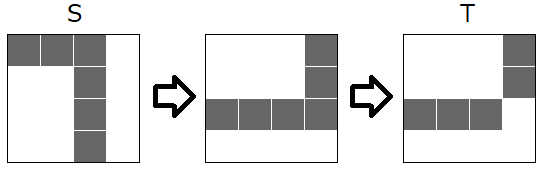
下図のようにして 2 回の操作で S を T と一致させることができます。
入力例 2
13
.#..###..##..
#.#.#..#.#.#.
#.#.###..#...
###.#..#.#.#.
#.#.###..##..
.............
..#...#....#.
.##..#.#..##.
#.#..#.#.#.#.
####.#.#.####
..#..#.#...#.
..#...#....#.
.............
.............
.#....#...#..
.#...#.#..#..
####.#.#.####
.#.#.###..#.#
.##....#..##.
.#....#...#..
.............
..##..###.#.#
.#.#.#..#.###
.#.#..###.#.#
.#.#.#..#.#.#
..##..###..#.
出力例 2
5
Score : 250 points
Problem Statement
There are two grids S and T, each with N rows and N columns. Let (i,j) denote the cell at the i-th row from the top and the j-th column from the left.
Each cell of grids S and T is colored either white or black. Cell (i,j) of S is white if S_{i,j} is ., and black if S_{i,j} is #. The same applies to T.
You may perform the following two types of operations any number of times in any order. Find the minimum number of operations required to make grid S identical to grid T.
- Choose one cell of grid S and change its color.
- Rotate the entire grid S 90 degrees clockwise.
Constraints
- 1 \le N \le 100
- N is an integer.
- Each of S_{i,j} and T_{i,j} is
.or#.
Input
The input is given from Standard Input in the following format:
N
S_{1,1}S_{1,2}\dots S_{1,N}
\vdots
S_{N,1}S_{N,2}\dots S_{N,N}
T_{1,1}T_{1,2}\dots T_{1,N}
\vdots
T_{N,1}T_{N,2}\dots T_{N,N}
Output
Output the minimum number of operations required.
Sample Input 1
4
###.
..#.
..#.
..#.
...#
...#
###.
....
Sample Output 1
2
You can match S to T in two operations as shown below.
Sample Input 2
13
.#..###..##..
#.#.#..#.#.#.
#.#.###..#...
###.#..#.#.#.
#.#.###..##..
.............
..#...#....#.
.##..#.#..##.
#.#..#.#.#.#.
####.#.#.####
..#..#.#...#.
..#...#....#.
.............
.............
.#....#...#..
.#...#.#..#..
####.#.#.####
.#.#.###..#.#
.##....#..##.
.#....#...#..
.............
..##..###.#.#
.#.#.#..#.###
.#.#..###.#.#
.#.#.#..#.#.#
..##..###..#.
Sample Output 2
5
実行時間制限: 2 sec / メモリ制限: 1024 MiB
配点 : 300 点
問題文
AtCoder社ではカードを使った 1 人ゲームが流行っています。
ゲームで使う各カードには、英小文字 1 文字または @ の文字が書かれており、いずれのカードも十分多く存在します。
ゲームは以下の手順で行います。
- カードを同じ枚数ずつ 2 列に並べる。
@のカードを、それぞれa,t,c,o,d,e,rのいずれかのカードと置き換える。- 2 つの列が一致していれば勝ち。そうでなければ負け。
このゲームに勝ちたいあなたは、次のようなイカサマをすることにしました。
- 手順 1 以降の好きなタイミングで、列内のカードを自由に並び替えてよい。
手順 1 で並べられた 2 つの列を表す 2 つの文字列 S,T が与えられるので、イカサマをしてもよいときゲームに勝てるか判定してください。
制約
- S,T は英小文字と
@からなる - S,T の長さは等しく 1 以上 2\times 10^5 以下
入力
入力は以下の形式で標準入力から与えられる。
S
T
出力
イカサマをしてもよいとき、ゲームに勝てるなら Yes、勝てないなら No と出力せよ。
入力例 1
ch@ku@ai
choku@@i
出力例 1
Yes
@ をうまく置き換えることによって、両方とも chokudai と一致させることが可能です。
入力例 2
ch@kud@i
akidu@ho
出力例 2
Yes
イカサマをし、@ をうまく置き換えることによって、両方とも chokudai と一致させることが可能です。
入力例 3
aoki
@ok@
出力例 3
No
イカサマをしても勝つことはできません。
入力例 4
aa
bb
出力例 4
No
Score : 300 points
Problem Statement
A single-player card game is popular in AtCoder Inc.
Each card in the game has a lowercase English letter or the symbol @ written on it. There is plenty number of cards for each kind.
The game goes as follows.
- Arrange the same number of cards in two rows.
- Replace each card with
@with one of the following cards:a,t,c,o,d,e,r. - If the two rows of cards coincide, you win. Otherwise, you lose.
To win this game, you will do the following cheat.
- Freely rearrange the cards within a row whenever you want after step 1.
You are given two strings S and T, representing the two rows you have after step 1. Determine whether it is possible to win with cheating allowed.
Constraints
- S and T consist of lowercase English letters and
@. - The lengths of S and T are equal and between 1 and 2\times 10^5, inclusive.
Input
The input is given from Standard Input in the following format:
S
T
Output
If it is possible to win with cheating allowed, print Yes; otherwise, print No.
Sample Input 1
ch@ku@ai
choku@@i
Sample Output 1
Yes
You can replace the @s so that both rows become chokudai.
Sample Input 2
ch@kud@i
akidu@ho
Sample Output 2
Yes
You can cheat and replace the @s so that both rows become chokudai.
Sample Input 3
aoki
@ok@
Sample Output 3
No
You cannot win even with cheating.
Sample Input 4
aa
bb
Sample Output 4
No
実行時間制限: 2 sec / メモリ制限: 1024 MiB
配点 : 300 点
問題文
H 行 W 列の格子状に HW 枚のカードが並べられています。
i=1,\ldots,N について、上から A_i 行目、左から B_i 列目にあるカードには数 i が書かれており、それ以外の HW-N 枚のカードには何も書かれていません。
これらのカードに対し、以下の 2 種類の操作を可能な限り繰り返します。
- 数の書かれたカードを含まない行が存在するとき、その行のカードを全て取り除き、残りのカードを上へ詰める
- 数の書かれたカードを含まない列が存在するとき、その列のカードを全て取り除き、残りのカードを左へ詰める
操作が終了したとき、数が書かれたカードがそれぞれどこにあるか求めてください。なお、答えは操作の仕方に依らず一意に定まることが証明されます。
制約
- 1 \leq H,W \leq 10^9
- 1 \leq N \leq \min(10^5,HW)
- 1 \leq A_i \leq H
- 1 \leq B_i \leq W
- (A_i,B_i) は相異なる
- 入力に含まれる値は全て整数である
入力
入力は以下の形式で標準入力から与えられる。
H W N
A_1 B_1
\vdots
A_N B_N
出力
N 行出力せよ。
操作終了後に数 i が書かれたカードが上から C_i 行目、左から D_i 列目に存在するとき、i 行目には C_i,D_i をこの順に空白区切りで出力せよ。
入力例 1
4 5 2
3 2
2 5
出力例 1
2 1
1 2
何も書かれていないカードを * で表すことにします。最初、カードの配置は以下の通りです。
*****
****2
*1***
*****
操作終了後、カードの配置は以下の通りになります。
*2
1*
1 が書かれたカードは上から 2 行目、左から 1 列目にあり、2 が書かれたカードは上から 1 行目、左から 2 列目にあります。
入力例 2
1000000000 1000000000 10
1 1
10 10
100 100
1000 1000
10000 10000
100000 100000
1000000 1000000
10000000 10000000
100000000 100000000
1000000000 1000000000
出力例 2
1 1
2 2
3 3
4 4
5 5
6 6
7 7
8 8
9 9
10 10
Score : 300 points
Problem Statement
We have HW cards arranged in a matrix with H rows and W columns.
For each i=1, \ldots, N, the card at the A_i-th row from the top and B_i-th column from the left has a number i written on it. The other HW-N cards have nothing written on them.
We will repeat the following two kinds of operations on these cards as long as we can.
- If there is a row without a numbered card, remove all the cards in that row and fill the gap by shifting the remaining cards upward.
- If there is a column without a numbered card, remove all the cards in that column and fill the gap by shifting the remaining cards to the left.
Find the position of each numbered card after the end of the process above. It can be proved that these positions are uniquely determined without depending on the order in which the operations are done.
Constraints
- 1 \leq H,W \leq 10^9
- 1 \leq N \leq \min(10^5,HW)
- 1 \leq A_i \leq H
- 1 \leq B_i \leq W
- All pairs (A_i,B_i) are distinct.
- All values in input are integers.
Input
Input is given from Standard Input in the following format:
H W N
A_1 B_1
\vdots
A_N B_N
Output
Print N lines.
If, after the end of the process, the card with the number i is at the C_i-th row from the top and D_i-th column from the left, the i-th line should contain C_i and D_i in this order with a space between them.
Sample Input 1
4 5 2
3 2
2 5
Sample Output 1
2 1
1 2
Let * represent a card with nothing written on it. The initial arrangement of cards is:
*****
****2
*1***
*****
After the end of the process, they will be arranged as follows:
*2
1*
Here, the card with 1 is at the 2-nd row from the top and 1-st column from the left, and the card with 2 is at the 1-st row from the top and 2-nd column from the left.
Sample Input 2
1000000000 1000000000 10
1 1
10 10
100 100
1000 1000
10000 10000
100000 100000
1000000 1000000
10000000 10000000
100000000 100000000
1000000000 1000000000
Sample Output 2
1 1
2 2
3 3
4 4
5 5
6 6
7 7
8 8
9 9
10 10
実行時間制限: 2 sec / メモリ制限: 1024 MiB
配点 : 425 点
問題文
無限に広いグリッドがあります。グリッドのあるマスはマス (0,0) と名前がついています。
マス (0,0) から下に r マス、右に c マスの移動した位置にあるマスをマス (r,c) と呼びます。
ここで、「下に r マス移動する」は r が負のときは「上に |r| マス移動する」ことを表し、「右に c マス移動する」は c が負のときには「左に |c| マス移動する」ことを表すものとします。
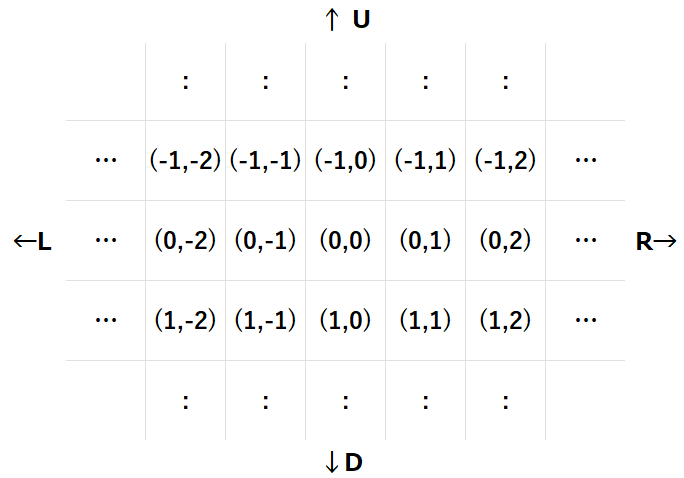
具体的には、マス (0,0) の周辺にあるマスは以下のようになります。
最初、高橋君はマス (R_t,C_t) に、青木君はマス (R_a,C_a) にいます。二人はそれぞれ U,D,L,R からなる長さ N の文字列 S,T に従って N 回移動を行います。
各 i について、高橋君と青木君の i 回目の移動は同時に行われます。具体的には、高橋君は S の i 文字目が U のとき上、D のとき下、L のとき左、R のとき右へ 1 マス移動し、青木君は T の i 文字目によって同様に移動します。
N 回の移動の中で、移動直後に高橋君と青木君が同じマスにいた回数を求めてください。
ただし、N は非常に大きいため S,T は ( (S'_1, A_1),\ldots(S'_M,A_M) ), ( (T'_1,B_1),\ldots,(T'_L,B_L) ) の形で与えられ、 S は「文字 S'_1 を A_1 個、\dots、文字 S'_M を A_M 個」をこの順に連結した文字列であり、T も同様です。
制約
- -10^9 \leq R_t,C_t,R_a,C_a \leq 10^9
- 1\leq N \leq 10^{14}
- 1\leq M,L \leq 10^5
- S'_i,T'_i は
U,D,L,Rのいずれか - 1 \leq A_i,B_i \leq 10^9
- A_1+\dots+A_M=B_1+\dots+B_L=N
- 与えられる数値は全て整数
入力
入力は以下の形式で標準入力から与えられる。
R_t C_t R_a C_a
N M L
S'_1 A_1
\vdots
S'_M A_M
T'_1 B_1
\vdots
T'_L B_L
出力
答えを出力せよ。
入力例 1
0 0 4 2
3 2 1
R 2
D 1
U 3
出力例 1
1
このケースでは S= RRD、T= UUU であり、移動は次のように行われます。
- 最初、高橋君はマス (0,0) に、青木君はマス (4,2) にいる。
- 1 回目の移動後、高橋君はマス (0,1)、青木君はマス (3,2) にいる。
- 2 回目の移動後、高橋君はマス (0,2)、青木君はマス (2,2) にいる。
- 3 回目の移動後、高橋君はマス (1,2)、青木君はマス (1,2) にいる。
よって、高橋君と青木君が移動直後に同じマスにいた回数は 1 です。
入力例 2
1000000000 1000000000 -1000000000 -1000000000
3000000000 3 3
L 1000000000
U 1000000000
U 1000000000
D 1000000000
R 1000000000
U 1000000000
出力例 2
1000000001
2000000000 回目の移動から 3000000000 回目の移動までの 1000000001 回で高橋君と青木君は移動直後に同じマスにいます。
入力例 3
3 3 3 2
1 1 1
L 1
R 1
出力例 3
0
入力例 4
0 0 0 0
1 1 1
L 1
R 1
出力例 4
0
Score : 425 points
Problem Statement
There is an infinitely large grid. One cell of the grid is named cell (0,0).
The cell located r cells down and c cells right from cell (0,0) is called cell (r,c).
Here, "r cells down" means "|r| cells up" when r is negative, and "c cells right" means "|c| cells left" when c is negative.
Specifically, the cells around cell (0,0) are as follows:
Initially, Takahashi is at cell (R_t,C_t) and Aoki is at cell (R_a,C_a). They will each make N moves according to strings S and T of length N consisting of U, D, L, R.
For each i, Takahashi's and Aoki's i-th moves occur simultaneously: Takahashi moves one cell up if the i-th character of S is U, down if D, left if L, and right if R; Aoki moves similarly according to the i-th character of T.
Find the number of times Takahashi and Aoki are at the same cell immediately after a move during the N moves.
Since N is very large, S and T are given in the form ((S'_1, A_1),\ldots,(S'_M,A_M)) and ((T'_1,B_1),\ldots,(T'_L,B_L)), where S is the string obtained by concatenating "A_1 copies of character S'_1, \dots, A_M copies of character S'_M" in this order, and T is given similarly.
Constraints
- -10^9 \leq R_t,C_t,R_a,C_a \leq 10^9
- 1\leq N \leq 10^{14}
- 1\leq M,L \leq 10^5
- Each of S'_i and T'_i is one of
U,D,L,R. - 1 \leq A_i,B_i \leq 10^9
- A_1+\dots+A_M=B_1+\dots+B_L=N
- All given values are integers.
Input
The input is given from Standard Input in the following format:
R_t C_t R_a C_a
N M L
S'_1 A_1
\vdots
S'_M A_M
T'_1 B_1
\vdots
T'_L B_L
Output
Print the answer.
Sample Input 1
0 0 4 2
3 2 1
R 2
D 1
U 3
Sample Output 1
1
In this case, S= RRD and T= UUU, and the movements proceed as follows:
- Initially, Takahashi is at cell (0,0) and Aoki is at cell (4,2).
- After the 1st move, Takahashi is at cell (0,1) and Aoki is at cell (3,2).
- After the 2nd move, Takahashi is at cell (0,2) and Aoki is at cell (2,2).
- After the 3rd move, Takahashi is at cell (1,2) and Aoki is at cell (1,2).
Thus, the number of times Takahashi and Aoki are at the same cell immediately after a move is 1.
Sample Input 2
1000000000 1000000000 -1000000000 -1000000000
3000000000 3 3
L 1000000000
U 1000000000
U 1000000000
D 1000000000
R 1000000000
U 1000000000
Sample Output 2
1000000001
From the 2000000000-th move to the 3000000000-th move, Takahashi and Aoki are at the same cell immediately after a move for 1000000001 times.
Sample Input 3
3 3 3 2
1 1 1
L 1
R 1
Sample Output 3
0
Sample Input 4
0 0 0 0
1 1 1
L 1
R 1
Sample Output 4
0
実行時間制限: 2 sec / メモリ制限: 1024 MiB
配点 : 450 点
問題文
H 行 W 列のグリッドがあり、はじめすべてのマスは色 0 で塗られています。
これから i = 1, 2, \ldots, M の順で以下の操作を行います。
-
T_i = 1 のとき、A_i 行目のマスをすべて色 X_i に塗り替える
-
T_i = 2 のとき、A_i 列目のマスをすべて色 X_i に塗り替える
すべての操作を終えたとき、最終的に色 i で塗られたマスが存在するような各色 i についてその色で塗られたマスの個数を求めてください。
制約
- 1 \leq H, W, M \leq 2 \times 10^5
- T_i \in \lbrace 1, 2 \rbrace
- T_i = 1 なる i に対して 1 \leq A_i \leq H
- T_i = 2 なる i に対して 1 \leq A_i \leq W
- 0 \leq X_i \leq 2 \times 10^5
- 入力される値はすべて整数
入力
入力は以下の形式で標準入力から与えられる。
H W M
T_1 A_1 X_1
T_2 A_2 X_2
\vdots
T_M A_M X_M
出力
色 i で塗られたマスが存在するような整数 i の個数を K として、K + 1 行出力せよ。
1 行目には K の値を出力せよ。
2 行目以降には色 i で塗られたマスが存在するような各色 i について、色の番号およびその色で塗られたマスの個数を出力せよ。
具体的には、i + 1 (1 \leq i \leq K) 行目には色の番号 c_i と色 c_i で塗られたマスの個数 x_i をこの順に空白区切りで出力せよ。
ただし、色の番号は昇順で出力せよ。すなわち、c_1 < c_2 < \ldots < c_K を満たすように出力せよ。また、x_i > 0 が必要であることに注意せよ。
入力例 1
3 4 4
1 2 5
2 4 0
1 3 3
1 3 2
出力例 1
3
0 5
2 4
5 3
操作によってグリッドの各マスの色は以下のように変化します。
0000   0000   0000   0000   0000
0000 → 5555 → 5550 → 5550 → 5550
0000   0000   0000   3333   2222
最終的に色 0 で塗られたマスは 5 つ、色 2 で塗られたマスは 4 つ、色 5 で塗られたマスは 3 つです。
入力例 2
1 1 5
1 1 1
1 1 10
2 1 100
1 1 1000
2 1 10000
出力例 2
1
10000 1
入力例 3
5 5 10
1 1 1
1 2 2
1 3 3
1 4 4
1 5 5
2 1 6
2 2 7
2 3 8
2 4 9
2 5 10
出力例 3
5
6 5
7 5
8 5
9 5
10 5
Score: 450 points
Problem Statement
There is a grid with H rows and W columns. Initially, all cells are painted with color 0.
You will perform the following operations in the order i = 1, 2, \ldots, M.
-
If T_i = 1, repaint all cells in the A_i-th row with color X_i.
-
If T_i = 2, repaint all cells in the A_i-th column with color X_i.
After all operations are completed, for each color i that exists on the grid, find the number of cells that are painted with color i.
Constraints
- 1 \leq H, W, M \leq 2 \times 10^5
- T_i \in \lbrace 1, 2 \rbrace
- 1 \leq A_i \leq H for each i such that T_i = 1,
- 1 \leq A_i \leq W for each i such that T_i = 2.
- 0 \leq X_i \leq 2 \times 10^5
- All input values are integers.
Input
The input is given from Standard Input in the following format:
H W M
T_1 A_1 X_1
T_2 A_2 X_2
\vdots
T_M A_M X_M
Output
Let K be the number of distinct integers i such that there are cells painted with color i. Print K + 1 lines.
The first line should contain the value of K.
The second and subsequent lines should contain, for each color i that exists on the grid, the color number i and the number of cells painted with that color.
Specifically, the (i + 1)-th line (1 \leq i \leq K) should contain the color number c_i and the number of cells x_i painted with color c_i, in this order, separated by a space.
Here, print the color numbers in ascending order. That is, ensure that c_1 < c_2 < \ldots < c_K. Note also that x_i > 0 is required.
Sample Input 1
3 4 4
1 2 5
2 4 0
1 3 3
1 3 2
Sample Output 1
3
0 5
2 4
5 3
The operations will change the colors of the cells in the grid as follows:
0000   0000   0000   0000   0000
0000 → 5555 → 5550 → 5550 → 5550
0000   0000   0000   3333   2222
Eventually, there are five cells painted with color 0, four with color 2, and three with color 5.
Sample Input 2
1 1 5
1 1 1
1 1 10
2 1 100
1 1 1000
2 1 10000
Sample Output 2
1
10000 1
Sample Input 3
5 5 10
1 1 1
1 2 2
1 3 3
1 4 4
1 5 5
2 1 6
2 2 7
2 3 8
2 4 9
2 5 10
Sample Output 3
5
6 5
7 5
8 5
9 5
10 5
実行時間制限: 4 sec / メモリ制限: 1024 MiB
配点 : 500 点
問題文
T 個のテストケースについて、数字のみからなる文字列 S と正整数 L,R が与えられるので、以下の問題を解いてください。
正整数 x に対して f(x)= ( x を ( 先頭に 0 を含まないように ) 書き下した文字列の連続部分列のうち S と合致するものの個数 ) と定義します。
例えば S= 22 であるとき、f(122) = 1, f(123) = 0, f(226) = 1, f(222) = 2 となります。
このとき、 \displaystyle \sum_{k=L}^{R} f(k) を求めてください。
制約
- 1 \le T \le 1000
- S は数字のみからなる長さ 1 以上 16 以下の文字列
- L,R は 1 \le L \le R < 10^{16} を満たす整数
入力
入力は以下の形式で標準入力から与えられる。\rm{case}_i は i 個目のテストケースを表す。
T
\rm{case}_{1}
\rm{case}_{2}
\vdots
\rm{case}_{\it{T}}
各テストケースは以下の形式である。
S L R
出力
全体で T 行出力せよ。
そのうち i 行目には i 番目のテストケースに対する答えを整数として出力せよ。
入力例 1
6
22 23 234
0295 295 295
0 1 9999999999999999
2718 998244353 9982443530000000
869120 1234567890123456 2345678901234567
2023032520230325 1 9999999999999999
出力例 1
12
0
14888888888888889
12982260572545
10987664021
1
この入力には 6 個のテストケースが含まれます。
- 1 つ目のケースは S=
22,L=23,R=234 です。- f(122)=f(220)=f(221)=f(223)=f(224)=\dots=f(229)=1
- f(222)=2
- 以上より、このケースに対する答えは 12 です。
- 2 つ目のケースは S=
0295,L=295,R=295 です。- f(295)=0 となることに注意してください。
Score : 500 points
Problem Statement
You are given a string S consisting of digits and positive integers L and R for each of T test cases. Solve the following problem.
For a positive integer x, let us define f(x) as the number of contiguous substrings of the decimal representation of x (without leading zeros) that equal S.
For instance, if S= 22, we have f(122) = 1, f(123) = 0, f(226) = 1, and f(222) = 2.
Find \displaystyle \sum_{k=L}^{R} f(k).
Constraints
- 1 \le T \le 1000
- S is a string consisting of digits whose length is between 1 and 16, inclusive.
- L and R are integers satisfying 1 \le L \le R < 10^{16}.
Input
The input is given from Standard Input in the following format, where \rm{case}_i denotes the i-th test case:
T
\rm{case}_{1}
\rm{case}_{2}
\vdots
\rm{case}_{\it{T}}
Each test case is in the following format:
S L R
Output
Print T lines in total.
The i-th line should contain an integer representing the answer to the i-th test case.
Sample Input 1
6
22 23 234
0295 295 295
0 1 9999999999999999
2718 998244353 9982443530000000
869120 1234567890123456 2345678901234567
2023032520230325 1 9999999999999999
Sample Output 1
12
0
14888888888888889
12982260572545
10987664021
1
This input contains six test cases.
- In the first test case, S=
22, L=23, R=234.- f(122)=f(220)=f(221)=f(223)=f(224)=\dots=f(229)=1.
- f(222)=2.
- Thus, the answer is 12.
- In the second test case, S=
0295, L=295, R=295.- Note that f(295)=0.