実行時間制限: 2 sec / メモリ制限: 1024 MiB
配点 : 100 点
問題文
全長 100\;\mathrm{km} のマラソンコースがあります。 マラソンコースにはスタートから 5\;\mathrm{km} おきに給水所が設置されており、スタート地点・ゴール地点とあわせて 21 箇所の給水所があります。
高橋くんは、このマラソンコースの N\;\mathrm{km} 地点にいます。 高橋くんに最も近い給水所は何 \mathrm{km} 地点の給水所か求めてください。
この問題の制約のもとで、最も近い給水所が 1 つに定まることが証明できます。
制約
- 0\leq N\leq100
- N は整数
入力
入力は以下の形式で標準入力から与えられる。
N
出力
高橋くんがいる地点に最も近い給水所が何 \mathrm{km} 地点にあるかを 1 行で出力せよ。
入力例 1
53
出力例 1
55
高橋くんは、マラソンコースの 53\;\mathrm{km} 地点にいます。 55\;\mathrm{km} 地点の給水所までの距離は 2\;\mathrm{km} で、これより近い給水所はありません。 よって、55 を出力してください。
入力例 2
21
出力例 2
20
高橋くんはマラソンコースを戻ることもできます。
入力例 3
100
出力例 3
100
給水所はスタートやゴールにもあります。 また、高橋くんはすでに給水所にいることもあります。
Score : 100 points
Problem Statement
There is an ultramarathon course totaling 100\;\mathrm{km}. Water stations are set up every 5\;\mathrm{km} along the course, including the start and goal, for a total of 21.
Takahashi is at the N\;\mathrm{km} point of this course. Find the position of the nearest water station to him.
Under the constraints of this problem, it can be proven that the nearest water station is uniquely determined.
Constraints
- 0\leq N\leq100
- N is an integer.
Input
The input is given from Standard Input in the following format:
N
Output
Print the distance between the start and the water station nearest to Takahashi, in kilometers, in a single line.
Sample Input 1
53
Sample Output 1
55
Takahashi is at the 53\;\mathrm{km} point of the course. The water station at the 55\;\mathrm{km} point is 2\;\mathrm{km} away, and there is no closer water station. Therefore, you should print 55.
Sample Input 2
21
Sample Output 2
20
Takahashi could also go back the way.
Sample Input 3
100
Sample Output 3
100
There are also water stations at the start and goal. Additionally, Takahashi may already be at a water station.
実行時間制限: 2 sec / メモリ制限: 1024 MiB
配点 : 100 点
問題文
長さ N の正整数列 A=(A_1,A_2,\dots,A_N) が与えられます。
A の奇数番目の要素の総和を求めてください。すなわち、N 以下の最大の奇数を m としたとき A_1+A_3+A_5+\ldots+A_m を求めてください。
制約
- 1\leq N\leq 100
- 1\leq A_i\leq 100
- 入力は全て整数
入力
入力は以下の形式で標準入力から与えられる。
N
A_1 A_2 \ldots A_N
出力
答えを出力せよ。
入力例 1
7
3 1 4 1 5 9 2
出力例 1
14
A の奇数番目の要素の総和は A_1+A_3+A_5+A_7=3+4+5+2=14 です。
入力例 2
1
100
出力例 2
100
入力例 3
14
100 10 1 10 100 10 1 10 100 10 1 10 100 10
出力例 3
403
Score : 100 points
Problem Statement
You are given a sequence of positive integers of length N: A=(A_1,A_2,\dots,A_N).
Find the sum of the odd-indexed elements of A. That is, find A_1 + A_3 + A_5 + \dots + A_m, where m is the largest odd number not exceeding N.
Constraints
- 1 \le N \le 100
- 1 \le A_i \le 100
- All input values are integers.
Input
The input is given from Standard Input in the following format:
N
A_1 A_2 \dots A_N
Output
Print the answer.
Sample Input 1
7
3 1 4 1 5 9 2
Sample Output 1
14
The sum of the odd-indexed elements of A is A_1+A_3+A_5+A_7=3+4+5+2=14.
Sample Input 2
1
100
Sample Output 2
100
Sample Input 3
14
100 10 1 10 100 10 1 10 100 10 1 10 100 10
Sample Output 3
403
実行時間制限: 2 sec / メモリ制限: 1024 MiB
配点 : 200 点
問題文
0 と 1 からなる長さ 64 の数列 A=(A_0,A_1,\dots,A_{63}) が与えられます。
A_0 2^0 + A_1 2^1 + \dots + A_{63} 2^{63} を求めてください。
制約
- A_i は 0 または 1
入力
入力は以下の形式で標準入力から与えられる。
A_0 A_1 \dots A_{63}
出力
答えを整数として出力せよ。
入力例 1
1 0 1 1 0 0 0 0 0 0 0 0 0 0 0 0 0 0 0 0 0 0 0 0 0 0 0 0 0 0 0 0 0 0 0 0 0 0 0 0 0 0 0 0 0 0 0 0 0 0 0 0 0 0 0 0 0 0 0 0 0 0 0 0
出力例 1
13
A_0 2^0 + A_1 2^1 + \dots + A_{63} 2^{63} = 2^0 + 2^2 + 2^3 = 13 です。
入力例 2
1 0 1 0 1 0 0 0 0 1 0 0 1 1 0 1 1 1 1 0 0 0 1 0 0 1 1 1 1 1 1 0 0 0 0 1 0 1 0 1 0 1 1 1 1 0 0 1 1 0 0 0 0 1 0 1 0 1 0 1 0 0 0 0
出力例 2
766067858140017173
Score : 200 points
Problem Statement
You are given a sequence A=(A_0,A_1,\dots,A_{63}) of length 64 consisting of 0 and 1.
Find A_0 2^0 + A_1 2^1 + \dots + A_{63} 2^{63}.
Constraints
- A_i is 0 or 1.
Input
The input is given from Standard Input in the following format:
A_0 A_1 \dots A_{63}
Output
Print the answer as an integer.
Sample Input 1
1 0 1 1 0 0 0 0 0 0 0 0 0 0 0 0 0 0 0 0 0 0 0 0 0 0 0 0 0 0 0 0 0 0 0 0 0 0 0 0 0 0 0 0 0 0 0 0 0 0 0 0 0 0 0 0 0 0 0 0 0 0 0 0
Sample Output 1
13
A_0 2^0 + A_1 2^1 + \dots + A_{63} 2^{63} = 2^0 + 2^2 + 2^3 = 13.
Sample Input 2
1 0 1 0 1 0 0 0 0 1 0 0 1 1 0 1 1 1 1 0 0 0 1 0 0 1 1 1 1 1 1 0 0 0 0 1 0 1 0 1 0 1 1 1 1 0 0 1 1 0 0 0 0 1 0 1 0 1 0 1 0 0 0 0
Sample Output 2
766067858140017173
実行時間制限: 2 sec / メモリ制限: 1024 MiB
配点 : 200 点
問題文
正整数からなる長さ N の数列 A=(A_1,\ldots,A_N) があります。どの隣接する 2 項の値も相異なります。
この数列に対し、次の操作によりいくつか数を挿入します。
- 数列 A のどの隣接する 2 項の差の絶対値も 1 であるとき、操作を終了する。
- 数列 A の先頭から見て、隣接する 2 項の差の絶対値が 1 でない最初の箇所を A_i,A_{i+1} とする。
- A_i < A_{i+1} ならば、A_i と A_{i+1} の間に、A_i+1,A_i+2,\ldots,A_{i+1}-1 を挿入する。
- A_i > A_{i+1} ならば、A_i と A_{i+1} の間に、A_i-1,A_i-2,\ldots,A_{i+1}+1 を挿入する。
- 手順 1 に戻る。
操作が終了したときの数列を出力してください。
制約
- 2 \leq N \leq 100
- 1 \leq A_i \leq 100
- A_i \neq A_{i+1}
- 入力は全て整数
入力
入力は以下の形式で標準入力から与えられる。
N
A_1 A_2 \ldots A_N
出力
操作が終了したときの数列の各要素を空白区切りで出力せよ。
入力例 1
4
2 5 1 2
出力例 1
2 3 4 5 4 3 2 1 2
最初、数列は (2,5,1,2) です。操作は以下のように行われます。
- 1 項目の 2 と 2 項目の 5 の間に 3,4 を挿入する。数列は (2,3,4,5,1,2) となる。
- 4 項目の 5 と 5 項目の 1 の間に 4,3,2 を挿入する。数列は (2,3,4,5,4,3,2,1,2) となる。
入力例 2
6
3 4 5 6 5 4
出力例 2
3 4 5 6 5 4
一度も挿入が行われないこともあります。
Score : 200 points
Problem Statement
We have a sequence of length N consisting of positive integers: A=(A_1,\ldots,A_N). Any two adjacent terms have different values.
Let us insert some numbers into this sequence by the following procedure.
- If every pair of adjacent terms in A has an absolute difference of 1, terminate the procedure.
- Let A_i, A_{i+1} be the pair of adjacent terms nearest to the beginning of A whose absolute difference is not 1.
- If A_i < A_{i+1}, insert A_i+1,A_i+2,\ldots,A_{i+1}-1 between A_i and A_{i+1}.
- If A_i > A_{i+1}, insert A_i-1,A_i-2,\ldots,A_{i+1}+1 between A_i and A_{i+1}.
- Return to step 1.
Print the sequence when the procedure ends.
Constraints
- 2 \leq N \leq 100
- 1 \leq A_i \leq 100
- A_i \neq A_{i+1}
- All values in the input are integers.
Input
The input is given from Standard Input in the following format:
N
A_1 A_2 \ldots A_N
Output
Print the terms in the sequence when the procedure ends, separated by spaces.
Sample Input 1
4
2 5 1 2
Sample Output 1
2 3 4 5 4 3 2 1 2
The initial sequence is (2,5,1,2). The procedure goes as follows.
- Insert 3,4 between the first term 2 and the second term 5, making the sequence (2,3,4,5,1,2).
- Insert 4,3,2 between the fourth term 5 and the fifth term 1, making the sequence (2,3,4,5,4,3,2,1,2).
Sample Input 2
6
3 4 5 6 5 4
Sample Output 2
3 4 5 6 5 4
No insertions may be performed.
実行時間制限: 3 sec / メモリ制限: 1024 MiB
配点 : 300 点
問題文
長さ N の数列 A = (a_1, a_2, \dots, a_N) があります。
以下で説明される Q 個のクエリに答えてください。
- クエリ i : 整数の組 (x_i, k_i) が与えられます。A の要素を a_1, a_2, \dots と前から順に見ていったときに、数 x_i が k_i 回目に登場するのは A の前から何番目の要素を見たときかを出力してください。
ただし条件を満たす要素が存在しない場合は -1 を出力してください。
制約
- 1 \leq N \leq 2 \times 10^5
- 1 \leq Q \leq 2 \times 10^5
- 0 \leq a_i \leq 10^9 (1 \leq i \leq N)
- 0 \leq x_i \leq 10^9 (1 \leq i \leq Q)
- 1 \leq k_i \leq N (1 \leq i \leq Q)
- 入力はすべて整数である。
入力
入力は以下の形式で標準入力から与えられる。
N Q
a_1 a_2 \dots a_N
x_1 k_1
x_2 k_2
\vdots
x_Q k_Q
出力
Q 行出力せよ。i 行目ではクエリ i に対する答えを出力せよ。
入力例 1
6 8
1 1 2 3 1 2
1 1
1 2
1 3
1 4
2 1
2 2
2 3
4 1
出力例 1
1
2
5
-1
3
6
-1
-1
A の中で 1 は a_1, a_2, a_5 に登場します。よって、クエリ 1 からクエリ 4 の答えは順に 1, 2, 5, -1 となります。
入力例 2
3 2
0 1000000000 999999999
1000000000 1
123456789 1
出力例 2
2
-1
Score : 300 points
Problem Statement
We have a sequence of N numbers: A = (a_1, a_2, \dots, a_N).
Process the Q queries explained below.
- Query i: You are given a pair of integers (x_i, k_i). Let us look at the elements of A one by one from the beginning: a_1, a_2, \dots Which element will be the k_i-th occurrence of the number x_i?
Print the index of that element, or -1 if there is no such element.
Constraints
- 1 \leq N \leq 2 \times 10^5
- 1 \leq Q \leq 2 \times 10^5
- 0 \leq a_i \leq 10^9 (1 \leq i \leq N)
- 0 \leq x_i \leq 10^9 (1 \leq i \leq Q)
- 1 \leq k_i \leq N (1 \leq i \leq Q)
- All values in input are integers.
Input
Input is given from Standard Input in the following format:
N Q
a_1 a_2 \dots a_N
x_1 k_1
x_2 k_2
\vdots
x_Q k_Q
Output
Print Q lines. The i-th line should contain the answer to Query i.
Sample Input 1
6 8
1 1 2 3 1 2
1 1
1 2
1 3
1 4
2 1
2 2
2 3
4 1
Sample Output 1
1
2
5
-1
3
6
-1
-1
1 occurs in A at a_1, a_2, a_5. Thus, the answers to Query 1 through 4 are 1, 2, 5, -1 in this order.
Sample Input 2
3 2
0 1000000000 999999999
1000000000 1
123456789 1
Sample Output 2
2
-1
実行時間制限: 2 sec / メモリ制限: 1024 MiB
配点 : 300 点
問題文
N 人の巨人がいます。巨人にはそれぞれ 1, 2, \ldots, N の名前がついており、巨人 i が地面に立ったとき、肩の高さは A_i、頭の高さは B_i となります。
あなたは (1, 2, \ldots, N) を並べ替えて得られる数列 (P_1, P_2, \ldots, P_N) を選び、以下の規則に従って N 人の巨人を積み上げることができます。
-
まず地面に巨人 P_1 を立たせる。巨人 P_1 の肩は地面を基準として A_{P_1}、頭は地面を基準として B_{P_1} の高さとなる。
-
i = 1, 2, \ldots, N - 1 の順に巨人 P_i の肩の上に巨人 P_{i + 1} を立たせる。巨人 P_i の肩が地面を基準として高さ t のとき、巨人 P_{i + 1} の肩は地面を基準として t + A_{P_{i + 1}}、頭は地面を基準として t + B_{P_{i + 1}} の高さとなる。
一番上に立っている巨人、すなわち巨人 P_N の地面を基準とした頭の高さとして実現できる最大値を求めてください。
制約
- 2 \leq N \leq 2 \times 10^5
- 1 \leq A_i \leq B_i \leq 10^9
- 入力される値はすべて整数
入力
入力は以下の形式で標準入力から与えられる。
N
A_1 B_1
A_2 B_2
\vdots
A_N B_N
出力
答えを出力せよ。
入力例 1
3
4 10
5 8
2 9
出力例 1
18
(P_1, P_2, P_3) = (2, 1, 3) とすると、地面を基準として巨人 2 は肩の高さが 5、頭の高さが 8、巨人 1 は肩の高さが 9、頭の高さが 15、巨人 3 は肩の高さが 11、頭の高さが 18 となります。
一番上に立っている巨人の頭の高さが地面を基準として 18 より大きくなることはないため 18 を出力します。
入力例 2
5
1 1
1 1
1 1
1 1
1 1
出力例 2
5
入力例 3
10
690830957 868532399
741145463 930111470
612846445 948344128
540375785 925723427
723092548 925021315
928915367 973970164
563314352 832796216
562681294 868338948
923012648 954764623
691107436 891127278
出力例 3
7362669937
Score: 300 points
Problem Statement
There are N giants, named 1 to N. When giant i stands on the ground, their shoulder height is A_i, and their head height is B_i.
You can choose a permutation (P_1, P_2, \ldots, P_N) of (1, 2, \ldots, N) and stack the N giants according to the following rules:
-
First, place giant P_1 on the ground. The giant P_1's shoulder will be at a height of A_{P_1} from the ground, and their head will be at a height of B_{P_1} from the ground.
-
For i = 1, 2, \ldots, N - 1 in order, place giant P_{i + 1} on the shoulders of giant P_i. If giant P_i's shoulders are at a height of t from the ground, then giant P_{i + 1}'s shoulders will be at a height of t + A_{P_{i + 1}} from the ground, and their head will be at a height of t + B_{P_{i + 1}} from the ground.
Find the maximum possible height of the head of the topmost giant P_N from the ground.
Constraints
- 2 \leq N \leq 2 \times 10^5
- 1 \leq A_i \leq B_i \leq 10^9
- All input values are integers.
Input
The input is given from Standard Input in the following format:
N
A_1 B_1
A_2 B_2
\vdots
A_N B_N
Output
Print the answer.
Sample Input 1
3
4 10
5 8
2 9
Sample Output 1
18
If (P_1, P_2, P_3) = (2, 1, 3), then measuring from the ground, giant 2 has a shoulder height of 5 and a head height of 8, giant 1 has a shoulder height of 9 and a head height of 15, and giant 3 has a shoulder height of 11 and a head height of 18.
The head height of the topmost giant from the ground cannot be greater than 18, so print 18.
Sample Input 2
5
1 1
1 1
1 1
1 1
1 1
Sample Output 2
5
Sample Input 3
10
690830957 868532399
741145463 930111470
612846445 948344128
540375785 925723427
723092548 925021315
928915367 973970164
563314352 832796216
562681294 868338948
923012648 954764623
691107436 891127278
Sample Output 3
7362669937
実行時間制限: 2 sec / メモリ制限: 1024 MiB
配点 : 400 点
問題文
整数 N が与えられます。以下の条件を満たす N 以下の正整数の組 (i,j) の個数を求めてください。
- i \times j は平方数である。
制約
- 1 \le N \le 2 \times 10^5
- N は整数である。
入力
入力は以下の形式で標準入力から与えられる。
N
出力
答えを出力せよ。
入力例 1
4
出力例 1
6
(1,1),(1,4),(2,2),(3,3),(4,1),(4,4) の 6 個が条件を満たします。
(2,3) は 2 \times 3 =6 が平方数でないため条件を満たしません。
入力例 2
254
出力例 2
896
Score : 400 points
Problem Statement
You are given an integer N. Find the number of pairs (i,j) of positive integers at most N that satisfy the following condition:
- i \times j is a square number.
Constraints
- 1 \le N \le 2 \times 10^5
- N is an integer.
Input
Input is given from Standard Input in the following format:
N
Output
Print the answer.
Sample Input 1
4
Sample Output 1
6
The six pairs (1,1),(1,4),(2,2),(3,3),(4,1),(4,4) satisfy the condition.
On the other hand, (2,3) does not, since 2 \times 3 =6 is not a square number.
Sample Input 2
254
Sample Output 2
896
実行時間制限: 2 sec / メモリ制限: 1024 MiB
配点 : 475 点
問題文
座標空間上に一辺 7 の立方体を 3 つ、ちょうど 1,2,3 個の立方体に含まれる領域の体積がそれぞれ V_1,V_2,V_3 となるように配置したいです。
3 つの整数 a,b,c に対し、(a\leq x\leq a+7) \land (b\leq y\leq b+7) \land (c\leq z\leq c+7) で表される立方体領域を C(a,b,c) とおきます。
以下の条件を全て満たすような 9 つの整数 a_1,b_1,c_1,a_2,b_2,c_2,a_3,b_3,c_3 が存在するか判定し、存在するならば実際に 1 つ求めてください。
- |a_1|,|b_1|,|c_1|,|a_2|,|b_2|,|c_2|,|a_3|,|b_3|,|c_3| \leq 100
- C_i = C(a_i,b_i,c_i)\ (i=1,2,3) とおいたとき、
- C_1,C_2,C_3 のうちちょうど 1 個に含まれる領域の体積は V_1 である。
- C_1,C_2,C_3 のうちちょうど 2 個に含まれる領域の体積は V_2 である。
- C_1,C_2,C_3 の全てに含まれる領域の体積は V_3 である。
制約
- 0\leq V_1,V_2,V_3 \leq 3\times 7^3
- 入力は全て整数
入力
入力は以下の形式で標準入力から与えられる。
V_1 V_2 V_3
出力
問題文中の条件を全て満たすような 9 つの整数 a_1,b_1,c_1,a_2,b_2,c_2,a_3,b_3,c_3 が存在しないならば No を出力し、存在するならば以下の形式で出力せよ。
複数存在する場合はそのどれを出力してもよい。
Yes
a_1 b_1 c_1 a_2 b_2 c_2 a_3 b_3 c_3
入力例 1
840 84 7
出力例 1
Yes
0 0 0 0 6 0 6 0 0
(a_1,b_1,c_1,a_2,b_2,c_2,a_3,b_3,c_3)=(0,0,0,0,6,0,6,0,0) の場合を考えます。

この図は C_1,C_2,C_3 の位置関係を表したもので、それぞれ橙、水色、緑の立方体に対応しています。
このとき、
- |a_1|,|b_1|,|c_1|,|a_2|,|b_2|,|c_2|,|a_3|,|b_3|,|c_3| は全て 100 以下
- C_1,C_2,C_3 の全てに含まれる領域は (6\leq x\leq 7)\land (6\leq y\leq 7) \land (0\leq z\leq 7) であり、その体積は (7-6)\times(7-6)\times(7-0)=7
- C_1,C_2,C_3 のうちちょうど 2 個に含まれる領域は ((0\leq x < 6)\land (6\leq y\leq 7) \land (0\leq z\leq 7))\lor((6\leq x\leq 7)\land (0\leq y< 6) \land (0\leq z\leq 7)) であり、 その体積は (6-0)\times(7-6)\times(7-0)\times 2=84
- C_1,C_2,C_3 のうちちょうど 1 個に含まれる領域の体積は 840
であり、条件を全て満たします。
(a_1,b_1,c_1,a_2,b_2,c_2,a_3,b_3,c_3)=(-10, 0, 0, -10, 0, 6, -10, 6, 1) なども同様に条件を全て満たすため、正当な出力として判定されます。
入力例 2
343 34 3
出力例 2
No
条件を全て満たすような 9 つの整数 a_1,b_1,c_1,a_2,b_2,c_2,a_3,b_3,c_3 は存在しません。
Score: 475 points
Problem Statement
In a coordinate space, we want to place three cubes with a side length of 7 so that the volumes of the regions contained in exactly one, two, three cube(s) are V_1, V_2, V_3, respectively.
For three integers a, b, c, let C(a,b,c) denote the cubic region represented by (a\leq x\leq a+7) \land (b\leq y\leq b+7) \land (c\leq z\leq c+7).
Determine whether there are nine integers a_1, b_1, c_1, a_2, b_2, c_2, a_3, b_3, c_3 that satisfy all of the following conditions, and find one such tuple if it exists.
- |a_1|, |b_1|, |c_1|, |a_2|, |b_2|, |c_2|, |a_3|, |b_3|, |c_3| \leq 100
- Let C_i = C(a_i, b_i, c_i)\ (i=1,2,3).
- The volume of the region contained in exactly one of C_1, C_2, C_3 is V_1.
- The volume of the region contained in exactly two of C_1, C_2, C_3 is V_2.
- The volume of the region contained in all of C_1, C_2, C_3 is V_3.
Constraints
- 0 \leq V_1, V_2, V_3 \leq 3 \times 7^3
- All input values are integers.
Input
The input is given from Standard Input in the following format:
V_1 V_2 V_3
Output
If no nine integers a_1, b_1, c_1, a_2, b_2, c_2, a_3, b_3, c_3 satisfy all of the conditions in the problem statement, print No. Otherwise, print such integers in the following format. If multiple solutions exist, you may print any of them.
Yes
a_1 b_1 c_1 a_2 b_2 c_2 a_3 b_3 c_3
Sample Input 1
840 84 7
Sample Output 1
Yes
0 0 0 0 6 0 6 0 0
Consider the case (a_1, b_1, c_1, a_2, b_2, c_2, a_3, b_3, c_3) = (0, 0, 0, 0, 6, 0, 6, 0, 0).
The figure represents the positional relationship of C_1, C_2, and C_3, corresponding to the orange, cyan, and green cubes, respectively.
Here,
- All of |a_1|, |b_1|, |c_1|, |a_2|, |b_2|, |c_2|, |a_3|, |b_3|, |c_3| are not greater than 100.
- The region contained in all of C_1, C_2, C_3 is (6\leq x\leq 7)\land (6\leq y\leq 7) \land (0\leq z\leq 7), with a volume of (7-6)\times(7-6)\times(7-0)=7.
- The region contained in exactly two of C_1, C_2, C_3 is ((0\leq x < 6)\land (6\leq y\leq 7) \land (0\leq z\leq 7))\lor((6\leq x\leq 7)\land (0\leq y < 6) \land (0\leq z\leq 7)), with a volume of (6-0)\times(7-6)\times(7-0)\times 2=84.
- The region contained in exactly one of C_1, C_2, C_3 has a volume of 840.
Thus, all conditions are satisfied.
(a_1, b_1, c_1, a_2, b_2, c_2, a_3, b_3, c_3) = (-10, 0, 0, -10, 0, 6, -10, 6, 1) also satisfies all conditions and would be a valid output.
Sample Input 2
343 34 3
Sample Output 2
No
No nine integers a_1, b_1, c_1, a_2, b_2, c_2, a_3, b_3, c_3 satisfy all of the conditions.
実行時間制限: 2 sec / メモリ制限: 1024 MiB
配点 : 525 点
問題文
1 から N の番号がついた N 棟のビルが数直線上に建っています。
ビル i は座標 X_i にあり、高さは H_i です。ビルの高さ方向以外の大きさは無視できるものとします。
座標 x の高さ h の地点 P からビル i が見えるとは、ビル i 上のある点 Q であって、線分 PQ が他のビルと共有点を持たないものが存在することと定めます。
座標 0 から全てのビルを見ることができない高さの最大値を求めてください。ただし、高さは非負の値を取るとし、高さ 0 で全てのビルを見ることができる場合はかわりに -1 と答えてください。
制約
- 1 \leq N \leq 2 \times 10^5
- 1 \leq X_1 < \dots < X_N \leq 10^9
- 1 \leq H_i \leq 10^9
- 入力は全て整数である
入力
入力は以下の形式で標準入力から与えられる。
N
X_1 H_1
\vdots
X_N H_N
出力
座標 0、高さ 0 の地点から全てのビルを見ることができる場合は -1 と出力せよ。
そうでないとき、座標 0 から全てのビルを見ることができない高さの最大値を出力せよ。真の解との絶対誤差または相対誤差が 10^{-9} 以下のとき正解と判定される。
入力例 1
3
3 2
5 4
7 5
出力例 1
1.500000000000000000
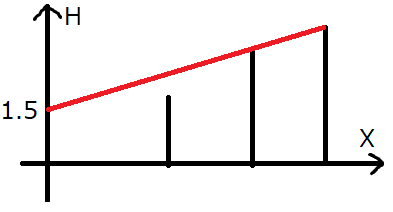
座標 0 高さ 1.5 の位置ではビル 3 を見ることができません。高さが 1.5 より僅かでも高ければビル 3 を含む全てのビルを見ることができるため、答えは 1.5 です。
入力例 2
2
1 1
2 100
出力例 2
-1
-1.000 などの出力では不正解となることに注意してください。
入力例 3
3
1 1
2 2
3 3
出力例 3
0.000000000000000000
入力例 4
4
10 10
17 5
20 100
27 270
出力例 4
17.142857142857142350
Score : 525 points
Problem Statement
There are N buildings numbered 1 to N on a number line.
Building i is at coordinate X_i and has height H_i. The size in directions other than height is negligible.
From a point P with coordinate x and height h, building i is considered visible if there exists a point Q on building i such that the line segment PQ does not intersect with any other building.
Find the maximum height at coordinate 0 from which it is not possible to see all buildings. Height must be non-negative; if it is possible to see all buildings at height 0 at coordinate 0, report -1 instead.
Constraints
- 1 \leq N \leq 2 \times 10^5
- 1 \leq X_1 < \dots < X_N \leq 10^9
- 1 \leq H_i \leq 10^9
- All input values are integers.
Input
The input is given from Standard Input in the following format:
N
X_1 H_1
\vdots
X_N H_N
Output
If it is possible to see all buildings from coordinate 0 and height 0, print -1. Otherwise, print the maximum height at coordinate 0 from which it is not possible to see all buildings. Answers with an absolute or relative error of at most 10^{-9} from the true answer will be considered correct.
Sample Input 1
3
3 2
5 4
7 5
Sample Output 1
1.500000000000000000
From coordinate 0 and height 1.5, building 3 cannot be seen. If the height is even slightly greater than 1.5, all buildings including building 3 can be seen. Thus, the answer is 1.5.
Sample Input 2
2
1 1
2 100
Sample Output 2
-1
Note that -1.000 or similar outputs would be considered incorrect.
Sample Input 3
3
1 1
2 2
3 3
Sample Output 3
0.000000000000000000
Sample Input 4
4
10 10
17 5
20 100
27 270
Sample Output 4
17.142857142857142350