Time Limit: 2 sec / Memory Limit: 1024 MiB
配点 : 100 点
問題文
高橋君は
2025 年 5 月 17 日 A 時 B 分締切のレポートを、
2025 年 5 月 17 日 C 時 D 分に提出しました。
ここで、「A 時 B 分」と「C 時 D 分」は異なる時刻であることが保証されます。
高橋君が締切前にレポートを提出しているならば Yes を、そうでないならば No を出力してください。
制約
- 0 \leq A,C \leq 23
- 0 \leq B,D \leq 59
- (A,B)\neq(C,D)
- A,B,C,D は整数
入力
入力は以下の形式で標準入力から与えられる。
A B C D
出力
高橋君が締切前にレポートを提出しているならば Yes を、そうでないならば No を出力せよ。
入力例 1
22 40 22 30
出力例 1
Yes
レポートの締切は 22 時 40 分であり、高橋君は 22 時 30 分に提出しているため、締切前にレポートを提出しています。
よって、Yes を出力します。
入力例 2
22 40 22 45
出力例 2
No
レポートの締切は 22 時 40 分であり、高橋君は 22 時 45 分に提出しているため、締切後にレポートを提出しています。
よって、No を出力します。
入力例 3
12 0 11 30
出力例 3
Yes
Score : 100 points
Problem Statement
Takahashi had a report whose deadline was B minutes past A o'clock on May 17, 2025. He submitted it at D minutes past C o'clock on May 17, 2025.
It is guaranteed that "B minutes past A o'clock" and "D minutes past C o'clock" are different times.
Output Yes if Takahashi submitted the report before the deadline, and No otherwise.
Constraints
- 0 \leq A, C \leq 23
- 0 \leq B, D \leq 59
- (A, B) \neq (C, D)
- A, B, C, and D are integers.
Input
The input is given from Standard Input in the following format:
A B C D
Output
If Takahashi submitted the report before the deadline, output Yes; otherwise, output No.
Sample Input 1
22 40 22 30
Sample Output 1
Yes
The deadline is 22:40, and he submitted at 22:30, so he submitted before the deadline.
Hence, output Yes.
Sample Input 2
22 40 22 45
Sample Output 2
No
The deadline is 22:40, and he submitted at 22:45, so he submitted after the deadline.
Hence, output No.
Sample Input 3
12 0 11 30
Sample Output 3
Yes
Time Limit: 2 sec / Memory Limit: 1024 MiB
配点 : 100 点
問題文
A 以上 B 以下であるような C の倍数を、1 つ出力してください。
条件を満たす数が存在しない場合は -1 を出力してください。
制約
- 1 \leq A \leq B \leq 1000
- 1 \leq C \leq 1000
- 入力は全て整数
入力
入力は以下の形式で標準入力から与えられる。
A B C
出力
答えを出力せよ。
条件を満たす数が存在しない場合は -1 を出力せよ。
入力例 1
123 456 100
出力例 1
200
300 や 400 も正解です。
入力例 2
630 940 314
出力例 2
-1
Score : 100 points
Problem Statement
Print a number between A and B (inclusive) that is a multiple of C.
If there is no such number, print -1.
Constraints
- 1 \leq A \leq B \leq 1000
- 1 \leq C \leq 1000
- All values in input are integers.
Input
Input is given from Standard Input in the following format:
A B C
Output
Print the answer.
If there is no number with the desired property, print -1.
Sample Input 1
123 456 100
Sample Output 1
200
300 or 400 would also be accepted.
Sample Input 2
630 940 314
Sample Output 2
-1
Time Limit: 2 sec / Memory Limit: 1024 MiB
配点 : 200 点
問題文
人 1, 人 2, \dots 人 N の N 人の人がいます。人 i の姓は s_i、名は t_i です。
N 人の人すべてにあだ名をつけることを考えます。人 i のあだ名 a_i は以下の条件を満たす必要があります。
- a_i は人 i の姓あるいは名と一致する。言い換えると、a_i = s_i または a_i = t_i の少なくとも一方が成り立つ。
- a_i は自分以外の人の姓および名のどちらとも一致しない。言い換えると、1 \leq j \leq N, i \neq j を満たすすべての整数 j について a_i \neq s_j かつ a_i \neq t_j が成り立つ。
N 人全員に条件を満たすあだ名をつけることは可能でしょうか。可能ならば Yes を、そうでないならば No を出力してください。
制約
- 2 \leq N \leq 100
- N は整数である。
- s_i,t_i は英小文字からなる 1 文字以上 10 文字以下の文字列である。
入力
入力は以下の形式で標準入力から与えられる。
N
s_1 t_1
s_2 t_2
\vdots
s_N t_N
出力
N 人すべてにあだ名をつけることが可能ならば Yes を、そうでないならば No を出力せよ。
入力例 1
3
tanaka taro
tanaka jiro
suzuki hanako
出力例 1
Yes
a_1 = taro, a_2 = jiro, a_3 = hanako とすれば、これは問題文にあるあだ名の条件を満たしています。(a_3 は suzuki でもよいです。)
ここで、a_1 = tanaka とはできないことに注意してください。なぜならば 人 2 の姓 s_2 もまた tanaka であるため、あだ名の条件の 2 つ目を満たさなくなるからです。
入力例 2
3
aaa bbb
xxx aaa
bbb yyy
出力例 2
No
問題文の条件を満たすあだ名のつけ方は存在しません。
入力例 3
2
tanaka taro
tanaka taro
出力例 3
No
同姓同名である人の組が存在する場合もあります。
入力例 4
3
takahashi chokudai
aoki kensho
snu ke
出力例 4
Yes
a_1 = chokudai, a_2 = kensho, a_3 = ke とすればよいです。
Score : 200 points
Problem Statement
There are N people numbered Person 1, Person 2, \dots, and Person N. Person i has a family name s_i and a given name t_i.
Consider giving a nickname to each of the N people. Person i's nickname a_i should satisfy all the conditions below.
- a_i coincides with Person i's family name or given name. In other words, a_i = s_i and/or a_i = t_i holds.
- a_i does not coincide with the family name and the given name of any other person. In other words, for all integer j such that 1 \leq j \leq N and i \neq j, it holds that a_i \neq s_j and a_i \neq t_j.
Is it possible to give nicknames to all the N people? If it is possible, print Yes; otherwise, print No.
Constraints
- 2 \leq N \leq 100
- N is an integer.
- s_i and t_i are strings of lengths between 1 and 10 (inclusive) consisting of lowercase English alphabets.
Input
Input is given from Standard Input in the following format:
N
s_1 t_1
s_2 t_2
\vdots
s_N t_N
Output
If it is possible to give nicknames to all the N people, print Yes; otherwise, print No.
Sample Input 1
3
tanaka taro
tanaka jiro
suzuki hanako
Sample Output 1
Yes
The following assignment satisfies the conditions of nicknames described in the Problem Statement: a_1 = taro, a_2 = jiro, a_3 = hanako. (a_3 may be suzuki, too.)
However, note that we cannot let a_1 = tanaka, which violates the second condition of nicknames, since Person 2's family name s_2 is tanaka too.
Sample Input 2
3
aaa bbb
xxx aaa
bbb yyy
Sample Output 2
No
There is no way to give nicknames satisfying the conditions in the Problem Statement.
Sample Input 3
2
tanaka taro
tanaka taro
Sample Output 3
No
There may be a pair of people with the same family name and the same given name.
Sample Input 4
3
takahashi chokudai
aoki kensho
snu ke
Sample Output 4
Yes
We can let a_1 = chokudai, a_2 = kensho, and a_3 = ke.
Time Limit: 2 sec / Memory Limit: 1024 MiB
配点 : 150 点
問題文
1 から N までの番号がつけられた N 個の国があり、i = 1, 2, \ldots, N について、高橋君は国 i の通貨を A_i 単位持っています。
高橋君は、下記の操作を好きな回数( 0 回でも良い)繰り返します。
- まず、1 以上 N-1 以下の整数 i を選ぶ。
- その後、国 i の通貨を S_i 単位以上持っているなら、下記の行動を 1 回行う。
- 国 i の通貨を S_i 単位だけ支払い、国 (i+1) の通貨を T_i 単位だけ獲得する。
最終的に高橋君が持っている国 N の通貨の単位数としてあり得る最大値を出力してください。
制約
- 入力される値はすべて整数
- 2 \leq N \leq 2 \times 10^5
- 0 \leq A_i \leq 10^9
- 1 \leq T_i \leq S_i \leq 10^9
入力
入力は以下の形式で標準入力から与えられる。
N
A_1 A_2 \ldots A_N
S_1 T_1
S_2 T_2
\vdots
S_{N-1} T_{N-1}
出力
答えを出力せよ。
入力例 1
4
5 7 0 3
2 2
4 3
5 2
出力例 1
5
以下の説明では、高橋君が持っている各国の通貨の単位数を、数列 A = (A_1, A_2, A_3, A_4) として表します。はじめ、A = (5, 7, 0, 3) です。
下記の通りに 4 回操作を行うことを考えます。
- i = 2 を選び、国 2 の通貨 4 単位を支払って、国 3 の通貨 3 単位を獲得する。その結果、A = (5, 3, 3, 3) となる。
- i = 1 を選び、国 1 の通貨 2 単位を支払って、国 2 の通貨 2 単位を獲得する。その結果、A = (3, 5, 3, 3) となる。
- i = 2 を選び、国 2 の通貨 4 単位を支払って、国 3 の通貨 3 単位を獲得する。その結果、A = (3, 1, 6, 3) となる。
- i = 3 を選び、国 3 の通貨 5 単位を支払って、国 4 の通貨 2 単位を獲得する。その結果、A = (3, 1, 1, 5) となる。
このとき、最終的に高橋君が持っている国 4 の通貨の単位数は 5 であり、これが考えられる最大値です。
入力例 2
10
32 6 46 9 37 8 33 14 31 5
5 5
3 1
4 3
2 2
3 2
3 2
4 4
3 3
3 1
出力例 2
45
Score: 150 points
Problem Statement
There are N countries numbered 1 to N. For each i = 1, 2, \ldots, N, Takahashi has A_i units of the currency of country i.
Takahashi can repeat the following operation any number of times, possibly zero:
- First, choose an integer i between 1 and N-1, inclusive.
- Then, if Takahashi has at least S_i units of the currency of country i, he performs the following action once:
- Pay S_i units of the currency of country i and gain T_i units of the currency of country (i+1).
Print the maximum possible number of units of the currency of country N that Takahashi could have in the end.
Constraints
- All input values are integers.
- 2 \leq N \leq 2 \times 10^5
- 0 \leq A_i \leq 10^9
- 1 \leq T_i \leq S_i \leq 10^9
Input
The input is given from Standard Input in the following format:
N
A_1 A_2 \ldots A_N
S_1 T_1
S_2 T_2
\vdots
S_{N-1} T_{N-1}
Output
Print the answer.
Sample Input 1
4
5 7 0 3
2 2
4 3
5 2
Sample Output 1
5
In the following explanation, let the sequence A = (A_1, A_2, A_3, A_4) represent the numbers of units of the currencies of the countries Takahashi has. Initially, A = (5, 7, 0, 3).
Consider performing the operation four times as follows:
- Choose i = 2, pay four units of the currency of country 2, and gain three units of the currency of country 3. Now, A = (5, 3, 3, 3).
- Choose i = 1, pay two units of the currency of country 1, and gain two units of the currency of country 2. Now, A = (3, 5, 3, 3).
- Choose i = 2, pay four units of the currency of country 2, and gain three units of the currency of country 3. Now, A = (3, 1, 6, 3).
- Choose i = 3, pay five units of the currency of country 3, and gain two units of the currency of country 4. Now, A = (3, 1, 1, 5).
At this point, Takahashi has five units of the currency of country 4, which is the maximum possible number.
Sample Input 2
10
32 6 46 9 37 8 33 14 31 5
5 5
3 1
4 3
2 2
3 2
3 2
4 4
3 3
3 1
Sample Output 2
45
Time Limit: 2 sec / Memory Limit: 1024 MiB
配点 : 300 点
問題文
アーティストの高砂君は、魚の骨をかたどったオブジェを作りました。
オブジェは N 本の肋骨と 1 本の脊椎からなります。 肋骨には 1 から N までの番号が付けられています。
高砂君は、以下の条件をすべて満たすように N+1 本の骨に 1 つずつ文字列を書こうと考えています。
- 脊椎に書く文字列の長さは N である。
- 肋骨 i = 1, \dots, N に対して、以下が成り立つ。
- 肋骨 i に書く文字列の長さは A_i である。
- 肋骨 i に書く文字列の B_i 文字目は、脊椎に書く文字列の i 文字目に一致する。
- N+1 本の骨に書く文字列はいずれも、S_1, \cdots, S_M のいずれかである(重複してもよい)。
S_1, \cdots, S_M は英小文字からなる文字列であり、互いに異なります。
j = 1, \cdots, M に対して、以下の質問に答えてください。
- 条件を満たす書き方のうち、脊椎に書く文字列が S_j であるものは存在しますか?
制約
- N は整数
- 1 \leq N \leq 10
- A_i, B_i は整数 (1 \leq i \leq N)
- 1 \leq B_i \leq A_i \leq 10 (1 \leq i \leq N)
- M は整数
- 1 \leq M \leq 200\,000
- S_j は英小文字からなる文字列 (1 \leq j \leq M)
- 1 \leq |S_j| \leq 10 (1 \leq j \leq M)
- S_1, \cdots, S_M は相異なる
入力
入力は以下の形式で標準入力から与えられる。
N
A_1 B_1
\vdots
A_N B_N
M
S_1
\vdots
S_M
出力
M 行出力せよ。
j 行目 (1 \leq j \leq M) には、条件を満たす書き方のうち脊椎に書く文字列が S_j のものが存在するならば Yes を、存在しないならば No を出力せよ。
入力例 1
5
5 3
5 2
4 1
5 1
3 2
8
retro
chris
itchy
tuna
crab
rock
cod
ash
出力例 1
Yes
Yes
No
No
No
No
No
No
肋骨 1,2,3,4,5 にそれぞれ chris, retro, tuna, retro, cod と書くことで、脊椎に retro を書いたときに条件を満たします。
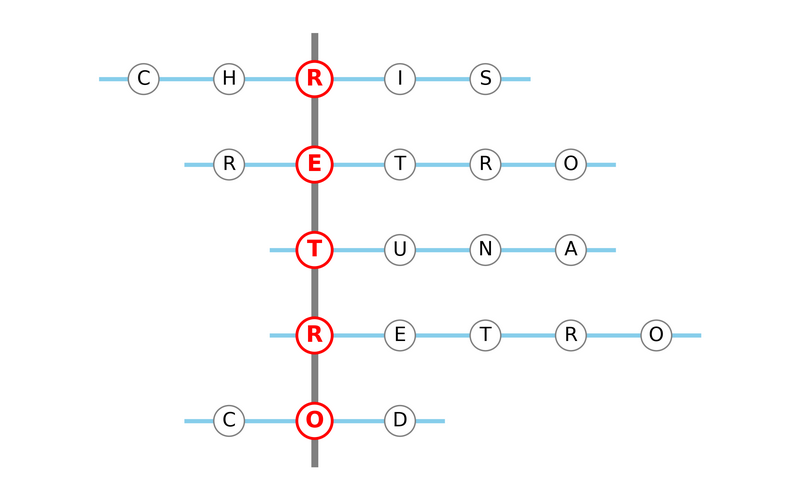
retroの長さは 5 文字。- 各肋骨について、以下が成り立つ。
- 肋骨 1 に書かれる文字列
chrisの長さは 5 文字である。その 3 文字目はrであり、retroの 1 文字目に一致する。 - 肋骨 2 に書かれる文字列
retroの長さは 5 文字である。その 2 文字目はeであり、retroの 2 文字目に一致する。 - 肋骨 3 に書かれる文字列
tunaの長さは 4 文字である。その 1 文字目はtであり、retroの 3 文字目に一致する。 - 肋骨 4 に書かれる文字列
retroの長さは 5 文字である。その 1 文字目はrであり、retroの 4 文字目に一致する。 - 肋骨 5 に書かれる文字列
codの長さは 3 文字である。その 2 文字目はoであり、retroの 5 文字目に一致する。
- 肋骨 1 に書かれる文字列
肋骨 1,2,3,4,5 にそれぞれ itchy, chris, rock, itchy, ash と書くことで、脊椎に chris を書いたときに条件を満たします。
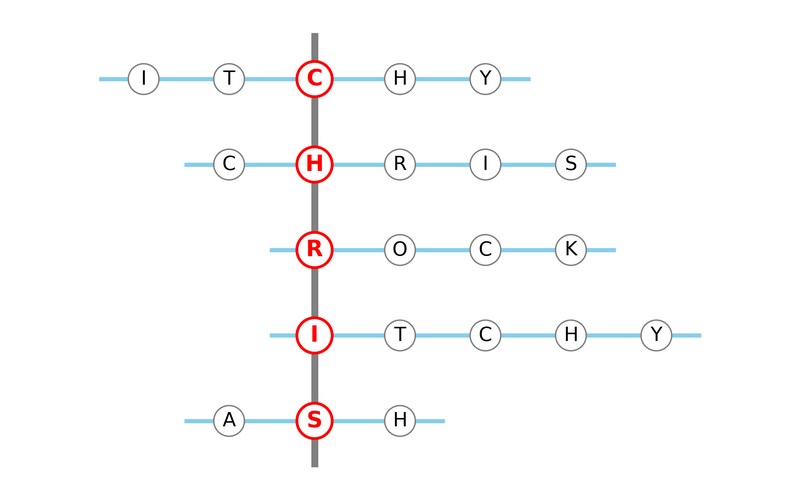
入力例 2
5
5 1
5 2
5 3
5 4
5 5
8
retro
chris
itchy
tuna
crab
rock
cod
ash
出力例 2
Yes
Yes
Yes
No
No
No
No
No
Score : 300 points
Problem Statement
Artist Takasago has created an object in the shape of a fish skeleton.
The object consists of N ribs and one spine. The ribs are numbered 1 through N.
He wants to write one string on each of the N+1 bones, satisfying all of the following conditions.
- The length of the string written on the spine is N.
- For each rib i = 1, \dots, N, the following hold.
- The length of the string written on rib i is A_i.
- The B_i-th character of the string written on rib i equals the i-th character of the string written on the spine.
- Each of the strings written on the N+1 bones is one of S_1, \cdots, S_M (duplicates allowed).
S_1, \cdots, S_M are strings consisting of lowercase English letters, and they are all distinct.
For each j = 1, \cdots, M, answer the following question.
- Among the ways to write strings satisfying the conditions, is there one where the string written on the spine is S_j?
Constraints
- N is an integer.
- 1 \leq N \leq 10
- A_i and B_i are integers. (1 \leq i \leq N)
- 1 \leq B_i \leq A_i \leq 10 (1 \leq i \leq N)
- M is an integer.
- 1 \leq M \leq 200\,000
- S_j is a string consisting of lowercase English letters. (1 \leq j \leq M)
- 1 \leq |S_j| \leq 10 (1 \leq j \leq M)
- S_1, \cdots, S_M are pairwise distinct.
Input
The input is given from Standard Input in the following format:
N
A_1 B_1
\vdots
A_N B_N
M
S_1
\vdots
S_M
Output
Output M lines.
The j-th line (1 \leq j \leq M) should contain Yes if there exists a way to write strings satisfying the conditions with S_j written on the spine, and No otherwise.
Sample Input 1
5
5 3
5 2
4 1
5 1
3 2
8
retro
chris
itchy
tuna
crab
rock
cod
ash
Sample Output 1
Yes
Yes
No
No
No
No
No
No
By writing chris, retro, tuna, retro, cod on ribs 1,2,3,4,5 respectively, the conditions are satisfied with retro written on the spine.
- The length of
retrois 5. - For each rib, the following hold.
- The string written on rib 1 is
chris, which has length 5. Its third character isr, which equals the first character ofretro. - The string written on rib 2 is
retro, which has length 5. Its second character ise, which equals the second character ofretro. - The string written on rib 3 is
tuna, which has length 4. Its first character ist, which equals the third character ofretro. - The string written on rib 4 is
retro, which has length 5. Its first character isr, which equals the fourth character ofretro. - The string written on rib 5 is
cod, which has length 3. Its second character iso, which equals the fifth character ofretro.
- The string written on rib 1 is
By writing itchy, chris, rock, itchy, ash on ribs 1,2,3,4,5 respectively, the conditions are satisfied with chris written on the spine.
Sample Input 2
5
5 1
5 2
5 3
5 4
5 5
8
retro
chris
itchy
tuna
crab
rock
cod
ash
Sample Output 2
Yes
Yes
Yes
No
No
No
No
No
Time Limit: 2 sec / Memory Limit: 1024 MiB
配点 : 300 点
問題文
N 人のすぬけ君が円周上に並んでおり、反時計回りに 1,2,...,N の番号がついています。
i\, (1 \leq i \leq N) 番目のすぬけ君は時刻 t に宝石をもらうと S_i 単位時間後、すなわち時刻 t+S_i にその宝石を (i+1) 番目のすぬけ君に渡します。ただし、(N+1) 番目のすぬけ君とは 1 番目のすぬけ君のことを指すとします。
また、高橋君は時刻 T_i に i 番目のすぬけ君に宝石を渡します。
全ての i\, (1 \leq i \leq N) について、i 番目のすぬけ君が初めて宝石をもらう時刻を求めてください。なお、宝石の受け渡しにかかる時間は無視できるものとします。
制約
- 1 \leq N \leq 200000
- 1 \leq S_i,T_i \leq 10^9
- 入力は全て整数である。
入力
入力は以下の形式で標準入力から与えられる。
N
S_1 S_2 \ldots S_N
T_1 T_2 \ldots T_N
出力
N 行出力せよ。i\, (1 \leq i \leq N) 行目には、i 番目のすぬけ君が初めて宝石をもらう時刻を出力すること。
入力例 1
3
4 1 5
3 10 100
出力例 1
3
7
8
時刻 13 までのすぬけ君と高橋君の行動を時系列順に並べます。
時刻 3 : 高橋君が 1 番目のすぬけ君に宝石を渡します。
時刻 7 : 1 番目のすぬけ君が 2 番目のすぬけ君に宝石を渡します。
時刻 8 : 2 番目のすぬけ君が 3 番目のすぬけ君に宝石を渡します。
時刻 10 : 高橋君が 2 番目のすぬけ君に宝石を渡します。
時刻 11 : 2 番目のすぬけ君が 3 番目のすぬけ君に宝石を渡します。
時刻 13 : 3 番目のすぬけ君が 1 番目のすぬけ君に宝石を渡します。
時刻 14 以降も彼らは宝石の受け渡しを行いますが、答えには影響しません。
入力例 2
4
100 100 100 100
1 1 1 1
出力例 2
1
1
1
1
S_i や T_i が相異なるとは限らないことに注意してください。
入力例 3
4
1 2 3 4
1 2 4 7
出力例 3
1
2
4
7
あるすぬけくんが同時刻に複数の宝石の受け渡しをする可能性があること、特に高橋くんとすぬけくんの両方から同時に宝石を貰う可能性があることに注意してください。
入力例 4
8
84 87 78 16 94 36 87 93
50 22 63 28 91 60 64 27
出力例 4
50
22
63
28
44
60
64
27
Score : 300 points
Problem Statement
There are N creatures standing in a circle, called Snuke 1, 2, ..., N in counter-clockwise order.
When Snuke i (1 \leq i \leq N) receives a gem at time t, S_i units of time later, it will hand that gem to Snuke i+1 at time t+S_i. Here, Snuke N+1 is Snuke 1.
Additionally, Takahashi will hand a gem to Snuke i at time T_i.
For each i (1 \leq i \leq N), find the time when Snuke i receives a gem for the first time. Assume that it takes a negligible time to hand a gem.
Constraints
- 1 \leq N \leq 200000
- 1 \leq S_i,T_i \leq 10^9
- All values in input are integers.
Input
Input is given from Standard Input in the following format:
N
S_1 S_2 \ldots S_N
T_1 T_2 \ldots T_N
Output
Print N lines. The i-th line (1 \leq i \leq N) should contain the time when Snuke i receives a gem for the first time.
Sample Input 1
3
4 1 5
3 10 100
Sample Output 1
3
7
8
We will list the three Snuke's and Takahashi's actions up to time 13 in chronological order.
Time 3: Takahashi hands a gem to Snuke 1.
Time 7: Snuke 1 hands a gem to Snuke 2.
Time 8: Snuke 2 hands a gem to Snuke 3.
Time 10: Takahashi hands a gem to Snuke 2.
Time 11: Snuke 2 hands a gem to Snuke 3.
Time 13: Snuke 3 hands a gem to Snuke 1.
After that, they will continue handing gems, though it will be irrelevant to the answer.
Sample Input 2
4
100 100 100 100
1 1 1 1
Sample Output 2
1
1
1
1
Note that the values S_i and T_i may not be distinct.
Sample Input 3
4
1 2 3 4
1 2 4 7
Sample Output 3
1
2
4
7
Note that a Snuke may perform multiple transactions simultaneously. Particularly, a Snuke may receive gems simultaneously from Takahashi and another Snuke.
Sample Input 4
8
84 87 78 16 94 36 87 93
50 22 63 28 91 60 64 27
Sample Output 4
50
22
63
28
44
60
64
27
Time Limit: 3 sec / Memory Limit: 1024 MiB
配点 : 400 点
問題文
N 個の実数の区間が与えられます。i\,(1 \leq i \leq N) 番目の区間は [l_i,r_i] です。i 番目の区間と j 番目の区間が共通部分を持つような組 (i,j)\,(1\leq i < j \leq N) の個数を求めてください。
制約
- 2 \leq N \leq 5 \times 10^5
- 0 \leq l_i < r_i \leq 10^9
- 入力はすべて整数
入力
入力は以下の形式で標準入力から与えられる。
N
l_1 r_1
l_2 r_2
\vdots
l_N r_N
出力
答えを出力せよ。
入力例 1
3
1 5
7 8
3 7
出力例 1
2
与えられた区間は [1,5], [7,8], [3,7] です。このうち,1 番目と 3 番目、 2 番目と 3 番目の区間が共通部分を持つため、答えは 2 です。
入力例 2
3
3 4
2 5
1 6
出力例 2
3
入力例 3
2
1 2
3 4
出力例 3
0
Score : 400 points
Problem Statement
You are given N intervals of real numbers. The i-th (1 \leq i \leq N) interval is [l_i, r_i]. Find the number of pairs (i, j)\,(1 \leq i < j \leq N) such that the i-th and j-th intervals intersect.
Constraints
- 2 \leq N \leq 5 \times 10^5
- 0 \leq l_i < r_i \leq 10^9
- All input values are integers.
Input
The input is given from Standard Input in the following format:
N
l_1 r_1
l_2 r_2
\vdots
l_N r_N
Output
Print the answer.
Sample Input 1
3
1 5
7 8
3 7
Sample Output 1
2
The given intervals are [1,5], [7,8], [3,7]. Among these, the 1-st and 3-rd intervals intersect, as well as the 2-nd and 3-rd intervals, so the answer is 2.
Sample Input 2
3
3 4
2 5
1 6
Sample Output 2
3
Sample Input 3
2
1 2
3 4
Sample Output 3
0
Time Limit: 2 sec / Memory Limit: 1024 MiB
配点 : 500 点
問題文
1 以上 N-1 以下の整数からなる長さ M の数列 A=(A_1,A_2,\dots,A_M) が与えられます。 i=1,2,\dots,M について、以下の質問に答えてください。
- 数列 B=(B_1,B_2,\dots,B_N) がある。最初、各 j について B_j=j である。今から、k=1,2,\dots,i-1,i+1,\dots,M の順に以下の操作を行う
(すなわち、i を除いた 1 以上 M 以下の整数 k について、昇順に以下の操作を行う)。
- B_{A_k} と B_{A_k+1} の値を入れ替える。
- 全ての操作が終了した段階で、B_j=1 を満たす j の値を S_i と定義する。S_i を求めよ。
制約
- 2 \leq N \leq 2\times 10^5
- 1 \leq M \leq 2\times 10^5
- 1 \leq A_i \leq N-1\ (1\leq i \leq M)
- 入力は全て整数
入力
入力は以下の形式で標準入力から与えられる。
N M
A_1 A_2 \dots A_M
出力
M 行出力せよ。 i\ (1\leq i \leq M) 行目には、S_i の値を整数として出力せよ。
入力例 1
5 4
1 2 3 2
出力例 1
1
3
2
4
i = 2 のとき、操作によって B は以下のように変化します。
- 最初、B = (1,2,3,4,5)
- k=1 として操作を行う。すなわち B_1 と B_2 の値を入れ替えて、B = (2,1,3,4,5)
- k=3 として操作を行う。すなわち B_3 と B_4 の値を入れ替えて、B = (2,1,4,3,5)
- k=4 として操作を行う。すなわち B_2 と B_3 の値を入れ替えて、B = (2,4,1,3,5)
全ての操作が終了した段階で B_3=1 であるため、S_2 = 3 です。
同様に、
- i=1 のとき:k=2,3,4 の順に操作を行うと B=(1,4,3,2,5) になるので、S_1=1
- i=3 のとき:k=1,2,4 の順に操作を行うと B=(2,1,3,4,5) になるので、S_3=2
- i=4 のとき:k=1,2,3 の順に操作を行うと B=(2,3,4,1,5) になるので、S_4=4
です。
入力例 2
3 3
2 2 2
出力例 2
1
1
1
入力例 3
10 10
1 1 1 9 4 4 2 1 3 3
出力例 3
2
2
2
3
3
3
1
3
4
4
Score : 500 points
Problem Statement
You are given a sequence of length M consisting of integers between 1 and N-1, inclusive: A=(A_1,A_2,\dots,A_M). Answer the following question for i=1, 2, \dots, M.
- There is a sequence B=(B_1,B_2,\dots,B_N). Initially, we have B_j=j for each j. Let us perform the following operation for k=1, 2, \dots, i-1, i+1, \dots, M in this order (in other words, for integers k between 1 and M except i in ascending order).
- Swap the values of B_{A_k} and B_{A_k+1}.
- After all the operations, let S_i be the value of j such that B_j=1. Find S_i.
Constraints
- 2 \leq N \leq 2\times 10^5
- 1 \leq M \leq 2\times 10^5
- 1 \leq A_i \leq N-1\ (1\leq i \leq M)
- All values in the input are integers.
Input
The input is given from Standard Input in the following format:
N M
A_1 A_2 \dots A_M
Output
Print M lines. The i-th line (1\leq i \leq M) should contain the value S_i as an integer.
Sample Input 1
5 4
1 2 3 2
Sample Output 1
1
3
2
4
For i = 2, the operations change B as follows.
- Initially, B = (1,2,3,4,5).
- Perform the operation for k=1. That is, swap the values of B_1 and B_2, making B = (2,1,3,4,5).
- Perform the operation for k=3. That is, swap the values of B_3 and B_4, making B = (2,1,4,3,5).
- Perform the operation for k=4. That is, swap the values of B_2 and B_3, making B = (2,4,1,3,5).
After all the operations, we have B_3=1, so S_2 = 3.
Similarly, we have the following.
- For i=1: performing the operation for k=2,3,4 in this order makes B=(1,4,3,2,5), so S_1=1.
- For i=3: performing the operation for k=1,2,4 in this order makes B=(2,1,3,4,5), so S_3=2.
- For i=4: performing the operation for k=1,2,3 in this order makes B=(2,3,4,1,5), so S_4=4.
Sample Input 2
3 3
2 2 2
Sample Output 2
1
1
1
Sample Input 3
10 10
1 1 1 9 4 4 2 1 3 3
Sample Output 3
2
2
2
3
3
3
1
3
4
4
Time Limit: 2 sec / Memory Limit: 1024 MiB
配点 : 525 点
問題文
以下の条件を満たす正整数 X を 良い整数 とします。
- X を十進法で表記したとき一の位、十の位、\ldots が広義単調減少になっている。
- より厳密には、\displaystyle X=\sum_{i=0}^{\infty} d_i10^i (0\le d_i < 10) を満たす唯一の非負整数列 (d_0,d_1,\ldots) が広義単調減少列になっている。
例えば、 112389 や 1 、777 は良い整数ですが、 443 や 404 は良い整数ではありません。
正整数 N が与えられます。
N の倍数であるような良い整数が存在するか判定し、存在する場合はその最小値を求めてください。
制約
- 1\le N\le 3\times 10^6
- 入力される値は整数
入力
入力は以下の形式で標準入力から与えられる。
N
出力
N の倍数であるような良い整数が存在しない場合は -1 を出力せよ。
存在する場合は N の倍数であるような良い整数の最小値を出力せよ。
入力例 1
21
出力例 1
126
126 は 21 の倍数であり、 6 \geq 2 \geq 1 \geq 0 \geq \ldots が成り立つため良い整数です。 126 未満の 21 の倍数であるような良い整数は存在しないため、 126 を出力してください。
入力例 2
10
出力例 2
-1
入力例 3
3
出力例 3
3
入力例 4
1089
出力例 4
9999999999999999999999
答えが 2^{64} 以上になる場合があります。
Score : 525 points
Problem Statement
A positive integer X is called a good integer if and only if it satisfies the following condition:
- When X is written in decimal notation, the ones digit, tens digit, \ldots form a non-increasing sequence.
- More formally, the unique non-negative integer sequence (d_0,d_1,\ldots) satisfying \displaystyle X=\sum_{i=0}^{\infty} d_i10^i (0\le d_i < 10) forms a non-increasing sequence.
For example, 112389, 1, and 777 are good integers, but 443 and 404 are not good integers.
You are given a positive integer N.
Determine whether there exists a good integer that is a multiple of N, and if it exists, find its minimum value.
Constraints
- 1\le N\le 3\times 10^6
- All input values are integers.
Input
The input is given from Standard Input in the following format:
N
Output
If there does not exist a good integer that is a multiple of N, output -1.
If it exists, output the minimum value of a good integer that is a multiple of N.
Sample Input 1
21
Sample Output 1
126
126 is a multiple of 21, and we have 6 \geq 2 \geq 1 \geq 0 \geq \ldots, so it is a good integer. There does not exist a good integer less than 126 that is a multiple of 21, so output 126.
Sample Input 2
10
Sample Output 2
-1
Sample Input 3
3
Sample Output 3
3
Sample Input 4
1089
Sample Output 4
9999999999999999999999
The answer may be 2^{64} or greater.