実行時間制限: 2 sec / メモリ制限: 1024 MiB
配点 : 100 点
問題文
N 個の座席が横一列に並んでいます。各座席には最大で 1 人まで座ることができます。以下の条件を満たすように M 人の人を座席に座らせることができるかどうか判定してください。
隣り合う 2 つの席の両方に人が座ってはいけない。
制約
- 1 \le N, M \le 100
- 入力される値は全て整数
入力
入力は以下の形式で標準入力から与えられる。
N M
出力
条件を満たすように座席に座らせることが可能ならば Yes を、不可能ならば No を出力せよ。
入力例 1
6 3
出力例 1
Yes
例えば、左から 1, 3, 6 番目に座らせれば可能です。したがって Yes を出力してください。
入力例 2
4 3
出力例 2
No
条件を満たすような座らせ方はありません。したがって No を出力してください。
入力例 3
5 3
出力例 3
Yes
入力例 4
44 7
出力例 4
Yes
Score : 100 points
Problem Statement
There are N seats arranged in a row. Each seat can accommodate at most one person. Determine whether it is possible to seat M people in the seats satisfying the following condition.
No two adjacent seats may both be occupied.
Constraints
- 1 \le N, M \le 100
- All input values are integers.
Input
The input is given from Standard Input in the following format:
N M
Output
Output Yes if it is possible to seat the people satisfying the condition, and No otherwise.
Sample Input 1
6 3
Sample Output 1
Yes
For example, seating people in the first, third, and sixth seats from the left is one valid way. Thus, output Yes.
Sample Input 2
4 3
Sample Output 2
No
There is no valid way to seat the people satisfying the condition. Thus, output No.
Sample Input 3
5 3
Sample Output 3
Yes
Sample Input 4
44 7
Sample Output 4
Yes
実行時間制限: 2 sec / メモリ制限: 1024 MiB
配点 : 100 点
問題文
0 と 1 からなる長さ 16 の文字列 S が与えられます。
2 以上 16 以下のすべての偶数 i について S の i 文字目が 0 ならば Yes を、
そうでないならば No を出力してください。
制約
- S は
0と1からなる長さ 16 の文字列
入力
入力は以下の形式で標準入力から与えられる。
S
出力
2 以上 16 以下のすべての偶数 i について S の i 文字目が 0 ならば Yes を、
そうでないならば No を出力せよ。
入力例 1
1001000000001010
出力例 1
No
S= 1001000000001010 の 4 文字目が 1 であるため、No を出力します。
入力例 2
1010100000101000
出力例 2
Yes
S= 1010100000101000 の偶数番目の文字はすべて 0 であるため、Yes を出力します。
入力例 3
1111111111111111
出力例 3
No
S の偶数文字目はすべて 1 となっています。
特に「すべて 0 」ではないため、No を出力します。
Score : 100 points
Problem Statement
You are given a string S of length 16 consisting of 0 and 1.
If the i-th character of S is 0 for every even number i from 2 through 16, print Yes; otherwise, print No.
Constraints
- S is a string of length 16 consisting of
0and1.
Input
The input is given from Standard Input in the following format:
S
Output
If the i-th character of S is 0 for every even number i from 2 through 16, print Yes; otherwise, print No.
Sample Input 1
1001000000001010
Sample Output 1
No
The 4-th character of S= 1001000000001010 is 1, so you should print No.
Sample Input 2
1010100000101000
Sample Output 2
Yes
Every even-positioned character in S= 1010100000101000 is 0, so you should print Yes.
Sample Input 3
1111111111111111
Sample Output 3
No
Every even-positioned character in S is 1.
Particularly, they are not all 0, so you should print No.
実行時間制限: 2 sec / メモリ制限: 1024 MiB
配点 : 300 点
問題文
N 人の競技プログラマーがいます。順に 人 1, 人 2, \dots, 人 N と呼びます。
競技プログラマーの間には 強さ と呼ばれる関係性があり、相異なる 2 人組 (人 X, 人 Y) 全てに対して 「人 X は人 Y より強い」または「人 Y は人 X より強い」のどちらか一方が成り立ちます。
強さ は 推移律 が成り立ちます。言い換えると、相異なる 3 人組 (人 X, 人 Y, 人 Z) 全てに対して次の条件が成り立ちます。
- 人 X が人 Y よりも強く、かつ人 Y が人 Z よりも強いとき、人 X は人 Z よりも強い。
人 X が自分以外のどの人 Y に対しても「人 X は人 Y より強い」という関係が成り立つ時、人 X を 最強のプログラマー と呼びます。(上記の制約下においてそのような人がちょうど 1 人存在することが証明できます)
あなたは M 個の強さに関する情報を知っています。i 個目の情報は「人 A_i は人 B_i より強い」という情報です。
あなたは情報を元に N 人の中から最強のプログラマーを特定することができますか?
最強のプログラマーを特定できる場合はその人の番号を出力してください。特定できない場合、つまり最強のプログラマーとしてあり得る人が複数人いる場合は -1 を出力してください。
制約
- 2 \leq N \leq 50
- 0 \leq M \leq \frac{N(N-1)}{2}
- 1 \leq A_i, B_i \leq N
- A_i \neq B_i
- i \neq j ならば (A_i, B_i) \neq (A_j, B_j)
- 全ての情報が正しくなるように、全ての相異なる 2 人組にどちらが強いかを割り当てる方法が少なくとも 1 通り存在する
入力
入力は以下の形式で標準入力から与えられる。
N M
A_1 B_1
A_2 B_2
\vdots
A_M B_M
出力
最強のプログラマーを特定できる場合はその人の番号を出力せよ。特定できない場合は -1 を出力せよ。
入力例 1
3 2
1 2
2 3
出力例 1
1
あなたは「人 1 は人 2 より強い」「人 2 は人 3 より強い」という情報が分かっています。
推移律から「人 1 は人 3 より強い」という情報もわかるので、人 1 は最強のプログラマーです。
入力例 2
3 2
1 3
2 3
出力例 2
-1
最強のプログラマーである可能性がある人は人 1 と人 2 です。最強のプログラマーを一意に特定できないので -1 を出力してください。
入力例 3
6 6
1 6
6 5
6 2
2 3
4 3
4 2
出力例 3
-1
Score : 300 points
Problem Statement
There are N competitive programmers numbered person 1, person 2, \ldots, and person N.
There is a relation called superiority between the programmers. For all pairs of distinct programmers (person X, person Y), exactly one of the following two relations holds: "person X is stronger than person Y" or "person Y is stronger than person X."
The superiority is transitive. In other words, for all triplets of distinct programmers (person X, person Y, person Z), it holds that:
- if person X is stronger than person Y and person Y is stronger than person Z, then person X is stronger than person Z.
A person X is said to be the strongest programmer if person X is stronger than person Y for all people Y other than person X. (Under the constraints above, we can prove that there is always exactly one such person.)
You have M pieces of information on their superiority. The i-th of them is that "person A_i is stronger than person B_i."
Can you determine the strongest programmer among the N based on the information?
If you can, print the person's number. Otherwise, that is, if there are multiple possible strongest programmers, print -1.
Constraints
- 2 \leq N \leq 50
- 0 \leq M \leq \frac{N(N-1)}{2}
- 1 \leq A_i, B_i \leq N
- A_i \neq B_i
- If i \neq j, then (A_i, B_i) \neq (A_j, B_j).
- There is at least one way to determine superiorities for all pairs of distinct programmers, that is consistent with the given information.
Input
The input is given from Standard Input in the following format:
N M
A_1 B_1
A_2 B_2
\vdots
A_M B_M
Output
If you can uniquely determine the strongest programmer, print the person's number; otherwise, print -1.
Sample Input 1
3 2
1 2
2 3
Sample Output 1
1
You have two pieces of information: "person 1 is stronger than person 2" and "person 2 is stronger than person 3."
By the transitivity, you can also infer that "person 1 is stronger than person 3," so person 1 is the strongest programmer.
Sample Input 2
3 2
1 3
2 3
Sample Output 2
-1
Both person 1 and person 2 may be the strongest programmer. Since you cannot uniquely determine which is the strongest, you should print -1.
Sample Input 3
6 6
1 6
6 5
6 2
2 3
4 3
4 2
Sample Output 3
-1
実行時間制限: 2 sec / メモリ制限: 1024 MiB
配点 : 200 点
問題文
N 行 N 列のマス目が与えられます。上から i 行目、左から j 列目のマスには整数 A_{i,j} が書かれています。ここで、A_{i,j} は 0 か 1 であることが保証されます。
マス目の外側のマスに書かれた整数を時計回りに 1 個ずつずらしたときのマス目を出力してください。
ただし外側のマスとは、1 行目、N 行目、1 列目、N 列目のいずれか 1 つ以上に属するマスの集合のことを指します。
制約
- 2 \le N \le 100
- 0 \le A_{i,j} \le 1(1 \le i,j \le N)
- 入力は全て整数
入力
入力は以下の形式で標準入力から与えられる。
N
A_{1,1}A_{1,2}\dots A_{1,N}
A_{2,1}A_{2,2}\dots A_{2,N}
\vdots
A_{N,1}A_{N,2}\dots A_{N,N}
出力
マス目の外側のマスに書かれた整数を時計回りに 1 個ずつずらしたときのマス目において、上から i 行目、左から j 列目のマスに書かれている整数を B_{i,j} と置く。このとき、以下の形式で出力せよ。
B_{1,1}B_{1,2}\dots B_{1,N}
B_{2,1}B_{2,2}\dots B_{2,N}
\vdots
B_{N,1}B_{N,2}\dots B_{N,N}
入力例 1
4
0101
1101
1111
0000
出力例 1
1010
1101
0111
0001
上から i 行目、左から j 列目のマスを (i,j) と呼ぶこととします。
外側のマスは (1,1) から時計回りに列挙すると (1,1),(1,2),(1,3),(1,4),(2,4),(3,4),(4,4),(4,3),(4,2),(4,1),(3,1),(2,1) の 12 個です。
これらのマスに書かれている整数を、時計回りに 1 個ずつ動かすと出力欄のようになります。
入力例 2
2
11
11
出力例 2
11
11
入力例 3
5
01010
01001
10110
00110
01010
出力例 3
00101
11000
00111
00110
10100
Score : 200 points
Problem Statement
You are given a grid with N rows and N columns. An integer A_{i, j} is written on the square at the i-th row from the top and j-th column from the left. Here, it is guaranteed that A_{i,j} is either 0 or 1.
Shift the integers written on the outer squares clockwise by one square each, and print the resulting grid.
Here, the outer squares are those in at least one of the 1-st row, N-th row, 1-st column, and N-th column.
Constraints
- 2 \le N \le 100
- 0 \le A_{i,j} \le 1(1 \le i,j \le N)
- All input values are integers.
Input
The input is given from Standard Input in the following format:
N
A_{1,1}A_{1,2}\dots A_{1,N}
A_{2,1}A_{2,2}\dots A_{2,N}
\vdots
A_{N,1}A_{N,2}\dots A_{N,N}
Output
Let B_{i,j} be the integer written on the square at the i-th row from the top and j-th column from the left in the grid resulting from shifting the outer squares clockwise by one square each. Print them in the following format:
B_{1,1}B_{1,2}\dots B_{1,N}
B_{2,1}B_{2,2}\dots B_{2,N}
\vdots
B_{N,1}B_{N,2}\dots B_{N,N}
Sample Input 1
4
0101
1101
1111
0000
Sample Output 1
1010
1101
0111
0001
We denote by (i,j) the square at the i-th row from the top and j-th column from the left.
The outer squares, in clockwise order starting from (1,1), are the following 12 squares: (1,1),(1,2),(1,3),(1,4),(2,4),(3,4),(4,4),(4,3),(4,2),(4,1),(3,1), and (2,1).
The sample output shows the resulting grid after shifting the integers written on those squares clockwise by one square.
Sample Input 2
2
11
11
Sample Output 2
11
11
Sample Input 3
5
01010
01001
10110
00110
01010
Sample Output 3
00101
11000
00111
00110
10100
実行時間制限: 2 sec / メモリ制限: 1024 MiB
配点 : 300 点
問題文
AtCoderレストランでは 1 から N までの番号がつけられている N 種類の食材を扱っています。
また、AtCoderレストランでは 1 から M までの番号がつけられている M 個の料理を提供しています。料理 i には K_i 種類の食材が使われており、食材 A_{i,1}, A_{i,2}, \ldots, A_{i,K_i} が使われています。
すぬけくんは現在 N 種類の食材がすべて苦手です。また、すぬけ君は苦手な食材が 1 種類でも使われている料理を食べることができず、苦手な食材が 1 種類も使われていない料理を食べることができます。
すぬけ君はこれから N 日間かけて苦手な食材を克服しようとしています。 すぬけ君は i 日目に食材 B_i を克服し、それ以降苦手な食材でなくなります。
i=1,2,\ldots,N について以下の値を求めてください。
- i 日目にすぬけ君が食材 B_i を克服した直後、すぬけ君が食べることができるAtCoderレストランの料理の個数
制約
- 1 \leq N \leq 3 \times 10^{5}
- 1 \leq M \leq 3 \times 10^{5}
- 1 \leq K_i \leq N (1 \leq i \leq M)
- K_i の総和は 3 \times 10^{5} 以下
- 1 \leq A_{i,j} \leq N (1 \leq i \leq M, 1 \leq j \leq K_i)
- A_{i,j} \neq A_{i,k} (1 \leq i \leq M, j \neq k)
- 1 \leq B_i \leq N (1 \leq i \leq N)
- B_i \neq B_j (i \neq j )
- 入力は全て整数
入力
入力は以下の形式で標準入力から与えられる。
N M
K_1 A_{1,1} A_{1,2} \ldots A_{1,K_1}
K_2 A_{2,1} A_{2,2} \ldots A_{2,K_2}
\vdots
K_M A_{M,1} A_{M,2} \ldots A_{M,K_M}
B_1 B_2 \ldots B_N
出力
N 行出力せよ。k 行目には、i=k のときの値を出力せよ。
入力例 1
5 4
2 1 2
3 3 4 5
3 1 2 5
1 3
1 3 2 5 4
出力例 1
0
1
2
3
4
以下のようにすぬけ君は苦手な食材を克服します。
- 1 日目: 食材 1 を克服する。このとき、どの料理にも苦手な食材が使われているため 0 を出力する。
- 2 日目: 食材 3 を克服する。このとき、料理 4 は苦手な食材が使われなくなるため食べられるようになる。料理 4 以外の料理は苦手な食材が使われているため、 1 を出力する。
- 3 日目: 食材 2 を克服する。このとき、料理 1 は苦手な食材が使われなくなるため食べられるようになる。料理 1,4 以外の料理は苦手な食材が使われているため、 2 を出力する。
- 4 日目: 食材 5 を克服する。このとき、料理 3 は苦手な食材が使われなくなるため食べられるようになる。料理 1,3,4 以外の料理は苦手な食材が使われているため、 3 を出力する。
- 5 日目: 食材 4 を克服する。このとき、料理 2 は苦手な食材が使われなくなるため食べられるようになる。全ての料理に苦手な食材が使われていないため、 4 を出力する。
入力例 2
9 8
1 4
5 6 9 7 4 3
4 2 4 1 3
1 1
5 7 9 8 1 5
2 9 8
1 2
1 1
6 5 2 7 8 4 1 9 3
出力例 2
0
0
1
1
1
2
4
6
8
Score : 300 points
Problem Statement
The AtCoder Restaurant uses N types of ingredients numbered from 1 to N.
The restaurant offers M dishes numbered from 1 to M. Dish i uses K_i types of ingredients, namely A_{i,1}, A_{i,2}, \ldots, A_{i,K_i}.
Snuke currently dislikes all N ingredients. He cannot eat any dish that uses one or more ingredients he dislikes, and he can eat a dish that uses none of the disliked ingredients.
Over the next N days, he will overcome his dislikes one ingredient per day. On day i, he overcomes ingredient B_i, and from then on he no longer dislikes it.
For each i=1,2,\ldots,N, find:
- the number of dishes at the AtCoder Restaurant that he can eat immediately after overcoming ingredient B_i on day i.
Constraints
- 1 \leq N \leq 3 \times 10^{5}
- 1 \leq M \leq 3 \times 10^{5}
- 1 \leq K_i \leq N (1 \leq i \leq M)
- The sum of K_i is at most 3 \times 10^{5}.
- 1 \leq A_{i,j} \leq N (1 \leq i \leq M, 1 \leq j \leq K_i)
- A_{i,j} \neq A_{i,k} (1 \leq i \leq M, j \neq k)
- 1 \leq B_i \leq N (1 \leq i \leq N)
- B_i \neq B_j (i \neq j )
- All input values are integers.
Input
The input is given from Standard Input in the following format:
N M
K_1 A_{1,1} A_{1,2} \ldots A_{1,K_1}
K_2 A_{2,1} A_{2,2} \ldots A_{2,K_2}
\vdots
K_M A_{M,1} A_{M,2} \ldots A_{M,K_M}
B_1 B_2 \ldots B_N
Output
Print N lines. The k-th line should contain the answer for i=k.
Sample Input 1
5 4
2 1 2
3 3 4 5
3 1 2 5
1 3
1 3 2 5 4
Sample Output 1
0
1
2
3
4
Snuke overcomes his disliked ingredients as follows:
- Day 1: He overcomes ingredient 1. At this time, every dish still uses a disliked ingredient, so print 0.
- Day 2: He overcomes ingredient 3. Dish 4 no longer uses any disliked ingredient and becomes edible; all other dishes still use disliked ingredients, so print 1.
- Day 3: He overcomes ingredient 2. Dish 1 no longer uses any disliked ingredient and becomes edible; all dishes except 1 and 4 still use disliked ingredients, so print 2.
- Day 4: He overcomes ingredient 5. Dish 3 no longer uses any disliked ingredient and becomes edible; all dishes except 1, 3, and 4 still use disliked ingredients, so print 3.
- Day 5: He overcomes ingredient 4. Dish 2 no longer uses any disliked ingredient and becomes edible; now all dishes have no disliked ingredients, so print 4.
Sample Input 2
9 8
1 4
5 6 9 7 4 3
4 2 4 1 3
1 1
5 7 9 8 1 5
2 9 8
1 2
1 1
6 5 2 7 8 4 1 9 3
Sample Output 2
0
0
1
1
1
2
4
6
8
実行時間制限: 2 sec / メモリ制限: 1024 MiB
配点 : 300 点
問題文
ある地方に、1 から N の番号がついた N 個の街と、1 から M の番号がついた M 本の道路があります。
i 番目の道路は街 A_i と街 B_i を双方向に結び、長さは C_i です。
好きな街からスタートして同じ街を二度以上通らずに別の街へ移動するときの、通る道路の長さの和としてありえる最大値を求めてください。
制約
- 2 \leq N \leq 10
- 1 \leq M \leq \frac{N(N-1)}{2}
- 1\leq A_i < B_i \leq N
- (A_i,B_i) は相異なる
- 1\leq C_i \leq 10^8
- 入力は全て整数である
入力
入力は以下の形式で標準入力から与えられる。
N M
A_1 B_1 C_1
\vdots
A_M B_M C_M
出力
答えを出力せよ。
入力例 1
4 4
1 2 1
2 3 10
1 3 100
1 4 1000
出力例 1
1110
4\to 1\to 3\to 2 と移動すると、通る道路の長さの和は 1110 となります。
入力例 2
10 1
5 9 1
出力例 2
1
道路と繋がっていない街が存在するかもしれません。
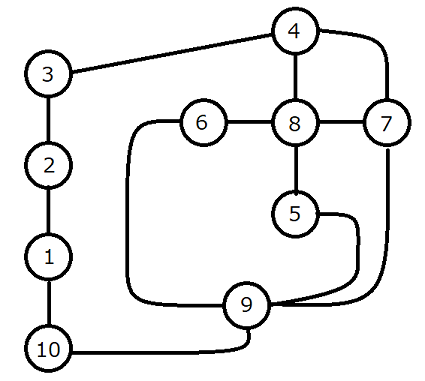
入力例 3
10 13
1 2 1
1 10 1
2 3 1
3 4 4
4 7 2
4 8 1
5 8 1
5 9 3
6 8 1
6 9 5
7 8 1
7 9 4
9 10 3
出力例 3
20
Score : 300 points
Problem Statement
A region has N towns numbered 1 to N, and M roads numbered 1 to M.
The i-th road connects town A_i and town B_i bidirectionally with length C_i.
Find the maximum possible total length of the roads you traverse when starting from a town of your choice and getting to another town without passing through the same town more than once.
Constraints
- 2 \leq N \leq 10
- 1 \leq M \leq \frac{N(N-1)}{2}
- 1 \leq A_i < B_i \leq N
- The pairs (A_i,B_i) are distinct.
- 1\leq C_i \leq 10^8
- All input values are integers.
Input
The input is given from Standard Input in the following format:
N M
A_1 B_1 C_1
\vdots
A_M B_M C_M
Output
Print the answer.
Sample Input 1
4 4
1 2 1
2 3 10
1 3 100
1 4 1000
Sample Output 1
1110
If you travel as 4\to 1\to 3\to 2, the total length of the roads you traverse is 1110.
Sample Input 2
10 1
5 9 1
Sample Output 2
1
There may be a town that is not connected to a road.
Sample Input 3
10 13
1 2 1
1 10 1
2 3 1
3 4 4
4 7 2
4 8 1
5 8 1
5 9 3
6 8 1
6 9 5
7 8 1
7 9 4
9 10 3
Sample Output 3
20
実行時間制限: 2 sec / メモリ制限: 1024 MiB
配点 : 400 点
問題文
英大文字からなる文字列 S が与えられます。
整数の組 (i, j, k) であって、以下の条件をともに満たすものの個数を求めてください。
- 1 \leq i < j < k \leq |S|
- S_i, S_j, S_k をこの順に結合して得られる長さ 3 の文字列が回文となる
ただし、|S| は文字列 S の長さ、S_x は S の x 番目の文字を指します。
制約
- S は長さ 1 以上 2 \times 10^5 以下の英大文字からなる文字列
入力
入力は以下の形式で標準入力から与えられる。
S
出力
答えを出力せよ。
入力例 1
ABCACC
出力例 1
5
(i, j, k) = (1, 2, 4), (1, 3, 4), (3, 4, 5), (3, 4, 6), (3, 5, 6) が条件を満たします。
入力例 2
OOOOOOOO
出力例 2
56
入力例 3
XYYXYYXYXXX
出力例 3
75
Score : 400 points
Problem Statement
You are given a string S consisting of uppercase English letters.
Find the number of integer triples (i, j, k) satisfying both of the following conditions:
- 1 \leq i < j < k \leq |S|
- The length-3 string formed by concatenating S_i, S_j, and S_k in this order is a palindrome.
Here, |S| denotes the length of S, and S_x denotes the x-th character of S.
Constraints
- S is a string of length between 1 and 2 \times 10^5, inclusive, consisting of uppercase English letters.
Input
The input is given from Standard Input in the following format:
S
Output
Print the answer.
Sample Input 1
ABCACC
Sample Output 1
5
The triples satisfying the conditions are (i, j, k) = (1, 2, 4), (1, 3, 4), (3, 4, 5), (3, 4, 6), (3, 5, 6).
Sample Input 2
OOOOOOOO
Sample Output 2
56
Sample Input 3
XYYXYYXYXXX
Sample Output 3
75
実行時間制限: 2.5 sec / メモリ制限: 1024 MiB
配点 : 500 点
問題文
頂点に 1 から N の番号が、辺に 1 から M の番号が付いた N 頂点 M 辺の重み付き単純連結無向グラフが与えられます。辺 i (1 \leq i \leq M) は頂点 u_i と頂点 v_i を双方向に結び、重みは w_i です。
あるパスに対してその重みをそのパスに含まれる辺の重みの最大値とします。 また、f(x,y) を 頂点 x から頂点 y へのパスの重みとしてありえる最小値とします。
長さ K の数列 (A_1,A_2,\ldots,A_K) と (B_1,B_2,\ldots,B_K) が与えられます。ここで、A_i \neq B_j (1 \leq i,j \leq K) が成り立つことが保証されます。
数列 B を自由に並べ替えて、\displaystyle\sum_{i=1}^{K}f(A_i,B_i) を最小化してください。
制約
- 2 \leq N \leq 2 \times 10^5
- N-1 \leq M \leq \min(\frac{N \times (N-1)}{2},2 \times 10^5)
- 1 \leq K \leq N
- 1 \leq u_i<v_i \leq N (1 \leq i \leq M)
- 1 \leq w_i \leq 10^9
- 1 \leq A_i,B_i \leq N (1 \leq i \leq K)
- A_i \neq B_j (1 \leq i,j \leq K)
- 与えられるグラフは単純かつ連結
- 入力は全て整数
入力
入力は以下の形式で標準入力から与えられる。
N M K
u_1 v_1 w_1
u_2 v_2 w_2
\vdots
u_M v_M w_M
A_1 A_2 \ldots A_K
B_1 B_2 \ldots B_K
出力
\displaystyle\sum_{i=1}^{K}f(A_i,B_i) の最小値を出力せよ。
入力例 1
4 4 3
1 3 2
3 4 1
2 4 5
1 4 4
1 1 3
4 4 2
出力例 1
8
B を並び替えて、B=(2,4,4) としたとき、
- f(1,2)=5 : 頂点 1 から頂点 4 を経由し頂点 2 に行くパスがあり、辺 3 の重み 5 が最大値を取ります。また、辺の重みの最大値が 4 以下になるようなパスは存在しないため 5 が最小値です。
- f(1,4)=2 : 頂点 1 から頂点 3 を経由し頂点 4 に行くパスがあり、辺 1 の重み 2 が最大値を取ります。また、辺の重みの最大値が 1 以下になるようなパスは存在しないため 2 が最小値です。
- f(3,4)=1 : 頂点 3 から頂点 4 への辺を通るパスがあり、辺の重みは 1 でこれが辺の重みの最大値です。また、パスの重みが 0 以下になることはないため 1 が最小値です。
よって、この場合 \displaystyle \sum_{i=1}^{3}f(A_i,B_i)=5+2+1=8 となります。また、B をどのように並び替えても 7 以下になることはないため、答えは 8 です。
入力例 2
3 3 2
1 2 5
2 3 2
1 3 1
1 1
2 3
出力例 2
3
Score : 500 points
Problem Statement
You are given a simple connected undirected graph with N vertices and M edges, where vertices are numbered 1 to N and edges are numbered 1 to M. Edge i (1 \leq i \leq M) connects vertices u_i and v_i bidirectionally and has weight w_i.
For a path, define its weight as the maximum weight of an edge in the path. Define f(x, y) as the minimum possible path weight of a path from vertex x to vertex y.
You are given two sequences of length K: (A_1, A_2, \ldots, A_K) and (B_1, B_2, \ldots, B_K). It is guaranteed that A_i \neq B_j (1 \leq i,j \leq K).
Permute the sequence B freely so that \displaystyle \sum_{i=1}^{K} f(A_i, B_i) is minimized.
Constraints
- 2 \leq N \leq 2 \times 10^5
- N-1 \leq M \leq \min(\frac{N \times (N-1)}{2},2 \times 10^5)
- 1 \leq K \leq N
- 1 \leq u_i<v_i \leq N (1 \leq i \leq M)
- 1 \leq w_i \leq 10^9
- 1 \leq A_i,B_i \leq N (1 \leq i \leq K)
- The given graph is simple and connected.
- All input values are integers.
Input
The input is given from Standard Input in the following format:
N M K
u_1 v_1 w_1
u_2 v_2 w_2
\vdots
u_M v_M w_M
A_1 A_2 \ldots A_K
B_1 B_2 \ldots B_K
Output
Print the minimum value of \displaystyle \sum_{i=1}^{K} f(A_i, B_i).
Sample Input 1
4 4 3
1 3 2
3 4 1
2 4 5
1 4 4
1 1 3
4 4 2
Sample Output 1
8
If we rearrange B as (2,4,4):
- f(1,2) = 5: The path from vertex 1 to vertex 2 passing through vertex 4 contains edge 3 with a maximum edge weight of 5. There is no path with a maximum edge weight less than or equal to 4, so 5 is the minimum possible.
- f(1,4) = 2: The path from vertex 1 to vertex 4 passing through vertex 3 contains edge 1 with a maximum edge weight of 2. There is no path with a maximum edge weight less than or equal to 1, so 2 is the minimum possible.
- f(3,4) = 1: The path from vertex 3 to vertex 4 passing through the direct edge contains an edge with a maximum edge weight of 1. No path can have a maximum weight 0 or less, so 1 is the minimum possible.
Thus, \displaystyle \sum_{i=1}^{3} f(A_i, B_i) = 5+2+1=8. No permutation of B yields 7 or less, so the answer is 8.
Sample Input 2
3 3 2
1 2 5
2 3 2
1 3 1
1 1
2 3
Sample Output 2
3
実行時間制限: 2 sec / メモリ制限: 1024 MiB
配点 : 550 点
問題文
N 人の人が一列に並んでおり、人 i は先頭から i 番目に並んでいます。
以下の操作を、列に並んでいる人が 1 人になるまで繰り返します。
- 先頭に並んでいる人を \frac{1}{2} の確率で列から取り除き、そうでない場合は列の末尾に移す。
人 i=1,2,\ldots,N それぞれについて、人 i が最後まで列に並んでいる 1 人になる確率を \text{mod }998244353 で求めて下さい。(取り除くかどうかの選択はすべてランダムかつ独立です。)
確率 \text{mod } 998244353 の定義
この問題で求める確率は必ず有理数になることが証明できます。 また、この問題の制約下では、求める確率を既約分数 \frac{y}{x} で表したときに x が 998244353 で割り切れないことが保証されます。
このとき xz \equiv y \pmod{998244353} を満たすような 0 以上 998244352 以下の整数 z が一意に定まります。この z を答えてください。
制約
- 2\leq N\leq 3000
- 入力は全て整数
入力
入力は以下の形式で標準入力から与えられる。
N
出力
人 i=1,2,\ldots,N に対する答えを空白区切りで出力せよ。
入力例 1
2
出力例 1
332748118 665496236
人 1 が最後まで列に並んでいる 1 人になる確率は \frac{1}{3} です。
人 2 が最後まで列に並んでいる 1 人になる確率は \frac{2}{3} です。
入力例 2
5
出力例 2
235530465 792768557 258531487 238597268 471060930
Score : 550 points
Problem Statement
There are N people standing in a line, with person i standing at the i-th position from the front.
Repeat the following operation until there is only one person left in the line:
- Remove the person at the front of the line with a probability of \frac{1}{2}, otherwise move them to the end of the line.
For each person i=1,2,\ldots,N, find the probability that person i is the last person remaining in the line, modulo 998244353. (All choices to remove or not are random and independent.)
How to find probabilities modulo 998244353
The probabilities sought in this problem can be proven to always be a rational number. Furthermore, the constraints of this problem guarantee that if the sought probability is expressed as an irreducible fraction \frac{y}{x}, then x is not divisible by 998244353.
Now, there is a unique integer z between 0 and 998244352, inclusive, such that xz \equiv y \pmod{998244353}. Report this z.
Constraints
- 2\leq N\leq 3000
- All input values are integers.
Input
The input is given from Standard Input in the following format:
N
Output
Print the answer for people i=1,2,\ldots,N, separated by spaces.
Sample Input 1
2
Sample Output 1
332748118 665496236
Person 1 will be the last person remaining in the line with probability \frac{1}{3}.
Person 2 will be the last person remaining in the line with probability \frac{2}{3}.
Sample Input 2
5
Sample Output 2
235530465 792768557 258531487 238597268 471060930