Time Limit: 2 sec / Memory Limit: 1024 MiB
配点 : 100 点
問題文
整数 R,C と 2 行 2 列からなる行列 A が与えられるので、 A_{R,C} を出力してください。
制約
- 入力は全て整数
- 1 \le R,C \le 2
- 0 \le A_{i,j} \le 100
入力
入力は以下の形式で標準入力から与えられる。
R C
A_{1,1} A_{1,2}
A_{2,1} A_{2,2}
出力
答えを整数として出力せよ。
入力例 1
1 2
1 0
0 1
出力例 1
0
A_{1,2}=0 です。
入力例 2
2 2
1 2
3 4
出力例 2
4
A_{2,2}=4 です。
入力例 3
2 1
90 80
70 60
出力例 3
70
A_{2,1}=70 です。
Score : 100 points
Problem Statement
Given integers R, C, and a 2 \times 2 matrix A, print A_{R,C}.
Constraints
- All values in input are integers.
- 1 \le R,C \le 2
- 0 \le A_{i,j} \le 100
Input
Input is given from Standard Input in the following format:
R C
A_{1,1} A_{1,2}
A_{2,1} A_{2,2}
Output
Print the answer as an integer.
Sample Input 1
1 2
1 0
0 1
Sample Output 1
0
We have A_{1,2}=0.
Sample Input 2
2 2
1 2
3 4
Sample Output 2
4
We have A_{2,2}=4.
Sample Input 3
2 1
90 80
70 60
Sample Output 3
70
We have A_{2,1}=70.
Time Limit: 2 sec / Memory Limit: 1024 MiB
配点 : 100 点
問題文
小数第三位までで表すことのできる実数 X が、小数第三位まで入力されます。
X を小数第一位で四捨五入した結果として得られる整数を出力してください。
制約
- 0 \leq X < 100
- X は小数第三位までで表現可能である。
- X は小数第三位まで与えられる。
入力
入力は以下の形式で標準入力から与えられる。
X
出力
X を小数第一位で四捨五入して得られる整数を出力せよ。
入力例 1
3.456
出力例 1
3
3.456 の小数第一位は 4 であるので、3.456 を小数第一位で四捨五入した値は 3 となります。
入力例 2
99.500
出力例 2
100
入力例 3
0.000
出力例 3
0
Score : 100 points
Problem Statement
You are given a real number X, which is representable using at most three decimal digits, with three decimal digits.
Round X to the nearest integer and print the result.
Constraints
- 0 \leq X < 100
- X is representable using at most three decimal digits.
- X has three decimal digits in input.
Input
Input is given from Standard Input in the following format:
X
Output
Print the integer resulting from rounding X to the nearest integer.
Sample Input 1
3.456
Sample Output 1
3
The digit in the first decimal place of 3.456 is 4, so we should round it down to 3.
Sample Input 2
99.500
Sample Output 2
100
Sample Input 3
0.000
Sample Output 3
0
Time Limit: 2 sec / Memory Limit: 1024 MiB
配点 : 200 点
問題文
以下の手順で行われる試験があります。
- 試験は 1 ラウンド目から N ラウンド目までの N ラウンドからなる。
- 各ラウンドに対し、 0 以上 100 以下の整数でスコアが与えられる。
- N ラウンドのスコアのうち、最高スコアと最低スコアを除いた N-2 ラウンドのスコアの合計が最終結果となる。
- 厳密には、各ラウンドのスコアを昇順に並べた列を S=(S_1,S_2,\dots,S_N) としたとき、最終結果は S_2+S_3+\dots+S_{N-1} となる。
現在、試験のうち N-1 ラウンドが終了し、 i ラウンド目のスコアは A_i でした。
最終結果を X 以上とするために N ラウンド目に取るべきスコアの最小値を出力してください。
但し、 N ラウンド目にどのようなスコアを取っても最終結果が X 以上にならない場合、代わりに -1 と出力してください。
なお、 N ラウンド目に取りうるスコアは 0 以上 100 以下の整数であることに注意してください。
制約
- 入力は全て整数
- 3 \le N \le 100
- 0 \le X \le 100 \times (N-2)
- 0 \le A_i \le 100
入力
入力は以下の形式で標準入力から与えられる。
N X
A_1 A_2 \dots A_{N-1}
出力
答えを出力せよ。
入力例 1
5 180
40 60 80 50
出力例 1
70
4 ラウンド目までのスコアは 40,60,80,50 でした。
5 ラウンド目にスコア 70 を取ると、スコアを昇順に並べた列は S=(40,50,60,70,80) となり、最終結果は 50+60+70=180 となります。
なお、最終結果を 180 以上にするために取るべきスコアの最小値が 70 であることが示せます。
入力例 2
3 100
100 100
出力例 2
0
2 ラウンド目までのスコアは 100,100 でした。
3 ラウンド目にスコア 0 を取ると、スコアを昇順に並べた列は S=(0,100,100) となり、最終結果は 100 となります。
最大スコアである 100 が複数ありますが、そのうち 1 つしか除かれないことに注意してください。(最小スコアについても同様です)
なお、最終結果を 100 以上にするために取るべきスコアの最小値が 0 であることが示せます。
入力例 3
5 200
0 0 99 99
出力例 3
-1
4 ラウンド目までのスコアは 0,0,99,99 でした。
5 ラウンド目にどのようなスコアを取っても、最終結果を 200 以上にすることができないことが示せます。
入力例 4
10 480
59 98 88 54 70 24 8 94 46
出力例 4
45
Score : 200 points
Problem Statement
There is an exam structured as follows.
- The exam consists of N rounds called round 1 to N.
- In each round, you are given an integer score between 0 and 100, inclusive.
- Your final grade is the sum of the N-2 of the scores earned in the rounds excluding the highest and lowest.
- Formally, let S=(S_1,S_2,\dots,S_N) be the sequence of the scores earned in the rounds sorted in ascending order, then the final grade is S_2+S_3+\dots+S_{N-1}.
Now, N-1 rounds of the exam have ended, and your score in round i was A_i.
Print the minimum score you must earn in round N for a final grade of X or higher.
If your final grade will never be X or higher no matter what score you earn in round N, print -1 instead.
Note that your score in round N can only be an integer between 0 and 100.
Constraints
- All input values are integers.
- 3 \le N \le 100
- 0 \le X \le 100 \times (N-2)
- 0 \le A_i \le 100
Input
The input is given from Standard Input in the following format:
N X
A_1 A_2 \dots A_{N-1}
Output
Print the answer.
Sample Input 1
5 180
40 60 80 50
Sample Output 1
70
Your scores in the first four rounds were 40, 60, 80, and 50.
If you earn a score of 70 in round 5, the sequence of the scores sorted in ascending order will be S=(40,50,60,70,80), for a final grade of 50+60+70=180.
It can be shown that 70 is the minimum score you must earn for a final grade of 180 or higher.
Sample Input 2
3 100
100 100
Sample Output 2
0
Your scores in the first two rounds were 100 and 100.
If you earn a score of 0 in round 3, the sequence of the scores sorted in ascending order will be S=(0,100,100), for a final grade of 100.
Note that the highest score, 100, is earned multiple times, and only one of them is excluded. (The same goes for the lowest score.)
It can be shown that 0 is the minimum score you must earn for a final grade of 100 or higher.
Sample Input 3
5 200
0 0 99 99
Sample Output 3
-1
Your scores in the first four rounds were 0, 0, 99, and 99.
It can be shown that your final grade will never be 200 or higher no matter what score you earn in round 5.
Sample Input 4
10 480
59 98 88 54 70 24 8 94 46
Sample Output 4
45
Time Limit: 2 sec / Memory Limit: 1024 MiB
配点 : 200 点
問題文
人 1 、人 2 、\ldots 、人 N と番号をつけられた N 人の人がいます。
N 人は、人 1 、人 2 、\ldots 、人 N の順番に下記の行動をちょうど 1 回ずつ行います。
- 人 i 自身がまだ一度も番号を呼ばれていないなら、人 A_i の番号を呼ぶ。
最後まで番号を一度も呼ばれない人全員の番号を昇順に列挙してください。
制約
- 2 \leq N \leq 2 \times 10^5
- 1 \leq A_i \leq N
- A_i \neq i
- 入力はすべて整数
入力
入力は以下の形式で標準入力から与えられる。
N
A_1 A_2 \ldots A_N
出力
下記の形式にしたがって、最後まで番号を一度も呼ばれない人全員の番号を昇順に列挙せよ。
K
X_1 X_2 \ldots X_K
すなわち、まず 1 行目に、最後まで番号を一度も呼ばれない人の人数 K を出力し、 2 行目に、最後まで番号を一度も呼ばれない人全員の番号を昇順に並べた列 (X_1, X_2, \ldots, X_K) を空白区切りで出力せよ。
入力例 1
5
3 1 4 5 4
出力例 1
2
2 4
5 人の行動は下記の通りです。
- 人 1 はまだ番号を一度も呼ばれていないので、人 1 は人 3 の番号を呼びます。
- 人 2 はまだ番号を一度も呼ばれていないので、人 2 は人 1 の番号を呼びます。
- 人 3 はすでに人 1 によって番号を呼ばれているので、何もしません。
- 人 4 はまだ番号を一度も呼ばれていないので、人 4 は人 5 の番号を呼びます。
- 人 5 はすでに人 4 によって番号を呼ばれているので、何もしません。
よって、最後まで番号を一度も呼ばれないのは人 2 と人 4 です。
入力例 2
20
9 7 19 7 10 4 13 9 4 8 10 15 16 3 18 19 12 13 2 12
出力例 2
10
1 2 5 6 8 11 14 17 18 20
Score : 200 points
Problem Statement
There are N people whose IDs are 1, 2, \ldots, and N.
Each of person 1, person 2, \ldots, and person N performs the following action once in this order:
- If person i's ID has not been called out yet, call out person A_i's ID.
Enumerate the IDs of all the people whose IDs are never called out until the end in ascending order.
Constraints
- 2 \leq N \leq 2 \times 10^5
- 1 \leq A_i \leq N
- A_i \neq i
- All values in the input are integers.
Input
The input is given from Standard Input in the following format:
N
A_1 A_2 \ldots A_N
Output
Enumerate the IDs of all the people whose IDs are not called out until the end in ascending order in the following format:
K
X_1 X_2 \ldots X_K
In other words, the first line should contain the number of people, K, whose IDs are never called out until the end; the second line should contain the sequence (X_1, X_2, \ldots, X_K) of IDs of such people in ascending order, with spaces in between.
Sample Input 1
5
3 1 4 5 4
Sample Output 1
2
2 4
The five people's actions are as follows.
- Person 1's ID has not been called out yet, so person 1 calls out person 3's ID.
- Person 2's ID has not been called out yet, so person 2 calls out person 1's ID.
- Person 3's ID has already been called out by person 1, so nothing happens.
- Person 4's ID has not been called out yet, so person 4 calls out person 5's ID.
- Person 5's ID has already been called out by person 4, so nothing happens.
Therefore, person 2 and 4's IDs are not called out until the end.
Sample Input 2
20
9 7 19 7 10 4 13 9 4 8 10 15 16 3 18 19 12 13 2 12
Sample Output 2
10
1 2 5 6 8 11 14 17 18 20
Time Limit: 2 sec / Memory Limit: 1024 MiB
配点 : 300 点
問題文
ボールがいくつか刺さった棒が N 本あり、各ボールには英小文字が 1 個書かれています。
i = 1, 2, \ldots, N について、i 番目の棒に刺さった各ボールの英小文字は、文字列 S_i によって表されます。 具体的には、i 番目の棒には文字列 S_i の長さ |S_i| に等しい個数のボールが刺さっており、 刺さっているボールの英小文字を、棒のある端から順に並べたものは文字列 S_i と等しいです。
2 つの棒は、一方の棒に刺さっているボールの英小文字をどちらかの端から並べた列と、もう一方の棒に刺さっているボールの英小文字をどちらかの端から並べた列が一致するとき、同じ棒とみなされます。 より形式的には、1 以上 N 以下の整数 i, j について、i 本目の棒と j 本目の棒は、S_i が S_j と一致するか、S_i が S_j を前後反転したものと一致するとき、かつそのときに限り、同じとみなされます。
N 本の棒の中に、何種類の異なる棒があるかを出力してください。
制約
- N は整数
- 2 \leq N \leq 2 \times 10^5
- S_i は英小文字のみからなる文字列
- |S_i| \geq 1
- \sum_{i = 1}^N |S_i| \leq 2 \times 10^5
入力
入力は以下の形式で標準入力から与えられる。
N
S_1
S_2
\vdots
S_N
出力
答えを出力せよ。
入力例 1
6
a
abc
de
cba
de
abc
出力例 1
3
- S_2 =
abcが S_4 =cbaを前後反転したものと一致するため、2 番目の棒と 4 番目の棒は同じとみなされます。 - S_2 =
abcが S_6 =abcと一致するため、2 番目の棒と 6 番目の棒は同じとみなされます。 - S_3 =
deが S_5 =deと一致するため、3 番目の棒と 5 番目の棒は同じとみなされます。
よって、6 本の棒の中に、1 本目の棒、2 本目の棒( 4, 6 本目の棒と同じ)、3 本目の棒( 5 本目の棒と同じ)の 3 種類の異なる棒があります。
Score : 300 points
Problem Statement
There are N sticks with several balls stuck onto them. Each ball has a lowercase English letter written on it.
For each i = 1, 2, \ldots, N, the letters written on the balls stuck onto the i-th stick are represented by a string S_i. Specifically, the number of balls stuck onto the i-th stick is the length |S_i| of the string S_i, and S_i is the sequence of letters on the balls starting from one end of the stick.
Two sticks are considered the same when the sequence of letters on the balls starting from one end of one stick is equal to the sequence of letters starting from one end of the other stick. More formally, for integers i and j between 1 and N, inclusive, the i-th and j-th sticks are considered the same if and only if S_i equals S_j or its reversal.
Print the number of different sticks among the N sticks.
Constraints
- N is an integer.
- 2 \leq N \leq 2 \times 10^5
- S_i is a string consisting of lowercase English letters.
- |S_i| \geq 1
- \sum_{i = 1}^N |S_i| \leq 2 \times 10^5
Input
The input is given from Standard Input in the following format:
N
S_1
S_2
\vdots
S_N
Output
Print the answer.
Sample Input 1
6
a
abc
de
cba
de
abc
Sample Output 1
3
- S_2 =
abcequals the reversal of S_4 =cba, so the second and fourth sticks are considered the same. - S_2 =
abcequals S_6 =abc, so the second and sixth sticks are considered the same. - S_3 =
deequals S_5 =de, so the third and fifth sticks are considered the same.
Therefore, there are three different sticks among the six: the first, second (same as the fourth and sixth), and third (same as the fifth).
Time Limit: 2 sec / Memory Limit: 1024 MiB
配点 : 350 点
問題文
正の整数 X は、次の条件をみたすときかつその時に限り、良い整数と呼ばれます。
- 正の整数の組 (a,b) を用いて、X=2^a\times b^2 と書ける。
例えば、400 は 400=2^2\times 10^2 と書けるため、良い整数です。
正の整数 N が与えられるので、1 以上 N 以下の良い整数の個数を求めてください。
制約
- 1 \leq N \leq 10^{18}
- N は整数
入力
入力は以下の形式で標準入力から与えられる。
N
出力
1 以上 N 以下の良い整数の個数を出力せよ。
入力例 1
20
出力例 1
5
1 以上 20 以下の良い整数は 2,4,8,16,18 の 5 つです。
よって、5 を出力します。
入力例 2
400
出力例 2
24
入力例 3
1234567890
出力例 3
42413
入力が 32bit 整数型に収まるとは限らないことに注意してください。
Score : 350 points
Problem Statement
A positive integer X is called a good integer if and only if it satisfies the following condition:
- There exists a pair of positive integers (a,b) such that X = 2^a \times b^2.
For example, 400 is a good integer because 400 = 2^2 \times 10^2.
Given a positive integer N, find the number of good integers between 1 and N, inclusive.
Constraints
- 1 \leq N \leq 10^{18}
- N is an integer.
Input
The input is given from Standard Input in the following format:
N
Output
Print the number of good integers between 1 and N, inclusive.
Sample Input 1
20
Sample Output 1
5
There are five good integers between 1 and 20: 2, 4, 8, 16, and 18.
Thus, print 5.
Sample Input 2
400
Sample Output 2
24
Sample Input 3
1234567890
Sample Output 3
42413
Note that the input might not fit in a 32-bit integer type.
Time Limit: 2 sec / Memory Limit: 1024 MiB
配点 : 425 点
問題文
H 行 W 列のマス目があり、各マスは白または黒に塗られています。
マス目の上から i 番目 (1\leq i\leq H) かつ左から j 番目 (1\leq j\leq W) のマスをマス (i,j) と表すことにします。
マス目の状態は H 個の、. と # のみからなる長さ W の文字列 S_1,S_2,\ldots,S_H によって与えられ、
S_i の j 文字目が . のとき、マス (i,j) が白く塗られていることを、# のときマス (i,j) が黒く塗られていることを表します。
高橋君はいくつか(0 個でも良い)の黒く塗られたマスを白に塗り替えることで、 マス目が黒く塗られたマスのみからなる 2\times 2 の部分を持たないようにしたいです。 より厳密には、次の条件をみたすようにしたいです。
1\leq i\leq H-1, 1\leq j\leq W-1 をみたす任意の整数の組 (i,j) について、 マス (i,j), マス (i,j+1), マス (i+1,j), マス (i+1,j+1) のうち 少なくとも 1 つは白く塗られている 。
高橋君が目標を達成するために、白く塗り替える必要のあるマスの個数の最小値を求めてください。
T 個のテストケースが与えられるので、それぞれについて答えを求めてください。
制約
- 1\leq T\leq 100
- 2\leq H\leq 7
- 2\leq W\leq 7
- S_i は
.と#のみからなる長さ W の文字列 - T,H,W は整数
入力
入力は以下の形式で標準入力から与えられる。
T
\mathrm{case}_1
\mathrm{case}_2
\vdots
\mathrm{case}_T
\mathrm{case}_i は i 番目のテストケースを表す。 各テストケースは以下の形式で与えられる。
H W
S_1
S_2
\vdots
S_H
出力
T 行出力せよ。
i 行目 (1\leq i\leq T) には、i 個目のテストケースの答えを出力せよ。
入力例 1
2
5 5
####.
##.##
#####
.####
##.#.
2 2
..
..
出力例 1
3
0
1 つめのテストケースについて、マス目の最初の状態は、下図左のようになっています。
このマス目の黒いマスのうち、例えば下図右の番号が入っている 3 つのマスを白く塗り替えることで、条件をみたすようにできます。
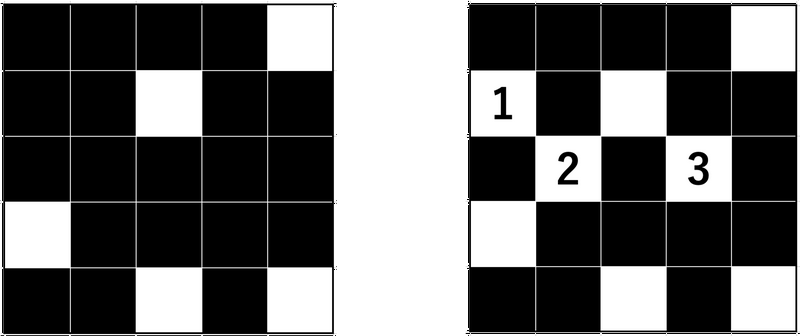
最初の状態から 2 個以下のマスを白く塗ることで条件をみたすようにすることはできないため、3 を 1 行目に出力します。
2 つめのテストケースについて、マス目は最初から条件をみたしています。
よって、0 を 2 行目に出力します。
Score : 425 points
Problem Statement
There is a grid with H rows and W columns, and each cell is painted white or black.
Let us denote the cell at the i-th row from the top (1\leq i\leq H) and the j-th column from the left (1\leq j\leq W) by cell (i,j).
The state of the grid is given by H strings S_1,S_2,\ldots,S_H of length W consisting of . and #.
If the j-th character of S_i is ., then cell (i,j) is white; if it is #, then cell (i,j) is black.
By repainting some black cells (possibly zero) to white, Takahashi wants to make the grid have no 2\times 2 subgrid consisting only of black cells. More precisely, he wants to satisfy the following condition.
For any integer pair (i,j) with 1\leq i\leq H-1 and 1\leq j\leq W-1, among cells (i,j), (i,j+1), (i+1,j), and (i+1,j+1), at least one is white.
Find the minimum number of cells that need to be repainted white in order for Takahashi to achieve his goal.
You are given T test cases; answer each of them.
Constraints
- 1\leq T\leq 100
- 2\leq H\leq 7
- 2\leq W\leq 7
- Each S_i is a string of length W consisting of
.and#. - T,H,W are integers.
Input
The input is given from Standard Input in the following format:
T
\mathrm{case}_1
\mathrm{case}_2
\vdots
\mathrm{case}_T
\mathrm{case}_i represents the i-th test case. Each test case is given in the following format:
H W
S_1
S_2
\vdots
S_H
Output
Output T lines. On the i-th line (1\leq i\leq T), output the answer for the i-th test case.
Sample Input 1
2
5 5
####.
##.##
#####
.####
##.#.
2 2
..
..
Sample Output 1
3
0
For the first test case, the initial state of the grid is as shown in the left figure below. By repainting, for example, the three cells with numbers in the right figure below from black to white, the condition can be satisfied.
It is impossible to satisfy the condition by repainting two or fewer cells from the initial state, so output 3 on the 1-st line.
For the second test case, the grid already satisfies the condition from the beginning. Thus, output 0 on the 2-nd line.
Time Limit: 2 sec / Memory Limit: 1024 MiB
配点 : 500 点
問題文
縦 H 行、横 W 列のマス目があります。上から i 行目、左から j 列目のマスをマス (i, j) と呼びます。
それぞれのマスには整数が書かれています。 i = 1, 2, \ldots, N について、マス (r_i, c_i) には正整数 a_i が書かれており、それら以外のマスには 0 が書かれています。
はじめ、マス (R, C) にコマが置かれています。 高橋君は、コマを「いま置かれているマスから別のマスに移動させる」ことを好きな回数だけ行うことができます。 ただし、コマを移動する際には下記の 2 つの条件をともに満たさなければなりません。
- 移動先のマスに書かれている整数は、移動前のマスに書かれている整数より真に大きい。
- 移動先のマスは移動前のマスと同じ行にある、または、移動先のマスは移動前のマスと同じ列にある。
i = 1, 2, \ldots, N のそれぞれについて、(R, C) = (r_i, c_i) の場合に高橋君がコマの移動を行うことができる回数の最大値を出力してください。
制約
- 2 \leq H, W \leq 2 \times 10^5
- 1 \leq N \leq \min(2 \times 10^5, HW)
- 1 \leq r_i \leq H
- 1 \leq c_i \leq W
- 1 \leq a_i \leq 10^9
- i \neq j \Rightarrow (r_i, c_i) \neq (r_j, c_j)
- 入力はすべて整数
入力
入力は以下の形式で標準入力から与えられる。
H W N
r_1 c_1 a_1
r_2 c_2 a_2
\vdots
r_N c_N a_N
出力
N 行出力せよ。 i = 1, 2, \ldots, N について、i 行目には (R, C) = (r_i, c_i) の場合に高橋君がコマの移動を行うことができる回数の最大値を出力せよ。
入力例 1
3 3 7
1 1 4
1 2 7
2 1 3
2 3 5
3 1 2
3 2 5
3 3 5
出力例 1
1
0
2
0
3
1
0
マス目に書かれた整数は下記の通りです。
4 7 0
3 0 5
2 5 5
- (R, C) = (r_1, c_1) = (1, 1) の場合、(1, 1) \rightarrow (1, 2) と移動すると、コマの移動を 1 回行うことができます。
- (R, C) = (r_2, c_2) = (1, 2) の場合、一度もコマの移動を行うことができません。
- (R, C) = (r_3, c_3) = (2, 1) の場合、(2, 1) \rightarrow (1, 1) \rightarrow (1, 2) と移動すると、コマの移動を 2 回行うことができます。
- (R, C) = (r_4, c_4) = (2, 3) の場合、一度もコマの移動を行うことができません。
- (R, C) = (r_5, c_5) = (3, 1) の場合、(3, 1) \rightarrow (2, 1) \rightarrow (1, 1) \rightarrow (1, 2) と移動すると、コマの移動を 3 回行うことができます。
- (R, C) = (r_6, c_6) = (3, 2) の場合、(3, 2) \rightarrow (1, 2) と移動すると、コマの移動を 1 回行うことができます。
- (R, C) = (r_7, c_7) = (3, 3) の場合、一度もコマの移動を行うことができません。
入力例 2
5 7 20
2 7 8
2 6 4
4 1 9
1 5 4
2 2 7
5 5 2
1 7 2
4 6 6
1 4 1
2 1 10
5 6 9
5 3 3
3 7 9
3 6 3
4 3 4
3 3 10
4 2 1
3 5 4
1 2 6
4 7 9
出力例 2
2
4
1
5
3
6
6
2
7
0
0
4
1
5
3
0
5
2
4
0
Score : 500 points
Problem Statement
We have a grid with H horizontal rows and W vertical columns. Let (i, j) denote the square at the i-th row from the top and j-th column from the left.
Each square contains an integer. For each i = 1, 2, \ldots, N, the square (r_i, c_i) contains a positive integer a_i. The other square contains a 0.
Initially, there is a piece on the square (R, C). Takahashi can move the piece to a square other than the square it occupies now, any number of times. However, when moving the piece, both of the following conditions must be satisfied.
- The integer written on the square to which the piece is moved is strictly greater than the integer written on the square from which the piece is moved.
- The squares to and from which the piece is moved are in the same row or the same column.
For each i = 1, 2, \ldots, N, print the maximum number of times Takahashi can move the piece when (R, C) = (r_i, c_i).
Constraints
- 2 \leq H, W \leq 2 \times 10^5
- 1 \leq N \leq \min(2 \times 10^5, HW)
- 1 \leq r_i \leq H
- 1 \leq c_i \leq W
- 1 \leq a_i \leq 10^9
- i \neq j \Rightarrow (r_i, c_i) \neq (r_j, c_j)
- All values in input are integers.
Input
Input is given from Standard Input in the following format:
H W N
r_1 c_1 a_1
r_2 c_2 a_2
\vdots
r_N c_N a_N
Output
Print N lines. For each i = 1, 2, \ldots, N, the i-th line should contain the maximum number of times Takahashi can move the piece when (R, C) = (r_i, c_i).
Sample Input 1
3 3 7
1 1 4
1 2 7
2 1 3
2 3 5
3 1 2
3 2 5
3 3 5
Sample Output 1
1
0
2
0
3
1
0
The grid contains the following integers.
4 7 0
3 0 5
2 5 5
- When (R, C) = (r_1, c_1) = (1, 1), you can move the piece once by moving it as (1, 1) \rightarrow (1, 2).
- When (R, C) = (r_2, c_2) = (1, 2), you cannot move the piece at all.
- When (R, C) = (r_3, c_3) = (2, 1), you can move the piece twice by moving it as (2, 1) \rightarrow (1, 1) \rightarrow (1, 2).
- When (R, C) = (r_4, c_4) = (2, 3), you cannot move the piece at all.
- When (R, C) = (r_5, c_5) = (3, 1), you can move the piece three times by moving it as (3, 1) \rightarrow (2, 1) \rightarrow (1, 1) \rightarrow (1, 2).
- When (R, C) = (r_6, c_6) = (3, 2), you can move the piece once by moving it as (3, 2) \rightarrow (1, 2).
- When (R, C) = (r_7, c_7) = (3, 3), you cannot move the piece at all.
Sample Input 2
5 7 20
2 7 8
2 6 4
4 1 9
1 5 4
2 2 7
5 5 2
1 7 2
4 6 6
1 4 1
2 1 10
5 6 9
5 3 3
3 7 9
3 6 3
4 3 4
3 3 10
4 2 1
3 5 4
1 2 6
4 7 9
Sample Output 2
2
4
1
5
3
6
6
2
7
0
0
4
1
5
3
0
5
2
4
0
Time Limit: 2 sec / Memory Limit: 1024 MiB
配点 : 500 点
問題文
高橋くんには歯が 2N 本あり、N 本は上の歯、残りの N 本は下の歯です。
左から i 本目 (1\leq i\leq N) の上の歯の長さは U _ i で、左から i 本目 (1\leq i\leq N) の下の歯の長さは D _ i です。
高橋くんの歯が次の 2 つの条件をどちらも満たしているとき、歯が「うまく噛み合っている」ということにします。
- ある整数 H が存在し、1\leq i\leq N を満たすすべての整数 i について、U _ i+D _ i=H が成り立つ。
- 1\leq i\lt N を満たすすべての整数 i について、\vert U _ i-U _ {i+1}\vert\leq X が成り立つ。
高橋くんは次の操作を好きなだけ繰り返すことができます。
- 1 円を支払って歯削り機を使い、長さが正であるような歯を 1 つ選んでその歯の長さを 1 減らす。
この操作以外の方法で歯の長さを変えることはできません。
高橋くんが歯をうまく噛み合わせるために支払うことになる最小の金額を求めてください。
制約
- 2\leq N\leq2\times10 ^ 5
- 1\leq U _ i\leq10 ^ 9\ (1\leq i\leq N)
- 1\leq D _ i\leq10 ^ 9\ (1\leq i\leq N)
- 1\leq X\leq10 ^ 9
- 入力はすべて整数
入力
入力は以下の形式で標準入力から与えられる。
N X
U _ 1 D _ 1
U _ 2 D _ 2
\vdots
U _ N D _ N
出力
答えを出力せよ。
入力例 1
4 3
3 1
4 1
5 9
2 6
出力例 1
15
はじめ、高橋くんのそれぞれの歯の高さは以下のようになっています。

たとえば、以下のようにして高橋くんの歯をうまく噛み合わせることができます。

15 円を支払うことでそれぞれの歯をこの長さにすることができます。
14 円以下を支払って高橋くんの歯をうまく噛み合わせることはできないため、15 を出力してください。
入力例 2
4 1000000000
3 3
3 3
3 3
3 3
出力例 2
0
歯の長さを変えなくてもうまく噛み合っている場合があります。
入力例 3
4 1
1000000000 1000000000
1000000000 1000000000
1000000000 1000000000
1 1
出力例 3
5999999994
答えが 32\operatorname{bit} 整数に収まらない場合があることに注意してください。
入力例 4
15 128
748 169
586 329
972 529
432 519
408 587
138 249
656 114
632 299
984 755
404 772
155 506
832 854
353 465
387 374
567 385
出力例 4
9460
Score : 500 points
Problem Statement
Takahashi has 2N teeth: N upper teeth and N lower teeth.
The length of the i-th upper tooth from the left (1 \leq i \leq N) is U _ i, and the length of the i-th lower tooth from the left (1 \leq i \leq N) is D _ i.
His teeth are said to “fit together well” if both of the following conditions are satisfied:
- There exists an integer H such that U _ i + D _ i = H for every integer i with 1 \leq i \leq N.
- \lvert U _ i - U _ {i+1} \rvert \leq X for every integer i with 1 \leq i < N.
He can perform the following operation any number of times:
- Pay 1 yen to use a tooth-grinding machine, choose exactly one tooth whose length is positive, and reduce its length by 1.
No other method may be used to change the lengths of the teeth.
Find the minimum total amount of money he needs to pay to make his teeth fit together well.
Constraints
- 2 \leq N \leq 2 \times 10^5
- 1 \leq U _ i \leq 10^9 \ (1 \leq i \leq N)
- 1 \leq D _ i \leq 10^9 \ (1 \leq i \leq N)
- 1 \leq X \leq 10^9
- All input values are integers.
Input
The input is given from Standard Input in the following format:
N X
U _ 1 D _ 1
U _ 2 D _ 2
\vdots
U _ N D _ N
Output
Print the answer.
Sample Input 1
4 3
3 1
4 1
5 9
2 6
Sample Output 1
15
Initially, Takahashi’s teeth have the following lengths:
For example, you can make them fit together well in the following way:
It costs 15 yen to achieve these lengths.
It is impossible to make them fit together well with 14 yen or less, so print 15.
Sample Input 2
4 1000000000
3 3
3 3
3 3
3 3
Sample Output 2
0
It is possible that the teeth already fit together well without any changes.
Sample Input 3
4 1
1000000000 1000000000
1000000000 1000000000
1000000000 1000000000
1 1
Sample Output 3
5999999994
Note that the answer may exceed the 32-bit integer range.
Sample Input 4
15 128
748 169
586 329
972 529
432 519
408 587
138 249
656 114
632 299
984 755
404 772
155 506
832 854
353 465
387 374
567 385
Sample Output 4
9460