実行時間制限: 2 sec / メモリ制限: 1024 MiB
配点 : 100 点
問題文
英小文字のみからなる文字列 S が与えられます。
S の各文字を英大文字に変換して得られる文字列 T を出力してください。
制約
- S は英小文字のみからなる、長さが 1 以上 100 以下の文字列
入力
入力は以下の形式で標準入力から与えられる。
S
出力
T を出力せよ。
入力例 1
abc
出力例 1
ABC
abc の各文字を英大文字に変換すると ABC になります。
入力例 2
a
出力例 2
A
入力例 3
abcdefghjiklnmoqprstvuwxyz
出力例 3
ABCDEFGHJIKLNMOQPRSTVUWXYZ
Score : 100 points
Problem Statement
You are given a string S consisting of lowercase English letters.
Uppercase each character of S and print the resulting string T.
Constraints
- S is a string consisting of lowercase English letters whose length is between 1 and 100, inclusive.
Input
The input is given from Standard Input in the following format:
S
Output
Print T.
Sample Input 1
abc
Sample Output 1
ABC
Uppercase each character of abc, and you have ABC.
Sample Input 2
a
Sample Output 2
A
Sample Input 3
abcdefghjiklnmoqprstvuwxyz
Sample Output 3
ABCDEFGHJIKLNMOQPRSTVUWXYZ
実行時間制限: 2 sec / メモリ制限: 1024 MiB
配点 : 100 点
問題文
0 以上 255 以下の整数 A,B が与えられます。 A \text{ xor }C=B となる 0 以上の整数 C を求めてください。
なお、そのような C はただ 1 つ存在し、0 以上 255 以下であることが証明されます。
\text{ xor } とは
整数 a, b のビットごとの排他的論理和 a \text{ xor } b は、以下のように定義されます。
- a \text{ xor } b を二進表記した際の 2^k (k \geq 0) の位の数は、a, b を二進表記した際の 2^k の位の数のうち一方のみが 1 であれば 1、そうでなければ 0 である。
制約
- 0\leq A,B \leq 255
- 入力に含まれる値は全て整数である
入力
入力は以下の形式で標準入力から与えられる。
A B
出力
答えを出力せよ。
入力例 1
3 6
出力例 1
5
3 は 二進表記で 11、5 は二進表記で 101 なので、これらの \text{xor} は二進表記で 110 であり、十進表記で 6 です。
このように、3 \text{ xor } 5 = 6 となるので、答えは 5 です。
入力例 2
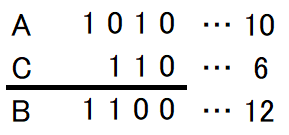
10 12
出力例 2
6
Score : 100 points
Problem Statement
You are given integers A and B between 0 and 255 (inclusive). Find a non-negative integer C such that A \text{ xor }C=B.
It can be proved that there uniquely exists such C, and it will be between 0 and 255 (inclusive).
What is bitwise \mathrm{XOR}?
The bitwise \mathrm{XOR} of integers A and B, A\ \mathrm{XOR}\ B, is defined as follows:
- When A\ \mathrm{XOR}\ B is written in base two, the digit in the 2^k's place (k \geq 0) is 1 if exactly one of A and B is 1, and 0 otherwise.
Constraints
- 0\leq A,B \leq 255
- All values in input are integers.
Input
Input is given from Standard Input in the following format:
A B
Output
Print the answer.
Sample Input 1
3 6
Sample Output 1
5
When written in binary, 3 will be 11, and 5 will be 101. Thus, their \text{xor} will be 110 in binary, or 6 in decimal.
In short, 3 \text{ xor } 5 = 6, so the answer is 5.
Sample Input 2
10 12
Sample Output 2
6
実行時間制限: 2 sec / メモリ制限: 1024 MiB
配点 : 200 点
問題文
N 人の人が総当り戦の試合をしました。
N 行 N 列からなる試合の結果の表 A が与えられます。A の i 行目 j 列目の要素を A_{i,j} と表します。
A_{i,j} は i=j のとき - であり、それ以外のとき W, L, D のいずれかです。
A_{i,j} が W, L, D であることは、人 i が人 j との試合に勝った、負けた、引き分けたことをそれぞれ表します。
与えられた表に矛盾があるかどうかを判定してください。
次のいずれかが成り立つとき、与えられた表には矛盾があるといいます。
- ある組 (i,j) が存在して、人 i が人 j に勝ったが、人 j が人 i に負けていない
- ある組 (i,j) が存在して、人 i が人 j に負けたが、人 j が人 i に勝っていない
- ある組 (i,j) が存在して、人 i が人 j に引き分けたが、人 j が人 i に引き分けていない
制約
- 2 \leq N \leq 1000
- A_{i,i} は
-である - i\neq j のとき、A_{i,j} は
W,L,Dのいずれかである
入力
入力は以下の形式で標準入力から与えられる。
N
A_{1,1}A_{1,2}\ldots A_{1,N}
A_{2,1}A_{2,2}\ldots A_{2,N}
\vdots
A_{N,1}A_{N,2}\ldots A_{N,N}
出力
与えられた表に矛盾がないとき correct、矛盾があるとき incorrect と出力せよ。
入力例 1
4
-WWW
L-DD
LD-W
LDW-
出力例 1
incorrect
人 3 が人 4 に勝ったにもかかわらず、人 4 も人 3 に勝ったことになっており、矛盾しています。
入力例 2
2
-D
D-
出力例 2
correct
矛盾はありません。
Score : 200 points
Problem Statement
N players played a round-robin tournament.
You are given an N-by-N table A containing the results of the matches. Let A_{i,j} denote the element at the i-th row and j-th column of A.
A_{i,j} is - if i=j, and W, L, or D otherwise.
A_{i,j} is W if Player i beat Player j, L if Player i lost to Player j, and D if Player i drew with Player j.
Determine whether the given table is contradictory.
The table is said to be contradictory when some of the following holds:
- There is a pair (i,j) such that Player i beat Player j, but Player j did not lose to Player i;
- There is a pair (i,j) such that Player i lost to Player j, but Player j did not beat Player i;
- There is a pair (i,j) such that Player i drew with Player j, but Player j did not draw with Player i.
Constraints
- 2 \leq N \leq 1000
- A_{i,i} is
-. - A_{i,j} is
W,L, orD, for i\neq j.
Input
Input is given from Standard Input in the following format:
N
A_{1,1}A_{1,2}\ldots A_{1,N}
A_{2,1}A_{2,2}\ldots A_{2,N}
\vdots
A_{N,1}A_{N,2}\ldots A_{N,N}
Output
If the given table is not contradictory, print correct; if it is contradictory, print incorrect.
Sample Input 1
4
-WWW
L-DD
LD-W
LDW-
Sample Output 1
incorrect
Player 3 beat Player 4, while Player 4 also beat Player 3, which is contradictory.
Sample Input 2
2
-D
D-
Sample Output 2
correct
There is no contradiction.
実行時間制限: 2 sec / メモリ制限: 1024 MiB
配点 : 200 点
問題文
I begin with T and end with T, and I am full of T. What am I?
文字列 t について、充填率を以下のように定義します。
- t の先頭と末尾の文字がともに
tであり、かつ |t| \geq 3 である場合: t に含まれるtの個数を x とすると、t の充填率は \displaystyle\frac{x-2}{|t|-2} である。ここで、|t| は t の長さを表す。 - そうでない場合: t の充填率は 0 である。
文字列 S が与えられます。S の部分文字列の充填率としてありうる最大値を求めてください。
部分文字列とは
S の部分文字列とは、S の先頭から 0 文字以上、末尾から 0 文字以上削除して得られる文字列のことをいいます。 例えば、ab, bc, bcd は abcd の部分文字列ですが、ac, dc, e は abcd の部分文字列ではありません。
制約
- 1 \leq |S| \leq 100
- S は英小文字からなる文字列。
入力
入力は以下の形式で標準入力から与えられる。
S
出力
S の部分文字列の充填率としてありうる最大値を出力せよ。
出力された値と真の値との絶対誤差が 10^{-9} 以下のとき、正答と判定される。
入力例 1
attitude
出力例 1
0.50000000000000000
ttit は S の部分文字列であり、その充填率は \displaystyle\frac{3-2}{4-2} = \frac{1}{2} です。
充填率が \frac{1}{2} より高い部分文字列は存在しないので、答えは \frac{1}{2} です。
入力例 2
ottottott
出力例 2
0.66666666666666667
ttottott は S の部分文字列であり、その充填率は \displaystyle\frac{6-2}{8-2} = \frac{2}{3} です。
充填率が \frac{2}{3} より高い部分文字列は存在しないので、答えは \frac{2}{3} です。
入力例 3
coffeecup
出力例 3
0.00000000000000000
ff は S の部分文字列であり、その充填率は 0 です。
充填率が 0 より高い部分文字列は存在しないので、答えは 0 です。
Score : 200 points
Problem Statement
I begin with T and end with T, and I am full of T. What am I?
For a string t, define the filling rate as follows:
- If the first and last characters of t are both
tand |t| \geq 3: Let x be the number oftin t. Then the filling rate of t is \displaystyle\frac{x-2}{|t|-2}, where |t| denotes the length of t. - Otherwise: the filling rate of t is 0.
You are given a string S. Find the maximum possible filling rate of a substring of S.
What is a substring?
A substring of S is a string obtained by removing zero or more characters from the beginning and the end of S. For example,ab, bc, and bcd are substrings of abcd, while ac, dc, and e are not substrings of abcd.
Constraints
- 1 \leq |S| \leq 100
- S is a string consisting of lowercase English letters.
Input
The input is given from Standard Input in the following format:
S
Output
Print the maximum possible filling rate of a substring of S.
Your output will be judged as correct when the absolute error from the true value is at most 10^{-9}.
Sample Input 1
attitude
Sample Output 1
0.50000000000000000
ttit is a substring of S, and its filling rate is \displaystyle\frac{3-2}{4-2} = \frac{1}{2}.
There is no substring with a filling rate greater than \frac{1}{2}, so the answer is \frac{1}{2}.
Sample Input 2
ottottott
Sample Output 2
0.66666666666666667
ttottott is a substring of S, and its filling rate is \displaystyle\frac{6-2}{8-2} = \frac{2}{3}.
There is no substring with a filling rate greater than \frac{2}{3}, so the answer is \frac{2}{3}.
Sample Input 3
coffeecup
Sample Output 3
0.00000000000000000
ff is a substring of S, and its filling rate is 0.
There is no substring with a filling rate greater than 0, so the answer is 0.
実行時間制限: 2 sec / メモリ制限: 1024 MiB
配点 : 300 点
問題文
N 頂点 M 辺の単純無向グラフが与えられます。頂点には 1, 2, \dots, N の番号が、辺には 1, 2, \dots, M の番号が付けられています。
辺 i \, (i = 1, 2, \dots, M) は頂点 u_i, v_i を結んでいます。
このグラフがパスグラフであるか判定してください。
単純無向グラフとは
単純無向グラフとは、自己ループや多重辺を含まず、辺に向きの無いグラフのことをいいます。
パスグラフとは
頂点に 1, 2, \dots, N の番号が付けられたN 頂点のグラフがパスグラフであるとは、(1, 2, \dots, N) を並べ変えて得られる数列 (v_1, v_2, \dots, v_N) であって、以下の条件を満たすものが存在することをいいます。
制約
- 2 \leq N \leq 2 \times 10^5
- 0 \leq M \leq 2 \times 10^5
- 1 \leq u_i, v_i \leq N \, (i = 1, 2, \dots, M)
- 入力される値は全て整数
- 入力で与えられるグラフは単純
入力
入力は以下の形式で標準入力から与えられる。
N M
u_1 v_1
u_2 v_2
\vdots
u_M v_M
出力
与えられたグラフがパスグラフなら Yes、そうでないなら No と出力せよ。
入力例 1
4 3
1 3
4 2
3 2
出力例 1
Yes
与えらえたグラフは下図のようであり、これはパスグラフです。

入力例 2
2 0
出力例 2
No
与えらえたグラフは下図のようであり、これはパスグラフではありません。

入力例 3
5 5
1 2
2 3
3 4
4 5
5 1
出力例 3
No
与えらえたグラフは下図のようであり、これはパスグラフではありません。

Score : 300 points
Problem Statement
You are given a simple undirected graph with N vertices and M edges. The vertices are numbered 1, 2, \dots, N, and the edges are numbered 1, 2, \dots, M.
Edge i \, (i = 1, 2, \dots, M) connects vertices u_i and v_i.
Determine if this graph is a path graph.
What is a simple undirected graph?
A simple undirected graph is a graph without self-loops or multiple edges whose edges do not have a direction.
What is a path graph?
A graph with N vertices numbered 1, 2, \dots, N is said to be a path graph if and only if there is a sequence (v_1, v_2, \dots, v_N) that is a permutation of (1, 2, \dots, N) and satisfies the following conditions:
Constraints
- 2 \leq N \leq 2 \times 10^5
- 0 \leq M \leq 2 \times 10^5
- 1 \leq u_i, v_i \leq N \, (i = 1, 2, \dots, M)
- All values in the input are integers.
- The graph given in the input is simple.
Input
The input is given from Standard Input in the following format:
N M
u_1 v_1
u_2 v_2
\vdots
u_M v_M
Output
Print Yes if the given graph is a path graph; print No otherwise.
Sample Input 1
4 3
1 3
4 2
3 2
Sample Output 1
Yes
Illustrated below is the given graph, which is a path graph.
Sample Input 2
2 0
Sample Output 2
No
Illustrated below is the given graph, which is not a path graph.
Sample Input 3
5 5
1 2
2 3
3 4
4 5
5 1
Sample Output 3
No
Illustrated below is the given graph, which is not a path graph.
実行時間制限: 2 sec / メモリ制限: 1024 MiB
配点 : 300 点
問題文
縦 N 行、横 N 列のマス目があり、上から i 行目、左から j 列目のマスには整数 N\times (i-1)+j が書かれています。
今から T ターンにわたって相異なる整数が宣言されます。i ターン目には A_i が宣言され、A_i が書かれたマスに印をつけます。初めてビンゴを達成するのは何ターン目か求めてください。ただし、T ターンの中でビンゴを達成しない場合は -1 を出力してください。
ここで、ビンゴを達成するとは以下のいずれかのうち少なくとも一つ満たされることを言います。
- マス目の横の列であって、列に含まれる N 個のマスすべてに印がついているものが存在する
- マス目の縦の列であって、列に含まれる N 個のマスすべてに印がついているものが存在する
- マス目の対角線の列であって、列に含まれる N 個のマスすべてに印がついているものが存在する
制約
- 2\leq N\leq 2\times 10^3
- 1\leq T\leq \min(N^2,2\times 10^5)
- 1\leq A_i\leq N^2
- i\neq j ならば A_i\neq A_j
- 入力は全て整数
入力
入力は以下の形式で標準入力から与えられる。
N T
A_1 A_2 \ldots A_T
出力
T ターンの中でビンゴを達成するならば初めてビンゴを達成するターンを、そうでないならば -1 を出力せよ。
入力例 1
3 5
5 1 8 9 7
出力例 1
4
マス目の状態は以下のように変化します。初めてビンゴを達成するのは 4 ターン目です。

入力例 2
3 5
4 2 9 7 5
出力例 2
-1
5 ターンの中でビンゴを達成できないので -1 を出力してください。
入力例 3
4 12
13 9 6 5 2 7 16 14 8 3 10 11
出力例 3
9
Score : 300 points
Problem Statement
There is an N \times N grid, where the cell at the i-th row from the top and the j-th column from the left contains the integer N \times (i-1) + j.
Over T turns, integers will be announced. On Turn i, the integer A_i is announced, and the cell containing A_i is marked. Determine the turn on which Bingo is achieved for the first time. If Bingo is not achieved within T turns, print -1.
Here, achieving Bingo means satisfying at least one of the following conditions:
- There exists a row in which all N cells are marked.
- There exists a column in which all N cells are marked.
- There exists a diagonal line (from top-left to bottom-right or from top-right to bottom-left) in which all N cells are marked.
Constraints
- 2 \leq N \leq 2 \times 10^3
- 1 \leq T \leq \min(N^2, 2 \times 10^5)
- 1 \leq A_i \leq N^2
- A_i \neq A_j if i \neq j.
- All input values are integers.
Input
The input is given from Standard Input in the following format:
N T
A_1 A_2 \ldots A_T
Output
If Bingo is achieved within T turns, print the turn number on which Bingo is achieved for the first time; otherwise, print -1.
Sample Input 1
3 5
5 1 8 9 7
Sample Output 1
4
The state of the grid changes as follows. Bingo is achieved for the first time on Turn 4.
Sample Input 2
3 5
4 2 9 7 5
Sample Output 2
-1
Bingo is not achieved within five turns, so print -1.
Sample Input 3
4 12
13 9 6 5 2 7 16 14 8 3 10 11
Sample Output 3
9
実行時間制限: 4 sec / メモリ制限: 1024 MiB
配点 : 400 点
問題文
高橋君は道端であるパズルを拾いました。
このパズルは、9 個の頂点と M 本の辺からなる無向グラフ、および、8 つのコマで構成されます。
グラフの 9 つの頂点はそれぞれ頂点 1、頂点 2、\ldots、頂点 9 と呼ばれ、
i = 1, 2, \ldots, M について、i 番目の辺は頂点 u_i と頂点 v_i を結んでいます。
8 つのコマはそれぞれコマ 1、コマ 2、\ldots、コマ 8 と呼ばれ、
j = 1, 2, \ldots, 8 について、コマ j は頂点 p_j に置かれています。
ここで、すべてのコマはそれぞれ異なる頂点に置かれていることが保証されます。
コマが置かれていない「空の頂点」がただ一つ存在することに注意してください。
高橋君はこのパズルに対して下記の操作を好きな回数( 0 回でもよい)だけ行うことができます。
空の頂点に隣接する頂点に置かれたコマを 1 つ選び、選んだコマを空の頂点に移動する。
高橋君は上記の操作を繰り返して、このパズルを「完成」させようとしています。 パズルは、下記の状態を満たしたときに完成となります。
j = 1, 2, \ldots, 8 について、コマ j は 頂点 j に置かれている。
高橋君がパズルを完成させることが可能かどうかを判定し、可能な場合はそのために必要な操作回数の最小値を出力してください。
制約
- 0 \leq M \leq 36
- 1 \leq u_i, v_i \leq 9
- 与えられるグラフは多重辺、自己ループを持たない
- 1 \leq p_j \leq 9
- j \neq j' \Rightarrow p_j \neq p_{j'}
- 入力はすべて整数
入力
入力は以下の形式で標準入力から与えられる。
M
u_1 v_1
u_2 v_2
\vdots
u_M v_M
p_1 p_2 \ldots p_8
出力
高橋君がパズルを完成させることが可能な場合は、そのために必要な操作回数の最小値を出力せよ。 高橋君がパズルを完成させることが不可能な場合は、-1 を出力せよ。
入力例 1
5
1 2
1 3
1 9
2 9
3 9
3 9 2 4 5 6 7 8
出力例 1
5
下記の手順によって、5 回の操作でパズルを完成させることができます。
- コマ 2 を頂点 9 から頂点 1 に移動する。
- コマ 3 を頂点 2 から頂点 9 に移動する。
- コマ 2 を頂点 1 から頂点 2 に移動する。
- コマ 1 を頂点 3 から頂点 1 に移動する。
- コマ 3 を頂点 9 から頂点 3 に移動する。
一方、5 回未満の操作でパズルを完成させることはできません。よって、5 を出力します。
与えられるグラフは連結とは限らないことに注意してください。
入力例 2
5
1 2
1 3
1 9
2 9
3 9
1 2 3 4 5 6 7 8
出力例 2
0
パズルは初めから完成しています。よって、完成させるために必要な操作回数の最小値は 0 回です。
入力例 3
12
8 5
9 6
4 5
4 1
2 5
8 9
2 1
3 6
8 7
6 5
7 4
2 3
1 2 3 4 5 6 8 7
出力例 3
-1
操作の繰り返しによってパズルを完成させることができないので、-1 を出力します。
入力例 4
12
6 5
5 4
4 1
4 7
8 5
2 1
2 5
6 9
3 6
9 8
8 7
3 2
2 3 4 6 1 9 7 8
出力例 4
16
Score : 400 points
Problem Statement
Takahashi found a puzzle along some road.
It is composed of an undirected graph with nine vertices and M edges, and eight pieces.
The nine vertices of the graph are called Vertex 1, Vertex 2, \ldots, Vertex 9. For each i = 1, 2, \ldots, M, the i-th edge connects Vertex u_i and Vertex v_i.
The eight pieces are called Piece 1, Piece 2, \ldots, Piece 8.
For each j = 1, 2, \ldots, 8, Piece j is on Vertex p_j.
Here, it is guaranteed that all pieces are on distinct vertices.
Note that there is exactly one empty vertex without a piece.
Takahashi can do the following operation on the puzzle any number of times (possibly zero).
Choose a piece on a vertex adjacent to the empty vertex, and move it to the empty vertex.
By repeating this operation, he aims to complete the puzzle. The puzzle is considered complete when the following holds.
- For each j = 1, 2, \ldots, 8, Piece j is on Vertex j.
Determine whether it is possible for Takahashi to complete the puzzle. If it is possible, find the minimum number of operations needed to do so.
Constraints
- 0 \leq M \leq 36
- 1 \leq u_i, v_i \leq 9
- The given graph has no multi-edges or self-loops.
- 1 \leq p_j \leq 9
- j \neq j' \Rightarrow p_j \neq p_{j'}
- All values in input are integers.
Input
Input is given from Standard Input in the following format:
M
u_1 v_1
u_2 v_2
\vdots
u_M v_M
p_1 p_2 \ldots p_8
Output
If it is possible for Takahashi to complete the puzzle, find the minimum number of operations needed to do so. Otherwise, print -1.
Sample Input 1
5
1 2
1 3
1 9
2 9
3 9
3 9 2 4 5 6 7 8
Sample Output 1
5
The following procedure completes the puzzle in five operations.
- Move Piece 2 from Vertex 9 to Vertex 1.
- Move Piece 3 from Vertex 2 to Vertex 9.
- Move Piece 2 from Vertex 1 to Vertex 2.
- Move Piece 1 from Vertex 3 to Vertex 1.
- Move Piece 3 from Vertex 9 to Vertex 3.
On the other hand, it is impossible to complete the puzzle in less than five operations. Thus, we should print 5.
Note that the given graph may not be connected.
Sample Input 2
5
1 2
1 3
1 9
2 9
3 9
1 2 3 4 5 6 7 8
Sample Output 2
0
The puzzle is already complete from the beginning. Thus, the minimum number of operations needed to complete the puzzle is 0.
Sample Input 3
12
8 5
9 6
4 5
4 1
2 5
8 9
2 1
3 6
8 7
6 5
7 4
2 3
1 2 3 4 5 6 8 7
Sample Output 3
-1
No sequence of operations can complete the puzzle, so we should print -1.
Sample Input 4
12
6 5
5 4
4 1
4 7
8 5
2 1
2 5
6 9
3 6
9 8
8 7
3 2
2 3 4 6 1 9 7 8
Sample Output 4
16
実行時間制限: 2 sec / メモリ制限: 1024 MiB
配点 : 475 点
問題文
1 から N の番号がついた N 人の人が輪になってならんでいます。人 1 の右隣には人 2 が、人 2 の右隣には人 3 が、……、人 N の右隣には人 1 がいます。
N 人の人にそれぞれ 0 以上 M 未満の整数を 1 つずつ渡します。
M^N 通りの渡し方のうち、どの隣り合う 2 人が渡された数も異なるものの数を、998244353 で割ったあまりを求めてください。
制約
- 2 \leq N,M \leq 10^6
- N,M は整数である
入力
入力は以下の形式で標準入力から与えられる。
N M
出力
答えを出力せよ。
入力例 1
3 3
出力例 1
6
人 1,2,3 に渡す整数がそれぞれ (0,1,2),(0,2,1),(1,0,2),(1,2,0),(2,0,1),(2,1,0) のときの 6 通りです。
入力例 2
4 2
出力例 2
2
人 1,2,3,4 に渡す整数がそれぞれ (0,1,0,1),(1,0,1,0) のときの 2 通りです。
入力例 3
987654 456789
出力例 3
778634319
998244353 で割ったあまりを求めてください。
Score : 475 points
Problem Statement
There are N people numbered from 1 to N standing in a circle. Person 1 is to the right of person 2, person 2 is to the right of person 3, ..., and person N is to the right of person 1.
We will give each of the N people an integer between 0 and M-1, inclusive.
Among the M^N ways to distribute integers, find the number, modulo 998244353, of such ways that no two adjacent people have the same integer.
Constraints
- 2 \leq N,M \leq 10^6
- N and M are integers.
Input
The input is given from Standard Input in the following format:
N M
Output
Print the answer.
Sample Input 1
3 3
Sample Output 1
6
There are six desired ways, where the integers given to persons 1,2,3 are (0,1,2),(0,2,1),(1,0,2),(1,2,0),(2,0,1),(2,1,0).
Sample Input 2
4 2
Sample Output 2
2
There are two desired ways, where the integers given to persons 1,2,3,4 are (0,1,0,1),(1,0,1,0).
Sample Input 3
987654 456789
Sample Output 3
778634319
Be sure to find the number modulo 998244353.
実行時間制限: 2 sec / メモリ制限: 1024 MiB
配点 : 525 点
問題文
H 行 W 列のグリッドがあります。 このグリッドの上から i\ (1\leq i\leq H) 行目、左から j\ (1\leq j\leq W) 列目のマスを (i,j) と表記します。
1 から N までの番号が付けられた N 個の横長のバーがグリッド上に置かれています。 バー i は 1\times 1 のブロックが横に L_i 個繋がった形をしており、その左端のブロックは最初マス (R_i,C_i) 上にあります。 すなわち、バー i は最初マス (R_i,C_i), (R_i,C_i+1), \dots, (R_i,C_i+L_i-1) を占めています。 ここで、相異なる 2 つのバーに占められているマスは存在しないことが保証されます。
現在の時刻は t=0 です。 非負整数 n を用いて t=0.5+n と表されるようなすべての時刻において、i=1,2,\dots,N の順に以下のことが起こります。
- バー i が一番下の行(H 行目)になく、かつバー i が占める各マスの 1 つ下のマスをどのバーも占めていない場合、バー i 全体が 1 マス分下に移動する。 すなわち、その時点でバー i が占めているマスが (r,C_i),(r,C_i+1),\dots,(r,C_i+L_i-1)\ (r < H) であり、どの j\ (0\leq j\leq L_i-1) についてもマス (r+1,C_i+j) を占めているバーが存在しないならば、 バー i の占めるマスが (r+1,C_i),(r+1,C_i+1),\dots,(r+1,C_i+L_i-1) に変化する。
- そうでないならば、何も起こらない。
t=10^{100} においてバー i が占めているマスを (R'_i,C_i), (R'_i,C_i+1), \dots, (R'_i,C_i+L_i-1) とします。 R'_1,R'_2,\dots,R'_N を求めてください。
制約
- 1\leq H,W \leq 2\times 10^5
- 1\leq N \leq 2\times 10^5
- 1\leq R_i\leq H
- 1\leq C_i\leq W
- 1\leq L_i\leq W-C_i+1
- 与えられる初期状態において、相異なる 2 つのバーに占められているマスは存在しない
- 入力は全て整数
入力
入力は以下の形式で標準入力から与えられる。
H W N
R_1 C_1 L_1
R_2 C_2 L_2
\vdots
R_N C_N L_N
出力
N 行出力せよ。 i\ (1\leq i \leq N) 行目には、R'_i を出力せよ。
入力例 1
4 4 4
1 2 3
3 2 2
2 1 2
2 4 1
出力例 1
2
4
3
4
以下の 3 つの図は左から順に t=0,1,2 でのグリッドの様子を表しています。 色の塗られた長方形は各バーを表し、長方形の中に書かれた数字はそのバーの番号です。
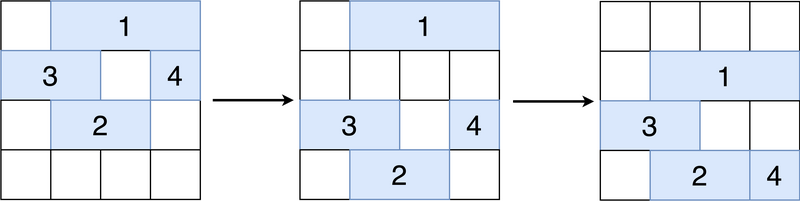
グリッドの状態の変化は以下の通り説明されます。
- t=0.5:
- i=1: バー 1 が占める各マスの 1 つ下のマスである (2,2),(2,3),(2,4) のうち、(2,2) がバー 3 に、(2,4) がバー 4 にそれぞれ占められているため、何も起こらない。
- i=2: バー 2 が占める各マスの 1 つ下のマスである (4,2),(4,3) がいずれも他のバーに占められていないため、バー 2 全体が 1 マス分下に移動する。
- i=3: バー 3 が占める各マスの 1 つ下のマスである (3,1),(3,2) がいずれも他のバーに占められていないため、バー 3 全体が 1 マス分下に移動する。
- i=4: バー 4 が占めるマスの 1 つ下のマスである (3,4) が他のバーに占められていないため、バー 4 全体が 1 マス分下に移動する。
- t=1.5:
- i=1: バー 1 が占める各マスの 1 つ下のマスである (2,2),(2,3),(2,4) がいずれも他のバーに占められていないため、バー 1 全体が 1 マス分下に移動する。
- i=2: バー 2 は一番下の行にあるため、何も起こらない。
- i=3: バー 3 が占める各マスの 1 つ下のマスである (4,1),(4,2) のうち、(4,2) がバー 2 に占められているため、何も起こらない。
- i=4: バー 4 が占めるマスの 1 つ下のマスである (4,4) が他のバーに占められていないため、バー 4 全体が 1 マス分下に移動する。
t=2.5,3.5,\dots においては 1 つ下のマスがすべて空いているようなバーが存在せず、何も起こらないため、t=10^{100} でのグリッドの状態は t=2 でのグリッドの状態(上図における一番右の状態)と同じです。
よって、R'_1=2,R'_2=4,R'_3=3,R'_4=4 です。
入力例 2
382 382 3
3 3 3
8 8 8
2 2 2
出力例 2
382
382
381
入力例 3
5 10 8
2 2 1
4 3 1
4 8 2
1 2 2
2 5 3
5 4 3
4 5 2
1 5 2
出力例 3
5
5
5
4
3
5
4
2
Score: 525 points
Problem Statement
There is a grid with H rows and W columns. Let (i,j) denote the cell at the i-th row from the top and the j-th column from the left.
There are N horizontal bars numbered from 1 to N placed on the grid. Bar i consists of L_i blocks of size 1 \times 1 connected horizontally, and its leftmost block is initially at cell (R_i, C_i). That is, initially, bar i occupies the cells (R_i, C_i), (R_i, C_i + 1), \dots, (R_i, C_i + L_i - 1). It is guaranteed that there is no cell occupied by two different bars.
The current time is t = 0. At every time t = 0.5 + n for some non-negative integer n, the following occurs in order of i = 1, 2, \dots, N:
- If bar i is not on the bottom row (the H-th row), and none of the cells directly below the cells occupied by bar i is occupied by any bar, then bar i moves down by one cell. That is, if at that time bar i occupies the cells (r,C_i),(r,C_i+1),\dots,(r,C_i+L_i-1)\ (r < H), and the cell (r + 1, C_i + j) is not occupied by any bar for all j (0 \leq j \leq L_i - 1), then bar i now occupies (r + 1, C_i), (r + 1, C_i + 1), \dots, (r + 1, C_i + L_i - 1).
- Otherwise, nothing happens.
Let (R'_i, C_i), (R'_i, C_i + 1), \dots, (R'_i, C_i + L_i - 1) be the cells occupied by bar i at time t = 10^{100}. Find R'_1, R'_2, \dots, R'_N.
Constraints
- 1 \leq H, W \leq 2 \times 10^5
- 1 \leq N \leq 2 \times 10^5
- 1 \leq R_i \leq H
- 1 \leq C_i \leq W
- 1 \leq L_i \leq W - C_i + 1
- In the initial state, there is no cell occupied by two different bars.
- All input values are integers.
Input
The input is given from Standard Input in the following format:
H W N
R_1 C_1 L_1
R_2 C_2 L_2
\vdots
R_N C_N L_N
Output
Print N lines. The i-th line (1 \leq i \leq N) should contain R'_i.
Sample Input 1
4 4 4
1 2 3
3 2 2
2 1 2
2 4 1
Sample Output 1
2
4
3
4
The following three diagrams represent the grid at times t = 0, 1, and 2 from left to right. Colored rectangles represent the bars, and the number inside each rectangle indicates its bar number.
The changes in the grid state are explained as follows:
- At t = 0.5:
- i = 1: The cells directly below bar 1 are (2,2),(2,3),(2,4). Among these, (2,2) is occupied by bar 3 and (2,4) is occupied by bar 4, so nothing happens.
- i = 2: The cells directly below bar 2 are (4,2),(4,3), which are not occupied by any other bar, so bar 2 moves down by one cell.
- i = 3: The cells directly below bar 3 are (3,1),(3,2), which are not occupied by any other bar, so bar 3 moves down by one cell.
- i = 4: The cell directly below bar 4 is (3,4), which is not occupied by any other bar, so bar 4 moves down by one cell.
- At t = 1.5:
- i = 1: The cells directly below bar 1 are (2,2),(2,3),(2,4), which are not occupied by any other bar, so bar 1 moves down by one cell.
- i = 2: Bar 2 is on the bottom row, so nothing happens.
- i = 3: The cells directly below bar 3 are (4,1),(4,2). Among these, (4,2) is occupied by bar 2, so nothing happens.
- i = 4: The cell directly below bar 4 is (4,4), which is not occupied by any other bar, so bar 4 moves down by one cell.
At times t = 2.5, 3.5, \dots, there is no bar such that the cells directly below it are all unoccupied, so nothing happens. Thus, the grid at time t = 10^{100} is the same as at t = 2 (the rightmost diagram above).
Therefore, R'_1 = 2, R'_2 = 4, R'_3 = 3, R'_4 = 4.
Sample Input 2
382 382 3
3 3 3
8 8 8
2 2 2
Sample Output 2
382
382
381
Sample Input 3
5 10 8
2 2 1
4 3 1
4 8 2
1 2 2
2 5 3
5 4 3
4 5 2
1 5 2
Sample Output 3
5
5
5
4
3
5
4
2