Time Limit: 2 sec / Memory Limit: 1024 MiB
配点 : 100 点
問題文
体力が A の敵がいます。あなたは、1 回攻撃をすることで敵の体力を B 減らすことが出来ます。
敵の体力を 0 以下にするためには、最小で何回攻撃をする必要があるでしょうか?
制約
- 1 \le A,B \le 10^{18}
- A, B は整数である。
入力
入力は以下の形式で標準入力から与えられる。
A B
出力
答えを出力せよ。
入力例 1
7 3
出力例 1
3
3 回攻撃すると敵の体力が -2 となります。
2 回攻撃しただけでは敵の体力は 1 であるため、3 回攻撃する必要があります。
入力例 2
123456789123456789 987654321
出力例 2
124999999
入力例 3
999999999999999998 2
出力例 3
499999999999999999
Score : 100 points
Problem Statement
There is an enemy with stamina A. Every time you attack the enemy, its stamina reduces by B.
At least how many times do you need to attack the enemy to make its stamina 0 or less?
Constraints
- 1 \le A,B \le 10^{18}
- A and B are integers.
Input
The input is given from Standard Input in the following format:
A B
Output
Print the answer.
Sample Input 1
7 3
Sample Output 1
3
Attacking three times make the enemy's stamina -2.
Attacking only twice makes the stamina 1, so you need to attack it three times.
Sample Input 2
123456789123456789 987654321
Sample Output 2
124999999
Sample Input 3
999999999999999998 2
Sample Output 3
499999999999999999
Time Limit: 2 sec / Memory Limit: 1024 MiB
配点 : 100 点
問題文
100 以上 999 以下の整数 S が与えられます。
S が 200 以上 299 以下のとき Success 、そうでないとき Failure と出力してください。
制約
- 100\leq S\leq999
- S は整数
入力
入力は以下の形式で標準入力から与えられる。
S
出力
答えを出力せよ。
入力例 1
200
出力例 1
Success
200 は 200 以上 299 以下なので、Success と出力してください。
入力例 2
401
出力例 2
Failure
401 は 200 以上 299 以下ではないので、Failure と出力してください。
入力例 3
999
出力例 3
Failure
Score : 100 points
Problem Statement
You are given an integer S between 100 and 999 (inclusive).
If S is between 200 and 299 (inclusive), print Success; otherwise, print Failure.
Constraints
- 100 \le S \le 999
- S is an integer.
Input
The input is given from Standard Input in the following format:
S
Output
Print the answer.
Sample Input 1
200
Sample Output 1
Success
200 is between 200 and 299, so print Success.
Sample Input 2
401
Sample Output 2
Failure
401 is not between 200 and 299, so print Failure.
Sample Input 3
999
Sample Output 3
Failure
Time Limit: 2 sec / Memory Limit: 1024 MiB
配点 : 200 点
問題文
N 種類の文字列 S _ 1,S _ 2,\ldots,S _ N が与えられます。
あなたは、次の操作を 1 度だけ行います。
- 相異なる整数 i,j\ (1\le i\le N,1\le j\le N) を選び、S _ i と S _ j をこの順で連結する。
この操作で連結した結果の文字列としてありえるものは何通りあるか求めてください。
選んだ (i,j) が異なっても、連結した文字列が同じ場合は 1 通りと数えることに注意してください。
制約
- 2\le N\le100
- N は整数
- S _ i は英小文字からなる長さ 1 以上 10 以下の文字列
- S _ i\ne S _ j\ (1\le i\lt j\le N)
入力
入力は以下の形式で標準入力から与えられる。
N
S _ 1
S _ 2
\vdots
S _ N
出力
操作の結果できる文字列が何通りあるかを出力せよ。
入力例 1
4
at
atco
coder
der
出力例 1
11
できる文字列は、atatco, atcoat, atcoder, atcocoder, atder, coderat, coderatco, coderder, derat, deratco, dercoder の 11 通りです。
よって、11 を出力してください。
入力例 2
5
a
aa
aaa
aaaa
aaaaa
出力例 2
7
できる文字列は、aaa, aaaa, aaaaa, aaaaaa, aaaaaaa, aaaaaaaa, aaaaaaaaa の 7 通りです。
よって、7 を出力してください。
入力例 3
10
armiearggc
ukupaunpiy
cogzmjmiob
rtwbvmtruq
qapfzsitbl
vhkihnipny
ybonzypnsn
esxvgoudra
usngxmaqpt
yfseonwhgp
出力例 3
90
Score : 200 points
Problem Statement
You are given N types of strings S_1,S_2,\ldots,S_N.
You perform the following operation once:
- Choose distinct integers i and j\ (1\le i\le N,1\le j\le N) and concatenate S_i and S_j in this order.
How many different strings can be obtained as a result of this operation?
If different choices of (i,j) result in the same concatenated string, it is counted as one string.
Constraints
- 2\le N\le100
- N is an integer.
- S_i is a string of length between 1 and 10, inclusive, consisting of lowercase English letters.
- S_i\ne S_j\ (1\le i\lt j\le N)
Input
The input is given from standard input in the following format:
N
S_1
S_2
\vdots
S_N
Output
Print the number of different strings that can be obtained from the operation.
Sample Input 1
4
at
atco
coder
der
Sample Output 1
11
The possible strings are atatco, atcoat, atcoder, atcocoder, atder, coderat, coderatco, coderder, derat, deratco, dercoder, which are 11 strings.
Thus, print 11.
Sample Input 2
5
a
aa
aaa
aaaa
aaaaa
Sample Output 2
7
The possible strings are aaa, aaaa, aaaaa, aaaaaa, aaaaaaa, aaaaaaaa, aaaaaaaaa, which are 7 strings.
Thus, print 7.
Sample Input 3
10
armiearggc
ukupaunpiy
cogzmjmiob
rtwbvmtruq
qapfzsitbl
vhkihnipny
ybonzypnsn
esxvgoudra
usngxmaqpt
yfseonwhgp
Sample Output 3
90
Time Limit: 2 sec / Memory Limit: 1024 MiB
配点 : 200 点
問題文
AtCoder 商店には N 個の商品があります。 i\ (1\leq i\leq N) 番目の商品の価格は P _ i です。 i\ (1\leq i\leq N) 番目の商品は C _ i 個の機能をもち、i\ (1\leq i\leq N) 番目の商品の j\ (1\leq j\leq C _ i) 番目の機能は 1 以上 M 以下の整数 F _ {i,j} として表されます。
高橋くんは、AtCoder 商店の商品で一方が一方の上位互換であるものがないか気になりました。
i 番目の商品と j 番目の商品 (1\leq i,j\leq N) であって、次の条件をすべて満たすものがあるとき Yes と、ないとき No と出力してください。
- P _ i\geq P _ j である。
- j 番目の製品は i 番目の製品がもつ機能をすべてもつ。
- P _ i\gt P _ j であるか、j 番目の製品は i 番目の製品にない機能を 1 つ以上もつ。
制約
- 2\leq N\leq100
- 1\leq M\leq100
- 1\leq P _ i\leq10^5\ (1\leq i\leq N)
- 1\leq C _ i\leq M\ (1\leq i\leq N)
- 1\leq F _ {i,1}\lt F _ {i,2}\lt\cdots\lt F _ {i,C _ i}\leq M\ (1\leq i\leq N)
- 入力はすべて整数
入力
入力は以下の形式で標準入力から与えられる。
N M
P _ 1 C _ 1 F _ {1,1} F _ {1,2} \ldots F _ {1,C _ 1}
P _ 2 C _ 2 F _ {2,1} F _ {2,2} \ldots F _ {2,C _ 2}
\vdots
P _ N C _ N F _ {N,1} F _ {N,2} \ldots F _ {N,C _ N}
出力
答えを 1 行で出力せよ。
入力例 1
5 6
10000 2 1 3
15000 3 1 2 4
30000 3 1 3 5
35000 2 1 5
100000 6 1 2 3 4 5 6
出力例 1
Yes
(i,j)=(4,3) とすると、条件を全て満たします。
他の組は条件を満たしません。例えば (i,j)=(4,5) とすると j 番目の商品は i 番目の商品の機能をすべてもっていますが、P _ i\lt P _ j なので上位互換ではありません。
入力例 2
4 4
3 1 1
3 1 2
3 1 2
4 2 2 3
出力例 2
No
まったく同じ価格と機能をもった商品がある場合もあります。
入力例 3
20 10
72036 3 3 4 9
7716 4 1 2 3 6
54093 5 1 6 7 8 10
25517 7 3 4 5 6 7 9 10
96930 8 2 3 4 6 7 8 9 10
47774 6 2 4 5 6 7 9
36959 5 1 3 4 5 8
46622 7 1 2 3 5 6 8 10
34315 9 1 3 4 5 6 7 8 9 10
54129 7 1 3 4 6 7 8 9
4274 5 2 4 7 9 10
16578 5 2 3 6 7 9
61809 4 1 2 4 5
1659 5 3 5 6 9 10
59183 5 1 2 3 4 9
22186 4 3 5 6 8
98282 4 1 4 7 10
72865 8 1 2 3 4 6 8 9 10
33796 6 1 3 5 7 9 10
74670 4 1 2 6 8
出力例 3
Yes
Score : 200 points
Problem Statement
AtCoder Shop has N products. The price of the i-th product (1\leq i\leq N) is P _ i. The i-th product (1\leq i\leq N) has C_i functions. The j-th function (1\leq j\leq C _ i) of the i-th product (1\leq i\leq N) is represented as an integer F _ {i,j} between 1 and M, inclusive.
Takahashi wonders whether there is a product that is strictly superior to another.
If there are i and j (1\leq i,j\leq N) such that the i-th and j-th products satisfy all of the following conditions, print Yes; otherwise, print No.
- P _ i\geq P _ j.
- The j-th product has all functions of the i-th product.
- P _ i\gt P _ j, or the j-th product has one or more functions that the i-th product lacks.
Constraints
- 2\leq N\leq100
- 1\leq M\leq100
- 1\leq P _ i\leq10^5\ (1\leq i\leq N)
- 1\leq C _ i\leq M\ (1\leq i\leq N)
- 1\leq F _ {i,1}\lt F _ {i,2}\lt\cdots\lt F _ {i,C _ i}\leq M\ (1\leq i\leq N)
- All input values are integers.
Input
The input is given from Standard Input in the following format:
N M
P _ 1 C _ 1 F _ {1,1} F _ {1,2} \ldots F _ {1,C _ 1}
P _ 2 C _ 2 F _ {2,1} F _ {2,2} \ldots F _ {2,C _ 2}
\vdots
P _ N C _ N F _ {N,1} F _ {N,2} \ldots F _ {N,C _ N}
Output
Print the answer in a single line.
Sample Input 1
5 6
10000 2 1 3
15000 3 1 2 4
30000 3 1 3 5
35000 2 1 5
100000 6 1 2 3 4 5 6
Sample Output 1
Yes
(i,j)=(4,3) satisfies all of the conditions.
No other pair satisfies them. For instance, for (i,j)=(4,5), the j-th product has all functions of the i-th one, but P _ i\lt P _ j, so it is not strictly superior.
Sample Input 2
4 4
3 1 1
3 1 2
3 1 2
4 2 2 3
Sample Output 2
No
Multiple products may have the same price and functions.
Sample Input 3
20 10
72036 3 3 4 9
7716 4 1 2 3 6
54093 5 1 6 7 8 10
25517 7 3 4 5 6 7 9 10
96930 8 2 3 4 6 7 8 9 10
47774 6 2 4 5 6 7 9
36959 5 1 3 4 5 8
46622 7 1 2 3 5 6 8 10
34315 9 1 3 4 5 6 7 8 9 10
54129 7 1 3 4 6 7 8 9
4274 5 2 4 7 9 10
16578 5 2 3 6 7 9
61809 4 1 2 4 5
1659 5 3 5 6 9 10
59183 5 1 2 3 4 9
22186 4 3 5 6 8
98282 4 1 4 7 10
72865 8 1 2 3 4 6 8 9 10
33796 6 1 3 5 7 9 10
74670 4 1 2 6 8
Sample Output 3
Yes
Time Limit: 4 sec / Memory Limit: 1024 MiB
配点 : 300 点
問題文
高橋君は全 10^9 巻の漫画『すぬけ君』を読むことにしました。
初め、高橋君は『すぬけ君』の単行本を N 冊持っています。i 番目の単行本は a_i 巻です。
高橋君は『すぬけ君』を読み始める前に限り次の操作を 0 回以上何度でも繰り返せます。
- 現在持っている単行本が 1 冊以下の場合、何もしない。そうでない場合、現在持っている単行本から 2 冊を選んで売り、代わりに好きな巻を選んで 1 冊買う
その後、高橋君は『すぬけ君』を 1 巻、2 巻、3 巻、\ldots と順番に読みます。ただし、次に読むべき巻を持っていない状態になった場合、(他の巻を持っているかどうかに関わらず)その時点で『すぬけ君』を読むのをやめます。
高橋君が『すぬけ君』を最大で何巻まで読めるかを求めてください。ただし、1 巻を読めない場合の答えは 0 とします。
制約
- 1 \leq N \leq 3 \times 10^5
- 1 \leq a_i \leq 10^9
- 入力はすべて整数
入力
入力は以下の形式で標準入力から与えられる。
N
a_1 \ldots a_N
出力
答えを出力せよ。
入力例 1
6
1 2 4 6 7 271
出力例 1
4
『すぬけ君』を読み始める前に「7 巻と 271 巻を選んで売り、代わりに 3 巻を選んで 1 冊買う」という内容で操作をすると、高橋君は 1 巻、2 巻、3 巻、4 巻、6 巻を 1 冊ずつ持っている状態になります。
この状態から『すぬけ君』を読み始めると、高橋君は 1 巻、2 巻、3 巻、4 巻を読み、続いて 5 巻を読もうとしますが持っていないためこの時点で『すぬけ君』を読むのをやめます。
操作の方法を変えても 5 巻を読むことは出来ないため、4 が答えです。
入力例 2
10
1 1 1 1 1 1 1 1 1 1
出力例 2
5
高橋君は同じ巻を 2 冊以上持っているかもしれません。
この入力に対しては以下のように 4 回操作をしてから『すぬけ君』を読み始めることで 5 巻まで読むことが出来、これが最大です。
- 1 巻を 2 冊選んで売り、代わりに 2 巻を選んで 1 冊買う
- 1 巻を 2 冊選んで売り、代わりに 3 巻を選んで 1 冊買う
- 1 巻を 2 冊選んで売り、代わりに 4 巻を選んで 1 冊買う
- 1 巻を 2 冊選んで売り、代わりに 5 巻を選んで 1 冊買う
入力例 3
1
5
出力例 3
0
高橋君は 1 巻を読めません。
Score : 300 points
Problem Statement
Takahashi is going to read a manga series "Snuke-kun" in 10^9 volumes.
Initially, Takahashi has N books of this series. The i-th book is Volume a_i.
Takahashi may repeat the following operation any number of (possibly zero) times only before he begins to read:
- Do nothing if he has 1 or less books; otherwise, sell two of the books he has and buy one book of any volume instead.
Then, Takahashi reads Volume 1, Volume 2, Volume 3, \ldots, in order. However, when he does not have a book of the next volume to read, he stops reading the series (regardless of the other volumes he has).
Find the latest volume of the series that he can read up to. If he cannot read any, let the answer be 0.
Constraints
- 1 \leq N \leq 3 \times 10^5
- 1 \leq a_i \leq 10^9
- All values in the input are integers.
Input
The input is given from Standard Input in the following format:
N
a_1 \ldots a_N
Output
Print the answer.
Sample Input 1
6
1 2 4 6 7 271
Sample Output 1
4
Before he begins to read the series, he may do the following operation: "sell books of Volumes 7 and 271 and buy one book of Volume 3 instead." Then, he has one book each of Volumes 1, 2, 3, 4, and 6.
If he then begins to read the series, he reads Volumes 1, 2, 3, and 4, then tries to read Volume 5. However, he does not have one, so he stops reading at this point.
Regardless of the choices in the operation, he cannot read Volume 5, so the answer is 4.
Sample Input 2
10
1 1 1 1 1 1 1 1 1 1
Sample Output 2
5
Takahashi may have multiple books of the same volume.
For this input, if he performs the following 4 operations before he begins to read the series, he can read up to Volume 5, which is the maximum:
- Sell two books of Volume 1 and buy a book of Volume 2 instead.
- Sell two books of Volume 1 and buy a book of Volume 3 instead.
- Sell two books of Volume 1 and buy a book of Volume 4 instead.
- Sell two books of Volume 1 and buy a book of Volume 5 instead.
Sample Input 3
1
5
Sample Output 3
0
Takahashi cannot read Volume 1.
Time Limit: 2 sec / Memory Limit: 1024 MiB
配点 : 300 点
問題文
10^9 階建てのビルがあり、N 本のはしごがかかっています。
ビルの 1 階にいる高橋君ははしごを繰り返し使って(0 回でもよい)できるだけ高い階へ上りたいと考えています。
はしごには 1 から N までの番号がついており、はしご i は A_i 階と B_i 階を結んでいます。はしご i を利用すると A_i 階から B_i 階へ、または B_i 階から A_i 階へ双方向に移動することができますが、それ以外の階の間の移動は行うことはできません。
また、高橋君は同じ階での移動は自由に行うことができますが、はしご以外の方法で他の階へ移動することはできません。
高橋君は最高で何階へ上ることができますか?
制約
- 1 \leq N \leq 2 \times 10^5
- 1 \leq A_i, B_i \leq 10^9
- A_i \neq B_i
- 入力はすべて整数
入力
入力は以下の形式で標準入力から与えられる。
N
A_1 B_1
A_2 B_2
\ldots
A_N B_N
出力
答えを出力せよ。
入力例 1
4
1 4
4 3
4 10
8 3
出力例 1
10
はしご 1 で 4 階に進み、はしご 3 で 10 階に進むことにより、10 階にたどり着くことができます。
入力例 2
6
1 3
1 5
1 12
3 5
3 12
5 12
出力例 2
12
入力例 3
3
500000000 600000000
600000000 700000000
700000000 800000000
出力例 3
1
他の階への移動ができない場合もあります。
Score : 300 points
Problem Statement
There is a 10^9-story building with N ladders.
Takahashi, who is on the 1-st (lowest) floor, wants to reach the highest floor possible by using ladders (possibly none).
The ladders are numbered from 1 to N, and ladder i connects the A_i-th and B_i-th floors. One can use ladder i in either direction to move from the A_i-th floor to the B_i-th floor or vice versa, but not between other floors.
Takahashi can freely move within the same floor, but cannot move between floors without using ladders.
What is the highest floor Takahashi can reach?
Constraints
- 1 \leq N \leq 2 \times 10^5
- 1 \leq A_i, B_i \leq 10^9
- A_i \neq B_i
- All values in the input are integers.
Input
The input is given from Standard Input in the following format:
N
A_1 B_1
A_2 B_2
\ldots
A_N B_N
Output
Print an integer representing the answer.
Sample Input 1
4
1 4
4 3
4 10
8 3
Sample Output 1
10
He can reach the 10-th floor by using ladder 1 to get to the 4-th floor and then ladder 3 to get to the 10-th floor.
Sample Input 2
6
1 3
1 5
1 12
3 5
3 12
5 12
Sample Output 2
12
Sample Input 3
3
500000000 600000000
600000000 700000000
700000000 800000000
Sample Output 3
1
He may be unable to move between floors.
Time Limit: 2 sec / Memory Limit: 1024 MiB
配点 : 400 点
問題文
10^9 行 W 列のグリッドがあります。左から x 列目、下から y 行目のマスを (x,y) と表します。
N 個のブロックがあります。各ブロックは 1 \times 1 の正方形で、ブロック i (1 \leq i \leq N) は時刻 0 にマス (X_i,Y_i) にあります。
時刻 t=1,2,\dots,10^{100} に、以下のルールに従ってブロックを動かします。
- グリッドの下から 1 行目がすべてブロックで埋まっているならば、下から 1 行目にあるブロックをすべて消滅させる。
- 残っているブロックについて、下にあるブロックから順番に、以下の操作を行う。
- ブロックが一番下の行にある、またはそのブロックの 1 つ下のマスにもブロックがあるならば、何もしない
- そうでなければ、ブロックを 1 つ下のマスに動かす。
Q 個の質問が与えられます。j 番目 (1 \leq j \leq Q) の質問では、時刻 T_j+0.5 にブロック A_j が存在するかどうか答えてください。
制約
- 1 \leq N \leq 2 \times 10^5
- 1 \leq W \leq N
- 1 \leq X_i \leq W
- 1 \leq Y_i \leq 10^9
- i \neq j なら (X_i,Y_i) \neq (X_j,Y_j)
- 1 \leq Q \leq 2 \times 10^5
- 1 \leq T_j \leq 10^9
- 1 \leq A_j \leq N
- 入力はすべて整数
入力
入力は以下の形式で標準入力から与えられる。
N W
X_1 Y_1
X_2 Y_2
\vdots
X_N Y_N
Q
T_1 A_1
T_2 A_2
\vdots
T_Q A_Q
出力
Q 行出力せよ。i 行目には、時刻 T_i+0.5 にブロック A_i が存在するならば Yes を、存在しないならば No を出力せよ。
入力例 1
5 3
1 1
1 2
2 2
3 2
2 3
6
1 1
1 2
2 3
2 5
3 4
3 5
出力例 1
Yes
Yes
No
Yes
No
Yes
ブロックの位置は以下のように変化します。
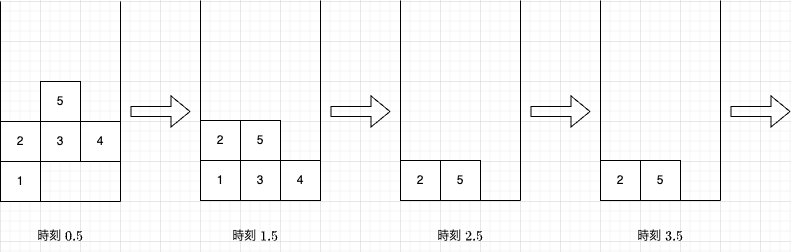
- 質問 1: 時刻 1.5 にブロック 1 は存在するので、答えは
Yesです。 - 質問 2: 時刻 1.5 にブロック 2 は存在するので、答えは
Yesです。 - 質問 3: ブロック 3 は時刻 2 に消滅します。よって、時刻 2.5 にブロック 3 は存在しないので、答えは
Noです。
入力例 2
3 2
1 1
2 1
1 2
4
1 1
1 2
1 3
2 3
出力例 2
No
No
Yes
Yes
Score : 400 points
Problem Statement
There is a grid with 10^9 rows and W columns. The cell at the x-th column from the left and the y-th row from the bottom is denoted by (x,y).
There are N blocks. Each block is a 1 \times 1 square, and block i-th (1 \leq i \leq N) is located at cell (X_i,Y_i) at time 0.
At times t=1,2,\dots,10^{100}, the blocks are moved according to the following rules:
- If the entire bottom row is filled with blocks, then all blocks in the bottom row are removed.
- For each remaining block, in order from bottom to top, perform the following:
- If the block is in the bottom row, or if there is a block in the cell immediately below it, do nothing.
- Otherwise, move the block one cell downward.
You are given Q queries. For the j-th query (1 \leq j \leq Q), answer whether block A_j exists at time T_j+0.5.
Constraints
- 1 \leq N \leq 2 \times 10^5
- 1 \leq W \leq N
- 1 \leq X_i \leq W
- 1 \leq Y_i \leq 10^9
- (X_i,Y_i) \neq (X_j,Y_j) if i \neq j.
- 1 \leq Q \leq 2 \times 10^5
- 1 \leq T_j \leq 10^9
- 1 \leq A_j \leq N
- All input values are integers.
Input
The input is given from Standard Input in the following format:
N W
X_1 Y_1
X_2 Y_2
\vdots
X_N Y_N
Q
T_1 A_1
T_2 A_2
\vdots
T_Q A_Q
Output
Print Q lines. The i-th line should contain Yes if block A_i exists at time T_i+0.5, and No otherwise.
Sample Input 1
5 3
1 1
1 2
2 2
3 2
2 3
6
1 1
1 2
2 3
2 5
3 4
3 5
Sample Output 1
Yes
Yes
No
Yes
No
Yes
The positions of the blocks change as follows: ("時刻" means "time.")
- Query 1: At time 1.5, block 1 exists, so the answer is
Yes. - Query 2: At time 1.5, block 2 exists, so the answer is
Yes. - Query 3: Block 3 disappears at time 2, so it does not exist at time 2.5, and the answer is
No.
Sample Input 2
3 2
1 1
2 1
1 2
4
1 1
1 2
1 3
2 3
Sample Output 2
No
No
Yes
Yes
Time Limit: 2 sec / Memory Limit: 1024 MiB
配点 : 475 点
問題文
長さ N の数列 A = (A_1, A_2, \dots, A_N) および整数 K があります。
A をいくつかの連続部分列に分割する方法は 2^{N-1} 通りありますが、そのうち分割後に要素の和が K である列が存在しない分割の方法は何通りありますか。答えを 998244353 で割った余りを求めてください。
ここで、「A をいくつかの連続部分列に分割する」とは次の手順のことを言います。
- 分割後の数列の個数 k (1 \leq k \leq N) および 1 = i_1 \lt i_2 \lt \dots \lt i_k \lt i_{k+1} = N+1 を満たす整数列 (i_1, i_2, \dots, i_k, i_{k+1}) を自由に選ぶ。
- 1 \leq n \leq k について、n 番目の数列を、A の i_n 番目から i_{n+1} - 1 番目までの要素を順番を保ったまま取り出して出来る数列とする。
A = (1, 2, 3, 4, 5) のときの分割の例を以下に挙げます。
- (1, 2, 3), (4), (5)
- (1, 2), (3, 4, 5)
- (1, 2, 3, 4, 5)
制約
- 1 \leq N \leq 2 \times 10^5
- -10^{15} \leq K \leq 10^{15}
- -10^9 \leq A_i \leq 10^9
- 入力される値は全て整数
入力
入力は以下の形式で標準入力から与えられる。
N K
A_1 A_2 \dots A_N
出力
答えを 998244353 で割った余りを出力せよ。
入力例 1
3 3
1 2 3
出力例 1
2
問題文の条件を満たす分割は次の 2 通りです。
- (1), (2, 3)
- (1, 2, 3)
入力例 2
5 0
0 0 0 0 0
出力例 2
0
入力例 3
10 5
-5 -1 -7 6 -6 -2 -5 10 2 -10
出力例 3
428
Score : 475 points
Problem Statement
You are given a sequence A = (A_1, A_2, \dots, A_N) of length N and an integer K.
There are 2^{N-1} ways to divide A into several contiguous subsequences. How many of these divisions have no subsequence whose elements sum to K? Find the count modulo 998244353.
Here, "to divide A into several contiguous subsequences" means the following procedure.
- Freely choose the number k (1 \leq k \leq N) of subsequences and an integer sequence (i_1, i_2, \dots, i_k, i_{k+1}) satisfying 1 = i_1 \lt i_2 \lt \dots \lt i_k \lt i_{k+1} = N+1.
- For each 1 \leq n \leq k, the n-th subsequence is formed by taking the i_n-th through (i_{n+1} - 1)-th elements of A, maintaining their order.
Here are some examples of divisions for A = (1, 2, 3, 4, 5):
- (1, 2, 3), (4), (5)
- (1, 2), (3, 4, 5)
- (1, 2, 3, 4, 5)
Constraints
- 1 \leq N \leq 2 \times 10^5
- -10^{15} \leq K \leq 10^{15}
- -10^9 \leq A_i \leq 10^9
- All input values are integers.
Input
The input is given from Standard Input in the following format:
N K
A_1 A_2 \dots A_N
Output
Print the count modulo 998244353.
Sample Input 1
3 3
1 2 3
Sample Output 1
2
There are two divisions that satisfy the condition in the problem statement:
- (1), (2, 3)
- (1, 2, 3)
Sample Input 2
5 0
0 0 0 0 0
Sample Output 2
0
Sample Input 3
10 5
-5 -1 -7 6 -6 -2 -5 10 2 -10
Sample Output 3
428
Time Limit: 6 sec / Memory Limit: 1024 MiB
配点 : 500 点
問題文
N 頂点 M 辺の重み付き単純有向グラフがあります。 頂点には 1 から N までの番号が付けられていて、i 本目の辺は頂点 U_i から頂点 V_i に伸びる重み W_i の辺です。 ここで、重みは負の値を取ることもありますが、負閉路は存在しません。
全ての頂点を一度以上通るようなウォークが存在するかどうか判定し、存在するならば通る辺の重みの総和の最小値を求めてください。 ただし、同じ辺を複数回通る場合、その辺の重みは通った回数分加算されるものとします。
なお、「全ての頂点を一度以上通るようなウォーク」とは、頂点の列 v_1,v_2,\dots,v_k であって以下の条件を共に満たすもののことを言います。
- すべての i\ (1\leq i\leq k-1) について、頂点 v_i から頂点 v_{i+1} に伸びる辺が存在する
- すべての j\ (1\leq j\leq N) について、v_i=j を満たす i\ (1\leq i\leq k) が存在する
制約
- 2\leq N \leq 20
- 1\leq M \leq N(N-1)
- 1\leq U_i,V_i \leq N
- U_i \neq V_i
- (U_i,V_i) \neq (U_j,V_j)\ (i\neq j)
- -10^6\leq W_i \leq 10^6
- 与えられるグラフに負閉路は存在しない
- 入力は全て整数
入力
入力は以下の形式で標準入力から与えられる。
N M
U_1 V_1 W_1
U_2 V_2 W_2
\vdots
U_M V_M W_M
出力
全ての頂点を一度以上通るようなウォークが存在するならば通る辺の重みの総和の最小値を、存在しないならば No を出力せよ。
入力例 1
3 4
1 2 5
2 1 -3
2 3 -4
3 1 100
出力例 1
-2
頂点 2\rightarrow 1\rightarrow 2\rightarrow 3 の順に辿ると、全ての頂点を一度以上通ることができ、通る辺の重みの総和は (-3)+5+(-4)=-2 になります。 これが最小です。
入力例 2
3 2
1 2 0
2 1 0
出力例 2
No
全ての頂点を一度以上通るようなウォークは存在しません。
入力例 3
5 9
1 2 -246288
4 5 -222742
3 1 246288
3 4 947824
5 2 -178721
4 3 -947824
5 4 756570
2 5 707902
5 1 36781
出力例 3
-449429
Score: 500 points
Problem Statement
There is a weighted simple directed graph with N vertices and M edges. The vertices are numbered 1 to N, and the i-th edge has a weight of W_i and extends from vertex U_i to vertex V_i. The weights can be negative, but the graph does not contain negative cycles.
Determine whether there is a walk that visits each vertex at least once. If such a walk exists, find the minimum total weight of the edges traversed. If the same edge is traversed multiple times, the weight of that edge is added for each traversal.
Here, "a walk that visits each vertex at least once" is a sequence of vertices v_1,v_2,\dots,v_k that satisfies both of the following conditions:
- For every i (1\leq i\leq k-1), there is an edge extending from vertex v_i to vertex v_{i+1}.
- For every j\ (1\leq j\leq N), there is i (1\leq i\leq k) such that v_i=j.
Constraints
- 2\leq N \leq 20
- 1\leq M \leq N(N-1)
- 1\leq U_i,V_i \leq N
- U_i \neq V_i
- (U_i,V_i) \neq (U_j,V_j) for i\neq j
- -10^6\leq W_i \leq 10^6
- The given graph does not contain negative cycles.
- All input values are integers.
Input
The input is given from Standard Input in the following format:
N M
U_1 V_1 W_1
U_2 V_2 W_2
\vdots
U_M V_M W_M
Output
If there is a walk that visits each vertex at least once, print the minimum total weight of the edges traversed. Otherwise, print No.
Sample Input 1
3 4
1 2 5
2 1 -3
2 3 -4
3 1 100
Sample Output 1
-2
By following the vertices in the order 2\rightarrow 1\rightarrow 2\rightarrow 3, you can visit all vertices at least once, and the total weight of the edges traversed is (-3)+5+(-4)=-2. This is the minimum.
Sample Input 2
3 2
1 2 0
2 1 0
Sample Output 2
No
There is no walk that visits all vertices at least once.
Sample Input 3
5 9
1 2 -246288
4 5 -222742
3 1 246288
3 4 947824
5 2 -178721
4 3 -947824
5 4 756570
2 5 707902
5 1 36781
Sample Output 3
-449429