実行時間制限: 2 sec / メモリ制限: 1024 MiB
配点 : 100 点
問題文
0123456789 に加えて 10,11,12,13,14,15 に対応する数字として ABCDEF を使う 16 進表記では、0 以上 255 以下の整数は 1 桁または 2 桁になります。
例えば、0 や 12 は 16 進表記では 0 や C と 1 桁になり、99 や 255 は 16 進表記では 63 や FF と 2 桁になります。
0 以上 255 以下の整数 N を、必要に応じて先頭に 0 を加えることでちょうど 2 桁の 16 進表記に変換してください。
注記
英大文字と英小文字は区別されます。特に、16 進表記の数字として ABCDEF の代わりに abcdef を使うことは出来ません。
制約
- 0 \leq N \leq 255
- N は整数
入力
入力は以下の形式で標準入力から与えられる。
N
出力
答えを出力せよ。
入力例 1
99
出力例 1
63
99 は 16 進表記で 63 です。
入力例 2
12
出力例 2
0C
12 は 16 進表記で C です。
要求されているのはちょうど 2 桁の 16 進表記に変換することなので、C の先頭に 0 を加えた 0C が答えです。
入力例 3
0
出力例 3
00
入力例 4
255
出力例 4
FF
Score : 100 points
Problem Statement
In the hexadecimal system, where the digits ABCDEF corresponding to 10,11,12,13,14, and 15 are used in addition to 0123456789, every integer between 0 and 255 is represented as a 1- or 2-digit numeral.
For example, 0 and 12 are represented as 1-digit hexadecimal numerals 0 and C; 99 and 255 are represented as 2-digit hexadecimals 63 and FF.
Given an integer N between 0 and 255, convert it to an exactly two-digit hexadecimal numeral, prepending leading 0s if necessary.
Notes
The judge is case-sensitive. Specifically, you cannot use abcdef as hexadecimal digits instead of ABCDEF.
Constraints
- 0 \leq N \leq 255
- N is an integer.
Input
The input is given from Standard Input in the following format:
N
Output
Print the answer.
Sample Input 1
99
Sample Output 1
63
99 is represented as 63 in hexadecimal.
Sample Input 2
12
Sample Output 2
0C
12 is represented as C in hexadecimal.
Since we ask you to convert it to a two-digit hexadecimal numeral, the answer is 0C, where 0 is prepended to C.
Sample Input 3
0
Sample Output 3
00
Sample Input 4
255
Sample Output 4
FF
実行時間制限: 2 sec / メモリ制限: 1024 MiB
配点 : 100 点
問題文
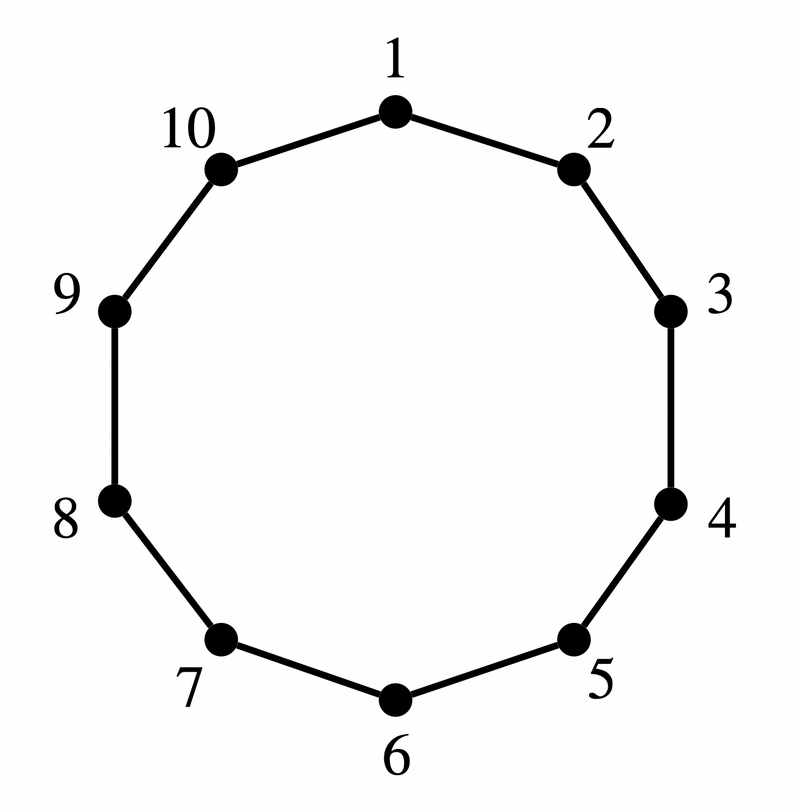
下の画像で示す図において、a 番の点と b 番の点が線で直接結ばれているかを答えてください。
制約
- 1 \leq a \lt b \leq 10
- a, b は整数
入力
入力は以下の形式で標準入力から与えられる。
a b
出力
a 番の点と b 番の点が線で直接結ばれている場合は Yes を出力し、結ばれていない場合は No を出力せよ。
ジャッジは英大文字と英小文字を厳密に区別することに注意せよ。
入力例 1
4 5
出力例 1
Yes
問題文で示した図において、4 番の点と 5 番の点は線で直接結ばれています。
よって、Yes を出力します。
入力例 2
3 5
出力例 2
No
問題文で示した図において、3 番の点と 5 番の点は線で直接結ばれていません。
よって、No を出力します。
入力例 3
1 10
出力例 3
Yes
Score : 100 points
Problem Statement
In the figure shown in the image below, are the points numbered a and b directly connected by a line segment?
Constraints
- 1 \leq a \lt b \leq 10
- a and b are integers.
Input
Input is given from Standard Input in the following format:
a b
Output
If the points numbered a and b are directly connected by a line segment, print Yes; otherwise, print No.
The judge is case-sensitive: be sure to print uppercase and lowercase letters correctly.
Sample Input 1
4 5
Sample Output 1
Yes
In the figure shown in the Problem Statement, the points numbered 4 and 5 are directly connected by a line segment.
Thus, Yes should be printed.
Sample Input 2
3 5
Sample Output 2
No
In the figure shown in the Problem Statement, the points numbered 3 and 5 are not directly connected by a line segment.
Thus, No should be printed.
Sample Input 3
1 10
Sample Output 3
Yes
実行時間制限: 2 sec / メモリ制限: 1024 MiB
配点 : 200 点
問題文
縦 H 行横 W 列のマス目があります。上から i 行目、左から j 列目のマスをマス (i,j) と表します。
マス (i,j) は S_{i,j} が # のとき通行不可能、. のとき通行可能であり家が建っていない、@ のとき通行可能であり家が建っていることを表します。
最初、マス (X,Y) にサンタクロースがいます。サンタクロースは文字列 T に従って以下の行動を行います。
- 文字列 T の長さを |T| とする。i=1,2,\ldots,|T| の順に以下のように移動する。
- 現在サンタクロースがいるマスを (x,y) とする。
- T_i が
Uかつマス (x-1,y) が通行可能ならマス (x-1,y) に移動する。 - T_i が
Dかつマス (x+1,y) が通行可能ならマス (x+1,y) に移動する。 - T_i が
Lかつマス (x,y-1) が通行可能ならマス (x,y-1) に移動する。 - T_i が
Rかつマス (x,y+1) が通行可能ならマス (x,y+1) に移動する。 - それ以外の場合、マス (x,y) に留まる。
- T_i が
- 現在サンタクロースがいるマスを (x,y) とする。
行動を終えたあとにサンタクロースがいるマスと、行動により通過または到達した家の数を求めてください。ただし、同じ家を複数回通過または到達してもそれらは重複して数えません。
制約
- 3 \leq H,W \leq 100
- 1 \leq X \leq H
- 1 \leq Y \leq W
- 与えられる数値は全て整数である
- S_{i,j} は
#,.,@のいずれか - 全ての 1 \leq i \leq H について S_{i,1},S_{i,W} は
# - 全ての 1 \leq j \leq W について S_{1,j},S_{H,j} は
# - S_{X,Y}=
. - T は
U,D,L,Rのいずれかからなる長さ 1 以上 10^4 以下の文字列
入力
入力は以下の形式で標準入力から与えられる。
H W X Y
S_{1,1}S_{1,2}\ldots S_{1,W}
\dots
S_{H,1}S_{H,2}\ldots S_{H,W}
T
出力
行動を終えたあとサンタクロースがいるマスを (X,Y)、行動により通過または到達した家の数を C とするとき、X,Y,C をこの順に空白区切りで出力せよ。
入力例 1
5 5 3 4
#####
#...#
#.@.#
#..@#
#####
LLLDRUU
出力例 1
2 3 1
サンタクロースは以下のように行動します。
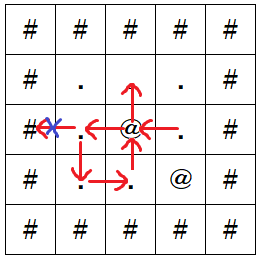
- T_1=
Lなのでマス (3,4) からマス (3,3) に移動する。これにより家を通過する。 - T_2=
Lなのでマス (3,3) からマス (3,2) に移動する。 - T_3=
Lだがマス (3,1) は通行不可能なので、マス (3,2) に留まる。 - T_4=
Dなのでマス (3,2) からマス (4,2) に移動する。 - T_5=
Rなのでマス (4,2) からマス (4,3) に移動する。 - T_6=
Uなのでマス (4,3) からマス (3,3) に移動する。これにより家を通過するが、この家はすでに通過したことがある家である。 - T_7=
Uなのでマス (3,3) からマス (2,3) に移動する。
行動により通過または到達した家の数は 1 です。
入力例 2
6 13 4 6
#############
#@@@@@@@@@@@#
#@@@@@@@@@@@#
#@@@@.@@@@@@#
#@@@@@@@@@@@#
#############
UURUURLRLUUDDURDURRR
出力例 2
3 11 11
入力例 3
12 35 7 10
###################################
#.................................#
#..........@......................#
#......@................@.........#
#.............##............@.....#
#...##........##....##............#
#...##........##....##.......##...#
#....##......##......##....##.....#
#....##......##......##..##.......#
#.....#######.........###.........#
#.................................#
###################################
LRURRRUUDDULUDUUDLRLRDRRLULRRUDLDRU
出力例 3
4 14 1
Score : 200 points
Problem Statement
There is a grid with H rows and W columns. Let (i,j) denote the cell at the i-th row from the top and the j-th column from the left.
If S_{i,j} is #, the cell (i,j) is impassable; if it is ., the cell is passable and contains no house; if it is @, the cell is passable and contains a house.
Initially, Santa Claus is in cell (X,Y). He will act according to the string T as follows.
- Let |T| be the length of the string T. For i=1,2,\ldots,|T|, he moves as follows.
- Let (x,y) be the cell he is currently in.
- If T_i is
Uand cell (x-1,y) is passable, move to cell (x-1,y). - If T_i is
Dand cell (x+1,y) is passable, move to cell (x+1,y). - If T_i is
Land cell (x,y-1) is passable, move to cell (x,y-1). - If T_i is
Rand cell (x,y+1) is passable, move to cell (x,y+1). - Otherwise, stay in cell (x,y).
- If T_i is
- Let (x,y) be the cell he is currently in.
Find the cell where he is after completing all actions, and the number of distinct houses that he passed through or arrived at during his actions. If the same house is passed multiple times, it is only counted once.
Constraints
- 3 \leq H,W \leq 100
- 1 \leq X \leq H
- 1 \leq Y \leq W
- All given numbers are integers.
- Each S_{i,j} is one of
#,.,@. - S_{i,1} and S_{i,W} are
#for every 1 \leq i \leq H. - S_{1,j} and S_{H,j} are
#for every 1 \leq j \leq W. - S_{X,Y}=
. - T is a string of length at least 1 and at most 10^4, consisting of
U,D,L,R.
Input
The Input is given from Standard Input in the following format:
H W X Y
S_{1,1}S_{1,2}\ldots S_{1,W}
\dots
S_{H,1}S_{H,2}\ldots S_{H,W}
T
Output
Let (X,Y) be the cell where he is after completing all actions, and C be the number of distinct houses he passed through or arrived at during his actions. Print X,Y,C in this order separated by spaces.
Sample Input 1
5 5 3 4
#####
#...#
#.@.#
#..@#
#####
LLLDRUU
Sample Output 1
2 3 1
Santa Claus behaves as follows:
- T_1=
L, so he moves from (3,4) to (3,3). A house is passed. - T_2=
L, so he moves from (3,3) to (3,2). - T_3=
L, but cell (3,1) is impassable, so he stays at (3,2). - T_4=
D, so he moves from (3,2) to (4,2). - T_5=
R, so he moves from (4,2) to (4,3). - T_6=
U, so he moves from (4,3) to (3,3). A house is passed, but it has already been passed. - T_7=
U, so he moves from (3,3) to (2,3).
The number of houses he passed or arrived during his actions is 1.
Sample Input 2
6 13 4 6
#############
#@@@@@@@@@@@#
#@@@@@@@@@@@#
#@@@@.@@@@@@#
#@@@@@@@@@@@#
#############
UURUURLRLUUDDURDURRR
Sample Output 2
3 11 11
Sample Input 3
12 35 7 10
###################################
#.................................#
#..........@......................#
#......@................@.........#
#.............##............@.....#
#...##........##....##............#
#...##........##....##.......##...#
#....##......##......##....##.....#
#....##......##......##..##.......#
#.....#######.........###.........#
#.................................#
###################################
LRURRRUUDDULUDUUDLRLRDRRLULRRUDLDRU
Sample Output 3
4 14 1
実行時間制限: 2 sec / メモリ制限: 1024 MiB
配点 : 200 点
問題文
AtCoder では現在、 ABC , ARC , AGC , AHC の 4 つのコンテストが定期的に開催されています。
AtCoder で現在定期的に開催されているコンテストは S_1 , S_2 , S_3 とあと 1 つは何ですか?
制約
- S_1 , S_2 , S_3 はそれぞれ、
ABC,ARC,AGC,AHCのいずれかである。 - S_1 , S_2 , S_3 は相異なる。
入力
入力は以下の形式で標準入力から与えられる。
S_1
S_2
S_3
出力
答えを出力せよ。
入力例 1
ARC
AGC
AHC
出力例 1
ABC
ARC , AGC , AHC の 3つが入力として与えられているので、
残りの 1 つはABC です。
入力例 2
AGC
ABC
ARC
出力例 2
AHC
Score : 200 points
Problem Statement
AtCoder currently holds four series of regular contests: ABC, ARC, AGC, and AHC.
What is the series of regular contests currently held by AtCoder in addition to S_1, S_2, and S_3?
Constraints
- Each of S_1, S_2, and S_3 is
ABC,ARC,AGC, orAHC. - S_1, S_2, and S_3 are pairwise different.
Input
Input is given from Standard Input in the following format:
S_1
S_2
S_3
Output
Print the answer.
Sample Input 1
ARC
AGC
AHC
Sample Output 1
ABC
Given in input are ARC, AGC, and AHC. The rest is ABC.
Sample Input 2
AGC
ABC
ARC
Sample Output 2
AHC
実行時間制限: 3 sec / メモリ制限: 1024 MiB
配点 : 400 点
問題文
N 行 N 列のグリッドが与えられます。ここで、N は偶数です。グリッドの上から i 行目、左から j 列目のマスをマス (i, j) と表記します。
グリッドの各マスは黒か白のいずれかで塗られており、A_{i, j} = # のときマス (i, j) は黒、A_{i, j} = . のときマス (i, j) は白で塗られています。
i = 1, 2, \ldots, \frac{N}{2} の順に以下の操作を行った後のグリッドの各マスの色を求めてください。
- i 以上 N + 1 - i 以下の整数 x, y について、マス (y, N + 1 - x) の色をマス (x, y) の色で置き換える。この置き換えは条件を満たすすべての整数 x, y について同時に行う。
制約
- N は 2 以上 3000 以下の偶数
- A_{i, j} は
#または.
入力
入力は以下の形式で標準入力から与えられる。
N
A_{1, 1}A_{1, 2}\ldotsA_{1, N}
A_{2, 1}A_{2, 2}\ldotsA_{2, N}
\vdots
A_{N, 1}A_{N, 2}\ldotsA_{N, N}
出力
すべての操作を終えた後、マス (i, j) の色が黒であるとき B_{i, j} = #、マス (i, j) の色が白であるとき B_{i, j} = . として以下の形式で出力せよ。
B_{1, 1}B_{1, 2}\ldotsB_{1, N}
B_{2, 1}B_{2, 2}\ldotsB_{2, N}
\vdots
B_{N, 1}B_{N, 2}\ldotsB_{N, N}
入力例 1
8
.......#
.......#
.####..#
.####..#
.##....#
.##....#
.#######
.#######
出力例 1
........
#######.
#.....#.
#.###.#.
#.#...#.
#.#####.
#.......
########
操作によってグリッドの各マスの色は以下のように変化します。
.......#   ........   ........   ........   ........
.......#   ######..   #######.   #######.   #######.
.####..#   ######..   #....##.   #.....#.   #.....#.
.####..# → ##..##.. → #....##. → #.##..#. → #.###.#.
.##....#   ##..##..   #..####.   #.##..#.   #.#...#.
.##....#   ##......   #..####.   #.#####.   #.#####.
.#######   ##......   #.......   #.......   #.......
.#######   ########   ########   ########   ########
入力例 2
6
.#.#.#
##.#..
...###
###...
..#.##
#.#.#.
出力例 2
#.#.#.
.#.#.#
#.#.#.
.#.#.#
#.#.#.
.#.#.#
入力例 3
12
.......#.###
#...#...#..#
###.#..#####
..#.#.#.#...
.#.....#.###
.......#.#..
#...#..#....
#####.......
...#...#.#.#
..###..#..##
#..#.#.#.#.#
.####.......
出力例 3
.#..##...##.
#.#.#.#.#...
###.##..#...
#.#.#.#.#...
#.#.##...##.
............
............
.###.###.###
...#...#.#..
.###...#.###
...#...#...#
.###...#.###
Score : 400 points
Problem Statement
You are given a grid with N rows and N columns, where N is an even number. Let (i, j) denote the cell at the i-th row from the top and j-th column from the left.
Each cell is painted black or white. If A_{i, j} = #, cell (i, j) is black; if A_{i, j} = ., it is white.
Find the color of each cell after performing the following operation for i = 1, 2, \ldots, \frac{N}{2} in this order.
- For all pairs of integers x, y between i and N + 1 - i, inclusive, replace the color of cell (y, N + 1 - x) with the color of cell (x, y). Perform these replacements simultaneously for all such pairs x, y.
Constraints
- N is an even number between 2 and 3000, inclusive.
- Each A_{i, j} is
#or..
Input
The input is given from Standard Input in the following format:
N
A_{1,1}A_{1,2}\ldots A_{1,N}
A_{2,1}A_{2,2}\ldots A_{2,N}
\vdots
A_{N,1}A_{N,2}\ldots A_{N,N}
Output
After all operations, let B_{i, j} = # if cell (i, j) is black, and B_{i, j} = . if it is white. Print the grid in the following format:
B_{1,1}B_{1,2}\ldots B_{1,N}
B_{2,1}B_{2,2}\ldots B_{2,N}
\vdots
B_{N,1}B_{N,2}\ldots B_{N,N}
Sample Input 1
8
.......#
.......#
.####..#
.####..#
.##....#
.##....#
.#######
.#######
Sample Output 1
........
#######.
#.....#.
#.###.#.
#.#...#.
#.#####.
#.......
########
The operations change the colors of the grid cells as follows:
.......#   ........   ........   ........   ........
.......#   ######..   #######.   #######.   #######.
.####..#   ######..   #....##.   #.....#.   #.....#.
.####..# → ##..##.. → #....##. → #.##..#. → #.###.#.
.##....#   ##..##..   #..####.   #.##..#.   #.#...#.
.##....#   ##......   #..####.   #.#####.   #.#####.
.#######   ##......   #.......   #.......   #.......
.#######   ########   ########   ########   ########
Sample Input 2
6
.#.#.#
##.#..
...###
###...
..#.##
#.#.#.
Sample Output 2
#.#.#.
.#.#.#
#.#.#.
.#.#.#
#.#.#.
.#.#.#
Sample Input 3
12
.......#.###
#...#...#..#
###.#..#####
..#.#.#.#...
.#.....#.###
.......#.#..
#...#..#....
#####.......
...#...#.#.#
..###..#..##
#..#.#.#.#.#
.####.......
Sample Output 3
.#..##...##.
#.#.#.#.#...
###.##..#...
#.#.#.#.#...
#.#.##...##.
............
............
.###.###.###
...#...#.#..
.###...#.###
...#...#...#
.###...#.###
実行時間制限: 2 sec / メモリ制限: 1024 MiB
配点 : 300 点
問題文
縦 H マス、横 W マスのグリッドがあります。上から i 行目、左から j 列目のマスを (i,j) と表します。
(i,j) には文字 G_{i,j} が書きこまれています。ここで G_{i,j} は U, D, L, R のいずれかです。
あなたは (1,1) にいます。あなたは移動することができなくなるまで次の操作を繰り返します。
あなたは現在 (i,j) にいるとする。
G_{i,j} がUであり、かつ i \neq 1 ならば (i-1,j) へ移動する。
G_{i,j} がDであり、かつ i \neq H ならば (i+1,j) へ移動する。
G_{i,j} がLであり、かつ j \neq 1 ならば (i,j-1) へ移動する。
G_{i,j} がRであり、かつ j \neq W ならば (i,j+1) へ移動する。
それ以外の場合、あなたは移動することができない。
操作を終了した時点であなたがいるマスを出力してください。
ただし、あなたが操作を終了することなく無限に移動し続ける場合は -1 を出力してください。
制約
- 1 \leq H, W \leq 500
- G_{i,j} は
U,D,L,Rのいずれかである。 - H, W は整数である。
入力
入力は以下の形式で標準入力から与えられる。
H W
G_{1,1}G_{1,2}\dots G_{1,W}
G_{2,1}G_{2,2}\dots G_{2,W}
\vdots
G_{H,1}G_{H,2}\dots G_{H,W}
出力
操作を終了した時点であなたが (i,j) にいる場合は次の形式で出力せよ。
i j
また、無限に動き続ける場合は -1 を出力せよ。
入力例 1
2 3
RDU
LRU
出力例 1
1 3
あなたは (1, 1) \to (1, 2) \to (2, 2) \to (2, 3) \to (1, 3) の順に動いたあとに操作を終了します。よって答えは (1, 3) です。
入力例 2
2 3
RRD
ULL
出力例 2
-1
あなたは (1, 1) \to (1, 2) \to (1, 3) \to (2, 3) \to (2, 2) \to (2, 1) \to (1, 1) \to (1, 2) \to \dots というように無限に動き続けます。この場合は -1 を出力します。
入力例 3
9 44
RRDDDDRRRDDDRRRRRRDDDRDDDDRDDRDDDDDDRRDRRRRR
RRRDLRDRDLLLLRDRRLLLDDRDLLLRDDDLLLDRRLLLLLDD
DRDLRLDRDLRDRLDRLRDDLDDLRDRLDRLDDRLRRLRRRDRR
DDLRRDLDDLDDRLDDLDRDDRDDDDRLRRLRDDRRRLDRDRDD
RDLRRDLRDLLLLRRDLRDRRDRRRDLRDDLLLLDDDLLLLRDR
RDLLLLLRDLRDRLDDLDDRDRRDRLDRRRLDDDLDDDRDDLDR
RDLRRDLDDLRDRLRDLDDDLDDRLDRDRDLDRDLDDLRRDLRR
RDLDRRLDRLLLLDRDRLLLRDDLLLLLRDRLLLRRRRLLLDDR
RRRRDRDDRRRDDRDDDRRRDRDRDRDRRRRRRDDDRDDDDRRR
出力例 3
9 5
Score : 300 points
Problem Statement
We have a grid with H horizontal rows and W vertical columns. (i, j) denotes the square at the i-th row from the top and j-th column from the left.
(i,j) has a character G_{i,j} written on it. G_{i,j} is U, D, L, or R.
You are initially at (1,1). You repeat the following operation until you cannot make a move.
Let (i,j) be the square you are currently at.
If G_{i,j} isUand i \neq 1, move to (i-1,j).
If G_{i,j} isDand i \neq H, move to (i+1,j).
If G_{i,j} isLand j \neq 1, move to (i,j-1).
If G_{i,j} isRand j \neq W, move to (i,j+1).
Otherwise, you cannot make a move.
Print the square you end up at when you cannot make a move.
If you indefinitely repeat moving, print -1 instead.
Constraints
- 1 \leq H, W \leq 500
- G_{i,j} is
U,D,L, orR. - H and W are integers.
Input
Input is given from Standard Input in the following format:
H W
G_{1,1}G_{1,2}\dots G_{1,W}
G_{2,1}G_{2,2}\dots G_{2,W}
\vdots
G_{H,1}G_{H,2}\dots G_{H,W}
Output
If you end up at (i, j), print it in the following format:
i j
If you indefinitely repeat moving, print -1.
Sample Input 1
2 3
RDU
LRU
Sample Output 1
1 3
You will move as (1, 1) \to (1, 2) \to (2, 2) \to (2, 3) \to (1, 3), ending up here, so the answer is (1, 3).
Sample Input 2
2 3
RRD
ULL
Sample Output 2
-1
You will indefinitely repeat moving as (1, 1) \to (1, 2) \to (1, 3) \to (2, 3) \to (2, 2) \to (2, 1) \to (1, 1) \to (1, 2) \to \dots, so -1 should be printed in this case.
Sample Input 3
9 44
RRDDDDRRRDDDRRRRRRDDDRDDDDRDDRDDDDDDRRDRRRRR
RRRDLRDRDLLLLRDRRLLLDDRDLLLRDDDLLLDRRLLLLLDD
DRDLRLDRDLRDRLDRLRDDLDDLRDRLDRLDDRLRRLRRRDRR
DDLRRDLDDLDDRLDDLDRDDRDDDDRLRRLRDDRRRLDRDRDD
RDLRRDLRDLLLLRRDLRDRRDRRRDLRDDLLLLDDDLLLLRDR
RDLLLLLRDLRDRLDDLDDRDRRDRLDRRRLDDDLDDDRDDLDR
RDLRRDLDDLRDRLRDLDDDLDDRLDRDRDLDRDLDDLRRDLRR
RDLDRRLDRLLLLDRDRLLLRDDLLLLLRDRLLLRRRRLLLDDR
RRRRDRDDRRRDDRDDDRRRDRDRDRDRRRRRRDDDRDDDDRRR
Sample Output 3
9 5
実行時間制限: 2 sec / メモリ制限: 1024 MiB
配点 : 425 点
問題文
あなたは最初、空文字列 S を持っています。
さらに、文字列がいくつか入った袋 1,2,\dots,N があります。
袋 i には A_i 個の文字列 S_{i,1},S_{i,2},\dots,S_{i,A_i} が入っています。
これから、以下の手順を i=1,2,\dots,N について繰り返します。
- 以下のふたつの行動のうち、どちらかを選択して行う。
- 1 円を支払い、袋 i からちょうどひとつの文字列を選択して S の末尾に連結する。
- 何もしない。
文字列 T が与えられるとき、最終的に S と T を一致させるために必要な最小の金額を求めてください。
但し、どのようにしても最終的な S を T に一致させることができない場合、 -1 と出力してください。
制約
- T は長さ 1 以上 100 以下の英小文字からなる文字列
- N は 1 以上 100 以下の整数
- A_i は 1 以上 10 以下の整数
- S_{i,j} は長さ 1 以上 10 以下の英小文字からなる文字列
入力
入力は以下の形式で標準入力から与えられる。
T
N
A_1 S_{1,1} S_{1,2} \dots S_{1,A_1}
A_2 S_{2,1} S_{2,2} \dots S_{2,A_2}
\vdots
A_N S_{N,1} S_{N,2} \dots S_{N,A_N}
出力
答えを整数として出力せよ。
入力例 1
abcde
3
3 ab abc abcd
4 f c cd bcde
2 e de
出力例 1
2
例えば、以下のようにすると 2 円で最終的な S と T を一致させることができ、これが必要な金額の最低値であることが示せます。
- i=1 について、袋 1 から
abcを選択し S の末尾に連結する。 S=abcとなる。 - i=2 について、何もしない。
- i=3 について、袋 3 から
deを選択し S の末尾に連結する。 S=abcdeとなる。
入力例 2
abcde
3
2 ab abc
3 f c bcde
1 e
出力例 2
-1
どのようにしても最終的な S と T を一致させることができないので、 -1 と出力してください。
入力例 3
aaabbbbcccc
6
2 aa aaa
2 dd ddd
2 ab aabb
4 bbaa bbbc bbb bbcc
2 cc bcc
3 ccc cccc ccccc
出力例 3
4
Score: 425 points
Problem Statement
You initially have an empty string S.
Additionally, there are bags 1, 2, \dots, N, each containing some strings.
Bag i contains A_i strings S_{i,1}, S_{i,2}, \dots, S_{i,A_i}.
You will repeat the following steps for i = 1, 2, \dots, N:
- Choose and perform one of the following two actions:
- Pay 1 yen, select exactly one string from bag i, and concatenate it to the end of S.
- Do nothing.
Given a string T, find the minimum amount of money required to make the final S equal T.
If there is no way to make the final S equal T, print -1.
Constraints
- T is a string consisting of lowercase English letters with length between 1 and 100, inclusive.
- N is an integer between 1 and 100, inclusive.
- A_i is an integer between 1 and 10, inclusive.
- S_{i,j} is a string consisting of lowercase English letters with length between 1 and 10, inclusive.
Input
The input is given from Standard Input in the following format:
T
N
A_1 S_{1,1} S_{1,2} \dots S_{1,A_1}
A_2 S_{2,1} S_{2,2} \dots S_{2,A_2}
\vdots
A_N S_{N,1} S_{N,2} \dots S_{N,A_N}
Output
Print the answer as an integer.
Sample Input 1
abcde
3
3 ab abc abcd
4 f c cd bcde
2 e de
Sample Output 1
2
For example, doing the following makes the final S equal T with two yen, which can be shown to be the minimum amount required.
- For i=1, select
abcfrom bag 1 and concatenate it to the end of S, making S=abc. - For i=2, do nothing.
- For i=3, select
defrom bag 3 and concatenate it to the end of S, making S=abcde.
Sample Input 2
abcde
3
2 ab abc
3 f c bcde
1 e
Sample Output 2
-1
There is no way to make the final S equal T, so print -1.
Sample Input 3
aaabbbbcccc
6
2 aa aaa
2 dd ddd
2 ab aabb
4 bbaa bbbc bbb bbcc
2 cc bcc
3 ccc cccc ccccc
Sample Output 3
4
実行時間制限: 2 sec / メモリ制限: 1024 MiB
配点 : 425 点
問題文
N 頂点 M 辺の有向グラフが与えられます。 i 番目 (1\leq i\leq M) の辺は頂点 u _ i から頂点 v _ i への有向辺です。
はじめ、あなたは頂点 1 におり、以下の操作を繰り返して頂点 N にたどり着きたいです。
- 次の操作のうちのいずれかを行う。
- 今いる頂点から辺をたどって移動する。コストが 1 かかる。より厳密には、今いる頂点を v として、v から u への有向辺が存在するような u を 1 つ選び、頂点 u へ移動する。
- すべての辺の向きを反転する。コストが X かかる。より厳密には、この操作の直前に v から u への有向辺が存在しているとき、かつそのときに限り、この操作の直後に u から v への有向辺が存在する。
与えられるグラフにおいて、上の操作を繰り返して頂点 1 から頂点 N にたどり着くことができることが保証されます。
頂点 N にたどりつくまでにかかるコストの総和の最小値を求めてください。
制約
- 2\leq N\leq2\times10 ^ 5
- 1\leq M\leq2\times10 ^ 5
- 1\leq X\leq10 ^ 9
- 1\leq u _ i\leq N\ (1\leq i\leq M)
- 1\leq v _ i\leq N\ (1\leq i\leq M)
- 与えられるグラフにおいて、上記の操作を繰り返して頂点 1 から頂点 N にたどり着くことができる。
- 入力はすべて整数
入力
入力は以下の形式で標準入力から与えられる。
N M X
u _ 1 v _ 1
u _ 2 v _ 2
\vdots
u _ M v _ M
出力
頂点 N にたどりつくまでにかかるコストの総和の最小値を出力せよ。
入力例 1
5 6 5
1 2
2 4
3 1
3 5
4 3
5 2
出力例 1
4
与えられたグラフは以下のようになります。

次のように操作を行うことで、コストの総和を 4 として頂点 5 にたどり着くことができます。
- コストを 1 かけて頂点 2 に移動する。
- コストを 1 かけて頂点 4 に移動する。
- コストを 1 かけて頂点 3 に移動する。
- コストを 1 かけて頂点 5 に移動する。
コストの総和を 3 以下として頂点 5 にたどり着くことはできないため、4 を出力してください。
入力例 2
5 6 1
1 2
2 4
3 1
3 5
4 3
5 2
出力例 2
3
与えられたグラフは入出力例 1 と同じですが、辺を反転させるのにかかるコストが異なります。
次のように操作を行うことで、コストの総和を 3 として頂点 5 にたどり着くことができます。
- コストを 1 かけて頂点 2 に移動する。
- コストを 1 かけてすべての辺を反転させる。
- コストを 1 かけて頂点 5 に移動する。
コストの総和を 2 以下として頂点 5 にたどり着くことはできないため、3 を出力してください。
入力例 3
8 7 613566756
2 1
2 3
4 3
4 5
6 5
6 7
8 7
出力例 3
4294967299
答えが 32\operatorname{bit} 整数に収まらない場合があることに注意してください。
入力例 4
20 13 5
1 3
14 18
18 17
12 19
3 5
4 6
13 9
8 5
14 2
20 18
8 14
4 9
14 8
出力例 4
21
Score : 425 points
Problem Statement
You are given a directed graph with N vertices and M edges. The i-th edge (1 \leq i \leq M) is a directed edge from vertex u _ i to vertex v _ i.
Initially, you are at vertex 1. You want to repeat the following operations until you reach vertex N:
- Perform one of the two operations below:
- Move along a directed edge from your current vertex. This incurs a cost of 1. More precisely, if you are at vertex v, choose a vertex u such that there is a directed edge from v to u, and move to vertex u.
- Reverse the direction of all edges. This incurs a cost of X. More precisely, if and only if there was a directed edge from v to u immediately before this operation, there is a directed edge from u to v immediately after this operation.
It is guaranteed that, for the given graph, you can reach vertex N from vertex 1 by repeating these operations.
Find the minimum total cost required to reach vertex N.
Constraints
- 2 \leq N \leq 2 \times 10^5
- 1 \leq M \leq 2 \times 10^5
- 1 \leq X \leq 10^9
- 1 \leq u _ i \leq N \ (1 \leq i \leq M)
- 1 \leq v _ i \leq N \ (1 \leq i \leq M)
- For the given graph, it is guaranteed that you can reach vertex N from vertex 1 by the operations described.
- All input values are integers.
Input
The input is given from Standard Input in the following format:
N M X
u _ 1 v _ 1
u _ 2 v _ 2
\vdots
u _ M v _ M
Output
Print the minimum total cost required to reach vertex N.
Sample Input 1
5 6 5
1 2
2 4
3 1
3 5
4 3
5 2
Sample Output 1
4
The given graph looks like this:
You can reach vertex 5 with a total cost of 4 by doing the following:
- Move to vertex 2 at a cost of 1.
- Move to vertex 4 at a cost of 1.
- Move to vertex 3 at a cost of 1.
- Move to vertex 5 at a cost of 1.
It is impossible to reach vertex 5 with a total cost of 3 or less, so print 4.
Sample Input 2
5 6 1
1 2
2 4
3 1
3 5
4 3
5 2
Sample Output 2
3
The graph is the same as in Sample 1, but the cost to reverse edges is different.
You can reach vertex 5 with a total cost of 3 as follows:
- Move to vertex 2 at a cost of 1.
- Reverse all edges at a cost of 1.
- Move to vertex 5 at a cost of 1.
It is impossible to reach vertex 5 with a total cost of 2 or less, so print 3.
Sample Input 3
8 7 613566756
2 1
2 3
4 3
4 5
6 5
6 7
8 7
Sample Output 3
4294967299
Note that the answer may exceed the 32-bit integer range.
Sample Input 4
20 13 5
1 3
14 18
18 17
12 19
3 5
4 6
13 9
8 5
14 2
20 18
8 14
4 9
14 8
Sample Output 4
21
実行時間制限: 2 sec / メモリ制限: 1024 MiB
配点 : 500 点
問題文
1 から N までの番号がつけられた N 個の足場が一列に並んでいます。足場 i(1 \leq i \leq N) の高さは H_i です。
高橋君は足場に乗って移動する遊びをすることにしました。 最初、高橋君は整数 i(1 \leq i \leq N) を自由に選び、足場 i に乗ります。
高橋君はある時点で足場 i に乗っている時、以下の条件を満たす整数 j(1 \leq j \leq N) を選び足場 j に移動することができます。
- H_j \leq H_i - D かつ 1 \leq |i-j| \leq R
高橋君は移動を行えなくなるまで移動を繰り返すとき、移動できる回数の最大値を求めてください。
制約
- 1 \leq N \leq 5 \times 10^5
- 1 \leq D,R \leq N
- H は (1,2,\ldots,N) の順列
- 入力はすべて整数
入力
入力は以下の形式で標準入力から与えられる。
N D R
H_1 H_2 \ldots H_N
出力
答えを出力せよ。
入力例 1
5 2 1
5 3 1 4 2
出力例 1
2
高橋君は初めに足場 1 に乗り、以下のように足場を移動することができます。
- 1 回目の移動: H_2 \leq H_1 -D かつ |2-1| \leq R であるため足場 2 に移動することができる。足場 1 から足場 2 に移動する。
- 2 回目の移動: H_3 \leq H_2 -D かつ |3-2| \leq R であるため足場 3 に移動することができる。足場 2 から足場 3 に移動する。
- 足場 3 の高さは 1 であるため、これ以上移動できない。
以上のように 2 回移動することができます。また、どのように移動する足場を選んでも 3 回以上移動することはできません。よって、2 を出力します。
入力例 2
13 3 2
13 7 10 1 9 5 4 11 12 2 8 6 3
出力例 2
3
Score : 500 points
Problem Statement
There are N scaffolds numbered from 1 to N arranged in a line. The height of scaffold i(1 \leq i \leq N) is H_i.
Takahashi decides to play a game of moving on the scaffolds. Initially, he freely chooses an integer i(1 \leq i \leq N) and gets on scaffold i.
When he is on scaffold i at some point, he can choose an integer j(1 \leq j \leq N) satisfying the following condition and move to scaffold j:
- H_j \leq H_i - D and 1 \leq |i-j| \leq R.
Find the maximum number of moves he can make when he repeats moving until he can no longer move.
Constraints
- 1 \leq N \leq 5 \times 10^5
- 1 \leq D,R \leq N
- H is a permutation of (1,2,\ldots,N).
- All input values are integers.
Input
The input is given from Standard Input in the following format:
N D R
H_1 H_2 \ldots H_N
Output
Output the answer.
Sample Input 1
5 2 1
5 3 1 4 2
Sample Output 1
2
Takahashi initially gets on scaffold 1 and can move between the scaffolds as follows:
- First move: Since H_2 \leq H_1 -D and |2-1| \leq R, he can move to scaffold 2. Move from scaffold 1 to scaffold 2.
- Second move: Since H_3 \leq H_2 -D and |3-2| \leq R, he can move to scaffold 3. Move from scaffold 2 to scaffold 3.
- Since the height of scaffold 3 is 1, he can no longer move.
As shown above, he can move 2 times. Also, no matter how he chooses the scaffolds to move to, he cannot move 3 or more times. Therefore, output 2.
Sample Input 2
13 3 2
13 7 10 1 9 5 4 11 12 2 8 6 3
Sample Output 2
3