Time Limit: 2 sec / Memory Limit: 1024 MiB
配点 : 100 点
問題文
3 種類の文字 . | * からなる、長さ N の文字列 S が与えられます。
S には | がちょうど 2 つ、* がちょうど 1 つ含まれます。
2 つの | で囲まれた部分の中に * が含まれるか判定してください。
含まれている場合 in と、含まれていない場合 out と出力してください。
より厳密には、* より前にある文字のいずれかが | であり、かつ、* より後ろにある文字のいずれかが | であるか判定してください。
制約
- 3\leq N\leq 100
- N は整数
- S は
.|*からなる長さ N の文字列 - S に
|はちょうど 2 個含まれる - S に
*はちょうど 1 個含まれる
入力
入力は以下の形式で標準入力から与えられる。
N
S
出力
2 つの | に囲まれた部分の中に * が含まれている場合 in と、含まれていない場合 out と 1 行に出力せよ。
入力例 1
10
.|..*...|.
出力例 1
in
2 つの | に囲まれた部分は |..*...| です。
この中に * が含まれているため、in と出力してください。
入力例 2
10
.|..|.*...
出力例 2
out
2 つの | に囲まれた部分は |..| です。
この中に * は含まれていないため、out と出力してください。
入力例 3
3
|*|
出力例 3
in
Score : 100 points
Problem Statement
You are given a string S of length N consisting of three kinds of characters: ., |, and *.
S contains exactly two | and exactly one *.
Determine whether the * is between the two |, and if so, print in; otherwise, print out.
More formally, determine whether one of the characters before the * is | and one of the characters after the * is |.
Constraints
- 3\leq N\leq 100
- N is an integer.
- S is a string of length N consisting of
.,|, and*. - S contains exactly two
|. - S contains exactly one
*.
Input
The input is given from Standard Input in the following format:
N
S
Output
Print a single line containing in if the * is between the two |, and out otherwise.
Sample Input 1
10
.|..*...|.
Sample Output 1
in
Between the two |, we have |..*...|, which contains *, so you should print in.
Sample Input 2
10
.|..|.*...
Sample Output 2
out
Between the two |, we have |..|, which does not contain *, so you should print out.
Sample Input 3
3
|*|
Sample Output 3
in
Time Limit: 2 sec / Memory Limit: 1024 MiB
配点 : 100 点
問題文
数字のみからなる、長さがちょうど 9 の文字列 S が与えられます。
S には 0 から 9 までのうち、ちょうど 1 つの数字を除いた 9 種類の数字が一度ずつ登場します。
S に登場しない唯一の数字を出力してください。
制約
- S は数字のみからなる長さ 9 の文字列である。
- S の文字はすべて相異なる。
入力
入力は以下の形式で標準入力から与えられる。
S
出力
S に登場しない唯一の数字を出力せよ。
入力例 1
023456789
出力例 1
1
文字列 023456789 には 1 のみが登場していません。
よって、1 を出力します。
入力例 2
459230781
出力例 2
6
文字列 459230781 には 6 のみが登場していません。
よって、6 を出力します。
文字列に数字が現れる順番は昇順とは限らないので注意してください。
Score : 100 points
Problem Statement
You are given a string S of length exactly 9 consisting of digits.
One but all digits from 0 to 9 appear exactly once in S.
Print the only digit missing in S.
Constraints
- S is a string of length 9 consisting of digits.
- All characters in S are distinct.
Input
Input is given from Standard Input in the following format:
S
Output
Print the only digit missing in S.
Sample Input 1
023456789
Sample Output 1
1
The string 023456789 only lacks 1.
Thus, 1 should be printed.
Sample Input 2
459230781
Sample Output 2
6
The string 459230781 only lacks 6.
Thus, 6 should be printed.
Note that the digits in the string may not appear in increasing order.
Time Limit: 2 sec / Memory Limit: 1024 MiB
配点 : 200 点
問題文
-10^{18} 以上 10^{18} 以下の整数 N が与えられます。
以下の条件を満たす 0 以上 998244353 未満の整数 x を求めてください。なお、答えが一意に定まることが証明できます。
- N-x は 998244353 の倍数
制約
- N は -10^{18} 以上 10^{18} 以下の整数
入力
入力は以下の形式で標準入力から与えられる。
N
出力
答えを出力せよ。
入力例 1
998244354
出力例 1
1
998244354-1 = 998244353 は 998244353 の倍数なので条件を満たします。
入力例 2
-9982443534
出力例 2
998244349
-9982443534-998244349= -10980687883 は 998244353 の倍数なので条件を満たします。
Score : 200 points
Problem Statement
You are given an integer N between -10^{18} and 10^{18} (inclusive).
Find an integer x between 0 and 998244353 - 1 (inclusive) that satisfies the following condition. It can be proved that such an integer is unique.
- N-x is a multiple of 998244353.
Constraints
- N is an integer between -10^{18} and 10^{18} (inclusive).
Input
Input is given from Standard Input in the following format:
N
Output
Print the answer.
Sample Input 1
998244354
Sample Output 1
1
998244354-1 = 998244353 is a multiple of 998244353, so the condition is satisfied.
Sample Input 2
-9982443534
Sample Output 2
998244349
-9982443534-998244349= -10980687883 is a multiple of 998244353, so the condition is satisfied.
Time Limit: 2 sec / Memory Limit: 1024 MiB
配点 : 200 点
問題文
英小文字のみからなる N 個の文字列 S_1,S_2,\ldots,S_N が与えられます。
1 以上 N 以下の 相異なる 整数 i,j であって、S_i と S_j をこの順に連結した文字列が回文となるようなものが存在するか判定してください。
ただし、長さ M の文字列 T が回文であるとは、任意の 1\leq i\leq M について、T の i 文字目と (M+1-i) 文字目が一致していることをいいます。
制約
- 2\leq N\leq 100
- 1\leq \lvert S_i\rvert \leq 50
- N は整数
- S_i は英小文字のみからなる文字列
- S_i はすべて異なる。
入力
入力は以下の形式で標準入力から与えられる。
N
S_1
S_2
\vdots
S_N
出力
問題文の条件をみたす i,j が存在するならば Yes を、そうでないならば No を出力せよ。
入力例 1
5
ab
ccef
da
a
fe
出力例 1
Yes
(i,j)=(1,4) とすると、S_1=ab と S_4=a をこの順に連結した文字列は aba となり、
これは回文であるため条件をみたしています。
よって、Yes を出力します。
また、(i,j)=(5,2) としても、S_5=fe と S_2=ccef をこの順に連結した文字列は feccef となり、やはり条件をみたしています。
入力例 2
3
a
b
aba
出力例 2
No
S_1, S_2, S_3 のうち、どの相異なる 2 つの文字列を繋げても回文となりません。
よって、No を出力します。
問題文における i,j は相異なる必要があることに注意してください。
入力例 3
2
aaaaaaaaaaaaaaaaaaaaaaaaaaaaaaaaaaaaaaaaaaaaaaaaa
aaaaaaaaaaaaaaaaaaaaaaaaaaaaaaaaaaaaaaaaaaaaaaaaaa
出力例 3
Yes
Score : 200 points
Problem Statement
You are given N strings S_1,S_2,\ldots,S_N consisting of lowercase English letters.
Determine if there are distinct integers i and j between 1 and N, inclusive, such that the concatenation of S_i and S_j in this order is a palindrome.
A string T of length M is a palindrome if and only if the i-th character and the (M+1-i)-th character of T are the same for every 1\leq i\leq M.
Constraints
- 2\leq N\leq 100
- 1\leq \lvert S_i\rvert \leq 50
- N is an integer.
- S_i is a string consisting of lowercase English letters.
- All S_i are distinct.
Input
The input is given from Standard Input in the following format:
N
S_1
S_2
\vdots
S_N
Output
If there are i and j that satisfy the condition in the problem statement, print Yes; otherwise, print No.
Sample Input 1
5
ab
ccef
da
a
fe
Sample Output 1
Yes
If we take (i,j)=(1,4), the concatenation of S_1=ab and S_4=a in this order is aba, which is a palindrome, satisfying the condition.
Thus, print Yes.
Here, we can also take (i,j)=(5,2), for which the concatenation of S_5=fe and S_2=ccef in this order is feccef, satisfying the condition.
Sample Input 2
3
a
b
aba
Sample Output 2
No
No two distinct strings among S_1, S_2, and S_3 form a palindrome when concatenated.
Thus, print No.
Note that the i and j in the statement must be distinct.
Sample Input 3
2
aaaaaaaaaaaaaaaaaaaaaaaaaaaaaaaaaaaaaaaaaaaaaaaaa
aaaaaaaaaaaaaaaaaaaaaaaaaaaaaaaaaaaaaaaaaaaaaaaaaa
Sample Output 3
Yes
Time Limit: 2 sec / Memory Limit: 1024 MiB
配点 : 300 点
問題文
ある地方に、1 から N の番号がついた N 個の街と、1 から M の番号がついた M 本の道路があります。
i 番目の道路は街 A_i と街 B_i を双方向に結び、長さは C_i です。
好きな街からスタートして同じ街を二度以上通らずに別の街へ移動するときの、通る道路の長さの和としてありえる最大値を求めてください。
制約
- 2 \leq N \leq 10
- 1 \leq M \leq \frac{N(N-1)}{2}
- 1\leq A_i < B_i \leq N
- (A_i,B_i) は相異なる
- 1\leq C_i \leq 10^8
- 入力は全て整数である
入力
入力は以下の形式で標準入力から与えられる。
N M
A_1 B_1 C_1
\vdots
A_M B_M C_M
出力
答えを出力せよ。
入力例 1
4 4
1 2 1
2 3 10
1 3 100
1 4 1000
出力例 1
1110
4\to 1\to 3\to 2 と移動すると、通る道路の長さの和は 1110 となります。
入力例 2
10 1
5 9 1
出力例 2
1
道路と繋がっていない街が存在するかもしれません。
入力例 3
10 13
1 2 1
1 10 1
2 3 1
3 4 4
4 7 2
4 8 1
5 8 1
5 9 3
6 8 1
6 9 5
7 8 1
7 9 4
9 10 3
出力例 3
20
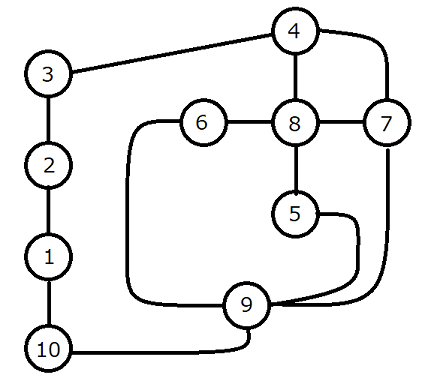
Score : 300 points
Problem Statement
A region has N towns numbered 1 to N, and M roads numbered 1 to M.
The i-th road connects town A_i and town B_i bidirectionally with length C_i.
Find the maximum possible total length of the roads you traverse when starting from a town of your choice and getting to another town without passing through the same town more than once.
Constraints
- 2 \leq N \leq 10
- 1 \leq M \leq \frac{N(N-1)}{2}
- 1 \leq A_i < B_i \leq N
- The pairs (A_i,B_i) are distinct.
- 1\leq C_i \leq 10^8
- All input values are integers.
Input
The input is given from Standard Input in the following format:
N M
A_1 B_1 C_1
\vdots
A_M B_M C_M
Output
Print the answer.
Sample Input 1
4 4
1 2 1
2 3 10
1 3 100
1 4 1000
Sample Output 1
1110
If you travel as 4\to 1\to 3\to 2, the total length of the roads you traverse is 1110.
Sample Input 2
10 1
5 9 1
Sample Output 2
1
There may be a town that is not connected to a road.
Sample Input 3
10 13
1 2 1
1 10 1
2 3 1
3 4 4
4 7 2
4 8 1
5 8 1
5 9 3
6 8 1
6 9 5
7 8 1
7 9 4
9 10 3
Sample Output 3
20
Time Limit: 2 sec / Memory Limit: 1024 MiB
配点 : 300 点
問題文
十進法ですべての桁の数字が 1 である整数をレピュニットと呼びます。レピュニットを小さい順に並べると 1,11,111,\ldots です。
ちょうど 3 つのレピュニットの和として表せる整数のうち N 番目に小さいものを求めてください。
制約
- N は 1 以上 333 以下の整数
入力
入力は以下の形式で標準入力から与えられる。
N
出力
答えを出力せよ。
入力例 1
5
出力例 1
113
ちょうど 3 つのレピュニットの和として表せる整数を小さい順に並べると 3,13,23,33,113,\ldots です。例えば 113 は 113=1+1+111 と表せます。
3 つのレピュニットは相異ならなくてもよいことに注意してください。
入力例 2
19
出力例 2
2333
入力例 3
333
出力例 3
112222222233
Score : 300 points
Problem Statement
A repunit is an integer whose digits are all 1 in decimal representation. The repunits in ascending order are 1, 11, 111, \ldots.
Find the N-th smallest integer that can be expressed as the sum of exactly three repunits.
Constraints
- N is an integer between 1 and 333, inclusive.
Input
The input is given from Standard Input in the following format:
N
Output
Print the answer.
Sample Input 1
5
Sample Output 1
113
The integers that can be expressed as the sum of exactly three repunits are 3, 13, 23, 33, 113, \ldots in ascending order. For example, 113 can be expressed as 113 = 1 + 1 + 111.
Note that the three repunits do not have to be distinct.
Sample Input 2
19
Sample Output 2
2333
Sample Input 3
333
Sample Output 3
112222222233
Time Limit: 2 sec / Memory Limit: 1024 MiB
配点 : 400 点
問題文
長さ N の整数列 A = (A_1, \dots, A_N) が与えられます。
以下の条件を全て満たす整数の組 (i, j, k) の総数を求めてください。
- 1 \leq i, j, k \leq N
- \frac{A_i}{A_j} = A_k
制約
- 1 \leq N \leq 2 \times 10^5
- 1 \leq A_i \leq 2 \times 10^5 \, (1 \leq i \leq N)
- 入力は全て整数
入力
入力は以下の形式で標準入力から与えられる。
N
A_1 \ldots A_N
出力
答えを出力せよ。
入力例 1
3
6 2 3
出力例 1
2
(i, j, k) = (1, 2, 3), (1, 3, 2) が条件を満たします。
入力例 2
1
2
出力例 2
0
入力例 3
10
1 3 2 4 6 8 2 2 3 7
出力例 3
62
Score : 400 points
Problem Statement
You are given an integer sequence A = (A_1, \dots, A_N) of length N.
Find the number of triplets of integers (i, j, k) satisfying all of the conditions below.
- 1 \leq i, j, k \leq N
- \frac{A_i}{A_j} = A_k
Constraints
- 1 \leq N \leq 2 \times 10^5
- 1 \leq A_i \leq 2 \times 10^5 \, (1 \leq i \leq N)
- All values in input are integers.
Input
Input is given from Standard Input in the following format:
N
A_1 \ldots A_N
Output
Print the answer.
Sample Input 1
3
6 2 3
Sample Output 1
2
(i, j, k) = (1, 2, 3), (1, 3, 2) satisfy the conditions.
Sample Input 2
1
2
Sample Output 2
0
Sample Input 3
10
1 3 2 4 6 8 2 2 3 7
Sample Output 3
62
Time Limit: 2 sec / Memory Limit: 1024 MiB
配点 : 500 点
問題文
頂点に 1 から N の番号が、辺に 1 から M の番号がついた N 頂点 M 辺の単純有向グラフが与えられます。辺 i は頂点 u_i から頂点 v_i への有向辺です。
また、あなたは次の操作を 0 回以上何度でも行えます。
- 相異なる頂点 x,y であって頂点 x から頂点 y への有向辺が存在しないようなものを選ぶ。そして、頂点 x から頂点 y への有向辺を追加する。
このグラフが次の条件を満たす状態にするために最小で何回操作を行う必要があるかを求めてください。
- 相異なる頂点 a,b,c すべてについて、頂点 a から頂点 b への有向辺と頂点 b から頂点 c への有向辺がともに存在するならば頂点 a から頂点 c への有向辺も存在する。
制約
- 3 \leq N \leq 2000
- 0 \leq M \leq 2000
- 1 \leq u_i ,v_i \leq N
- u_i \neq v_i
- i \neq j ならば (u_i,v_i) \neq (u_j,v_j)
- 入力はすべて整数
入力
入力は以下の形式で標準入力から与えられる。
N M
u_1 v_1
\vdots
u_M v_M
出力
答えを出力せよ。
入力例 1
4 3
2 4
3 1
4 3
出力例 1
3
初め、一例として頂点 2,4,3 について、頂点 2 から頂点 4 への有向辺と頂点 4 から頂点 3 への有向辺がともに存在するにもかかわらず、頂点 2 から頂点 3 への有向辺は存在せず、条件を満たさない状態です。
そこで、以下の 3 本の有向辺を追加すると条件を満たす状態になります。
- 頂点 2 から頂点 3 への有向辺
- 頂点 2 から頂点 1 への有向辺
- 頂点 4 から頂点 1 への有向辺
一方、3 本未満の追加で条件を満たす状態には出来ないため、答えは 3 です。
入力例 2
292 0
出力例 2
0
入力例 3
5 8
1 2
2 1
1 3
3 1
1 4
4 1
1 5
5 1
出力例 3
12
Score : 500 points
Problem Statement
You are given a simple directed graph with N vertices numbered 1 to N and M edges numbered 1 to M. Edge i is a directed edge from vertex u_i to vertex v_i.
You may perform the following operation zero or more times.
- Choose distinct vertices x and y such that there is no directed edge from vertex x to vertex y, and add a directed edge from vertex x to vertex y.
Find the minimum number of times you need to perform the operation to make the graph satisfy the following condition.
- For every triple of distinct vertices a, b, and c, if there are directed edges from vertex a to vertex b and from vertex b to vertex c, there is also a directed edge from vertex a to vertex c.
Constraints
- 3 \leq N \leq 2000
- 0 \leq M \leq 2000
- 1 \leq u_i ,v_i \leq N
- u_i \neq v_i
- (u_i,v_i) \neq (u_j,v_j) if i \neq j.
- All values in the input are integers.
Input
The input is given from Standard Input in the following format:
N M
u_1 v_1
\vdots
u_M v_M
Output
Print the answer.
Sample Input 1
4 3
2 4
3 1
4 3
Sample Output 1
3
Initially, the condition is not satisfied because, for instance, for vertices 2, 4, and 3, there are directed edges from vertex 2 to vertex 4 and from vertex 4 to vertex 3, but not from vertex 2 to vertex 3.
You can make the graph satisfy the condition by adding the following three directed edges:
- one from vertex 2 to vertex 3,
- one from vertex 2 to vertex 1, and
- one from vertex 4 to vertex 1.
On the other hand, the condition cannot be satisfied by adding two or fewer edges, so the answer is 3.
Sample Input 2
292 0
Sample Output 2
0
Sample Input 3
5 8
1 2
2 1
1 3
3 1
1 4
4 1
1 5
5 1
Sample Output 3
12
Time Limit: 3 sec / Memory Limit: 1024 MiB
配点 : 500 点
問題文
縦 10^9 マス、横 10^9 マスのマス目があります。上から i 番目、左から j 番目のマスを (i,j) と表記します。
i=1,2,\ldots,N に対し (r_i,c_i) には正整数 x_i が、他の 10^{18}-N 個のマスには 0 が書かれています。
あなたはあるマス (R,C) を選び、 (R,C) と行または列が同じ 2 \times 10^9 - 1 個のマスに書かれた整数の総和 S を求めました。
S として考えられる最大値を求めてください。
制約
- 1 \leq N \leq 2 \times 10^5
- 1 \leq r_i,c_i,x_i \leq 10^9
- i \neq j ならば (r_i,c_i) \neq (r_j,c_j)
- 入力はすべて整数
入力
入力は以下の形式で標準入力から与えられる。
N
r_1 c_1 x_1
\vdots
r_N c_N x_N
出力
答えを出力せよ。
入力例 1
4
1 1 2
1 2 9
2 1 8
3 2 3
出力例 1
20
(R,C) として (2,2) を選ぶと S が 20 となります。これが最大値です。
入力例 2
1
1 1000000000 1
出力例 2
1
入力例 3
15
158260522 877914575 602436426
24979445 861648772 623690081
433933447 476190629 262703497
211047202 971407775 628894325
731963982 822804784 450968417
430302156 982631932 161735902
880895728 923078537 707723857
189330739 910286918 802329211
404539679 303238506 317063340
492686568 773361868 125660016
650287940 839296263 462224593
492601449 384836991 191890310
576823355 782177068 404011431
818008580 954291757 160449218
155374934 840594328 164163676
出力例 3
1510053068
Score : 500 points
Problem Statement
We have a grid with 10^9 rows and 10^9 columns. Let (i,j) denote the square at the i-th row from the top and j-th column from the left.
For i=1,2,\ldots,N, a positive integer x_i is written on (r_i,c_i). On the other 10^{18}-N squares, 0 is written.
You choose a square (R,C) and compute the sum S of the integers written on the 2 \times 10^9 - 1 squares that share a row or column with (R,C).
Find the maximum possible value of S.
Constraints
- 1 \leq N \leq 2 \times 10^5
- 1 \leq r_i,c_i,x_i \leq 10^9
- (r_i,c_i) \neq (r_j,c_j) if i \neq j.
- All values in the input are integers.
Input
The input is given from Standard Input in the following format:
N
r_1 c_1 x_1
\vdots
r_N c_N x_N
Output
Print the answer.
Sample Input 1
4
1 1 2
1 2 9
2 1 8
3 2 3
Sample Output 1
20
If you choose (2,2) as (R,C), then S will be 20, which is the maximum possible value.
Sample Input 2
1
1 1000000000 1
Sample Output 2
1
Sample Input 3
15
158260522 877914575 602436426
24979445 861648772 623690081
433933447 476190629 262703497
211047202 971407775 628894325
731963982 822804784 450968417
430302156 982631932 161735902
880895728 923078537 707723857
189330739 910286918 802329211
404539679 303238506 317063340
492686568 773361868 125660016
650287940 839296263 462224593
492601449 384836991 191890310
576823355 782177068 404011431
818008580 954291757 160449218
155374934 840594328 164163676
Sample Output 3
1510053068