実行時間制限: 2 sec / メモリ制限: 1024 MiB
配点 : 100 点
問題文
英大文字および英小文字からなる文字列 S が与えられます。
ここで、 S のうちちょうど 1 文字だけが英大文字であり、それ以外は全て英小文字です。
大文字が S の先頭から何文字目に登場するか出力してください。
ただし、S の先頭の文字を 1 文字目とします。
制約
- S は英大文字および英小文字からなる長さ 2 以上 100 以下の文字列
- S に大文字はちょうど 1 つ含まれる。
入力
入力は以下の形式で標準入力から与えられる。
S
出力
大文字が S の先頭から何文字目に登場するかを、整数で出力せよ。
入力例 1
aBc
出力例 1
2
aBc の先頭から 1 文字目は a , 2 文字目は B , 3 文字目は c であり、
このうち大文字は 2 文字目です。
よって、2 を出力します。
入力例 2
xxxxxxXxxx
出力例 2
7
S=xxxxxxXxxx の 7 文字目に、大文字である X が登場しています。よって、7 を出力します。
入力例 3
Zz
出力例 3
1
Score : 100 points
Problem Statement
You are given a string S consisting of uppercase and lowercase English letters.
Here, exactly one character of S is uppercase, and the others are all lowercase.
Find the integer x such that the x-th character of S is uppercase.
Here, the initial character of S is considered the 1-st one.
Constraints
- S is a string of length between 2 and 100, inclusive, consisting of uppercase and lowercase English letters.
- S has exactly one uppercase letter.
Input
The input is given from Standard Input in the following format:
S
Output
Print the integer x such that the x-th character of S is uppercase.
Sample Input 1
aBc
Sample Output 1
2
The 1-st character of aBc is a, the 2-nd is B, and the 3-rd is c;
the 2-nd character is uppercase.
Thus, 2 should be printed.
Sample Input 2
xxxxxxXxxx
Sample Output 2
7
An uppercase letter X occurs as the 7-th character of S=xxxxxxXxxx, so 7 should be printed.
Sample Input 3
Zz
Sample Output 3
1
実行時間制限: 2 sec / メモリ制限: 1024 MiB
配点 : 100 点
問題文
A を N 個、B を N 個、…、Z を N 個この順に繋げて得られる文字列の先頭から X 番目の文字を求めてください。
制約
- 1 \leq N \leq 100
- 1 \leq X \leq N\times 26
- 入力は全て整数
入力
入力は以下の形式で標準入力から与えられる。
N X
出力
答えを出力せよ。
入力例 1
1 3
出力例 1
C
得られる文字列は ABCDEFGHIJKLMNOPQRSTUVWXYZ です。先頭から 3 番目の文字は C です。
入力例 2
2 12
出力例 2
F
得られる文字列は AABBCCDDEEFFGGHHIIJJKKLLMMNNOOPPQQRRSSTTUUVVWWXXYYZZ です。先頭から 12 番目の文字は F です。
Score : 100 points
Problem Statement
Find the X-th character from the beginning of the string that is obtained by concatenating these characters: N copies of A's, N copies of B's, …, and N copies of Z's, in this order.
Constraints
- 1 \leq N \leq 100
- 1 \leq X \leq N\times 26
- All values in input are integers.
Input
Input is given from Standard Input in the following format:
N X
Output
Print the answer.
Sample Input 1
1 3
Sample Output 1
C
We obtain the string ABCDEFGHIJKLMNOPQRSTUVWXYZ, whose 3-rd character from the beginning is C.
Sample Input 2
2 12
Sample Output 2
F
We obtain the string AABBCCDDEEFFGGHHIIJJKKLLMMNNOOPPQQRRSSTTUUVVWWXXYYZZ, whose 12-th character from the beginning is F.
実行時間制限: 2 sec / メモリ制限: 1024 MiB
配点 : 200 点
問題文
1 から N までの番号がついた N 人の人がいます。
N 人の人の今後 D 日間の予定が与えられます。人 i の予定は長さ D の文字列 S_i で表されて、S_i の j 文字目が o ならば j 日目は暇であることを、x ならばそうでないことを意味します。
D 日間のうち全員が暇であるような 連続する 何日かを選ぶことを考えます。
選べる日数は最大で何日ですか?ただし、選べる日が存在しない場合は 0 日と答えてください。
制約
- 1 \leq N \leq 100
- 1 \leq D \leq 100
- N, D は整数
- S_i は
oとxからなる長さ D の文字列
入力
入力は以下の形式で標準入力から与えられる。
N D
S_1
S_2
\vdots
S_N
出力
選べる日数の最大値を出力せよ。選べる日が存在しない場合は 0 を出力せよ。
入力例 1
3 5
xooox
oooxx
oooxo
出力例 1
2
2 日目と 3 日目は全員が暇な日なので選ぶことができます。
この 2 日間を選ぶと、連続する日にちを選ぶ方法の中で日数を最大にすることができます。
入力例 2
3 3
oxo
oxo
oxo
出力例 2
1
選ぶ日にちは連続している必要があるのに注意してください。(1 日目と 3 日目は全員が暇な日なので選ぶことができますが、この 2 つを同時に選ぶことはできません)
入力例 3
3 3
oox
oxo
xoo
出力例 3
0
選べる日が存在しない場合は 0 を出力してください。
入力例 4
1 7
ooooooo
出力例 4
7
入力例 5
5 15
oxooooooooooooo
oxooxooooooooox
oxoooooooooooox
oxxxooooooxooox
oxooooooooxooox
出力例 5
5
Score : 200 points
Problem Statement
There are N people numbered 1 to N.
You are given their schedule for the following D days. The schedule for person i is represented by a string S_i of length D. If the j-th character of S_i is o, person i is free on the j-th day; if it is x, they are occupied that day.
From these D days, consider choosing some consecutive days when all the people are free.
How many days can be chosen at most? If no day can be chosen, report 0.
Constraints
- 1 \leq N \leq 100
- 1 \leq D \leq 100
- N and D are integers.
- S_i is a string of length D consisting of
oandx.
Input
The input is given from Standard Input in the following format:
N D
S_1
S_2
\vdots
S_N
Output
Print the maximum number of days that can be chosen, or 0 if no day can be chosen.
Sample Input 1
3 5
xooox
oooxx
oooxo
Sample Output 1
2
All the people are free on the second and third days, so we can choose them.
Choosing these two days will maximize the number of days among all possible choices.
Sample Input 2
3 3
oxo
oxo
oxo
Sample Output 2
1
Note that the chosen days must be consecutive. (All the people are free on the first and third days, so we can choose either of them, but not both.)
Sample Input 3
3 3
oox
oxo
xoo
Sample Output 3
0
Print 0 if no day can be chosen.
Sample Input 4
1 7
ooooooo
Sample Output 4
7
Sample Input 5
5 15
oxooooooooooooo
oxooxooooooooox
oxoooooooooooox
oxxxooooooxooox
oxooooooooxooox
Sample Output 5
5
実行時間制限: 2 sec / メモリ制限: 1024 MiB
配点 : 200 点
問題文
1,2,\ldots,N と番号づけられた N 人が M 回、一列に並んで集合写真を撮りました。i 番目の撮影で左から j 番目に並んだ人の番号は a_{i,j} です。
ある二人組は M 回の撮影で一度も連続して並ばなかった場合、不仲である可能性があります。
不仲である可能性がある二人組の個数を求めてください。なお、人 x と人 y からなる二人組と人 y と人 x からなる二人組は区別しません。
制約
- 2 \leq N \leq 50
- 1 \leq M \leq 50
- 1 \leq a_{i,j} \leq N
- a_{i,1},\ldots,a_{i,N} には 1,\ldots,N が 1 回ずつ現れる
- 入力はすべて整数
入力
入力は以下の形式で標準入力から与えられる。
N M
a_{1,1} \ldots a_{1,N}
\vdots
a_{M,1} \ldots a_{M,N}
出力
答えを出力せよ。
入力例 1
4 2
1 2 3 4
4 3 1 2
出力例 1
2
人 1 と人 4 からなる二人組と、人 2 と人 4 からなる二人組がそれぞれ不仲である可能性があります。
入力例 2
3 3
1 2 3
3 1 2
1 2 3
出力例 2
0
入力例 3
10 10
4 10 7 2 8 3 9 1 6 5
3 6 2 9 1 8 10 7 4 5
9 3 4 5 7 10 1 8 2 6
7 3 1 8 4 9 5 6 2 10
5 2 1 4 10 7 9 8 3 6
5 8 1 6 9 3 2 4 7 10
8 10 3 4 5 7 2 9 6 1
3 10 2 7 8 5 1 4 9 6
10 6 1 5 4 2 3 8 9 7
4 5 9 1 8 2 7 6 3 10
出力例 3
6
Score : 200 points
Problem Statement
N people numbered 1,2,\ldots,N were in M photos. In each of the photos, they stood in a single line. In the i-th photo, the j-th person from the left is person a_{i,j}.
Two people who did not stand next to each other in any of the photos may be in a bad mood.
How many pairs of people may be in a bad mood? Here, we do not distinguish a pair of person x and person y, and a pair of person y and person x.
Constraints
- 2 \leq N \leq 50
- 1 \leq M \leq 50
- 1 \leq a_{i,j} \leq N
- a_{i,1},\ldots,a_{i,N} contain each of 1,\ldots,N exactly once.
- All values in the input are integers.
Input
The input is given from Standard Input in the following format:
N M
a_{1,1} \ldots a_{1,N}
\vdots
a_{M,1} \ldots a_{M,N}
Output
Print the answer.
Sample Input 1
4 2
1 2 3 4
4 3 1 2
Sample Output 1
2
The pair of person 1 and person 4, and the pair of person 2 and person 4, may be in a bad mood.
Sample Input 2
3 3
1 2 3
3 1 2
1 2 3
Sample Output 2
0
Sample Input 3
10 10
4 10 7 2 8 3 9 1 6 5
3 6 2 9 1 8 10 7 4 5
9 3 4 5 7 10 1 8 2 6
7 3 1 8 4 9 5 6 2 10
5 2 1 4 10 7 9 8 3 6
5 8 1 6 9 3 2 4 7 10
8 10 3 4 5 7 2 9 6 1
3 10 2 7 8 5 1 4 9 6
10 6 1 5 4 2 3 8 9 7
4 5 9 1 8 2 7 6 3 10
Sample Output 3
6
実行時間制限: 2 sec / メモリ制限: 1024 MiB
配点 : 300 点
問題文
xy 座標平面上の 2 つの格子点 (x_1, y_1), (x_2, y_2) からの距離がともに \sqrt{5} である格子点は存在しますか?
注記
xy 座標平面上にある点のうち、x 座標と y 座標がともに整数である点を格子点と呼びます。
また、xy 平面上の 2 点 (a, b), (c, d) の距離をユークリッド距離 \sqrt{(a - c)^2 + (b-d)^2} として定義します。
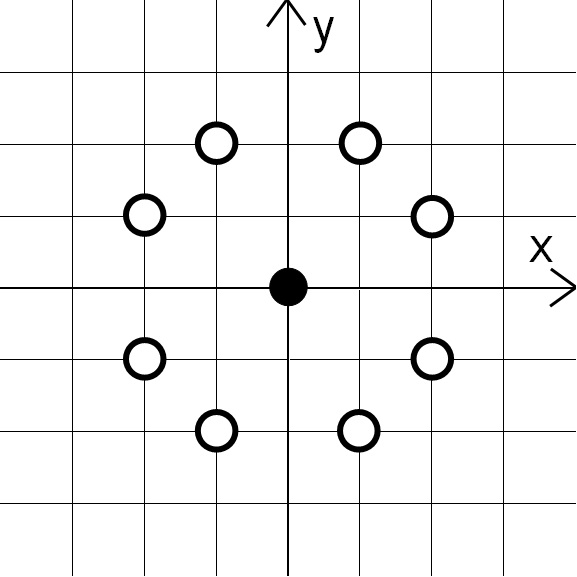
参考として、xy 平面の (0, 0) の上に黒丸を、(0, 0) からの距離が \sqrt{5} となる格子点の上に白丸を書いた図は以下のようになります。(x,y いずれかが整数となる部分に目盛り線を引いています。)
制約
- -10^9 \leq x_1 \leq 10^9
- -10^9 \leq y_1 \leq 10^9
- -10^9 \leq x_2 \leq 10^9
- -10^9 \leq y_2 \leq 10^9
- (x_1, y_1) \neq (x_2, y_2)
- 入力はすべて整数である。
入力
入力は以下の形式で標準入力から与えられる。
x_1 y_1 x_2 y_2
出力
条件を満たす格子点が存在する場合は Yes を、存在しない場合は No を出力せよ。
入力例 1
0 0 3 3
出力例 1
Yes
- 点 (2,1) と (x_1, y_1) の距離は \sqrt{(0-2)^2 + (0-1)^2} = \sqrt{5}
- 点 (2,1) と (x_2, y_2) の距離は \sqrt{(3-2)^2 + (3-1)^2} = \sqrt{5}
- 点 (2, 1) は格子点
なので点 (2, 1) は条件を満たします。よって Yes を出力します。
なお、点 (1, 2) も条件を満たすことが同様にして確認できます。
入力例 2
0 1 2 3
出力例 2
No
条件を満たす格子点は存在しません。よって No を出力します。
入力例 3
1000000000 1000000000 999999999 999999999
出力例 3
Yes
点 (10^9 + 1, 10^9 - 2) および点 (10^9 - 2, 10^9 + 1)が条件を満たします。
Score : 300 points
Problem Statement
On an xy-coordinate plane, is there a lattice point whose distances from two lattice points (x_1, y_1) and (x_2, y_2) are both \sqrt{5}?
Notes
A point on an xy-coordinate plane whose x and y coordinates are both integers is called a lattice point.
The distance between two points (a, b) and (c, d) is defined to be the Euclidean distance between them, \sqrt{(a - c)^2 + (b-d)^2}.
The following figure illustrates an xy-plane with a black circle at (0, 0) and white circles at the lattice points whose distances from (0, 0) are \sqrt{5}. (The grid shows where either x or y is an integer.)
Constraints
- -10^9 \leq x_1 \leq 10^9
- -10^9 \leq y_1 \leq 10^9
- -10^9 \leq x_2 \leq 10^9
- -10^9 \leq y_2 \leq 10^9
- (x_1, y_1) \neq (x_2, y_2)
- All values in input are integers.
Input
Input is given from Standard Input in the following format:
x_1 y_1 x_2 y_2
Output
If there is a lattice point satisfying the condition, print Yes; otherwise, print No.
Sample Input 1
0 0 3 3
Sample Output 1
Yes
- The distance between points (2,1) and (x_1, y_1) is \sqrt{(0-2)^2 + (0-1)^2} = \sqrt{5};
- the distance between points (2,1) and (x_2, y_2) is \sqrt{(3-2)^2 + (3-1)^2} = \sqrt{5};
- point (2, 1) is a lattice point,
so point (2, 1) satisfies the condition. Thus, Yes should be printed.
One can also assert in the same way that (1, 2) also satisfies the condition.
Sample Input 2
0 1 2 3
Sample Output 2
No
No lattice point satisfies the condition, so No should be printed.
Sample Input 3
1000000000 1000000000 999999999 999999999
Sample Output 3
Yes
Point (10^9 + 1, 10^9 - 2) and point (10^9 - 2, 10^9 + 1) satisfy the condition.
実行時間制限: 2 sec / メモリ制限: 1024 MiB
配点 : 300 点
問題文
頂点に 1 から N の番号が、辺に 1 から M の番号がついた N 頂点 M 辺の単純無向グラフが与えられます。辺 i は頂点 u_i と頂点 v_i を結んでいます。
グラフに含まれる連結成分の個数を求めてください。
注釈
単純無向グラフ とは、単純で辺に向きの無いグラフのことをいいます。
グラフが 単純 であるとは、グラフが自己ループや多重辺を含まないことをいいます。
あるグラフの 部分グラフ とは、元のグラフのいくつかの頂点といくつかの辺を選んでできるグラフのことをいいます。
グラフが 連結 であるとは、グラフに含まれるすべての頂点同士が辺を経由して互いに行き来できることをいいます。
連結成分 とは、連結な部分グラフのうち、そのグラフを含んだより大きい連結な部分グラフが存在しないものをいいます。
制約
- 1 \leq N \leq 100
- 0 \leq M \leq \frac{N(N - 1)}{2}
- 1 \leq u_i, v_i \leq N
- 入力で与えられるグラフは単純
- 入力される値はすべて整数
入力
入力は以下の形式で標準入力から与えられる。
N M
u_1 v_1
u_2 v_2
\vdots
u_M v_M
出力
答えを出力せよ。
入力例 1
5 3
1 2
1 3
4 5
出力例 1
2
与えられるグラフに含まれる連結成分は次の 2 個です。
- 頂点 1, 2, 3 および辺 1, 2 からなる部分グラフ
- 頂点 4, 5 および辺 3 からなる部分グラフ

入力例 2
5 0
出力例 2
5
入力例 3
4 6
1 2
1 3
1 4
2 3
2 4
3 4
出力例 3
1
Score : 300 points
Problem Statement
You are given a simple undirected graph with N vertices numbered 1 to N and M edges numbered 1 to M. Edge i connects vertex u_i and vertex v_i.
Find the number of connected components in this graph.
Notes
A simple undirected graph is a graph that is simple and has undirected edges.
A graph is simple if and only if it has no self-loop or multi-edge.
A subgraph of a graph is a graph formed from some of the vertices and edges of that graph.
A graph is connected if and only if one can travel between every pair of vertices via edges.
A connected component is a connected subgraph that is not part of any larger connected subgraph.
Constraints
- 1 \leq N \leq 100
- 0 \leq M \leq \frac{N(N - 1)}{2}
- 1 \leq u_i, v_i \leq N
- The given graph is simple.
- All values in the input are integers.
Input
The input is given from Standard Input in the following format:
N M
u_1 v_1
u_2 v_2
\vdots
u_M v_M
Output
Print the answer.
Sample Input 1
5 3
1 2
1 3
4 5
Sample Output 1
2
The given graph contains the following two connected components:
- a subgraph formed from vertices 1, 2, 3, and edges 1, 2;
- a subgraph formed from vertices 4, 5, and edge 3.
Sample Input 2
5 0
Sample Output 2
5
Sample Input 3
4 6
1 2
1 3
1 4
2 3
2 4
3 4
Sample Output 3
1
実行時間制限: 3 sec / メモリ制限: 1024 MiB
配点 : 400 点
問題文
高橋君は N 種類の硬貨をそれぞれ何枚か持っており、 具体的には、1\leq i\leq N について A_i 円硬貨を B_i 枚持っています。
高橋君が現在持っている硬貨を用いて、(お釣りが出ないように)ちょうど X 円を支払うことができるか判定してください。
制約
- 1\leq N\leq 50
- 1\leq X\leq 10^4
- 1\leq A_i\leq 100
- 1\leq B_i\leq 50
- A_i はすべて異なる。
- 入力はすべて整数
入力
入力は以下の形式で標準入力から与えられる。
N X
A_1 B_1
A_2 B_2
\vdots
A_N B_N
出力
高橋君が現在持っている硬貨を用いてちょうど X 円を支払うことができる場合は Yes を、
できない場合は No を出力せよ。
入力例 1
2 19
2 3
5 6
出力例 1
Yes
高橋君は 2 円硬貨を 3 枚、5 円硬貨を 6 枚持っています。
このうち、2 円硬貨を 2 枚、5 円硬貨を 3 枚用いることでちょうど 2\times 2+5\times 3=19 円を支払うことができます。
よって、Yes を出力します。
入力例 2
2 18
2 3
5 6
出力例 2
No
持っている硬貨をどのように組み合わせてもちょうど 18 円を支払うことはできません。
よって、No を出力します。
入力例 3
3 1001
1 1
2 1
100 10
出力例 3
Yes
1 枚も使用しない硬貨が存在しても構いません。
Score : 400 points
Problem Statement
Takahashi has N kinds of coins; specifically, for 1\leq i\leq N, he has B_i coins worth A_i yen (the currency in Japan) each.
Determine if Takahashi can pay exactly X yen (without change) with the coins he currently has.
Constraints
- 1\leq N\leq 50
- 1\leq X\leq 10^4
- 1\leq A_i\leq 100
- 1\leq B_i\leq 50
- A_i are pairwise distinct.
- All values in the input are integers.
Input
The input is given from Standard Input in the following format:
N X
A_1 B_1
A_2 B_2
\vdots
A_N B_N
Output
Print Yes if Takahashi can pay exactly X yen with the coins he currently has;
print No otherwise.
Sample Input 1
2 19
2 3
5 6
Sample Output 1
Yes
Takahashi has three 2-yen coins and six 5-yen coins.
He can use two 2-yen coins and three 5-yen coins to pay exactly 2\times 2+5\times 3=19 yen.
Thus, Yes should be printed.
Sample Input 2
2 18
2 3
5 6
Sample Output 2
No
There is no combination of the coins that he can use to pay exactly 18 yen.
Thus, No should be printed.
Sample Input 3
3 1001
1 1
2 1
100 10
Sample Output 3
Yes
He need not use all kinds of coins.
実行時間制限: 2 sec / メモリ制限: 1024 MiB
配点 : 500 点
問題文
Atcoder 王国では A_1 円, A_2 円, \ldots, A_N 円の N 種類の硬貨が使用されています。
ここで、1=A_1 < \ldots < A_N であり、全ての 1\leq i \leq N-1 に対し、A_{i+1} は A_i の倍数です。
硬貨のみを使って X 円を支払うとき、支払いに使う硬貨の枚数とお釣りでもらう硬貨の枚数の合計の最小値はいくつですか?
正確には、Y が X 以上の整数を自由に動く時、Y 円ちょうどを表すために必要な硬貨の枚数と、Y-X 円ちょうどを表すために必要な硬貨の枚数の和の最小値を求めてください。
制約
- 入力に含まれる値は全て整数である
- 1 \leq N \leq 60
- 1=A_1 < \ldots <A_N \leq 10^{18}
- 全ての 1\leq i \leq N-1 で A_{i+1} は A_i の倍数である
- 1\leq X \leq 10^{18}
入力
入力は以下の形式で標準入力から与えられる。
N X
A_1 \ldots A_N
出力
答えを出力せよ。
入力例 1
3 87
1 10 100
出力例 1
5
100 円硬貨 1 枚で支払いを行い、10 円硬貨 1 枚と 1 円硬貨 3 枚をお釣りでもらうと、合計枚数は 5 枚になります。
入力例 2
2 49
1 7
出力例 2
7
7 円硬貨 7 枚で支払いを行うのが最適です。
入力例 3
10 123456789012345678
1 100 10000 1000000 100000000 10000000000 1000000000000 100000000000000 10000000000000000 1000000000000000000
出力例 3
233
Score : 500 points
Problem Statement
There are N kinds of coins used in the Kingdom of Atcoder: A_1-yen, A_2-yen, \ldots, A_N-yen coins.
Here, 1=A_1 < \ldots < A_N holds, and A_{i+1} is a multiple of A_i for every 1\leq i \leq N-1.
When paying for a product worth X yen using just these coins, what is the minimum total number of coins used in payment and returned as change?
Accurately, when Y is an integer at least X, find the minimum sum of the number of coins needed to represent exactly Y yen and the number of coins needed to represent exactly Y-X yen.
Constraints
- All values in input are integers.
- 1 \leq N \leq 60
- 1=A_1 < \ldots <A_N \leq 10^{18}
- A_{i+1} is a multiple of A_i for every 1\leq i \leq N-1.
- 1\leq X \leq 10^{18}
Input
Input is given from Standard Input in the following format:
N X
A_1 \ldots A_N
Output
Print the answer.
Sample Input 1
3 87
1 10 100
Sample Output 1
5
If we pay with one 100-yen coin and receive one 10-yen coin and three 1-yen coins as the change, the total number of coins will be 5.
Sample Input 2
2 49
1 7
Sample Output 2
7
It is optimal to pay with seven 7-yen coins.
Sample Input 3
10 123456789012345678
1 100 10000 1000000 100000000 10000000000 1000000000000 100000000000000 10000000000000000 1000000000000000000
Sample Output 3
233
実行時間制限: 2 sec / メモリ制限: 1024 MiB
配点 : 625 点
問題文
1 から N までの番号が付けられた N 枚のカードがあります。 カードのそれぞれの面には整数が書かれており、カード i の表には A_i が、裏には B_i が書かれています。 最初、全てのカードは表を向いています。
今ここに M 台のマシーンがあり、1 から M までの番号が付けられています。 マシーン j は(相異なるとは限らない)2 つの 1 以上 N 以下の整数 X_j,Y_j を持っており、マシーン j が起動されると、 \frac{1}{2} の確率でカード X_j を、残りの \frac{1}{2} の確率でカード Y_j を裏返します。 この確率は各起動ごとに独立です。
すぬけくんは今から以下の操作を順に行います。
- 1 以上 M 以下の整数からなる集合 S を選ぶ。
- S に含まれる番号のマシーンを、番号が小さい順に 1 度ずつ起動する。
すぬけくんがうまく S を選んだとき、「すべての操作が終了した後に各カードが向いている面に書かれた整数の合計」の期待値が最大でいくつになるか求めてください。
制約
- 1\leq N \leq 40
- 1\leq M \leq 10^5
- 1\leq A_i,B_i \leq 10^4
- 1\leq X_j,Y_j \leq N
- 入力は全て整数
入力
入力は以下の形式で標準入力から与えられる。
N M
A_1 B_1
\vdots
A_N B_N
X_1 Y_1
\vdots
X_M Y_M
出力
答えを出力せよ。 出力は、真の値との絶対誤差または相対誤差が 10^{-6} 以下のとき正解と判定される。
入力例 1
3 1
3 10
10 6
5 2
1 2
出力例 1
19.500000
S として空集合を選んだ場合、どのマシーンも起動されないので、「すべての操作が終了した後に各カードが向いている面に書かれた整数の合計」の期待値は 3+10+5=18 です。
S として \lbrace 1 \rbrace を選んだ場合、マシーン 1 が起動され、
- カード X_1 = 1 が裏返された場合、「すべての操作が終了した後に各カードが向いている面に書かれた整数の合計」は 10+10+5=25
- カード Y_1 = 2 が裏返された場合、「すべての操作が終了した後に各カードが向いている面に書かれた整数の合計」は 3+6+5=14
なので、その期待値は \frac{25+14}{2} = 19.5 です。
よって、「すべての操作が終了した後に各カードが向いている面に書かれた整数の合計」の期待値の最大値は 19.5 です。
入力例 2
1 3
5 100
1 1
1 1
1 1
出力例 2
100.000000
同じ (X_j,Y_j) を持つマシーンが複数存在することもあります。
入力例 3
8 10
6918 9211
16 1868
3857 8537
3340 8506
6263 7940
1449 4593
5902 1932
310 6991
4 4
8 6
3 5
1 1
4 2
5 6
7 5
3 3
1 5
3 1
出力例 3
45945.000000
Score : 625 points
Problem Statement
There are N cards numbered 1 through N. Each face of a card has an integer written on it; card i has A_i on its front and B_i on its back. Initially, all cards are face up.
There are M machines numbered 1 through M. Machine j has two (not necessarily distinct) integers X_j and Y_j between 1 and N. If you power up machine j, it flips card X_j with the probability of \frac{1}{2}, and flips card Y_j with the remaining probability of \frac{1}{2}. This probability is independent for each power-up.
Snuke will perform the following procedure.
- Choose a set S consisting of integers from 1 through M.
- For each element in S in ascending order, power up the machine with that number.
Among Snuke's possible choices of S, find the maximum expected value of the sum of the integers written on the face-up sides of the cards after the procedure.
Constraints
- 1\leq N \leq 40
- 1\leq M \leq 10^5
- 1\leq A_i,B_i \leq 10^4
- 1\leq X_j,Y_j \leq N
- All input values are integers.
Input
The input is given from Standard Input in the following format:
N M
A_1 B_1
\vdots
A_N B_N
X_1 Y_1
\vdots
X_M Y_M
Output
Print the answer. Your output is considered correct if the absolute or relative difference from the true value is at most 10^{-6}.
Sample Input 1
3 1
3 10
10 6
5 2
1 2
Sample Output 1
19.500000
If S is chosen to be an empty set, no machine is powered up, so the expected sum of the integers written on the face-up sides of the cards after the procedure is 3+10+5=18.
If S is chosen to be \lbrace 1 \rbrace, machine 1 is powered up.
- If card X_1 = 1 is flipped, the expected sum of the integers written on the face-up sides of the cards after the procedure is 10+10+5=25.
- If card Y_1 = 2 is flipped, the expected sum of the integers written on the face-up sides of the cards after the procedure is 3+6+5=14.
Thus, the expected value is \frac{25+14}{2} = 19.5.
Therefore, the maximum expected value of the sum of the integers written on the face-up sides of the cards after the procedure is 19.5.
Sample Input 2
1 3
5 100
1 1
1 1
1 1
Sample Output 2
100.000000
Different machines may have the same (X_j,Y_j).
Sample Input 3
8 10
6918 9211
16 1868
3857 8537
3340 8506
6263 7940
1449 4593
5902 1932
310 6991
4 4
8 6
3 5
1 1
4 2
5 6
7 5
3 3
1 5
3 1
Sample Output 3
45945.000000