実行時間制限: 2 sec / メモリ制限: 1024 MiB
配点 : 100 点
問題文
与えられる 5 つの整数 A, B, C, D, E の中に何種類の整数があるかを出力してください。
制約
- 0 \leq A, B, C, D, E \leq 100
- 入力はすべて整数
入力
入力は以下の形式で標準入力から与えられる。
A B C D E
出力
答えを出力せよ。
入力例 1
31 9 24 31 24
出力例 1
3
与えられる 5 つの整数 31, 9, 24, 31, 24 の中には、9, 24, 31 という 3 種類の整数があります。 よって、3 を出力します。
入力例 2
0 0 0 0 0
出力例 2
1
Score : 100 points
Problem Statement
Print how many distinct integers there are in given five integers A, B, C, D, and E.
Constraints
- 0 \leq A, B, C, D, E \leq 100
- All values in input are integers.
Input
Input is given from Standard Input in the following format:
A B C D E
Output
Print the answer.
Sample Input 1
31 9 24 31 24
Sample Output 1
3
In the given five integers 31, 9, 24, 31, and 24, there are three distinct integers 9, 24, and 31. Thus, 3 should be printed.
Sample Input 2
0 0 0 0 0
Sample Output 2
1
実行時間制限: 2 sec / メモリ制限: 1024 MiB
配点 : 100 点
問題文
長さ N の英小文字からなる文字列 S が与えられます。
S の i 文字目を S_i と記します。
S_1,S_1,S_2,S_2,\dots,S_N,S_N をこの順に連結した長さ 2N の文字列を出力してください。
例えば、 S が beginner のときは bbeeggiinnnneerr と出力してください。
制約
- N は 1 \le N \le 50 を満たす整数
- S は長さ N の英小文字からなる文字列
入力
入力は以下の形式で標準入力から与えられる。
N
S
出力
答えを出力せよ。
入力例 1
8
beginner
出力例 1
bbeeggiinnnneerr
問題文中の例と同じです。
入力例 2
3
aaa
出力例 2
aaaaaa
Score : 100 points
Problem Statement
You are given a string S of length N consisting of lowercase English letters.
We denote the i-th character of S by S_i.
Print the string of length 2N obtained by concatenating S_1,S_1,S_2,S_2,\dots,S_N, and S_N in this order.
For example, if S is beginner, print bbeeggiinnnneerr.
Constraints
- N is an integer such that 1 \le N \le 50.
- S is a string of length N consisting of lowercase English letters.
Input
The input is given from Standard Input in the following format:
N
S
Output
Print the answer.
Sample Input 1
8
beginner
Sample Output 1
bbeeggiinnnneerr
It is the same as the example described in the problem statement.
Sample Input 2
3
aaa
Sample Output 2
aaaaaa
実行時間制限: 2 sec / メモリ制限: 1024 MiB
配点 : 200 点
問題文
高橋君の家には N 本の麺からなるパスタがあり、i 本目の麺の長さは A_i です。
高橋君はこれから M 日間の食事計画を立てており、
i 日目にはパスタの麺のうち長さがちょうど B_i であるようなものを 1 本選び、食べようと考えています。
もし、1 日目から M 日目の間に 1 日でもそのような麺が無い日があれば、食事計画は失敗となります。
また、同じ麺を複数の日に食べることはできません。
高橋君が食事計画を最後まで実行することは可能ですか?
制約
- 1 \leq M \leq N \leq 1000
- 1 \leq A_i \leq 10^9
- 1 \leq B_i \leq 10^9
- 入力はすべて整数である。
入力
入力は以下の形式で標準入力から与えられる。
N M
A_1 A_2 \ldots A_N
B_1 B_2 \ldots B_M
出力
高橋君が食事計画を最後まで実行できる場合は Yes を、そうでない場合は No を出力せよ。
入力例 1
3 2
1 1 3
3 1
出力例 1
Yes
1 日目に 3 本目の麺を、2 日目に 1 本目の麺を食べれば良いので、高橋君の食事計画は実行可能です。
入力例 2
1 1
1000000000
1
出力例 2
No
長さがちょうど 1 の麺が存在する必要があります。
入力例 3
5 2
1 2 3 4 5
5 5
出力例 3
No
長さが 5 の麺は 1 本しか存在しないため、2 日目に食事をとる事が出来ません。
Score : 200 points
Problem Statement
There is pasta consisting of N noodles at Takahashi's home. The length of the i-th noodle is A_i.
Takahashi has a meal plan for the next M days.
On the i-th day, he is going to choose a pasta noodle of length exactly B_i and eat it.
If no such noodle is available on any day, his plan fails.
Additionally, he cannot eat the same noodle on multiple days.
Can Takahashi accomplish his meal plan?
Constraints
- 1 \leq M \leq N \leq 1000
- 1 \leq A_i \leq 10^9
- 1 \leq B_i \leq 10^9
- All values in input are integers.
Input
Input is given from Standard Input in the following format:
N M
A_1 A_2 \ldots A_N
B_1 B_2 \ldots B_M
Output
If Takahashi can accomplish his meal plan, print Yes; otherwise, print No.
Sample Input 1
3 2
1 1 3
3 1
Sample Output 1
Yes
He can eat the 3-rd noodle on the 1-st day and the 1-st noodle on the 2-nd day, so his meal plan is feasible.
Sample Input 2
1 1
1000000000
1
Sample Output 2
No
A noodle of length exactly 1 is needed.
Sample Input 3
5 2
1 2 3 4 5
5 5
Sample Output 3
No
Since there are only 1 noodle of length 5, he cannot have a meal on the 2-nd day.
実行時間制限: 2 sec / メモリ制限: 1024 MiB
配点 : 200 点
問題文
AtCoder 国の暦では、一年は 1,2,\dots,M 番目の月の M か月からなり、そのうち i 番目の月は 1,2,\dots,D_i 番目の日の D_i 日からなります。
さらに、 AtCoder 国の一年の日数は奇数、即ち D_1+D_2+\dots+D_M は奇数です。
一年の真ん中の日は何番目の月の何番目の日か求めてください。
言い換えると、 1 番目の月の 1 番目の日を 1 日目としたときの (D_1+D_2+\dots+D_M+1)/2 日目が何番目の月の何番目の日かを求めてください。
制約
- 入力は全て整数
- 1 \le M \le 100
- 1 \le D_i \le 100
- D_1 + D_2 + \dots + D_M は奇数
入力
入力は以下の形式で標準入力から与えられる。
M
D_1 D_2 \dots D_M
出力
答えが a 番目の月の b 番目の日であるとき、以下の形式で出力せよ。
a b
入力例 1
12
31 28 31 30 31 30 31 31 30 31 30 31
出力例 1
7 2
この入力では、 1 年は 31+28+31+30+31+30+31+31+30+31+30+31=365 日からなります。
真ん中の日は (365+1)/2 = 183 日目であり、これを求めることを考えます。
- 1,2,3,4,5,6 番目の月に含まれる日数の合計は 181 日です。
- 7 番目の月の 1 番目の日は 182 日目です。
- 7 番目の月の 2 番目の日は 183 日目です。
以上から、答えが 7 番目の月の 2 番目の日であることが分かります。
入力例 2
1
1
出力例 2
1 1
入力例 3
6
3 1 4 1 5 9
出力例 3
5 3
Score : 200 points
Problem Statement
In the calendar of AtCoderLand, a year consists of M months: month 1, month 2, \dots, month M. The i-th month consists of D_i days: day 1, day 2, \dots, day D_i.
Furthermore, the number of days in a year is odd, that is, D_1+D_2+\dots+D_M is odd.
Find what day of what month is the middle day of the year.
In other words, let day 1 of month 1 be the first day, and find a and b such that the ((D_1+D_2+\dots+D_M+1)/2)-th day is day b of month a.
Constraints
- All input values are integers.
- 1 \le M \le 100
- 1 \le D_i \le 100
- D_1 + D_2 + \dots + D_M is odd.
Input
The input is given from Standard Input in the following format:
M
D_1 D_2 \dots D_M
Output
Let the answer be day b of month a, and print it in the following format:
a b
Sample Input 1
12
31 28 31 30 31 30 31 31 30 31 30 31
Sample Output 1
7 2
In this input, a year consists of 31+28+31+30+31+30+31+31+30+31+30+31=365 days.
Let us find the middle day, which is the ((365+1)/2 = 183)-th day.
- Months 1,2,3,4,5,6 contain a total of 181 days.
- Day 1 of month 7 is the 182-th day.
- Day 2 of month 7 is the 183-th day.
Thus, the answer is day 2 of month 7.
Sample Input 2
1
1
Sample Output 2
1 1
Sample Input 3
6
3 1 4 1 5 9
Sample Output 3
5 3
実行時間制限: 2 sec / メモリ制限: 1024 MiB
配点 : 300 点
問題文
整数 X が与えられます。この X に以下を施すことを「操作」と呼びます。
- 以下の 2 つのうちどちらかを選択し、実行する。
- X に 1 を加算する。
- X から 1 を減算する。
初項 A 、公差 D 、項数 N の等差数列 S に含まれる数を「良い数」と呼びます。
「操作」を 0 回以上何度でも使って X を「良い数」にする時、必要な「操作」の最小回数を求めてください。
制約
- 入力は全て整数
- -10^{18} \le X,A \le 10^{18}
- -10^6 \le D \le 10^6
- 1 \le N \le 10^{12}
入力
入力は以下の形式で標準入力から与えられる。
X A D N
出力
答えを整数として出力せよ。
入力例 1
6 2 3 3
出力例 1
1
A=2,D=3,N=3 であるため、 S=(2,5,8) です。
X=6 を「良い数」にするためには、 X から 1 を減算することを 1 度行えば良いです。
0 回の操作で X を「良い数」にすることはできません。
入力例 2
0 0 0 1
出力例 2
0
D=0 である場合もあります。また、操作を 1 回も必要としない場合もあります。
入力例 3
998244353 -10 -20 30
出力例 3
998244363
入力例 4
-555555555555555555 -1000000000000000000 1000000 1000000000000
出力例 4
444445
Score : 300 points
Problem Statement
You are given an integer X. The following action on this integer is called an operation.
- Choose and do one of the following.
- Add 1 to X.
- Subtract 1 from X.
The terms in the arithmetic progression S with N terms whose initial term is A and whose common difference is D are called good numbers.
Consider performing zero or more operations to make X a good number. Find the minimum number of operations required to do so.
Constraints
- All values in input are integers.
- -10^{18} \le X,A \le 10^{18}
- -10^6 \le D \le 10^6
- 1 \le N \le 10^{12}
Input
Input is given from Standard Input in the following format:
X A D N
Output
Print the answer as an integer.
Sample Input 1
6 2 3 3
Sample Output 1
1
Since A=2,D=3,N=3, we have S=(2,5,8).
You can subtract 1 from X once to make X=6 a good number.
It is impossible to make X good in zero operations.
Sample Input 2
0 0 0 1
Sample Output 2
0
We might have D=0. Additionally, no operation might be required.
Sample Input 3
998244353 -10 -20 30
Sample Output 3
998244363
Sample Input 4
-555555555555555555 -1000000000000000000 1000000 1000000000000
Sample Output 4
444445
実行時間制限: 2 sec / メモリ制限: 1024 MiB
配点 : 300 点
問題文
ある地方に、1 から N の番号がついた N 個の街と、1 から M の番号がついた M 本の道路があります。
i 番目の道路は街 A_i と街 B_i を双方向に結び、長さは C_i です。
好きな街からスタートして同じ街を二度以上通らずに別の街へ移動するときの、通る道路の長さの和としてありえる最大値を求めてください。
制約
- 2 \leq N \leq 10
- 1 \leq M \leq \frac{N(N-1)}{2}
- 1\leq A_i < B_i \leq N
- (A_i,B_i) は相異なる
- 1\leq C_i \leq 10^8
- 入力は全て整数である
入力
入力は以下の形式で標準入力から与えられる。
N M
A_1 B_1 C_1
\vdots
A_M B_M C_M
出力
答えを出力せよ。
入力例 1
4 4
1 2 1
2 3 10
1 3 100
1 4 1000
出力例 1
1110
4\to 1\to 3\to 2 と移動すると、通る道路の長さの和は 1110 となります。
入力例 2
10 1
5 9 1
出力例 2
1
道路と繋がっていない街が存在するかもしれません。
入力例 3
10 13
1 2 1
1 10 1
2 3 1
3 4 4
4 7 2
4 8 1
5 8 1
5 9 3
6 8 1
6 9 5
7 8 1
7 9 4
9 10 3
出力例 3
20
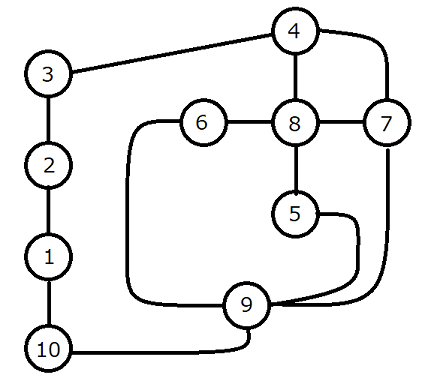
Score : 300 points
Problem Statement
A region has N towns numbered 1 to N, and M roads numbered 1 to M.
The i-th road connects town A_i and town B_i bidirectionally with length C_i.
Find the maximum possible total length of the roads you traverse when starting from a town of your choice and getting to another town without passing through the same town more than once.
Constraints
- 2 \leq N \leq 10
- 1 \leq M \leq \frac{N(N-1)}{2}
- 1 \leq A_i < B_i \leq N
- The pairs (A_i,B_i) are distinct.
- 1\leq C_i \leq 10^8
- All input values are integers.
Input
The input is given from Standard Input in the following format:
N M
A_1 B_1 C_1
\vdots
A_M B_M C_M
Output
Print the answer.
Sample Input 1
4 4
1 2 1
2 3 10
1 3 100
1 4 1000
Sample Output 1
1110
If you travel as 4\to 1\to 3\to 2, the total length of the roads you traverse is 1110.
Sample Input 2
10 1
5 9 1
Sample Output 2
1
There may be a town that is not connected to a road.
Sample Input 3
10 13
1 2 1
1 10 1
2 3 1
3 4 4
4 7 2
4 8 1
5 8 1
5 9 3
6 8 1
6 9 5
7 8 1
7 9 4
9 10 3
Sample Output 3
20
実行時間制限: 2 sec / メモリ制限: 1024 MiB
配点 : 400 点
問題文
X と . からなる文字列 S が与えられます。
S に対して、次の操作を 0 回以上 K 回以下行うことができます。
.をXに置き換える
操作後に、X を最大で何個連続させることができますか?
制約
- 1 \leq |S| \leq 2 \times 10^5
- S の各文字は
Xまたは.である - 0 \leq K \leq 2 \times 10^5
- K は整数である
入力
入力は以下の形式で標準入力から与えられる。
S
K
出力
答えを出力せよ。
入力例 1
XX...X.X.X.
2
出力例 1
5
S の 7 文字目と 9 文字目の . を X に置き換えて XX...XXXXX. とすると、6 文字目から 10 文字目で X が 5 個連続しています。
X を 6 個以上連続させることはできないので、答えは 5 です。
入力例 2
XXXX
200000
出力例 2
4
操作を行う回数は 0 回でも構いません。
Score : 400 points
Problem Statement
Given is a string S consisting of X and ..
You can do the following operation on S between 0 and K times (inclusive).
- Replace a
.with anX.
What is the maximum possible number of consecutive Xs in S after the operations?
Constraints
- 1 \leq |S| \leq 2 \times 10^5
- Each character of S is
Xor.. - 0 \leq K \leq 2 \times 10^5
- K is an integer.
Input
Input is given from Standard Input in the following format:
S
K
Output
Print the answer.
Sample Input 1
XX...X.X.X.
2
Sample Output 1
5
After replacing the Xs at the 7-th and 9-th positions with X, we have XX...XXXXX., which has five consecutive Xs at 6-th through 10-th positions.
We cannot have six or more consecutive Xs, so the answer is 5.
Sample Input 2
XXXX
200000
Sample Output 2
4
It is allowed to do zero operations.
実行時間制限: 4 sec / メモリ制限: 1024 MiB
配点 : 500 点
問題文
N 頂点 M 辺の単純無向グラフ(すなわち、自己辺も多重辺もない無向グラフ)が与えられます。i 本目の辺は頂点 U_i と頂点 V_i を結んでいます。頂点 i には正整数 A_i が書かれています。
あなたは、以下の操作を N 回繰り返します。
- まだ削除されていない頂点 x を選び、「頂点 x 」と「頂点 x を端点に持つ辺全て」を削除する。この操作のコストは、頂点 x と辺で直接結ばれていて、かつまだ削除されていない頂点に書かれている整数の総和である。
N 回の操作全体のコストを、1 回ごとの操作におけるコストのうちの最大値として定めます。操作全体のコストとして取り得る値の最小値を求めてください。
制約
- 1 \le N \le 2 \times 10^5
- 0 \le M \le 2 \times 10^5
- 1 \le A_i \le 10^9
- 1 \le U_i,V_i \le N
- 与えられるグラフは単純。
- 入力は全て整数。
入力
入力は以下の形式で標準入力から与えられる。
N M
A_1 A_2 \dots A_N
U_1 V_1
U_2 V_2
\vdots
U_M V_M
出力
答えを出力せよ。
入力例 1
4 3
3 1 4 2
1 2
1 3
4 1
出力例 1
3
以下のように操作を行うことにより、N 回の操作のコストのうちの最大値を 3 にすることができます。
- 頂点 3 を選ぶ。コストは A_1=3 である。
- 頂点 1 を選ぶ。コストは A_2+A_4=3 である。
- 頂点 2 を選ぶ。コストは 0 である。
- 頂点 4 を選ぶ。コストは 0 である。
N 回の操作のコストのうちの最大値を 2 以下にすることはできないため、解は 3 です。
入力例 2
7 13
464 661 847 514 74 200 188
5 1
7 1
5 7
4 1
4 5
2 4
5 2
1 3
1 6
3 5
1 2
4 6
2 7
出力例 2
1199
Score : 500 points
Problem Statement
You are given a simple undirected graph with N vertices and M edges. The i-th edge connects Vertices U_i and V_i. Vertex i has a positive integer A_i written on it.
You will repeat the following operation N times.
- Choose a Vertex x that is not removed yet, and remove Vertex x and all edges incident to Vertex x. The cost of this operation is the sum of the integers written on the vertices directly connected by an edge with Vertex x that are not removed yet.
We define the cost of the entire N operations as the maximum of the costs of the individual operations. Find the minimum possible cost of the entire operations.
Constraints
- 1 \le N \le 2 \times 10^5
- 0 \le M \le 2 \times 10^5
- 1 \le A_i \le 10^9
- 1 \le U_i,V_i \le N
- The given graph is simple.
- All values in input are integers.
Input
Input is given from Standard Input in the following format:
N M
A_1 A_2 \dots A_N
U_1 V_1
U_2 V_2
\vdots
U_M V_M
Output
Print the answer.
Sample Input 1
4 3
3 1 4 2
1 2
1 3
4 1
Sample Output 1
3
By performing the operations as follows, the maximum of the costs of the N operations can be 3.
- Choose Vertex 3. The cost is A_1=3.
- Choose Vertex 1. The cost is A_2+A_4=3.
- Choose Vertex 2. The cost is 0.
- Choose Vertex 4. The cost is 0.
The maximum of the costs of the N operations cannot be 2 or less, so the solution is 3.
Sample Input 2
7 13
464 661 847 514 74 200 188
5 1
7 1
5 7
4 1
4 5
2 4
5 2
1 3
1 6
3 5
1 2
4 6
2 7
Sample Output 2
1199
実行時間制限: 2 sec / メモリ制限: 1024 MiB
配点 : 500 点
問題文
10 進表記で N 桁の正整数 X が与えられます。X の各桁は 0 ではありません。
\lbrace 1,2, \ldots, N-1 \rbrace の部分集合 S に対し、f(S) を以下のように定義します。
X を 10 進表記したものを長さ N の文字列とみなし、i \in S のとき、またそのときに限り文字列の i 文字目と i + 1 文字目に区切りを入れることで |S| + 1 個の文字列に分解する。
このようにして得られた |S|+1 個の文字列を 10 進表記された整数とみなし、f(S) をこれら |S|+1 個の整数の積で定める。
S としてあり得るものは空集合を含めて 2^{N-1} 通りありますが、これら全てに対する f(S) の総和を 998244353 で割った余りを求めてください。
制約
- 2 \leq N \leq 2 \times 10^5
- X は 10 進表記で N 桁で、各桁は 0 でない
- 入力はすべて整数
入力
入力は以下の形式で標準入力から与えられる。
N
X
出力
答えを出力せよ。
入力例 1
3
234
出力例 1
418
S = \emptyset とすると、f(S) = 234 です。
S = \lbrace 1 \rbrace とすると、f(S) = 2 \times 34 = 68 です。
S = \lbrace 2 \rbrace とすると、f(S) = 23 \times 4 = 92 です。
S = \lbrace 1, 2 \rbrace とすると、f(S) = 2 \times 3 \times 4 = 24 です。
234 + 68 + 92 + 24 = 418 であるため、418 を出力します。
入力例 2
4
5915
出力例 2
17800
入力例 3
9
998244353
出力例 3
258280134
Score : 500 points
Problem Statement
You are given a positive integer X with N digits in decimal representation. None of the digits of X is 0.
For a subset S of \lbrace 1,2, \ldots, N-1 \rbrace , let f(S) be defined as follows.
See the decimal representation of X as a string of length N, and decompose it into |S| + 1 strings by splitting it between the i-th and (i + 1)-th characters if and only if i \in S.
Then, see these |S| + 1 strings as integers in decimal representation, and let f(S) be the product of these |S| + 1 integers.
There are 2^{N-1} subsets of \lbrace 1,2, \ldots, N-1 \rbrace , including the empty set, which can be S. Find the sum of f(S) over all these S, modulo 998244353.
Constraints
- 2 \leq N \leq 2 \times 10^5
- X has N digits in decimal representation, none of which is 0.
- All values in the input are integers.
Input
The input is given from Standard Input in the following format:
N
X
Output
Print the answer.
Sample Input 1
3
234
Sample Output 1
418
For S = \emptyset, we have f(S) = 234.
For S = \lbrace 1 \rbrace, we have f(S) = 2 \times 34 = 68.
For S = \lbrace 2 \rbrace, we have f(S) = 23 \times 4 = 92.
For S = \lbrace 1, 2 \rbrace, we have f(S) = 2 \times 3 \times 4 = 24.
Thus, you should print 234 + 68 + 92 + 24 = 418.
Sample Input 2
4
5915
Sample Output 2
17800
Sample Input 3
9
998244353
Sample Output 3
258280134