実行時間制限: 2 sec / メモリ制限: 1024 MiB
配点 : 100 点
問題文
0 以上 255 以下の整数 A,B が与えられます。 A \text{ xor }C=B となる 0 以上の整数 C を求めてください。
なお、そのような C はただ 1 つ存在し、0 以上 255 以下であることが証明されます。
\text{ xor } とは
整数 a, b のビットごとの排他的論理和 a \text{ xor } b は、以下のように定義されます。
- a \text{ xor } b を二進表記した際の 2^k (k \geq 0) の位の数は、a, b を二進表記した際の 2^k の位の数のうち一方のみが 1 であれば 1、そうでなければ 0 である。
制約
- 0\leq A,B \leq 255
- 入力に含まれる値は全て整数である
入力
入力は以下の形式で標準入力から与えられる。
A B
出力
答えを出力せよ。
入力例 1
3 6
出力例 1
5
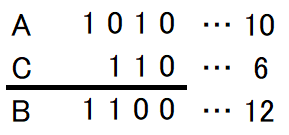
3 は 二進表記で 11、5 は二進表記で 101 なので、これらの \text{xor} は二進表記で 110 であり、十進表記で 6 です。
このように、3 \text{ xor } 5 = 6 となるので、答えは 5 です。
入力例 2
10 12
出力例 2
6
Score : 100 points
Problem Statement
You are given integers A and B between 0 and 255 (inclusive). Find a non-negative integer C such that A \text{ xor }C=B.
It can be proved that there uniquely exists such C, and it will be between 0 and 255 (inclusive).
What is bitwise \mathrm{XOR}?
The bitwise \mathrm{XOR} of integers A and B, A\ \mathrm{XOR}\ B, is defined as follows:
- When A\ \mathrm{XOR}\ B is written in base two, the digit in the 2^k's place (k \geq 0) is 1 if exactly one of A and B is 1, and 0 otherwise.
Constraints
- 0\leq A,B \leq 255
- All values in input are integers.
Input
Input is given from Standard Input in the following format:
A B
Output
Print the answer.
Sample Input 1
3 6
Sample Output 1
5
When written in binary, 3 will be 11, and 5 will be 101. Thus, their \text{xor} will be 110 in binary, or 6 in decimal.
In short, 3 \text{ xor } 5 = 6, so the answer is 5.
Sample Input 2
10 12
Sample Output 2
6
実行時間制限: 2 sec / メモリ制限: 1024 MiB
配点 : 100 点
問題文
3 種類の文字 . | * からなる、長さ N の文字列 S が与えられます。
S には | がちょうど 2 つ、* がちょうど 1 つ含まれます。
2 つの | で囲まれた部分の中に * が含まれるか判定してください。
含まれている場合 in と、含まれていない場合 out と出力してください。
より厳密には、* より前にある文字のいずれかが | であり、かつ、* より後ろにある文字のいずれかが | であるか判定してください。
制約
- 3\leq N\leq 100
- N は整数
- S は
.|*からなる長さ N の文字列 - S に
|はちょうど 2 個含まれる - S に
*はちょうど 1 個含まれる
入力
入力は以下の形式で標準入力から与えられる。
N
S
出力
2 つの | に囲まれた部分の中に * が含まれている場合 in と、含まれていない場合 out と 1 行に出力せよ。
入力例 1
10
.|..*...|.
出力例 1
in
2 つの | に囲まれた部分は |..*...| です。
この中に * が含まれているため、in と出力してください。
入力例 2
10
.|..|.*...
出力例 2
out
2 つの | に囲まれた部分は |..| です。
この中に * は含まれていないため、out と出力してください。
入力例 3
3
|*|
出力例 3
in
Score : 100 points
Problem Statement
You are given a string S of length N consisting of three kinds of characters: ., |, and *.
S contains exactly two | and exactly one *.
Determine whether the * is between the two |, and if so, print in; otherwise, print out.
More formally, determine whether one of the characters before the * is | and one of the characters after the * is |.
Constraints
- 3\leq N\leq 100
- N is an integer.
- S is a string of length N consisting of
.,|, and*. - S contains exactly two
|. - S contains exactly one
*.
Input
The input is given from Standard Input in the following format:
N
S
Output
Print a single line containing in if the * is between the two |, and out otherwise.
Sample Input 1
10
.|..*...|.
Sample Output 1
in
Between the two |, we have |..*...|, which contains *, so you should print in.
Sample Input 2
10
.|..|.*...
Sample Output 2
out
Between the two |, we have |..|, which does not contain *, so you should print out.
Sample Input 3
3
|*|
Sample Output 3
in
実行時間制限: 2 sec / メモリ制限: 1024 MiB
配点 : 200 点
問題文
文字列 S が与えられます。S の各文字を並び替えて得られる文字列 S' のうち、辞書順で最小のものを出力してください。
なお、相異なる 2 つの文字列 s = s_1 s_2 \ldots s_n と t = t_1 t_2 \ldots t_m について、それらが以下の条件のいずれかを満たすとき、辞書順で s \lt t であるとします。
- ある整数 i\ (1 \leq i \leq \min(n,m)) が存在し、s_i \lt t_i かつすべての整数 j\ (1 \leq j \lt i) について s_j=t_j
- すべての整数 i\ (1 \leq i \leq \min(n,m)) について s_i = t_i かつ、n \lt m
制約
- S は英小文字のみからなる長さ 1 以上 2 \times 10^5 以下の文字列
入力
入力は以下の形式で標準入力から与えられる。
S
出力
S の各文字を並び替えて得られる文字列 S' のうち、辞書順で最小のものを出力せよ。
入力例 1
aba
出力例 1
aab
S= aba を並び替えて得られる文字列は以下の 3 つが考えられます。
abaaabbaa
この中で辞書順で最小のものは、aab です。
入力例 2
zzzz
出力例 2
zzzz
Score : 200 points
Problem Statement
You are given a string S. Find the lexicographically smallest string S' obtained by permuting the characters of S.
Here, for different two strings s = s_1 s_2 \ldots s_n and t = t_1 t_2 \ldots t_m, s \lt t holds lexicographically when one of the conditions below is satisfied.
- There is an integer i\ (1 \leq i \leq \min(n,m)) such that s_i \lt t_i and s_j=t_j for all integers j\ (1 \leq j \lt i).
- s_i = t_i for all integers i\ (1 \leq i \leq \min(n,m)), and n \lt m.
Constraints
- S is a string of length between 1 and 2 \times 10^5 (inclusive) consisting of lowercase English letters.
Input
Input is given from Standard Input in the following format:
S
Output
Print the lexicographically smallest string S' obtained by permuting the characters in S.
Sample Input 1
aba
Sample Output 1
aab
Three strings can be obtained by permuting aba:
abaaabbaa
The lexicographically smallest among them is aab.
Sample Input 2
zzzz
Sample Output 2
zzzz
実行時間制限: 2 sec / メモリ制限: 1024 MiB
配点 : 200 点
問題文
人 1 、人 2 、\ldots 、人 N の N 人の人がルーレットの賭けに参加しました。 このルーレットの出目は、0 から 36 までの 37 個の整数のうちいずれかです。 i = 1, 2, \ldots, N について、人 i は 37 個の目のうち C_i 個の目 A_{i, 1}, A_{i, 2}, \ldots, A_{i, C_i} に賭けました。
ルーレットが回され、出目は X でした。 X に賭けた人たちのうち、賭けた目の個数が最も少ない人たちの番号を昇順にすべて出力してください。
より形式的には、1 以上 N 以下の整数 i であって、下記の 2 つの条件をともに満たすものを昇順にすべて出力してください。
- 人 i は X に賭けている。
- 任意の j = 1, 2, \ldots, N について「人 j が X に賭けているならば、C_i \leq C_j 」が成り立つ。
出力するべき番号が 1 つも無い場合もあることに注意してください(入力例2を参照)。
制約
- 1 \leq N \leq 100
- 1 \leq C_i \leq 37
- 0 \leq A_{i, j} \leq 36
- 任意の i = 1, 2, \ldots, N について、A_{i, 1}, A_{i, 2}, \ldots, A_{i, C_i} はすべて異なる。
- 0 \leq X \leq 36
- 入力はすべて整数
入力
入力は以下の形式で標準入力から与えられる。
N
C_1
A_{1, 1} A_{1, 2} \ldots A_{1, C_1}
C_2
A_{2, 1} A_{2, 2} \ldots A_{2, C_2}
\vdots
C_N
A_{N, 1} A_{N, 2} \ldots A_{N, C_N}
X
出力
出力するべき番号を昇順にすベて並べた列を、B_1, B_2, \ldots, B_K とする。 下記の形式にしたがい、1 行目には出力するべき番号の個数 K を、 2 行目には B_1, B_2, \ldots, B_K を空白区切りで、それぞれ出力せよ。
K
B_1 B_2 \ldots B_K
入力例 1
4
3
7 19 20
4
4 19 24 0
2
26 10
3
19 31 24
19
出力例 1
2
1 4
ルーレットが回され、出目は 19 でした。 19 に賭けた人は人 1 、人 2 、人 4 の 3 人であり、それぞれが賭けた目の個数は 3, 4, 3 です。 よって、19 に賭けた人のうち、賭けた目の個数が最も少ない人は人 1 と人 4 の 2 人です。
入力例 2
3
1
1
1
2
1
3
0
出力例 2
0
ルーレットが回され出目は 0 でしたが、0 に賭けた人は一人もいないため、 出力するべき番号は 1 つもありません。
Score : 200 points
Problem Statement
N people, person 1, person 2, \ldots, person N, are playing roulette. The outcome of a spin is one of the 37 integers from 0 to 36. For each i = 1, 2, \ldots, N, person i has bet on C_i of the 37 possible outcomes: A_{i, 1}, A_{i, 2}, \ldots, A_{i, C_i}.
The wheel has been spun, and the outcome is X. Print the numbers of all people who have bet on X with the fewest bets, in ascending order.
More formally, print all integers i between 1 and N, inclusive, that satisfy both of the following conditions, in ascending order:
- Person i has bet on X.
- For each j = 1, 2, \ldots, N, if person j has bet on X, then C_i \leq C_j.
Note that there may be no number to print (see Sample Input 2).
Constraints
- 1 \leq N \leq 100
- 1 \leq C_i \leq 37
- 0 \leq A_{i, j} \leq 36
- A_{i, 1}, A_{i, 2}, \ldots, A_{i, C_i} are all different for each i = 1, 2, \ldots, N.
- 0 \leq X \leq 36
- All input values are integers.
Input
The input is given from Standard Input in the following format:
N
C_1
A_{1, 1} A_{1, 2} \ldots A_{1, C_1}
C_2
A_{2, 1} A_{2, 2} \ldots A_{2, C_2}
\vdots
C_N
A_{N, 1} A_{N, 2} \ldots A_{N, C_N}
X
Output
Let B_1, B_2, \ldots, B_K be the sequence of numbers to be printed in ascending order. Using the following format, print the count of numbers to be printed, K, on the first line, and B_1, B_2, \ldots, B_K separated by spaces on the second line:
K
B_1 B_2 \ldots B_K
Sample Input 1
4
3
7 19 20
4
4 19 24 0
2
26 10
3
19 31 24
19
Sample Output 1
2
1 4
The wheel has been spun, and the outcome is 19. The people who has bet on 19 are person 1, person 2, and person 4, and the number of their bets are 3, 4, and 3, respectively. Therefore, among the people who has bet on 19, the ones with the fewest bets are person 1 and person 4.
Sample Input 2
3
1
1
1
2
1
3
0
Sample Output 2
0
The wheel has been spun and the outcome is 0, but no one has bet on 0, so there is no number to print.
実行時間制限: 2 sec / メモリ制限: 1024 MiB
配点 : 300 点
問題文
頂点に 1 から N の番号が、辺に 1 から M の番号がついた N 頂点 M 辺の単純無向グラフが与えられます。辺 i は頂点 u_i と頂点 v_i を結んでいます。
グラフに含まれる連結成分の個数を求めてください。
注釈
単純無向グラフ とは、単純で辺に向きの無いグラフのことをいいます。
グラフが 単純 であるとは、グラフが自己ループや多重辺を含まないことをいいます。
あるグラフの 部分グラフ とは、元のグラフのいくつかの頂点といくつかの辺を選んでできるグラフのことをいいます。
グラフが 連結 であるとは、グラフに含まれるすべての頂点同士が辺を経由して互いに行き来できることをいいます。
連結成分 とは、連結な部分グラフのうち、そのグラフを含んだより大きい連結な部分グラフが存在しないものをいいます。
制約
- 1 \leq N \leq 100
- 0 \leq M \leq \frac{N(N - 1)}{2}
- 1 \leq u_i, v_i \leq N
- 入力で与えられるグラフは単純
- 入力される値はすべて整数
入力
入力は以下の形式で標準入力から与えられる。
N M
u_1 v_1
u_2 v_2
\vdots
u_M v_M
出力
答えを出力せよ。
入力例 1
5 3
1 2
1 3
4 5
出力例 1
2
与えられるグラフに含まれる連結成分は次の 2 個です。
- 頂点 1, 2, 3 および辺 1, 2 からなる部分グラフ
- 頂点 4, 5 および辺 3 からなる部分グラフ

入力例 2
5 0
出力例 2
5
入力例 3
4 6
1 2
1 3
1 4
2 3
2 4
3 4
出力例 3
1
Score : 300 points
Problem Statement
You are given a simple undirected graph with N vertices numbered 1 to N and M edges numbered 1 to M. Edge i connects vertex u_i and vertex v_i.
Find the number of connected components in this graph.
Notes
A simple undirected graph is a graph that is simple and has undirected edges.
A graph is simple if and only if it has no self-loop or multi-edge.
A subgraph of a graph is a graph formed from some of the vertices and edges of that graph.
A graph is connected if and only if one can travel between every pair of vertices via edges.
A connected component is a connected subgraph that is not part of any larger connected subgraph.
Constraints
- 1 \leq N \leq 100
- 0 \leq M \leq \frac{N(N - 1)}{2}
- 1 \leq u_i, v_i \leq N
- The given graph is simple.
- All values in the input are integers.
Input
The input is given from Standard Input in the following format:
N M
u_1 v_1
u_2 v_2
\vdots
u_M v_M
Output
Print the answer.
Sample Input 1
5 3
1 2
1 3
4 5
Sample Output 1
2
The given graph contains the following two connected components:
- a subgraph formed from vertices 1, 2, 3, and edges 1, 2;
- a subgraph formed from vertices 4, 5, and edge 3.
Sample Input 2
5 0
Sample Output 2
5
Sample Input 3
4 6
1 2
1 3
1 4
2 3
2 4
3 4
Sample Output 3
1
実行時間制限: 2 sec / メモリ制限: 1024 MiB
配点 : 300 点
問題文
xy 平面上に 1 から N までの番号が付いた N 個の点があります。
点 i は座標 (X_i,Y_i) にあり、相異なる 2 点は異なる位置に存在します。
この N 点から 3 点を選ぶとき、選ばれた 3 点を線分で結んだ図形が正の面積を持つ三角形になるような点の選び方の総数を求めてください。
制約
- 入力は全て整数である
- 3 \le N \le 300
- -10^9 \le X_i,Y_i \le 10^9
- i \neq j ならば (X_i,Y_i) \neq (X_j,Y_j)
入力
入力は以下の形式で標準入力から与えられる。
N
X_1 Y_1
X_2 Y_2
\dots
X_N Y_N
出力
答えを整数として出力せよ。
入力例 1
4
0 1
1 3
1 1
-1 -1
出力例 1
3
点を図示すると、以下のようになります。

三角形をなすような点の選び方は、 \{1,2,3\},\{1,3,4\},\{2,3,4\} の 3 つです。
入力例 2
20
224 433
987654321 987654321
2 0
6 4
314159265 358979323
0 0
-123456789 123456789
-1000000000 1000000000
124 233
9 -6
-4 0
9 5
-7 3
333333333 -333333333
-9 -1
7 -10
-1 5
324 633
1000000000 -1000000000
20 0
出力例 2
1124
Score : 300 points
Problem Statement
In the xy-plane, we have N points numbered 1 through N.
Point i is at the coordinates (X_i,Y_i). Any two different points are at different positions.
Find the number of ways to choose three of these N points so that connecting the chosen points with segments results in a triangle with a positive area.
Constraints
- All values in input are integers.
- 3 \le N \le 300
- -10^9 \le X_i,Y_i \le 10^9
- (X_i,Y_i) \neq (X_j,Y_j) if i \neq j.
Input
Input is given from Standard Input in the following format:
N
X_1 Y_1
X_2 Y_2
\dots
X_N Y_N
Output
Print the answer as an integer.
Sample Input 1
4
0 1
1 3
1 1
-1 -1
Sample Output 1
3
The figure below illustrates the points.
There are three ways to choose points that form a triangle: \{1,2,3\},\{1,3,4\},\{2,3,4\}.
Sample Input 2
20
224 433
987654321 987654321
2 0
6 4
314159265 358979323
0 0
-123456789 123456789
-1000000000 1000000000
124 233
9 -6
-4 0
9 5
-7 3
333333333 -333333333
-9 -1
7 -10
-1 5
324 633
1000000000 -1000000000
20 0
Sample Output 2
1124
実行時間制限: 4 sec / メモリ制限: 1024 MiB
配点 : 400 点
問題文
N = 2^{20} 項からなる数列 A = (A_0, A_1, \dots, A_{N - 1}) があります。はじめ、全ての要素は -1 です。
Q 個のクエリを順番に処理してください。i \, (1 \leq i \leq Q) 個目のクエリは t_i = 1 または t_i = 2 を満たす整数 t_i および整数 x_i で表され、内容は以下の通りです。
- t_i = 1 のとき、以下の処理を順番に行う。
- 整数 h を h = x_i で定める。
- A_{h \bmod N} \neq -1 である間、h の値を 1 増やすことを繰り返す。この問題の制約下でこの操作が有限回で終了することは証明できる。
- A_{h \bmod N} の値を x_i で書き換える。
- t_i = 2 のとき、その時点での A_{x_i \bmod N} の値を出力する。
なお、整数 a, b に対し、a を b で割った余りを a \bmod b と表します。
制約
- 1 \leq Q \leq 2 \times 10^5
- t_i \in \{ 1, 2 \} \, (1 \leq i \leq Q)
- 0 \leq x_i \leq 10^{18} \, (1 \leq i \leq Q)
- t_i = 2 であるような i \, (1 \leq i \leq Q) が 1 つ以上存在する。
- 入力は全て整数である。
入力
入力は以下の形式で標準入力から与えられる。
Q
t_1 x_1
\vdots
t_{Q} x_{Q}
出力
t_i = 2 であるようなクエリに対し、それぞれ答えを 1 行に出力せよ。そのようなクエリが 1 つ以上存在することは保証される。
入力例 1
4
1 1048577
1 1
2 2097153
2 3
出力例 1
1048577
-1
x_1 \bmod N = 1 であるので、1 番目のクエリによって A_1 = 1048577 となります。
2 番目のクエリにおいて、はじめ h = x_2 ですが、A_{h \bmod N} = A_{1} \neq -1 であるので h の値を 1 増やします。すると A_{h \bmod N} = A_{2} = -1 となるので、このクエリによって A_2 = 1 となります。
3 番目のクエリにおいて、A_{x_3 \bmod N} = A_{1} = 1048577 を出力します。
4 番目のクエリにおいて、A_{x_4 \bmod N} = A_{3} = -1 を出力します。
この問題において N = 2^{20} = 1048576 は定数であり、入力では与えられないことに注意してください。
Score : 400 points
Problem Statement
There is a sequence A = (A_0, A_1, \dots, A_{N - 1}) with N = 2^{20} terms. Initially, every term is -1.
Process Q queries in order. The i-th query (1 \leq i \leq Q) is described by an integer t_i such that t_i = 1 or t_i = 2, and another integer x_i, as follows.
- If t_i = 1, do the following in order.
- Define an integer h as h = x_i.
- While A_{h \bmod N} \neq -1, keep adding 1 to h. We can prove that this process ends after finite iterations under the Constraints of this problem.
- Replace the value of A_{h \bmod N} with x_i.
- If t_i = 2, print the value of A_{x_i \bmod N} at that time.
Here, for integers a and b, a \bmod b denotes the remainder when a is divided by b.
Constraints
- 1 \leq Q \leq 2 \times 10^5
- t_i \in \{ 1, 2 \} \, (1 \leq i \leq Q)
- 0 \leq x_i \leq 10^{18} \, (1 \leq i \leq Q)
- There is at least one i (1 \leq i \leq Q) such that t_i = 2.
- All values in input are integers.
Input
Input is given from Standard Input in the following format:
Q
t_1 x_1
\vdots
t_{Q} x_{Q}
Output
For each query with t_i = 2, print the response in one line. It is guaranteed that there is at least one such query.
Sample Input 1
4
1 1048577
1 1
2 2097153
2 3
Sample Output 1
1048577
-1
We have x_1 \bmod N = 1, so the first query sets A_1 = 1048577.
In the second query, initially we have h = x_2, for which A_{h \bmod N} = A_{1} \neq -1, so we add 1 to h. Now we have A_{h \bmod N} = A_{2} = -1, so this query sets A_2 = 1.
In the third query, we print A_{x_3 \bmod N} = A_{1} = 1048577.
In the fourth query, we print A_{x_4 \bmod N} = A_{3} = -1.
Note that, in this problem, N = 2^{20} = 1048576 is a constant and not given in input.
実行時間制限: 2 sec / メモリ制限: 1024 MiB
配点 : 500 点
問題文
1,2,\ldots,N の番号がついた N 個のかごが円状に置かれています。
1\leq i \leq N-1 についてかご i の右隣にはかご i+1 があり、かご N の右隣にはかご 1 があります。
かご i の中には A_i 個りんごが入っています。
高橋君は最初かご 1 の前におり、以下の行動を繰り返します。
- 目の前にあるかごの中にりんごがあれば 1 個かごから取り出して食べる。その後、りんごを食べたかどうかにかかわらず、右隣のかごの前に移動する。
高橋君がちょうど K 個のりんごを食べた時点で、各かごの中に残っているりんごの個数を求めてください。
制約
- 1 \leq N \leq 10^5
- 0 \leq A_i \leq 10^{12}
- 1 \leq K \leq 10^{12}
- りんごは全部で K 個以上ある。すなわち、\sum_{i=1}^{N}A_i\geq K
- 入力に含まれる値は全て整数である
入力
入力は以下の形式で標準入力から与えられる。
N K
A_1 A_2 \ldots A_N
出力
N 個の整数を空白区切りで出力せよ。
i 番目には、高橋君がちょうど K 個のりんごを食べた時点で、かご i の中に残っているりんごの個数を出力せよ。
入力例 1
3 3
1 3 0
出力例 1
0 1 0
高橋君は次のように行動します。
- 目の前にあるかご 1 の中にりんごがあるので 1 個かごから取り出して食べる。その後、かご 2 の前に移動する。この時点で各かごの中のりんごの個数は (0,3,0) である。
- 目の前にあるかご 2 の中にりんごがあるので 1 個かごから取り出して食べる。その後、かご 3 の前に移動する。この時点で各かごの中のりんごの個数は (0,2,0) である。
- 目の前にあるかご 3 の中にりんごはない。かご 1 の前に移動する。この時点で各かごの中のりんごの個数は (0,2,0) である。
- 目の前にあるかご 1 の中にりんごはない。かご 2 の前に移動する。この時点で各かごの中のりんごの個数は (0,2,0) である。
- 目の前にあるかご 2 の中にりんごがあるので 1 個かごから取り出して食べる。その後、かご 3 の前に移動する。この時点で各かごの中のりんごの個数は (0,1,0) である。
入力例 2
2 1000000000000
1000000000000 1000000000000
出力例 2
500000000000 500000000000
Score : 500 points
Problem Statement
There are N baskets numbered 1, 2, \ldots, N arranged in a circle.
For each 1\leq i \leq N-1, basket i+1 is to the immediate right of basket i, and basket 1 is to the immediate right of basket N.
Basket i now contains A_i apples.
Takahashi starts in front of basket 1 and repeats the following action.
- If the basket he is facing contains an apple, take one and eat it. Then, regardless of whether he has eaten an apple now, go on to the next basket to the immediate right.
Find the number of apples remaining in each basket when Takahashi has eaten exactly K apples in total.
Constraints
- 1 \leq N \leq 10^5
- 0 \leq A_i \leq 10^{12}
- 1 \leq K \leq 10^{12}
- There are at least K apples in total. That is, \sum_{i=1}^{N}A_i\geq K.
- All values in the input are integers.
Input
The input is given from Standard Input in the following format:
N K
A_1 A_2 \ldots A_N
Output
Print N integers, with spaces in between.
The i-th integer should be the number of apples remaining in basket i when Takahashi has eaten exactly K apples in total.
Sample Input 1
3 3
1 3 0
Sample Output 1
0 1 0
Takahashi will do the following.
- Basket 1, which he is facing, contains an apple, so he takes one and eats it. Then, he goes on to basket 2. Now, the baskets have 0,3,0 apples.
- Basket 2, which he is facing, contains an apple, so he takes one and eats it. Then, he goes on to basket 3. Now, the baskets have 0,2,0 apples.
- Basket 3, which he is facing, contains no apple. Then, he goes on to basket 1. Now, the baskets have 0,2,0 apples.
- Basket 1, which he is facing, contains no apple. Then, he goes on to basket 2. Now, the baskets have 0,2,0 apples.
- Basket 2, which he is facing, contains an apple, so he takes one and eats it. Then, he goes on to basket 3. Now, the baskets have 0,1,0 apple(s).
Sample Input 2
2 1000000000000
1000000000000 1000000000000
Sample Output 2
500000000000 500000000000
実行時間制限: 2 sec / メモリ制限: 1024 MiB
配点 : 500 点
問題文
カードが N 枚あり、i 番目のカードには文字列 S_i が書かれています。
この中からちょうど K 枚選び、好きな順序で繋げてできる文字列のうち辞書順最小のものを求めてください。
制約
- 1 \leq K \leq N \leq 50
- 1 \leq |S_i| \leq 50
- S_i は英小文字からなる
入力
入力は以下の形式で標準入力から与えられる。
N K
S_1
S_2
\vdots
S_N
出力
答えを出力せよ。
入力例 1
4 3
ode
zaaa
r
atc
出力例 1
atcoder
カードの中に書かれている文字を、反転させたり並び替えたりすることはできません。
たとえば 1 枚目のカードに書かれている ode を、edo や deo のように使うことはできません。
入力例 2
5 2
z
z
zzz
z
zzzzzz
出力例 2
zz
S_i = S_j を満たす i,j(i\neq j) の組が存在することもあります。
Score : 500 points
Problem Statement
We have N cards. The i-th card has a string S_i written on it.
Find the lexicographically smallest string that can be obtained by choosing K of these cards and concatenating them in any order.
Constraints
- 1 \leq K \leq N \leq 50
- 1 \leq |S_i| \leq 50
- S_i consists of lowercase English letters.
Input
Input is given from Standard Input in the following format:
N K
S_1
S_2
\vdots
S_N
Output
Print the answer.
Sample Input 1
4 3
ode
zaaa
r
atc
Sample Output 1
atcoder
Note that it is not possible to reverse or permute the string written on a card.
For example, ode written on the first card cannot be used as edo or deo.
Sample Input 2
5 2
z
z
zzz
z
zzzzzz
Sample Output 2
zz
There may be a pair i, j (i\neq j) such that S_i = S_j.